I visited Selwyns Wood (Sussex Wildlife Trust), ne Cross in Hand (accessible from Brighton on the 29A Brighton & Hove Buse) , yesterday to do a recce for a lichen walk I am leading for their Selwyns Wood’s volunteers. On the sides of one of its ghylls I saw lots (a forest) of Pellia epiphylla with sporophytes (white bendy stalks with black spherical spore capsules). These appear in February and March each year.
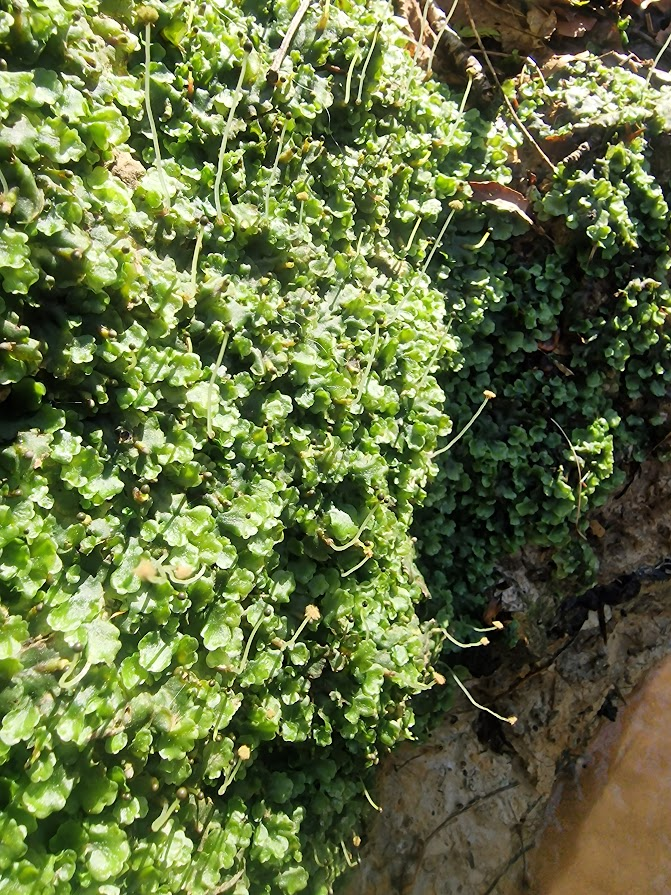
Pellia epiphylla, Common Pellia is a very common thalloid liverwort that can be found on the banks of ghylls across the high weald of Sussex, and in some low weald streams, where there are banks.
There are two types of liverwort: thalloid and leafy. In thalloid liverworts, the plant body (thallus) consists of flattened masses of cells. “A layer of photosynthetic tissue is underlain by nonphotosynthetic cells, with a final lower scaly layer that produces rhizoids, root-like structures that help hold the plant in place. Leafy liverworts look more like mosses, with obvious small leaves along a stem … Like other primitive plants, liverworts are not well adapted to dry situations, so they grow where the soil is moist and humidity high. Puget Sound University Thallose Liverworts
Common Pellia is monoecious, i.e. they have both the male and female reproductive structures in the same individual. The male structures are called antheridia, which contain the male sex cells, antherozoids, equipped with flagellae. When the antheridia burst from the antherozoids they swim into the female structures, the archegonia, and fertilise the egg cells.. This happens on wet winter days.
From the archegonia grow black capsules on white stalks; the capsules are full of spores developed form the fertilised eggs.
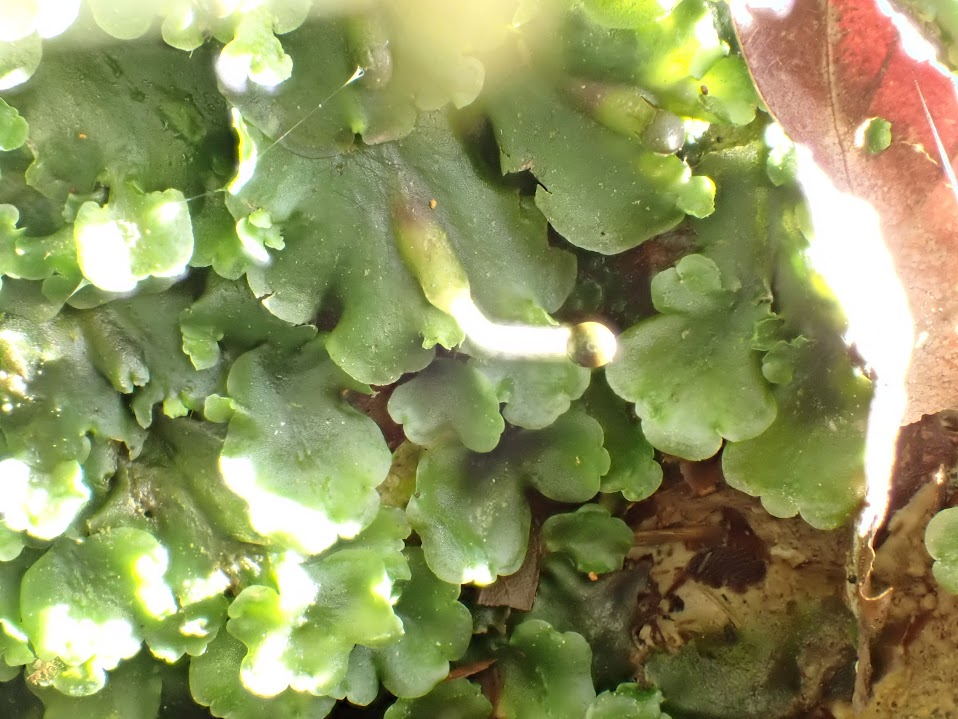

The capsule stalk grows to about 7 cm long, bending toward the light. Then the capsule explodes and splits into four sections, and the spores are thrown out by hair-like cells called elaters. Source of much of this information: Cabinet of Curiosities: Some Natural Wonders from North East England
Here is what is left of the capsule when the spores are gone; the fluffy filaments of the elaters.

If you want to see a “forest” of Common Pellia sporophytes, go to a high weald ghyll wood and look at the banks of the ghylls. Aside from the lovely Selwyns Wood (accessible by public transport on the 29A Brighton and Hove bus to Cross in Hand), you could go to Cow Wood (Nyman’s Woodlands) at Handrcoss, The Crowborough Ghyll, Ardingly Brook (in the valley at Wakehurst), Nap Wood near Tunbridge Wells, Fairlight Glen. Details of these locations and how to get these locations by public transport can be found on my nature by public transport website
Sim Elliott: Nature in Sussex: nature journeys made by public transport – Nap Wood
Sim Elliott: Nature in Sussex: nature journeys made by public transport – Fairlight Glen
Sim Elliott: Nature in Sussex: nature journeys made by public transport – Crowhurst Ghyll
Sim Elliott: Nature in Sussex: nature journeys made by public transport – Wakehurst Woods

 Sim's Nature Notes