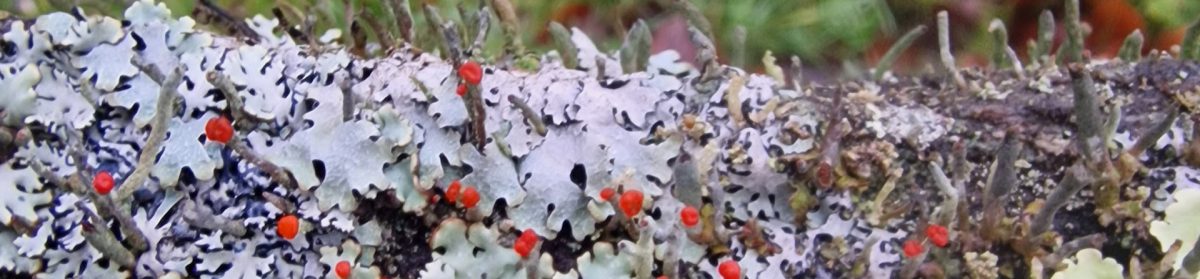
This post illustrates the species of Ancient Woodland Indicator Plants that I found in Fore Wood that are listed in Indicators Of Ancient Woodland – the use of vascular plants in evaluating ancient woods for nature conservation. Francis Rose, British Wildlife 10.4 April 1999, Pages 241-251
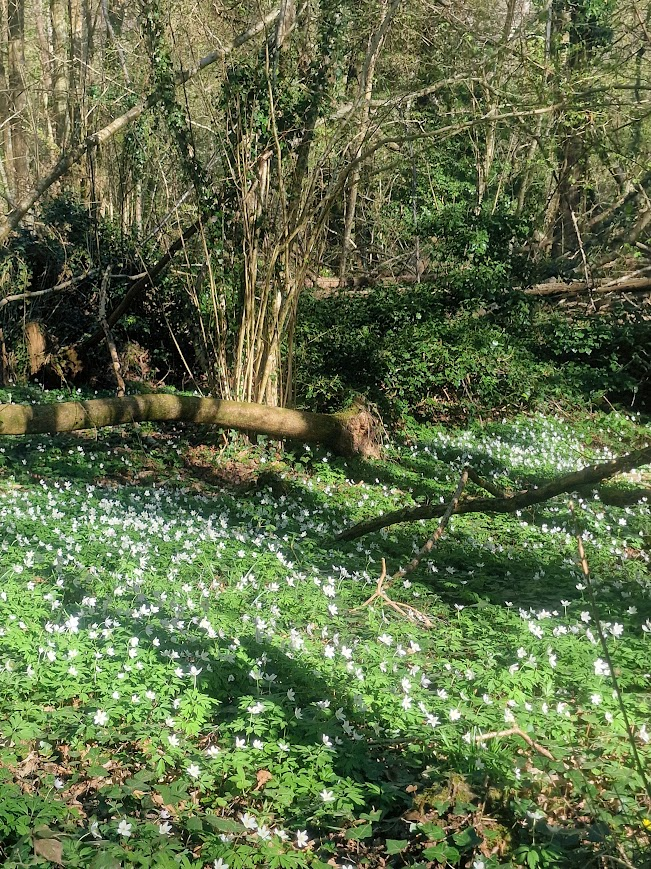
Fore Wood is a High Weald Ghyll Wood
Natural England maintains an index of woodland it has determined is ancient; the map of these woodland sites can be explored here: https://naturalengland-defra.opendata.arcgis.com/datasets/ancient-woodland-england/explore Fore Wood is listed by Natural England as Ancient Woodland (Ancient and Semi-natural Woodland). Here is the map for Fore Wood
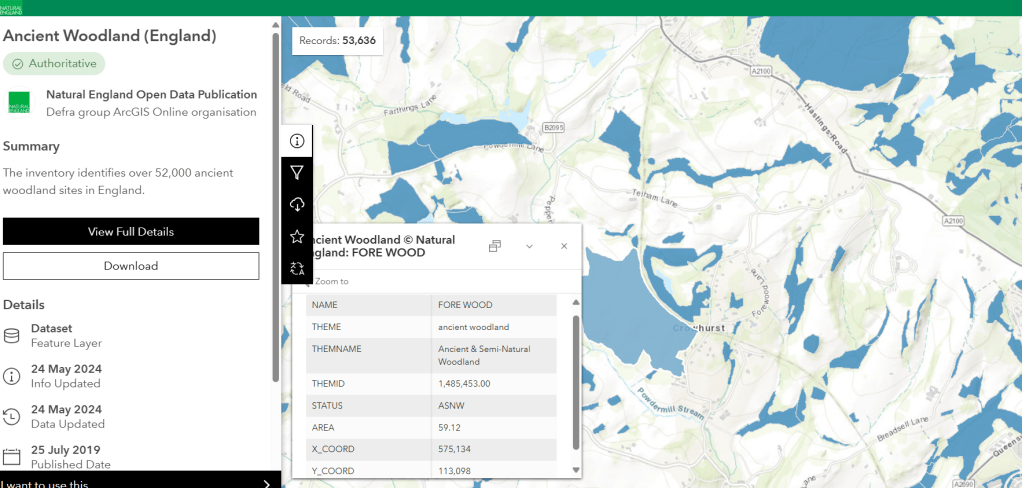
Natural England classifies ancient woodland as either:
(a) (ASNW) Ancient Semi-Natural Woodland mainly made up of trees and shrubs native to the site, usually arising from natural regeneration
or
(b) (PAWS) Plantations on Ancient Woodland Sights (or Ancient Replanted Woodland) – replanted with conifer or broadleaved trees (e.g. Sweet Chestnut, Castanea sativa) that retain ancient woodland features, such as undisturbed soil, ground flora and fungi
Fore Wood is designated by Natural England as Ancient Semi-Natural Woodland, but it does have some small areas of planted Sweet Chestnut which the RSPB is removing.
Fore Wood is managed by the RSPB:
Fore Wood is a stretch of peaceful woodland near Crowhurst, dotted by gyhlls – steep-sided little ravines in the sandstone where rare ferns grow and wildlife thrives. In the spring, Fore Wood is a riot of Bluebells and Wood Anemones, with Early Purple Orchids adding to the show, an ideal place for East Sussex walks.
This ancient woodland is a mix of Hornbeam, oak and Sweet Chestnut trees. We carefully manage the woodland for the benefit of the wildlife using coppicing – a traditional woodland management practice. RSPB Fore Wood
Fore Wood is designated as a Site of Special Scientific Interest: SSSI citation
Here are the Ancient Woodland Indicator Plants that I saw:
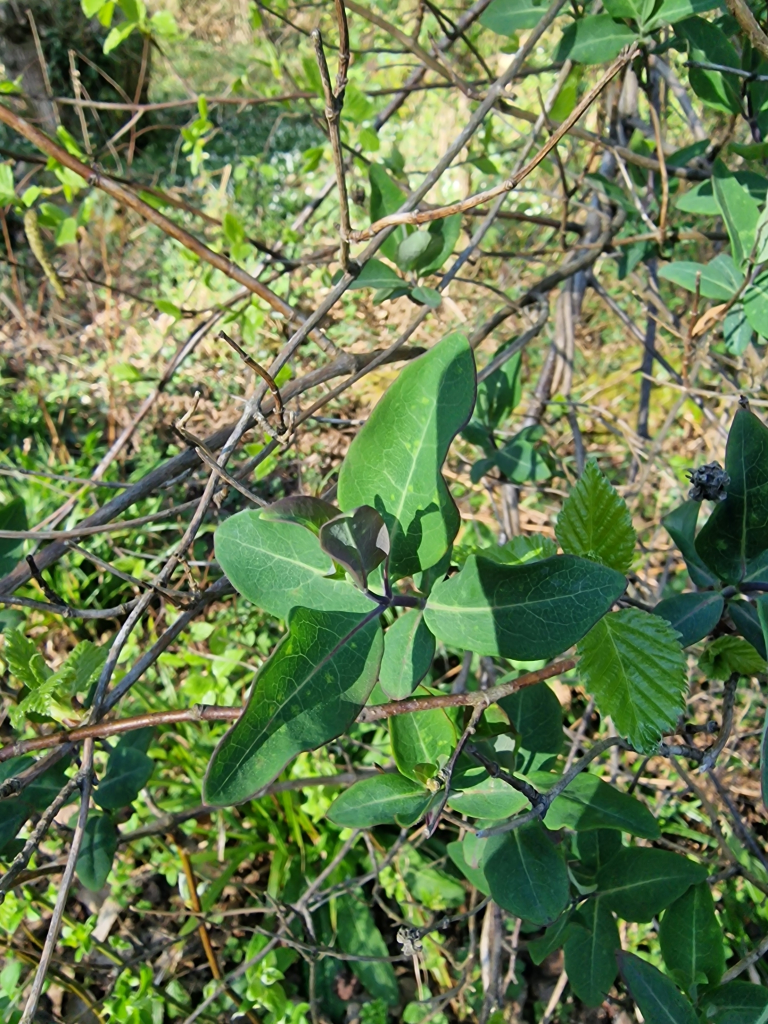
Lonicera periclymenum Honeysuckle
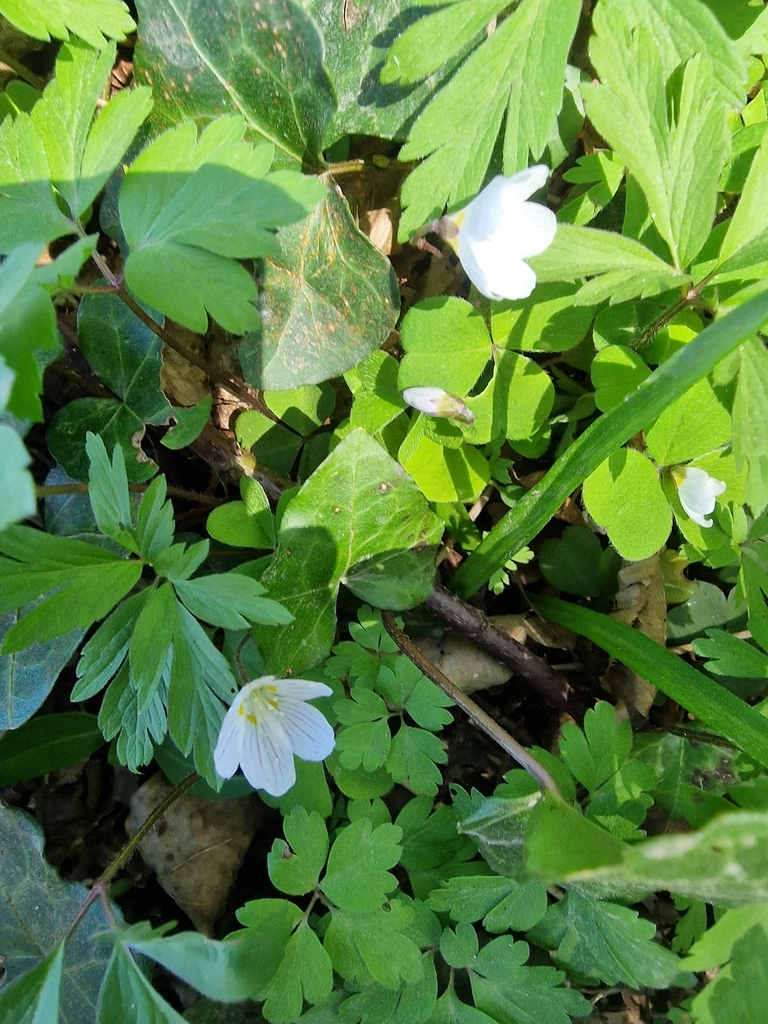
Oxalis acetosella Wood-Sorrel
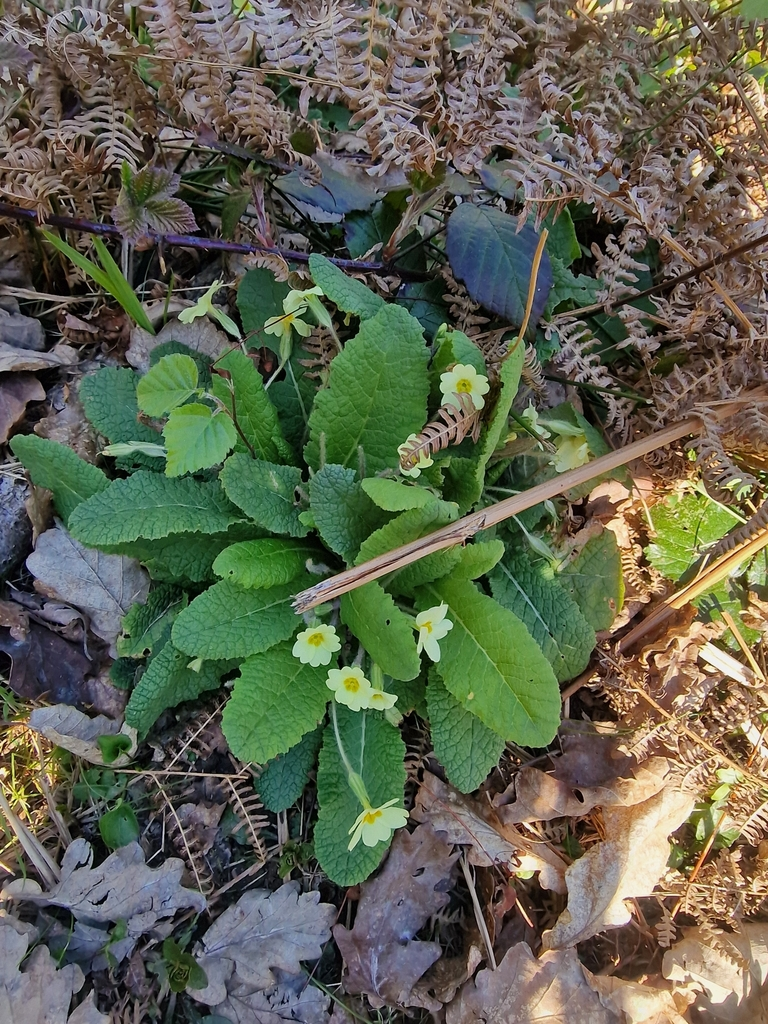
Primula vulgaris Primrose
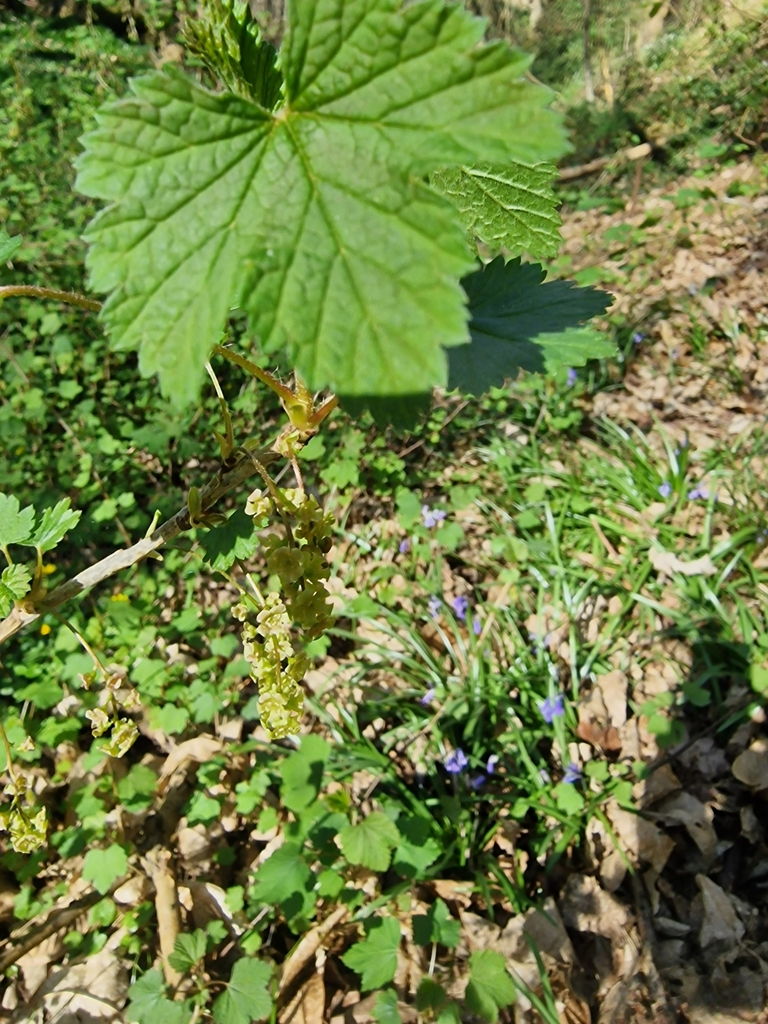
Ribes rubrum Red Currant, by one of the ghylls
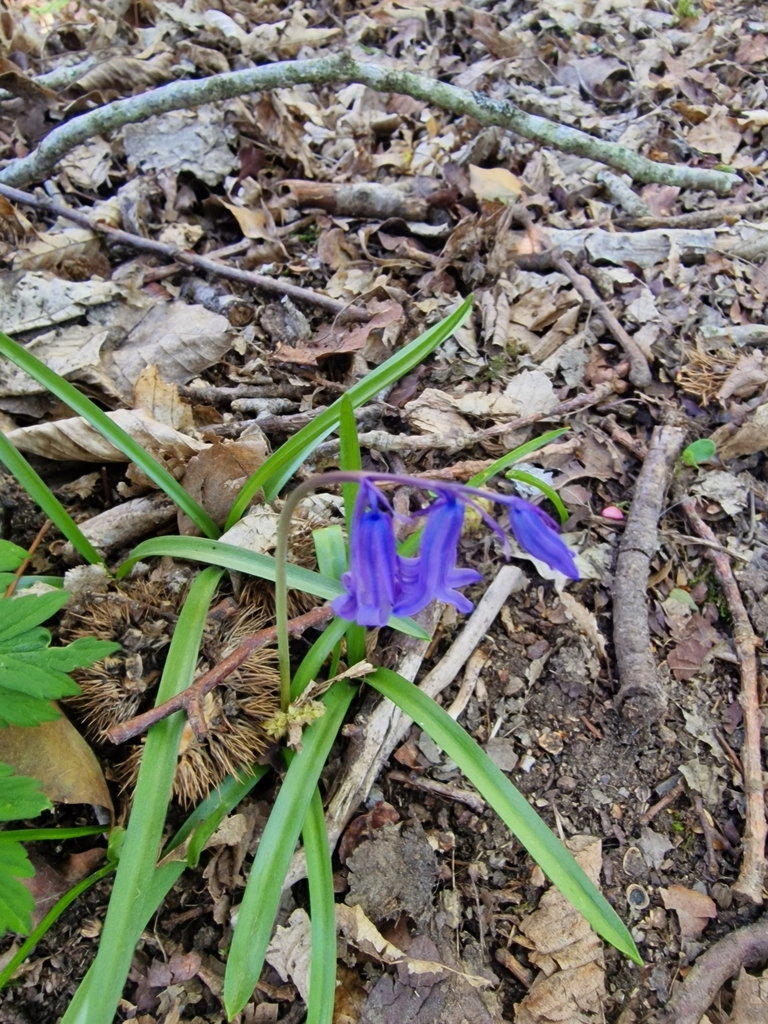
Hyacinthoides non-scripta Bluebell
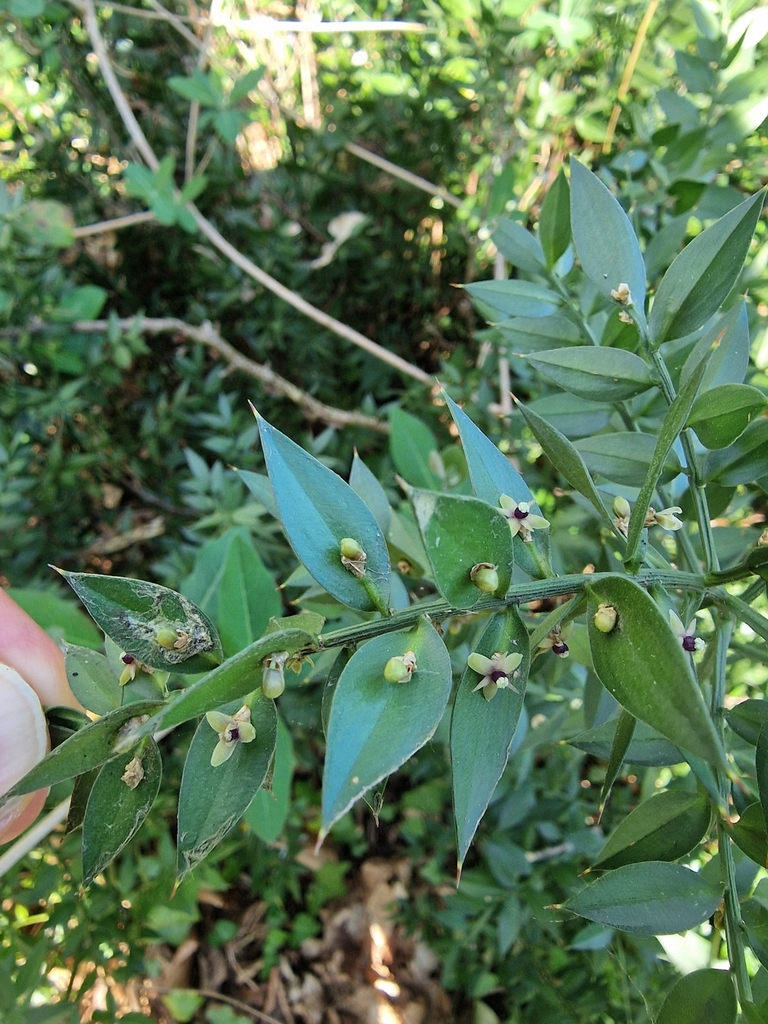
Ruscus aculeatus Butcher’s-Broom
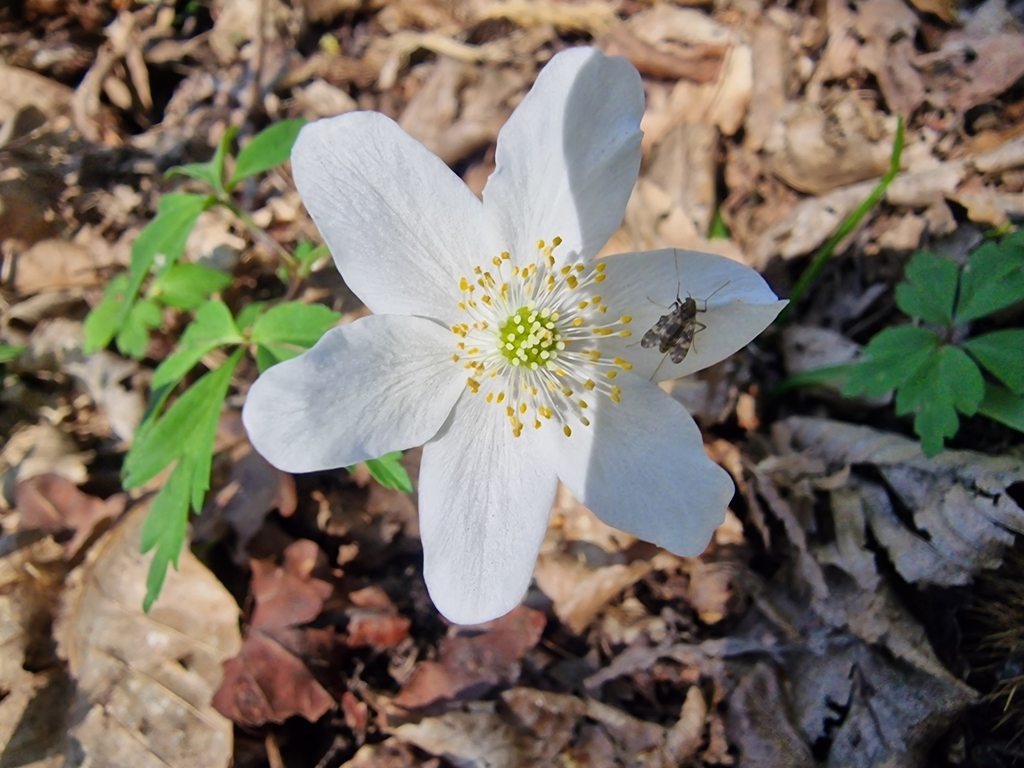
Anemonoides nemorosa Wood Anemone
with Psectrotanypus varius a species of non biting midge.
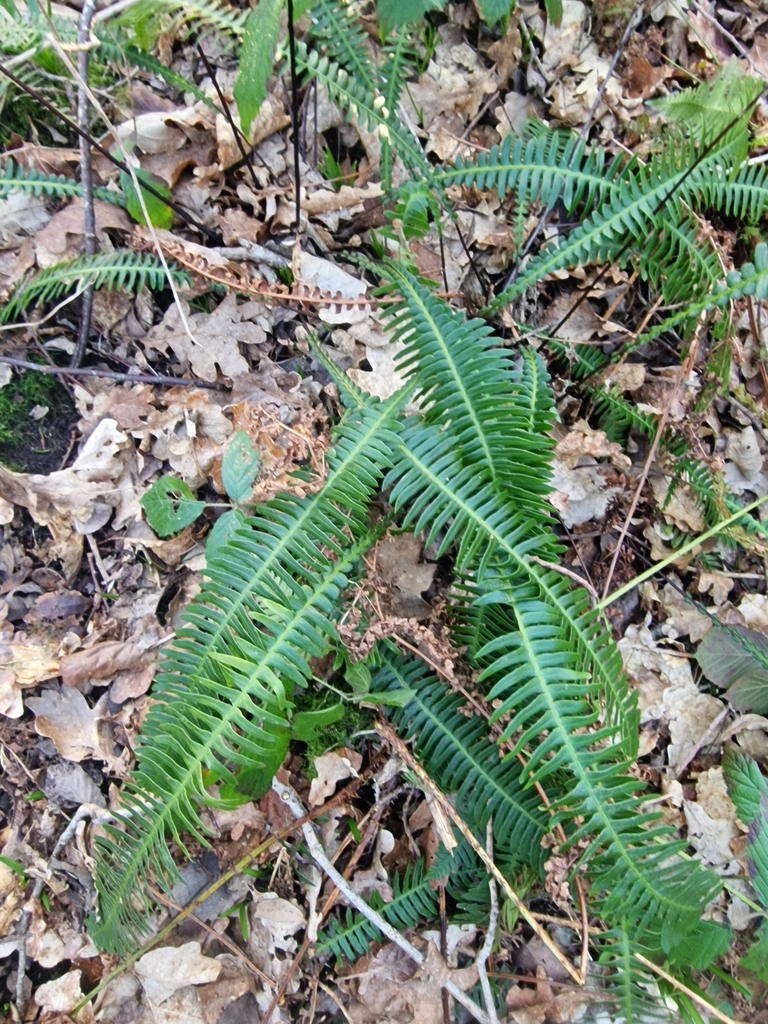
Struthiopteris spicant Hard Fern
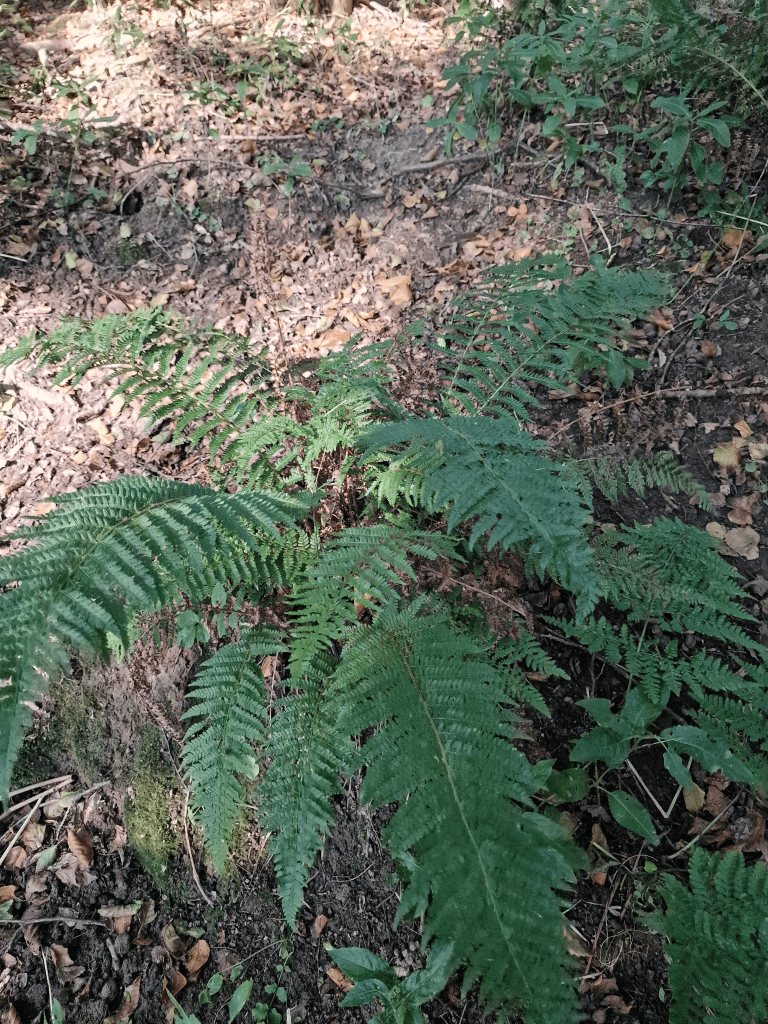
Polystichum setiferum Soft Shield Fern
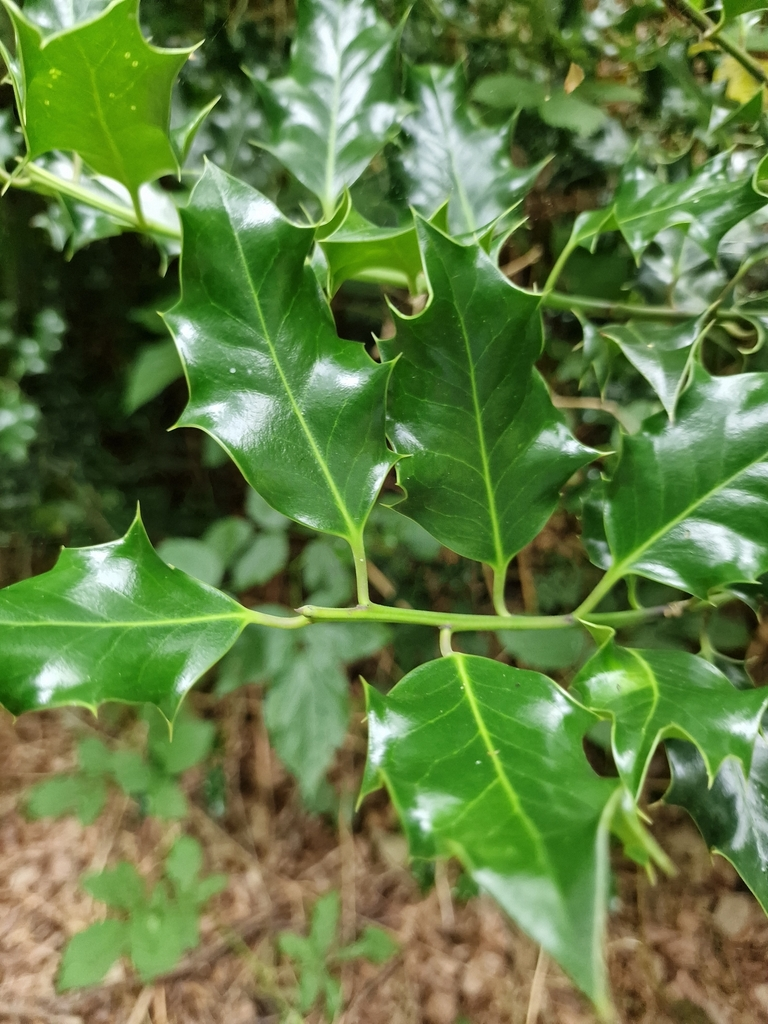
Ilex aquifolium European Holly
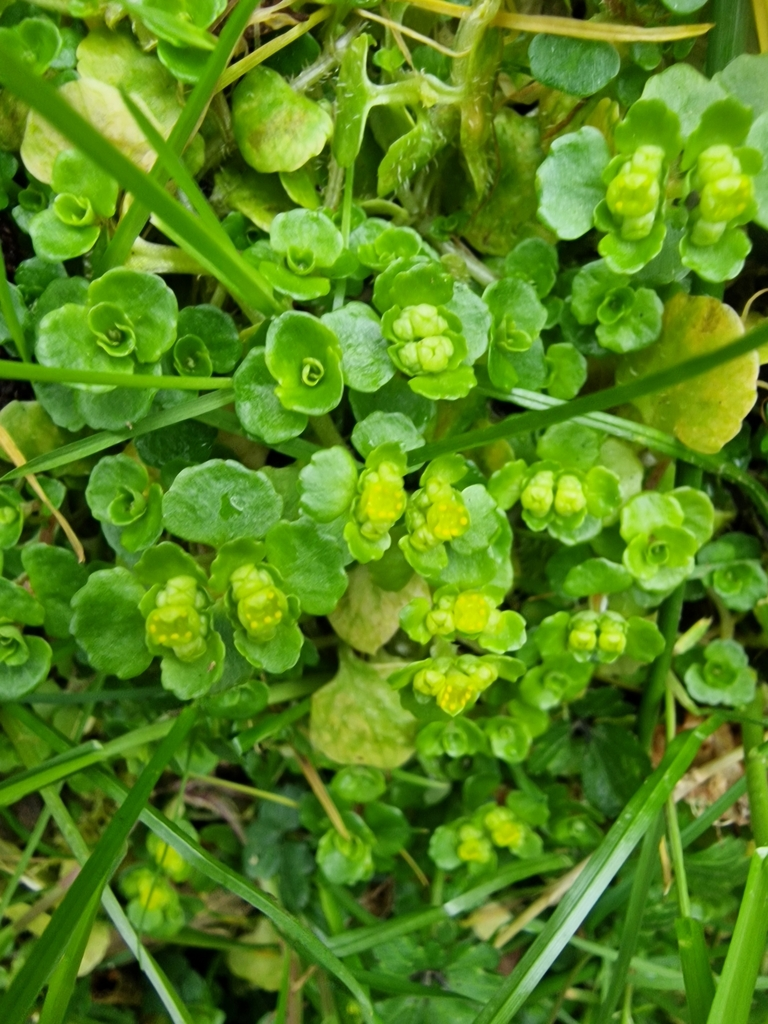
Chrysosplenium oppositifolium Opposite-leaved Golden-Saxifrage
By one of the ghylls; Opposite-leaved Golden-Saxifrage is mostly a plant of damp stream/ghyll sides, or wet flushes
A view of one of the ghylls with Lesser Celandine, Ficaria verna. Lesser Celandine is not an AWVP indicator but it is a very important early source of pollen for pollinators. There are two ghyll is Fire Wood – this one has shallow sides
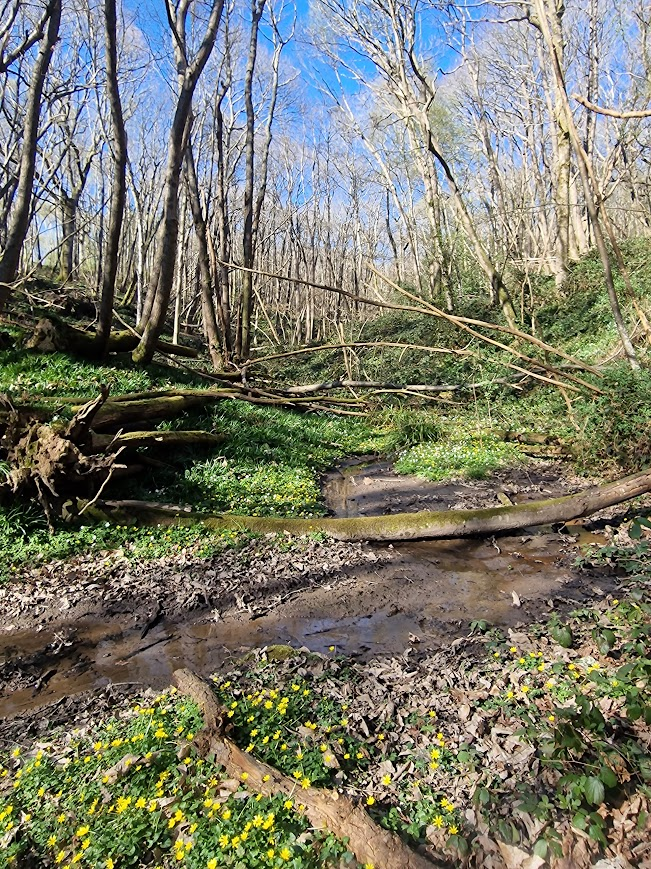
but the other ghyll has much steeper sides and is more typical of the upper reaches of ghylls in High Weald Ghyll Woods, like Fore Wood.
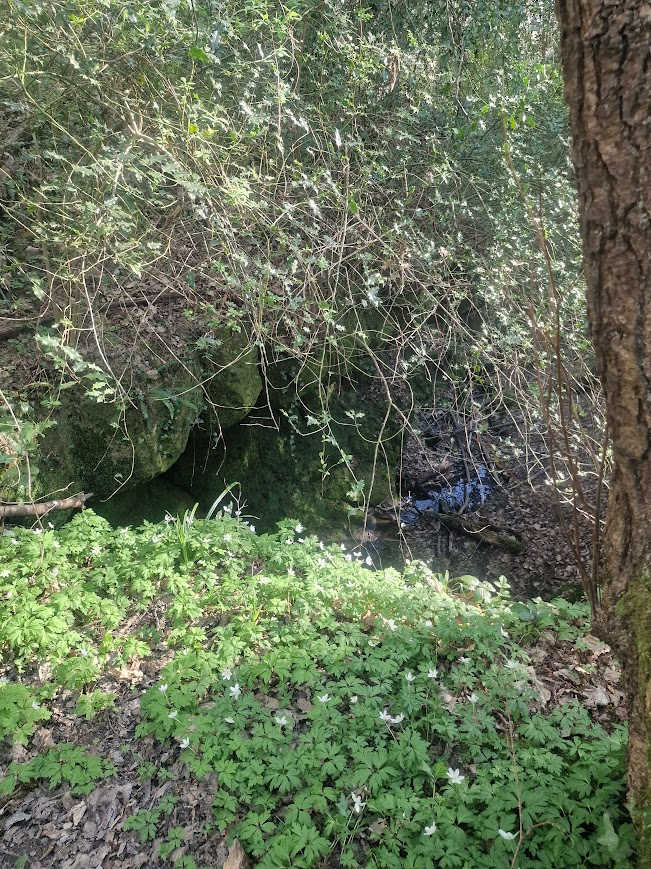
Ardingly Sandrock can be seen in this photograph. Where the porous Ardingly Sandrock meets the impervious Wadhurst Clay springs are formed that feed the ghylls. Global heating is a great threat to the survival of the internationaly important ghyll wood habitat of the High Weald.
In the south-east of England mean annual temperatures have increased by approximately 1.7°C over the past 50 years,(UKCIP 2013). Average rainfall remained unchanged during the same period, but patterns of precipitation did change with mean rainfall levels decreasing in the spring and summer months, but increasing in the autumn and winter. Over the same period the average annual and seasonal levels of relative humidity fell by up to 5% in the south and east of England (UKCIP 2013).
The presence of regionally and nationally important vascular and non-vascular
plant communities within the Wealden ghylls is attributed to the cool, humid
microclimatic conditions associated with the ghyll valleys (Paton 1956, Ratcliffe 1968, Rose and Patmore 1997). The rising temperature levels coupled with the existence within the ghyll woodlands is closely related to a cool, humid ghyll microclimate.
Andrew Flint, PhD Thesis, 2014, University of Brighton The biodiversity of the Wealden ghyll woodlands: species richness,
abundance and distribution patterns in a rare and fragmented habitat
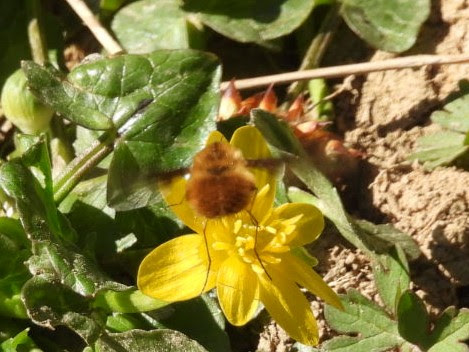
A Dark-edged bee-fly, Bombylius major, on Lesser Celandine. Flies are important pollinators. Natural History Museum: Meet the bee-fly: the cute bee mimic with a dark side
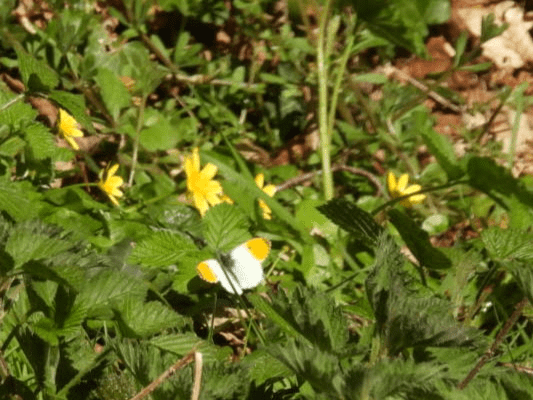
Orange-Tip Butterfly, Anthocharis cardamines, a butterfly of damp places, on Lesser Celandine
Bee-Flies and Orange Tip Butterflies are some of the earliest pollinators to appear in spring; but they have finished in the adult flying form by May/June; although Orange Tip Butterflies sometimes have a second brrod
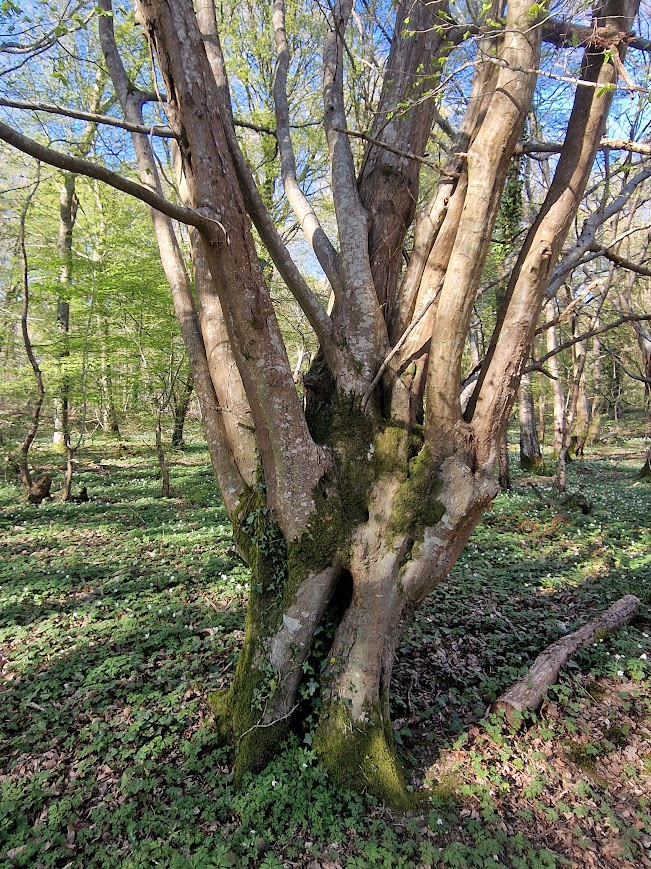
An ancient pollarded Carpinus betulus European Hornbeam within the wood. Rose makes it clear in his list that Carpinus betulus should only be considered an AWVP indicator only if they occur well within the wood and do not appear to have been planted.
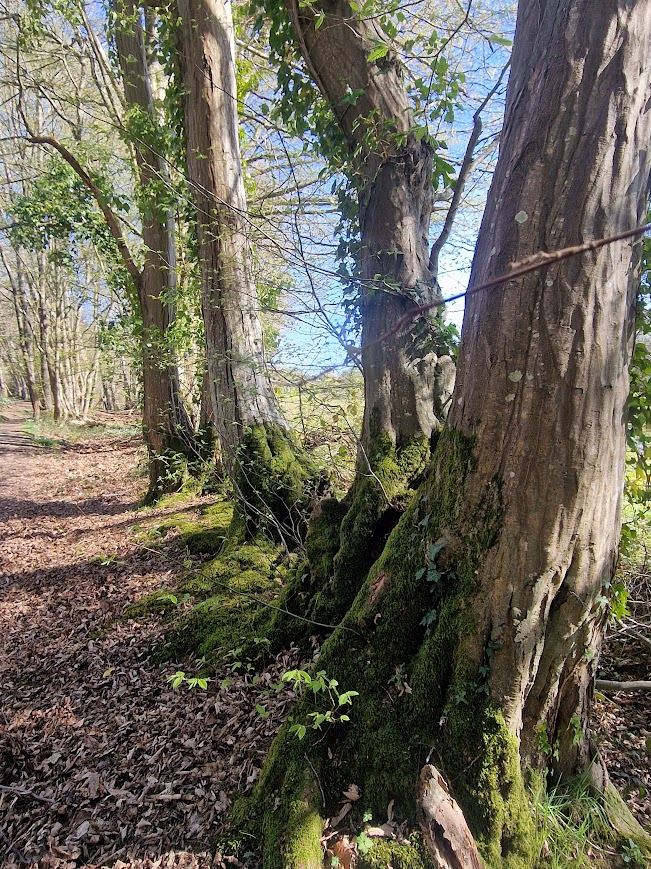
Theses Hornbeams form a boundary around the wood; whilst theses trees as species can not be considered as AWVP indicators; the structure of the ancient boundary (raised bank with coppiced trees) is probably an indicator of ancient woodland.
This is Francis Rose’s list of Ancient Woodland Indicator Plants (AWVP) for South East Woodland
Acer campestre*, Field Maple
Adoxa mosichatellina, Moschatel
Allium ursinum, Ramsons,
Anagallis minima, Chaffweed
Anemone memorosa, Wood Anemone
Aquilegia vulgaris*, Columbine
Blechnum spicant, Hard Fern
Bromopsis ramosa, Hairy-brome
Calamagrostis epigejos, Wood Small-reed
Campanula latifolia, Giant Bellflower
Campanula trachelium, Nettle-leaved Bellflower
Cardamine amara, Large Bitter-cress
Carex laevigat, Smooth-stalked Sedge
Carex pallescens, Pale Sedge
Carex pendiula*, Pendulous Sedge
Carex remota, Remote Sedge
Carex strigosa, Thin-spiked Wood-sedge
Carex sylvatica, Wood-sedge
Carpinus betulus*, Hornbeam
Ceratocapnos claviculata, Climbing Corydalis
Chrysosplenium oppositifolium, Opposite-leaved Golden-saxifrage
Colchicum autumnale, Meadow Saffron
Conopodium majus, Pignut
Convallaria majalis, Lily-of-the-valley
Crataegus laevigata, Midland Hawthorn
Daphne laureola*, Spurge-laurel
Dipsacus pilosus, Small Teasel
Dryopteris aemula, Hay-scented Buckler-fern
Dryopteris affinis, Scaly Male-fern
Dryopteris carthusiana, Narrow Buckler-fern
Elymus caninus, Bearded Couch
Epipactis helleborine, Broad-leaved Helleborine
Epipactis purpurata, Violet Helleborine
Equisetum sylvaticum, Wood Horsetail
Euonymus europaeus, Spindle
Euphorbia amygdaloides, Wood Spurge
Festuca gigantea, Giant Fescue
Frangula alnus, Alder Buckthorn
Galium odoratum, Sweet Woodruff
Gnaphalium sylvaticum, Heath Cudweed
Helleborus viridis*, Green Hellebore
Holcus mollis, Creeping Soft-grass
Hyacinthoidles non-scripta, Bluebell
Hypericum androsaemum, Tutsan
Hypericum pulchrum, Slender St John’s-wort
Ilex aquifolium, Holly
Iris foetidissima, Stinking Iris
Lamiastrum galeobdolon, Yellow Archangel
Lathraea squamaria, Toothwort
Lathyrus liniifolius, Bitter-vetch
Lathyrus sylvestris, Narrow-leaved Everlasting-pea
Luzula forsteri, Southern Wood-rush
Luzula pilosa, Hairy Wood-rush
Luzula sylvartica, Great Wood-rush
Lysimachia nemorum, Yellow Pimpernel
Malus sylvestris*, Crab Apple
Melampyrum pratense, Common Cow-wheat
Melica uniflora, Wood Melick
Milium effusum, Wood Millet
Moehringia trinervia, Three-veined Sandwort
Narcissus pseudonarcissus*, Wild Daffodil
Neottia nidus-avis, Bird’s-nest Orchid
Orchis mascula, Early Purple Orchid
Ophris purpurea, Lady Orchid
Oreopteris limbosperma, Lemon-scented Fern
Oxalis acetosella, Wood-sorrel
Paris quadrifolia, Herb-Paris
Phyllitis scolopendrium*, Hart’s-tongue
Pimpinella major, Greater Burnet-saxifrage
Platanthera chlorantha, Greater Butterfly-orchid
Poa nemoralis, Wood Meadow-grass
Polygonatum multiflorum
Polypodium spp., Solomon’s-seal
Polystichum aculeatum, Hard Shield-fern
Polystichum setiferum, Soft Shield-fern
Populus tremula, Aspen
Potentilla sterilis, Barren Strawberry
Primula vulgaris*, Primrose
Prunus avium, Wild Cherry
Pulmonaria longifolia, Narrow-leaved Lungwort
Quercus petraea*, Sessile Oak
Radiola linoides, Allseed
Ranunculus auricomus, Goldilocks Buttercup
Ribes nugrum, Black Currant
Ribes rubrum*, Red Currant
Rosa arvensis, Field-rose
Ruscus aculeatus, Butcher’s Broom
Sanicula europaea, Sanicle
Scutellaria minor, Lesser Skullcap
Scirpus sylvaticus, Wood Club-rush
Sedum telephium, Orpine
Serraula tintoria, Saw-wort
Solidago virgaurea, Golden-rod
Sorbus torminalis, Wild Service Tree
Stachys officinalis, Betony
Tamus communis, Black Bryony
Tilia cordata*, Small-leaved Lime
Ulmus glabra, Wych Elm
Vaccinium myrtillus, Bilberry
Veronica montana, Wood Speedwell
Viburnum lantana, Guelder Rose
Vicia sepium, Bush Vetch
Vicia sylvatica, Wood Vetch
Viola palustris, Marsh Violet
Viola reichenbachiana, Early Dog-violet
Wahlenbergia hederacea, Ivy-leaved Bellflower
* Consider these species only if they occur well within the wood and do not appear to have been planted.
It should be noted that when calculating Ancient Woodland Indicator Plants scores:
- A high AWVP score is a reliable indication of natural diversity.
- It also indicates ancient woodland, but does not on its own constitute proof.
- Some woods which are undoubtedly ancient have a low AWVP score. Study of other components of the woodland biodiversity such as lichens, or invertebrates in rotting wood, may give clearer indications of ancient woodland status. Quite often, ancient sites that are rich in AWVP’s will be poor in lichens and rotting wood invertebrates and vice-versa.
- Not all indicator species are strictly limited to ancient woodlands. For example, where secondary woodland adjoins older woodland, it will acquire species associated with older woods much more quickly than isolated secondary woods.
- Plants which are also cultivated in gardens (e.g. Wild Daffodil) should be used with great caution.
- Certain woodlands can credibly be established as being ‘ancient’ through the study of old historical records such as maps and estate records. Observations of landscape features such as banks, ditches and other topographical features within a wood will also give clues to previous land use. By surveying a number of these ‘proven’ ancient woodlands, species which are usually confined to this type of habitat can be identified. From: Countryside Information Ancient Woodland Indicator Species
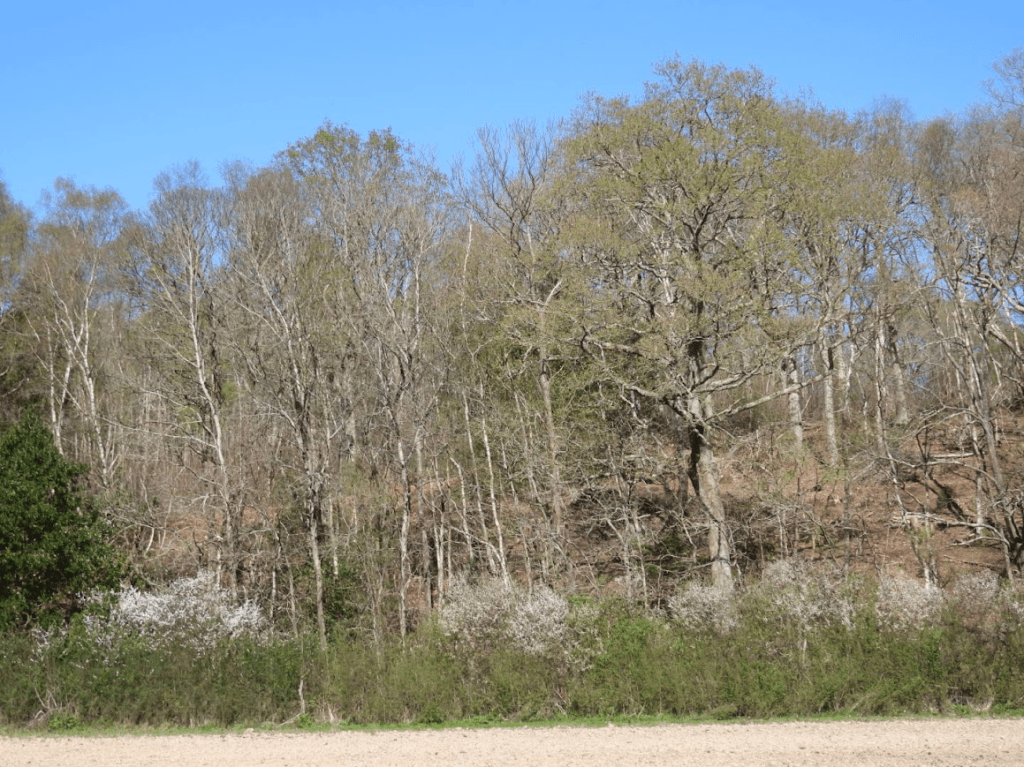
The edge of Fore Wood, with Blackthorn, Prunus spinosa, in blook, and behind Pedunculate Oak, Quercus robur, Silver Birch, Betula pendula and Holly, Ilex aquifolium

 Sim's Nature Notes