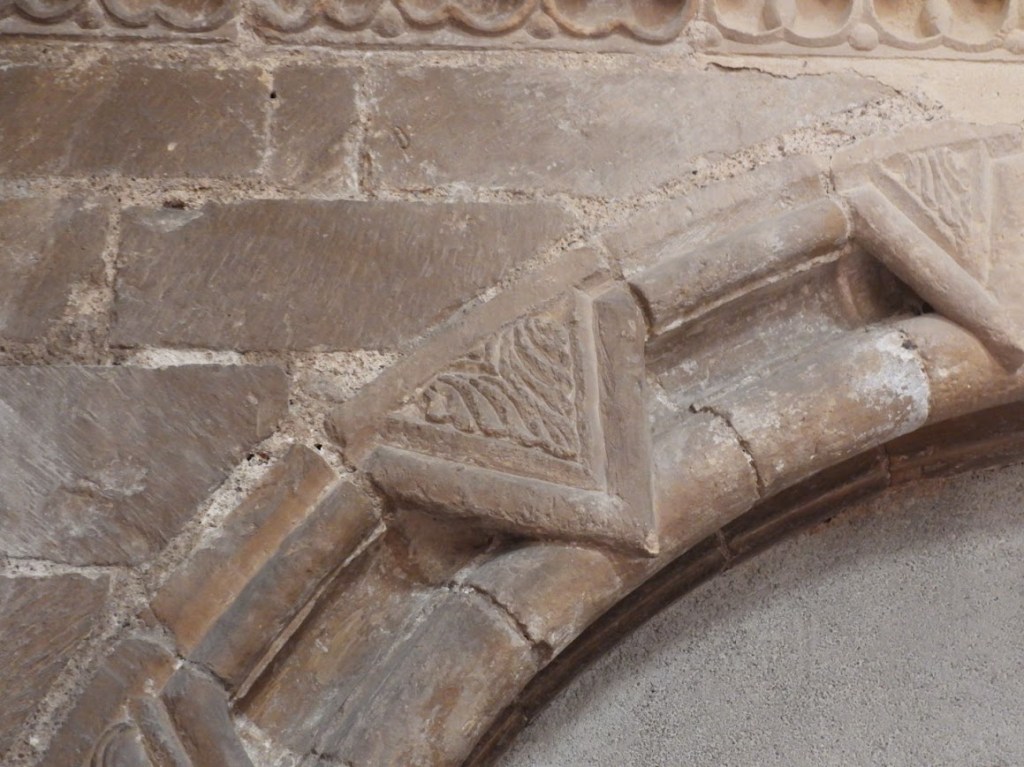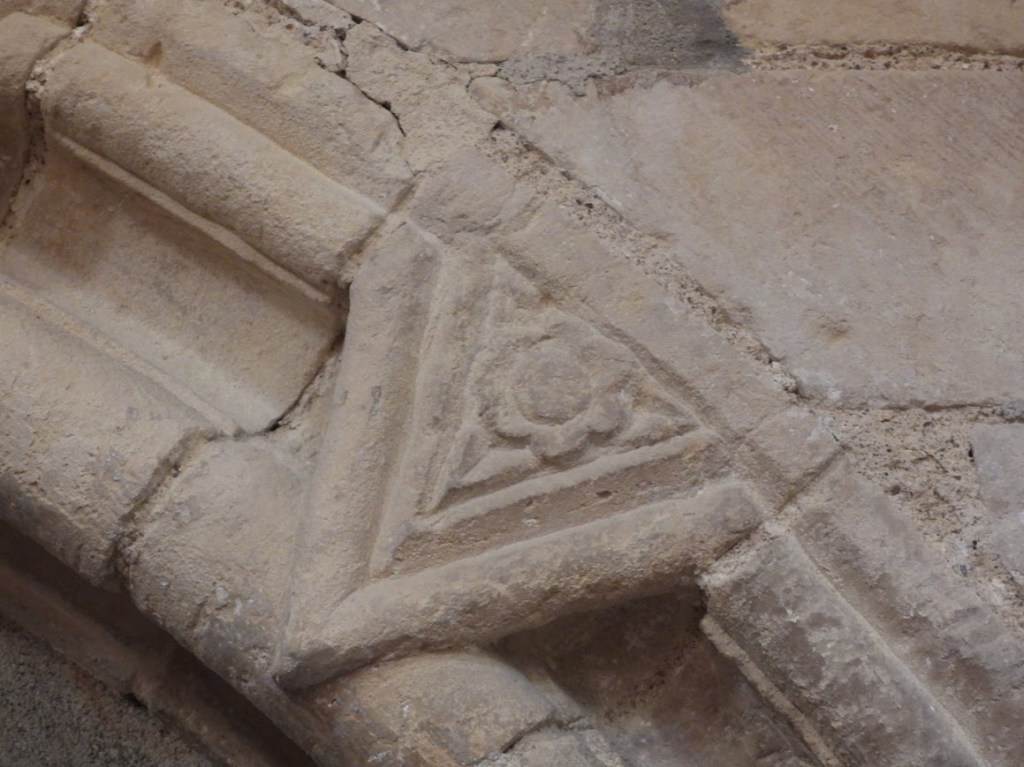
“With Verdure Clad”: Carved foliate decoration in the Norman C12 St Mary de Haura church, Shoreham-by-Sea, West Sussex, 02.01.26, compared with C12 mosaics plants in the Komnenian Daphni Monastery, Athens, 15.12.25

The church of Mary de Haura [de havre; of the harbour] was built built between ca. 1125 to ca. 1219, with funds from the 2nd Baron of Bramber, when he returned from the First Crusade Sussex: West, Pevsner Architectural Guides, The Building of England revised (2019) by Williamson, Hudson, Musson & Nairns. The de Broase were the Barons of Briouze in Normany, made Barons of the Norman Rape of Bramber by William the Conqueror. The port fees from Shoreham harbour, built by the First Baron of Bramber also funded the long building of St Mary de Haura

The exterior of the church:
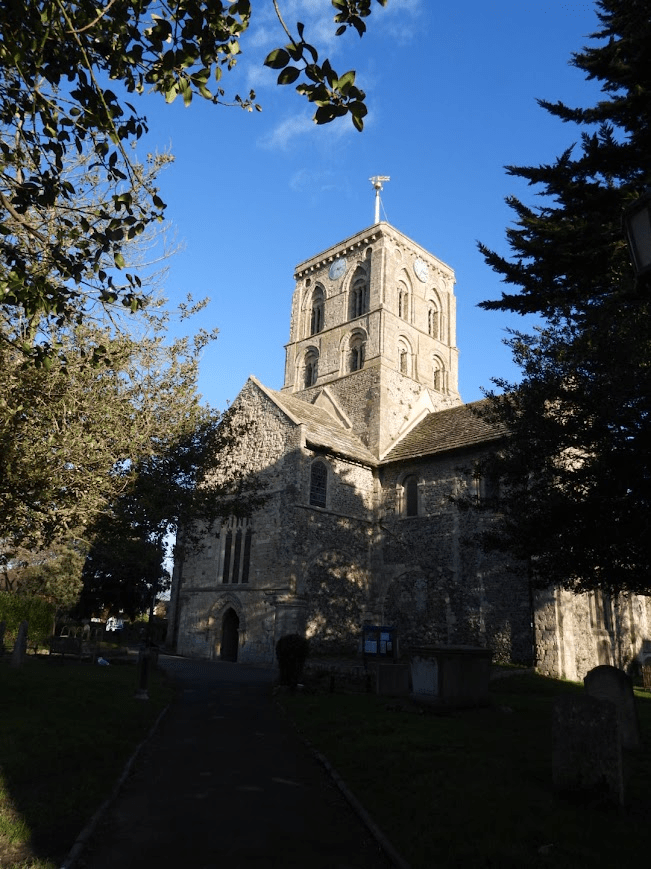
The port was of great importance to the new Norman rulers as Shoreham was one of the main ports for Normandy.  As a consequence, the Adur valley is aid to have been one of the three most densely populated parts of England (G Standing p93). , the river silted up and a new port was built on the coast, protected by the de Braoses of Bramber.  Its church … was granted to Saumur in 1096 (VCH 6(1) p168) to which the de Braoses had links through their foundation of Sele priory at Upper Beeding

The transepts, crossing and lower tower were built between about 1125 and 1140, followed by a mid-C12 nave of which less than a bay remains [most of the nave was demolished].  The upper tower followed shortly after and the choir was rebuilt, probably between 1180 and 1210.  Despite many puzzles, it contains some of the finest work of the period in England. Shoreham Sussex Parish Churches Mary de Haura, New Shoreham, retrieved 02.12.26.

The sculptured foliage which this post focusses on, are mainly in the choir. When I revisited St Mary de Haura in December 2025 (I have visited the church many times) what really struck me, was the sheer abundance of carved foliage in the choir.

The lyric with verdure clad from Haydn’s oratorio The Creation, popped into my head. The availability of that lyric to my memory was probably because discussion of the origins of the lyrics of The Creation formed a large part of my A level music lessons (1978-80) at Brighton and Hove VIth Form College as The Creation was one of the set compositions for the examination. The Creation was written between 1796 and 1798 and celebrates the creation of the world. The original English libretto by Johann Peter Salomon was given to Haydn in 1795. It is derived from the Book of Genesis (King James Version) and Milton’s Paradise Lost. The original English libretto was translated into German by Baron Gottfried van Swieten for Haydn. But the common English version sung today is a re-translation from that German translation, which leads to some clunky language e.g. with verdure clad the fields appear and straight opening her fertile womb, the earth obeys the word, and teems with creatures numberless, in perfect forms and fully grown. Cheerfully roaring, stands the tawny lion. With sudden leaps the flexible tiger appears.
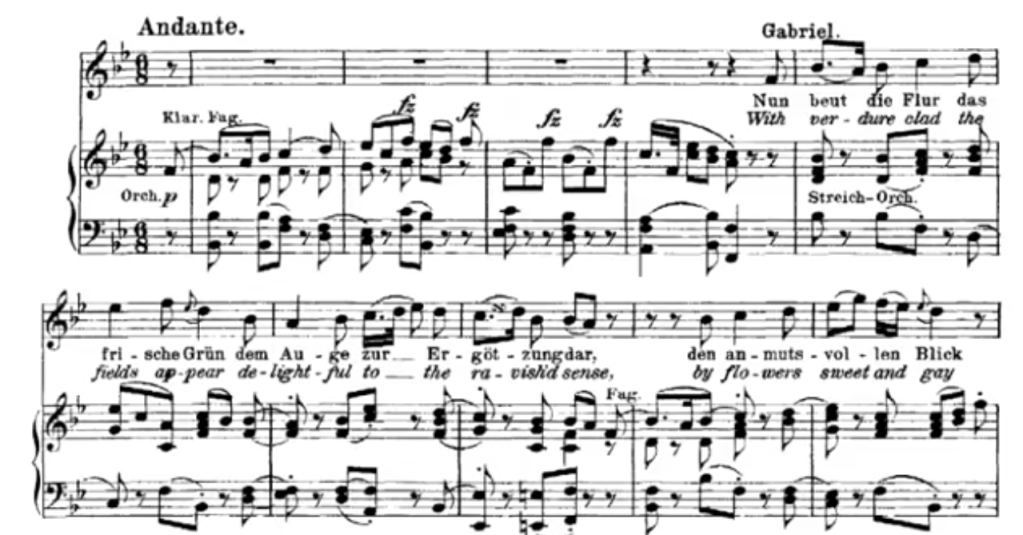
The aria With verdure clad the fields appear is sung by the archangel Gabriel (typically by a woman a soprano soloist). It describes the creation of plant life on the third day, celebrating the beauty and abundance of nature, including fragrant herbs, healing plants, and fruit-laden boughs

With verdure clad the fields appear
delightful to the ravish’d sense;
by flowers sweet and gay
enhanced is the charming sight.
Here vent their fumes the fragrant herbs;
here shoots the healing plant.
By load of fruits th’expanded boughs are press’d;
To shady vaults are bent the tufty groves;
The mountain’s brow is crown’d with closed wood. Retrieved from The Choral  Art Alliance of Missouri. Haydn’s Creation Lyrics 03.01.26. You can listen to Emma Kirby’s performance of the aria with The Academy of Ancient Music conducted by Christopher Hogwood at https://www.youtube.com/watch?v=IqKGFtTGUXY&t=16s

My interest in how landscape and botany are represented in medieval churches was engendered by taking a module on Byzantine art during studying for an MA in History of Art at the University of Sussex, 2003-2005. This module was not about landscape or botany; it was about the iconology of Byzantine art and production techniques, particularly mosaics, but because I was always always interested in landscape (I did A levels in Geology and Geography as well as Music, and spent a lot of time walking round the countryside of Sussex on A level field trips, and walking on the Downs at weekends with my Grandfather, an agricultural labourer on a farm in Rottingdean). I ploughed a lonely furrow researching the representation of gardens and wildernesses in the 1316-1321 mosaics of the Annunciations to St Anna and St Joachim in the narthex (entrance area) in the Church of the Chora Monastery, as when I took my MA,  little research on landscape in Byzantine mosaics has been undertaken. The Chora Monastery is in Constantinople (now Istanbul). The Annunciation to St Anna and St Joachim is part of the cycle of representations of the life of the Theotokos (mother of god) and life of Christ that appears in all Byzantine (Greek Orthodox) churches. This scene is not typically depicted in western art, as its story derives from the apocryphal Protoevangelion of James, i.e. a text not accepted as canonical in western Christianity. In Byzantine iconology, Joachim is always presented in a wilderness (dessert) and Anna is shown in walled garden (a symbols of virginity in Medieval art). 

The Church of the Chora Monastery is renowned … for its well-preserved mosaics and frescoes. It presents important and beautiful examples of East Roman painting [and mosaics] in its last period [the Palaiologoi dynasty, 1259 to 1453]. … The name “Kariye” (Turkish …: village) originated from an ancient Greek word  Chora (χώρα) [which] means “in the fields” or “in the countryside” because the old church and monastery remained outside the walls of Constantinople. [The] Theodosian walls [were] built in 408-450. [T]he fact that the word Chora is written along with the names of both of them on the mosaics depicting Jesus and Mary inside the church shows that it has a mystical meaning too. [The] Chora Church was originally built in the early 4th century as part of a monastery complex … during the reign of Emperor Iustinianos [Justinian] in the 5th century. Kariye Mosque retrieved 03.01.26.

The Annunciation of Mary’s Birth to Anne,  The Greek inscription in the scene reads “Saint Anne is praying in the garden”
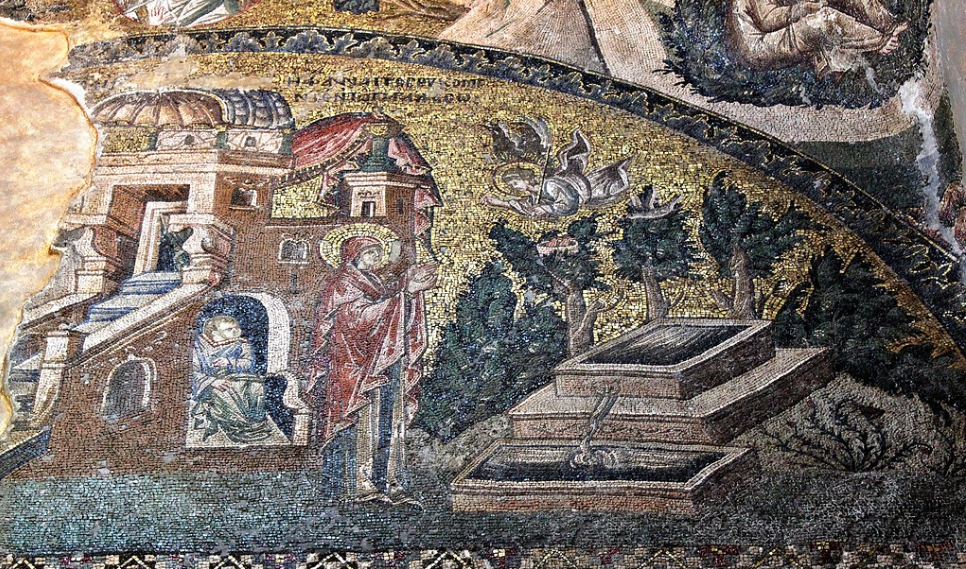
Photo from my visit to the Chora Monastery in Istanbul in 2014

I looked hard at how plants were represented in this mosaic version of the Annunciation, but I was unable to demonstrate any connection between plants in the Chora’s countryside location and the nature of the flora depicted; although The Protoevangelium of James sates that Anna went down to the garden to walk. And she saw a laurel, and sat under it, New Advent, retrieved 03.01.26. There also appears to be no connection between the carved foliage in St Mary de Haura and “real” flowers around Shoreham or anywhere. Flora in medieval religious art are not a representations of particular botanical species; flora, instead, symbolically represents core aspects of Christian belief; e.g. God’s creation, purity, resurrection, and eternal life. Some specific species did have set significations, e.g. Lilies of the Valley represented the Virgin and virginity. Although specific species were only rarely depicted in the medieval period; they become common in Western religious art in the Early Modern period of the Renaissance e.g. by Van Eyck, see Paul Van den Bremt (2011) translated by Lindsay Edwards A Garden Full of Symbols. Flora in the Paintings of Van Eyck retrieved 03.22.26

I am an atheist and do not believe in a creation of nature by god nor do I believe that plants have any religious meaning. However, I am very interested in how people construe nature in art. Symbolic religious interpretations of nature are part of the history of ideas in the religious art of both Western and Eastern Christianity. Christian symbolic motifs are very important to understanding the decoration of Medieval churches, in the eyes of those who designed and built them and worshiped in them.

Before Christmas, I went holiday to Athens with my husband; our first holiday abroad for 11 years. We went to the Monastery of Daphni, whose mosaics  were created ca. 1100 during the Byzantine Komnenoi dynasty
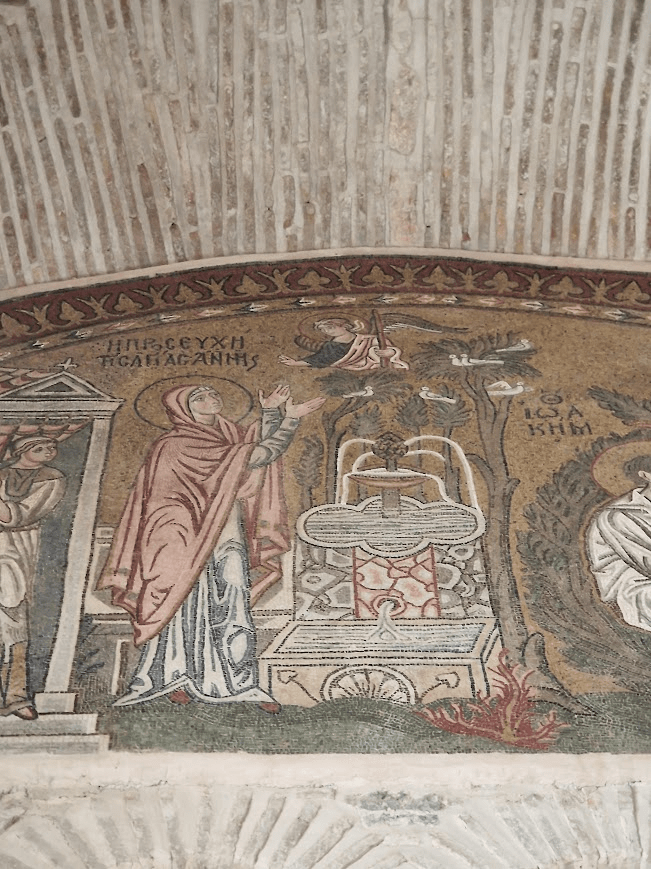
Again the plants in this mosaic are not identifiable as specific botanical species. The trees look a bit like Allepo Pines, Pinus halepensis, common in Athens suburb, more than Laurel, as mentioned Protoevangelion of James. The birds, Sparrows, are named as Sparrows in Protoevangelion: And gazing towards the heaven, she saw a sparrow’s nest in the laurel New Advent, retrieved 03.01.26. They do indeed look like sparrows; but it is impossible to determine whether they are House Sparrows, Passer domesticus or Tree Sparrows, Passer montanus; both common in Greece and the Levants; but when the Protoevangelion was written (mid-2nd century AD) a distinction between Domestic and Tree Sparrows may not have been known

Joachim’s wilderness bush:
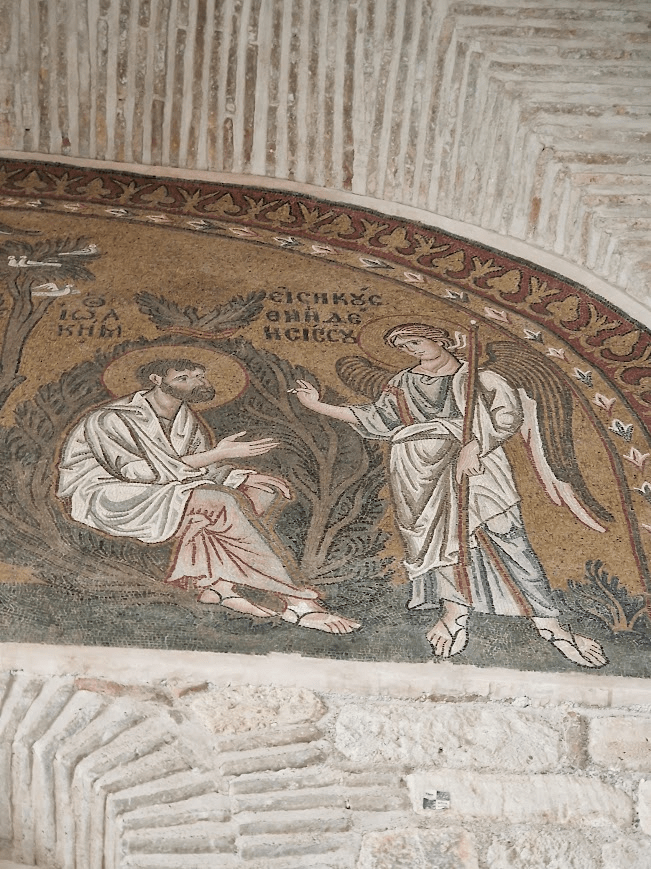
could be Olive trees, Olea europaea, which are a ubiquitous feature of the landscape of the eastern Mediterranean

Sussex carved stone representations of foliage in C12 and early C13 Shoreham seem quite primitive compared with Byzantine mosaics of foliage in C12 Athens; but this is not an entirely fair judgement; mosaics partially look more sophisticated because they are made of brightly coloured glass and carved stone is grey; but it is only grey now because its original painting has been lost. In C12 and C13 churches, sculptures would have been painted in bright colours, see Tysoe Heritage Research Group. The recently repainted corbel heads in Boxgrove Priory Church, West Sussex nr. Chichester, give an impression of how colourful Sussex churches may have looked in Norman, Plantagenet and Tudor times, before Henry VIII’s reformation
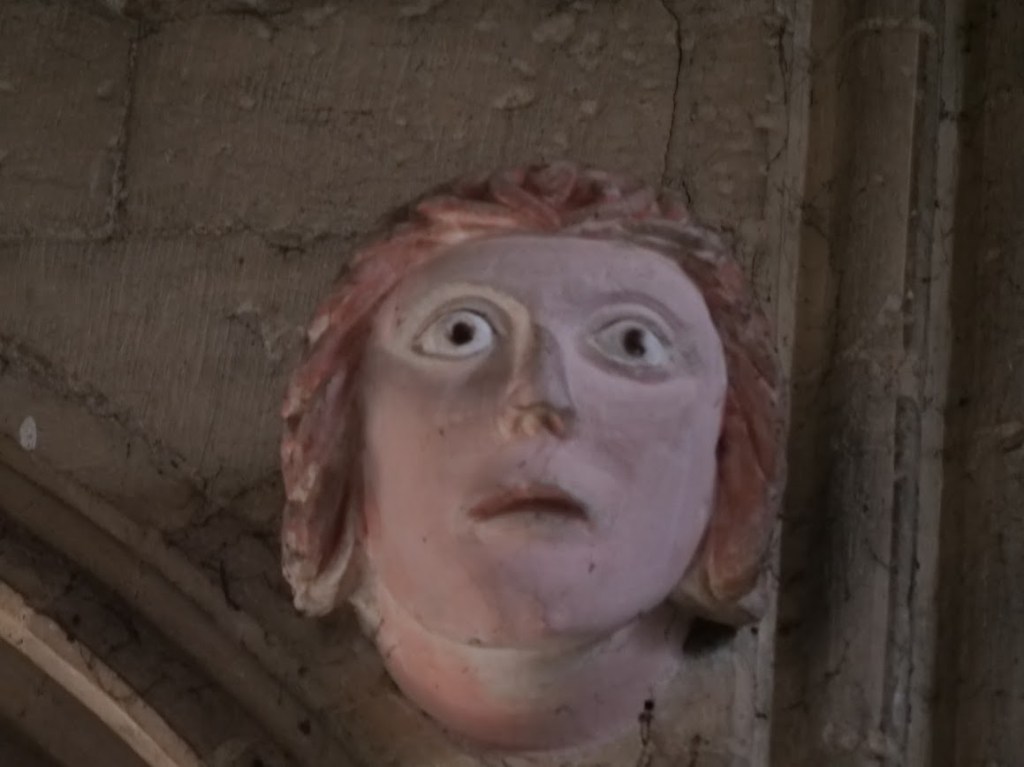
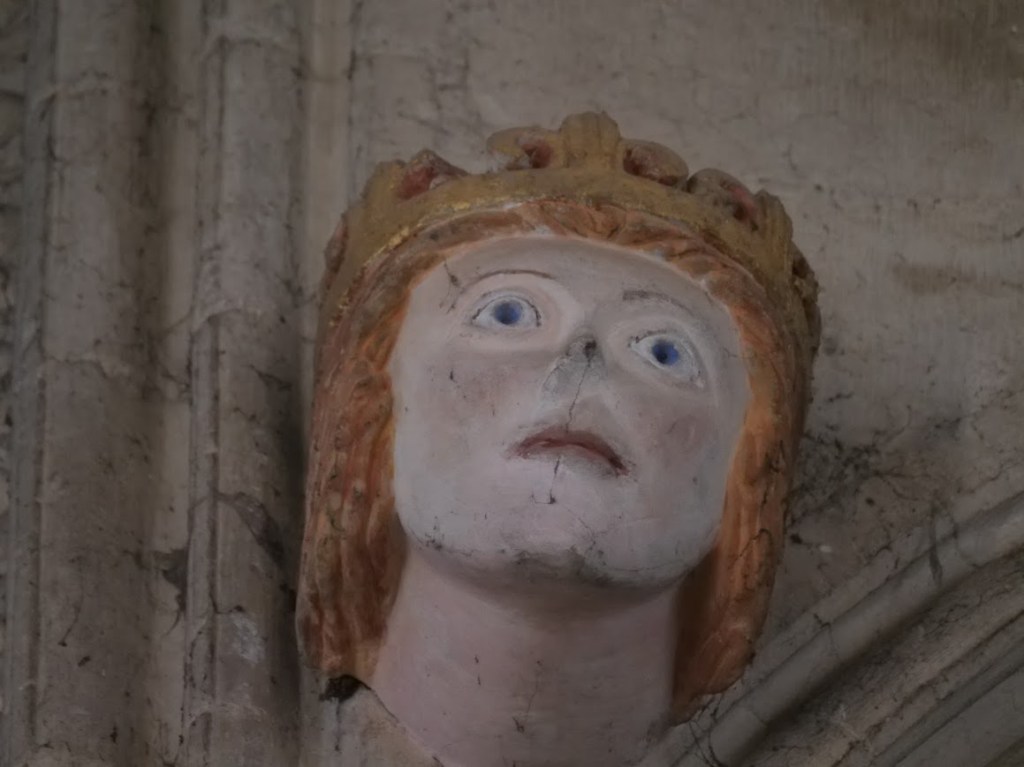
However, to some degree Byzantine C12 mosaic foliage is more sophisticated than English sculpted foliage; as Byzantine mosaics attempt to represent specific plants (and specific people) figuratively (even if what they represent is mythical rather than real); whereas Norman masons crafted mostly decorative generic foliage patterns in English C12 not representation of specific plants, although they did produce foliate heads (Green Men), which attempt to represented mythic figures. However, both the generic foliage of the west and specific plants in the east signify ,same theological concept: purity, resurrection, the beauty of “Gods creation”.

James Kellaway Colling asserted in 1874 that Early English Foliage [in churches] probably culminated about the middle of the thirteenth century, but many excellent examples are as early as the end of the 12th century. It was evidently progressively developed from the foliage of the Norman era. … By the Perpendicular period [C14-C16 the final period of English Gothic Architecture]greater scope was given to sculpture than foliage, especially in large works. Shields and heraldic emblems were commonly used, and grotesque animals often took the place of foliage, but seldom, as heretofore, mixed with foliage. The beautiful richness of foliated surfaces, so charmingly begun in the Norman, was completely lost.

However closely we endeavour to trace the origin of Decorative Art, we find that it constantly originated in forms taken from Natural Foliage. No doubt simple cutting, or notching with a knife or other sharp tool, preceded the imitation of natural form, and for this reason the zigzag and its simple combinations were the earliest forms of ornamentation invented by man. The zigzag is found in the primitive work of nearly all nations — shewing that it was the first natural step in the attempt at ornamentation although no people ever developed its capabilities so much, or adhered to it so long, as the Normans. As soon as tools improved, and primitive workmen felt they were able to go beyond simple notches, they began to imitate natural objects ; and consequently the most simple leaves and flowers which were growing around them, as well as the forms of the animals with which they were familiar, were soon rendered by them and adapted to the decoration of their works. Now as this facility of imitation varied among different people, so their renderings from nature varied; and as early artists also copied from one another, these diverse manners of following nature became more confirmed and stereotyped as time advanced. Thus arose that highly conventional treatment of natural forms which appears so conspicuously in early works, giving great distinctness of character, and shewing marked difference in the manner of rendering even the same natural objects by various nations at different periods in the world’s history. p. 24

 ….in the transitional piers at New Shoreham church the abacus is round, and the foliage begins to assume the Early English type p.55 James Kellaway Colling F.R.LB.A., (1874) Examples of English Medieval Foliage and Coloured Decoration, Taken From Buildings Of The Twelfth To The Fifteenth Century: With Descriptive Letterpress. B. T. Downloadable at https://archive.org/details/examplesofenglis00coll, retrieved 10.12.25

The choir of St Mary de Haura is a riot of vegetation; a paradigmatic example of the importance of vegetation in Romanesque (C11-C12) churches; before vegetation was replaced by other imagery in the Perpendicular period.

The quadripartite aisle vaults, with roll-moulded ribs and small foliage-bosses (including three with a green man in the south aisle), may have been complete before the upper parts [of the church] were started.  … The triple shafts on the outer walls, with stiff leaf capitals, also look late C12 and are closest to the lower parts of the arcades.  The stiff leaf capitals on the alternating round and octagonal piers of the north arcade, with an outer order of foliage, recall Canterbury.  Either they were the work of masons from there or there was influence from Chichester, where Canterbury masons are known to have worked… The mouldings of the pointed arches are finer than those of the south arcade, where the piers have clustered shafts, each with a stiff leaf capital.  The innermost ones rise to the vault and, as the date differs little from the north arcade, despite the differences, are further confirmation that a vault was intended from the start.

The variation of forms characteristic of New Shoreham is most evident in the gallery, beneath which is a continuous band of quatrefoils that does not vary.  Earliest are the single eastern bays on the north side, which have moulded trefoiled heads and shafts with more stiff leaf.  The remaining three bays have double openings.  Like the openings of the south side, they have hook-corbels at the outer corners.  These are a New Shoreham characteristic; not perhaps the happiest of designs, it is commoner in Normandy than England.  Here, they contrast with the inner capitals, which have foliage, and there are two more at the springing of the vaulting shafts on the north side.  Sussex Parish Churches Mary de Haura, New Shoreham, retrieved 02.12.26

A quatrefoil is a symmetrical design with four overlapping, leaf-like lobes, resembling a four-leaf clover or a four-petal flower, derived from Latin for “four leaves”. Popular in Gothic architecture for windows and tracery, it symbolizes good luck, harmony, and the four Gospels in Christianity, appearing in art, heraldry, and luxury goods globally, from ancient Islamic art to modern fashion. In Christianity, the symbol was adopted to represent the four gospels of the bible: Matthew, Mark, Luke, and John, as well as also seen as a representation of the cross. In Native America, the quatrefoil is a representation of their ‘Holy four corners of the Earth- North, East, South and West’ Quatrefoils: A Closer Look at this Superb Architectural Element accessed 04.01.26
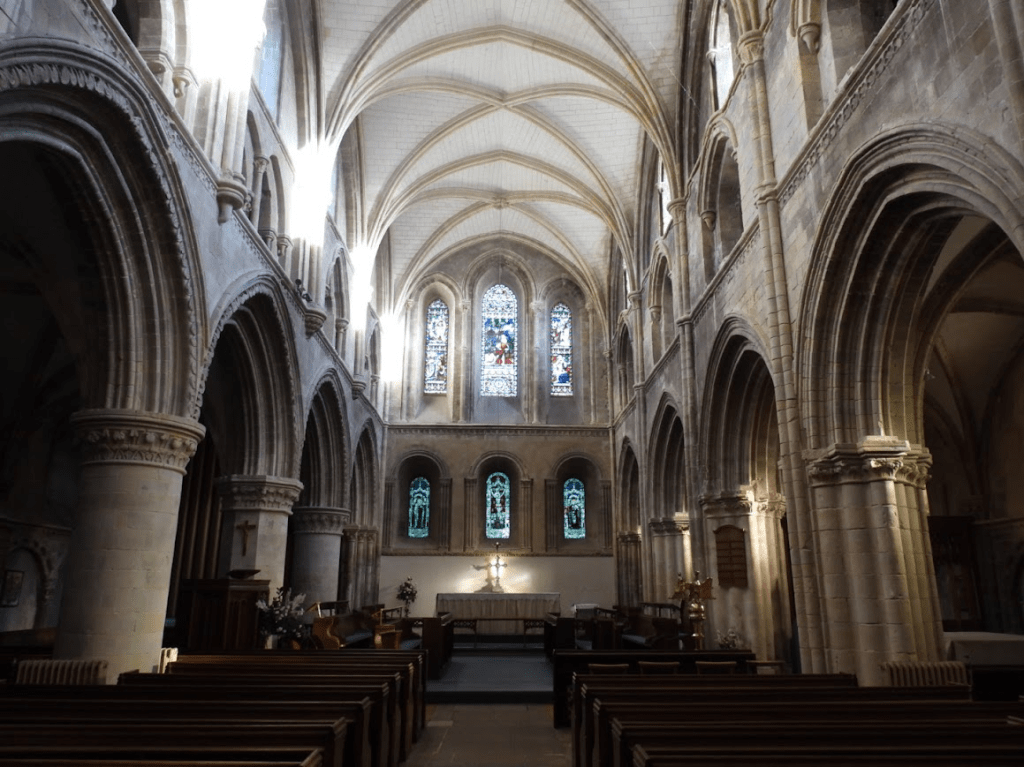
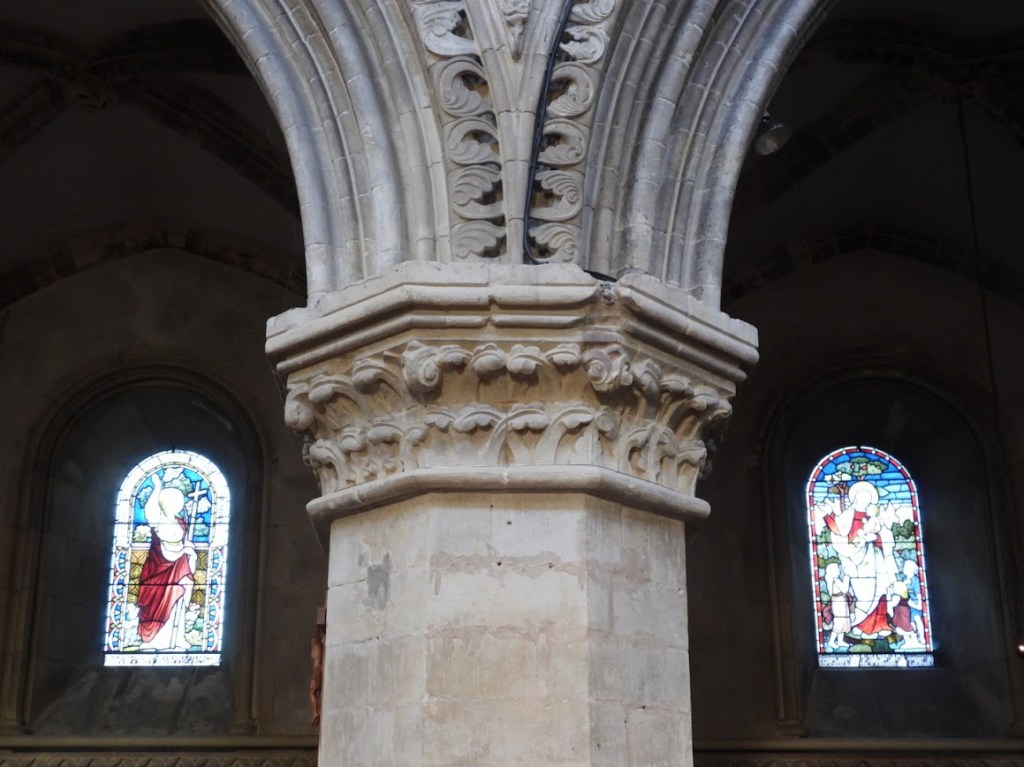
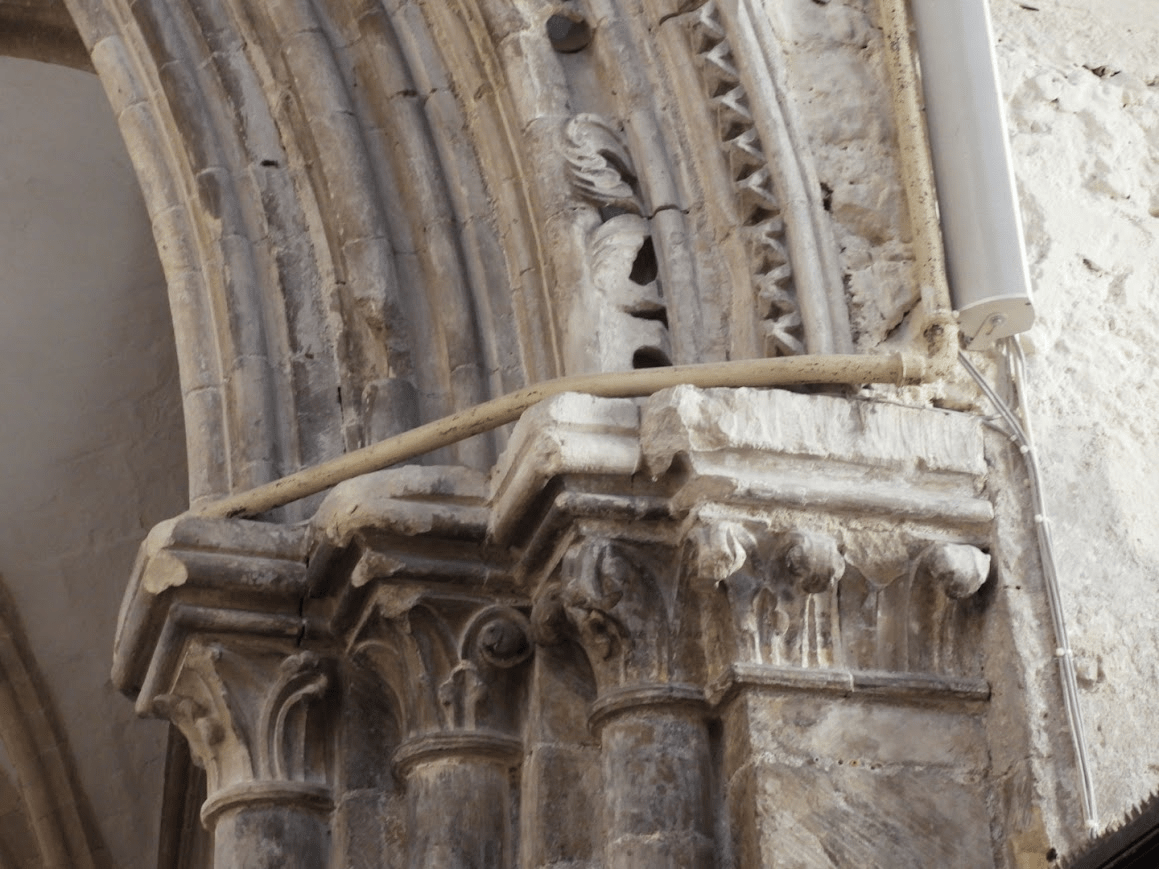
The leaf capitals of the componde columns of the choir
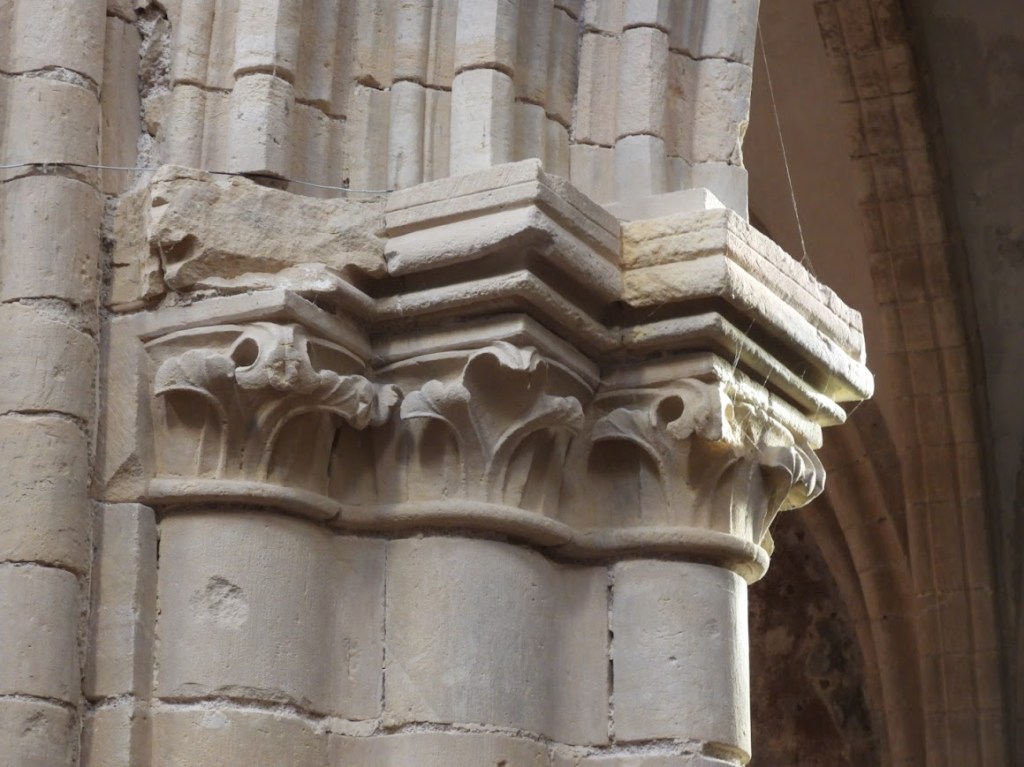
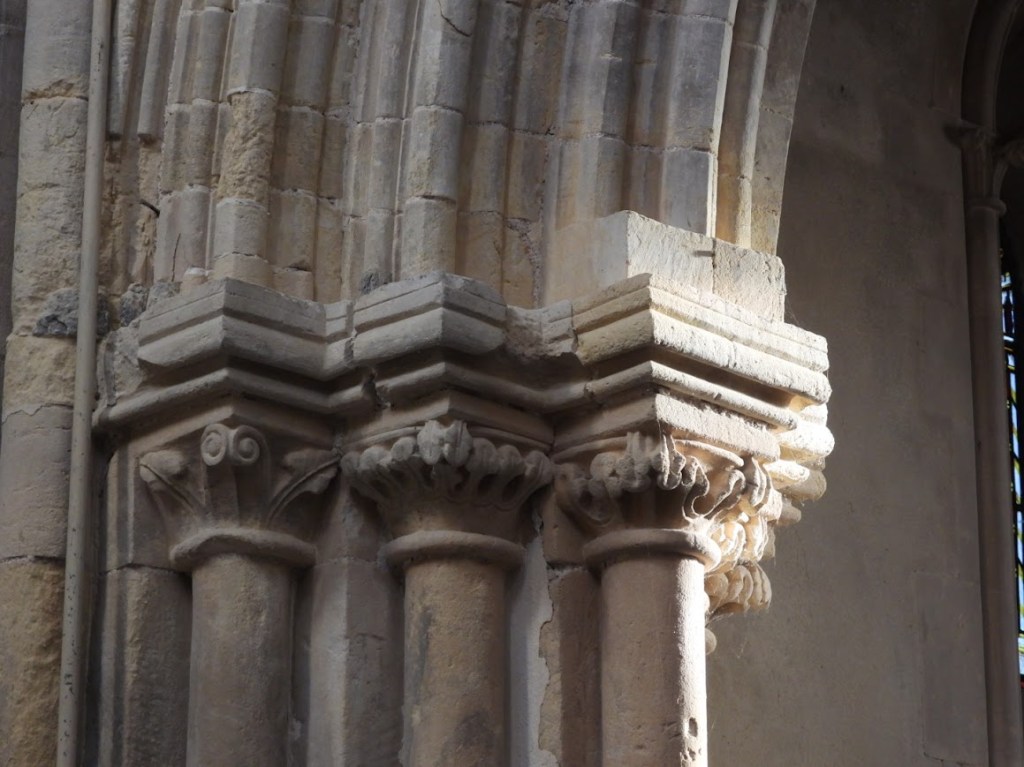
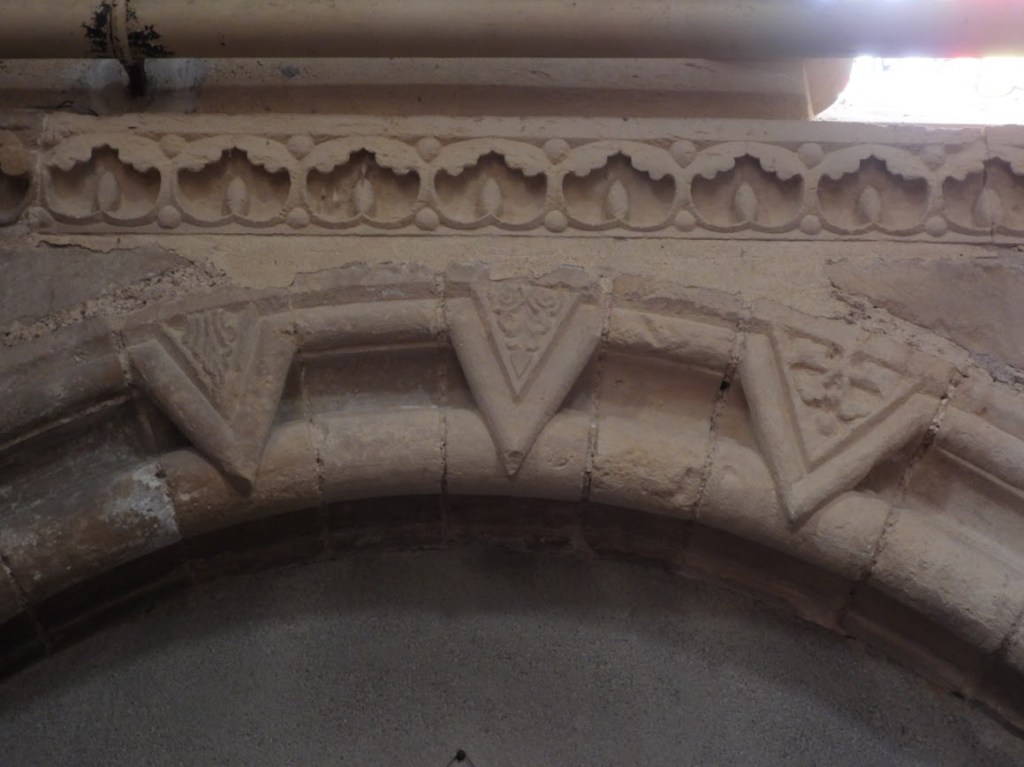
The blind arcade of arches (arches against a wall – decorative rather than structural) decorating the south wall of the choir (a typical feature of Romanesque architecture).
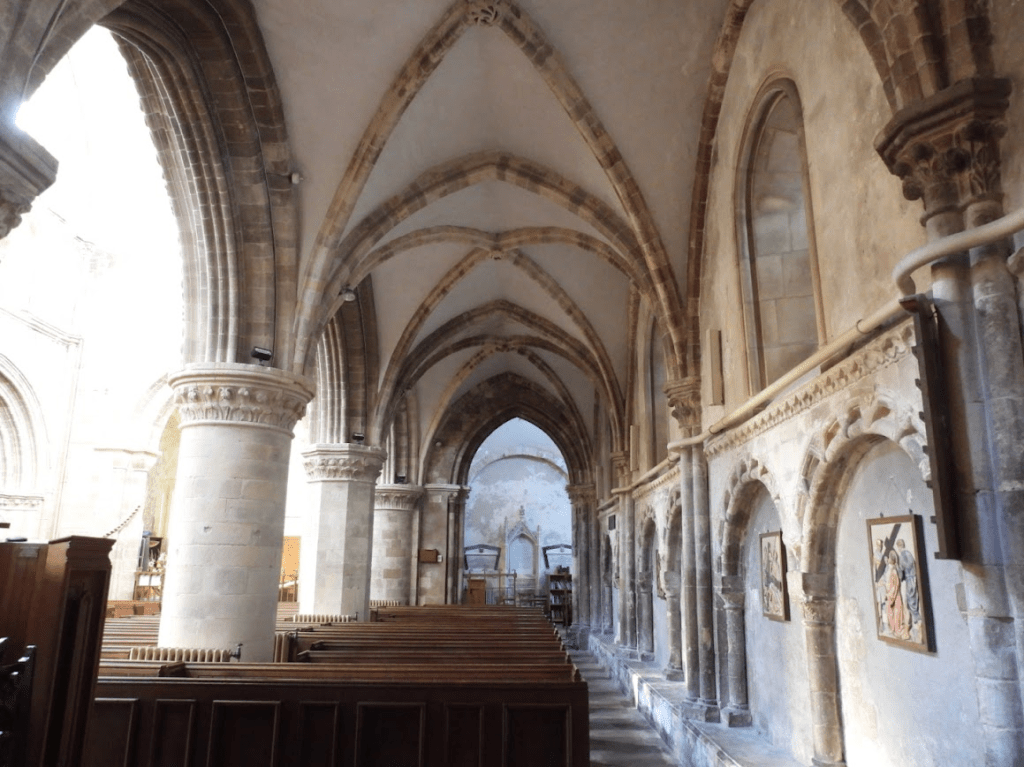
The voussoirs (wedge-shaped stones) of the blind arches are decorated with leaves – but each one leaf is different; showing remarkable creativity by the
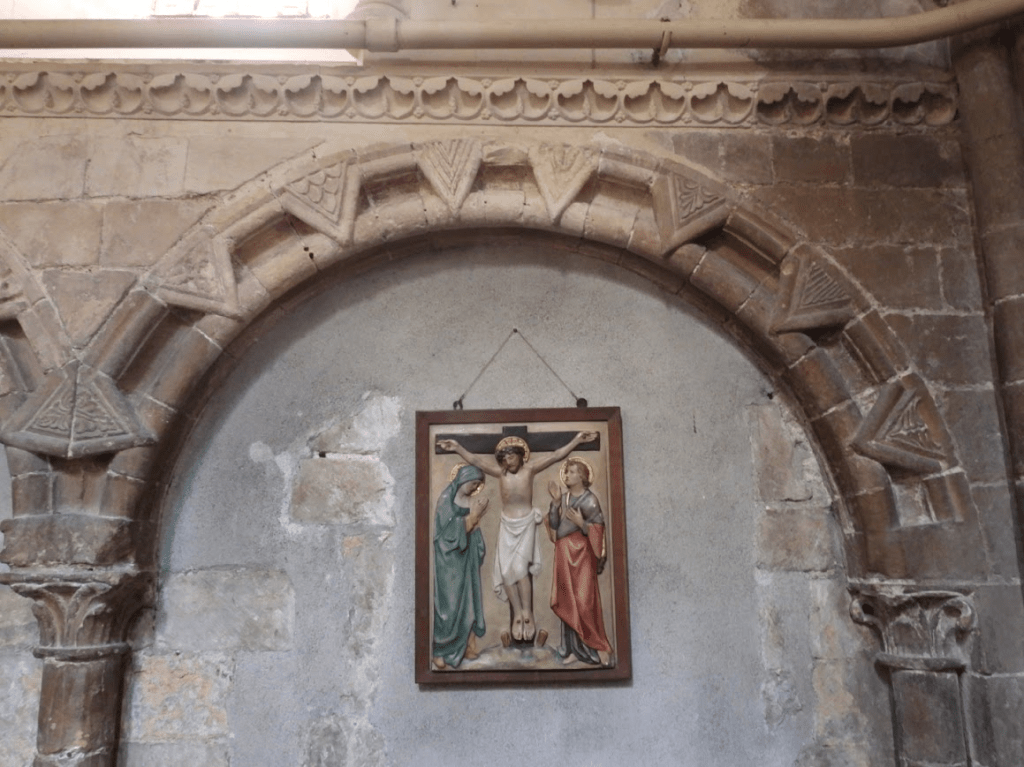
Examples of leaf vosiers
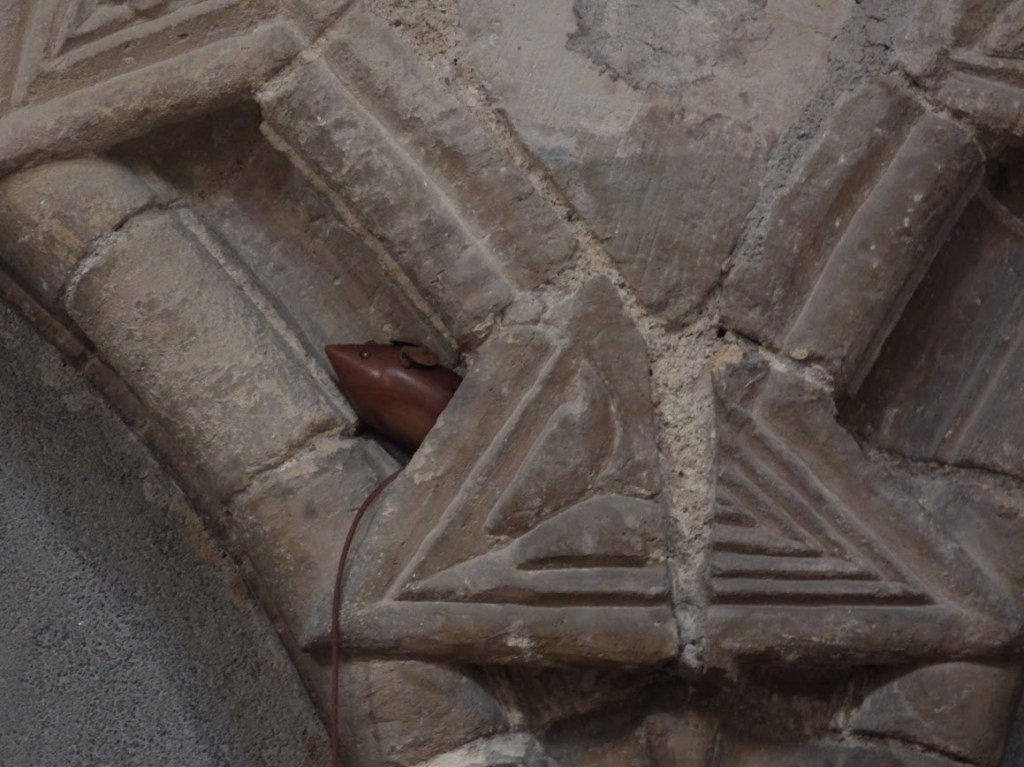
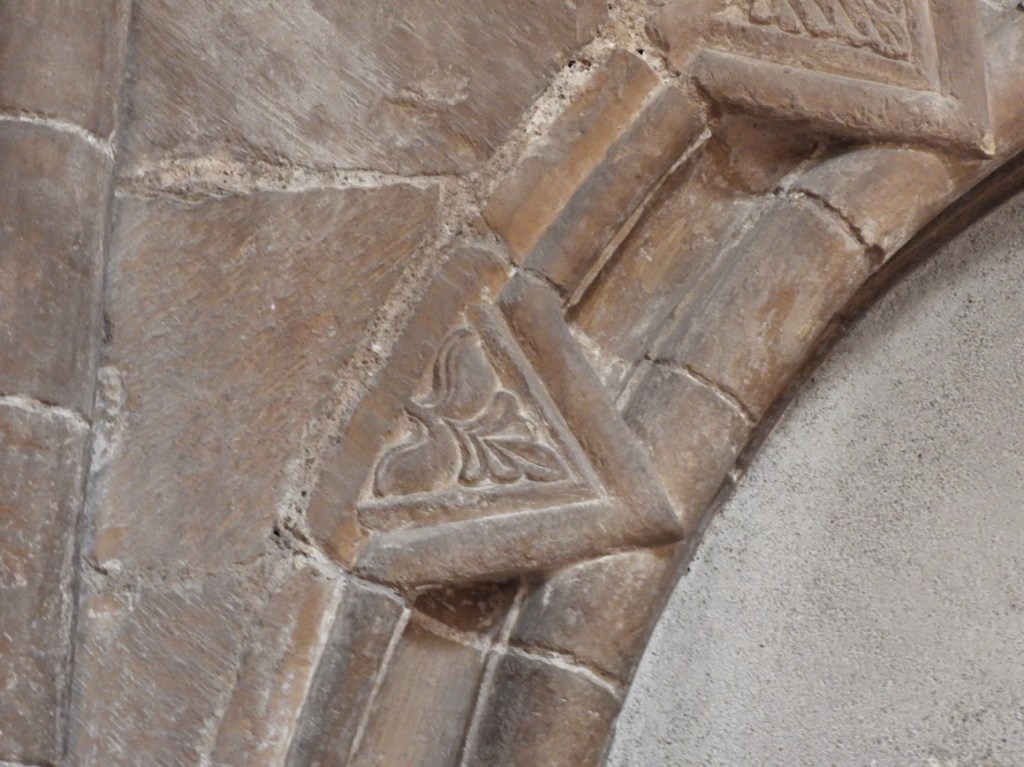
The frieze across the blind arcade of the choir is also foliate
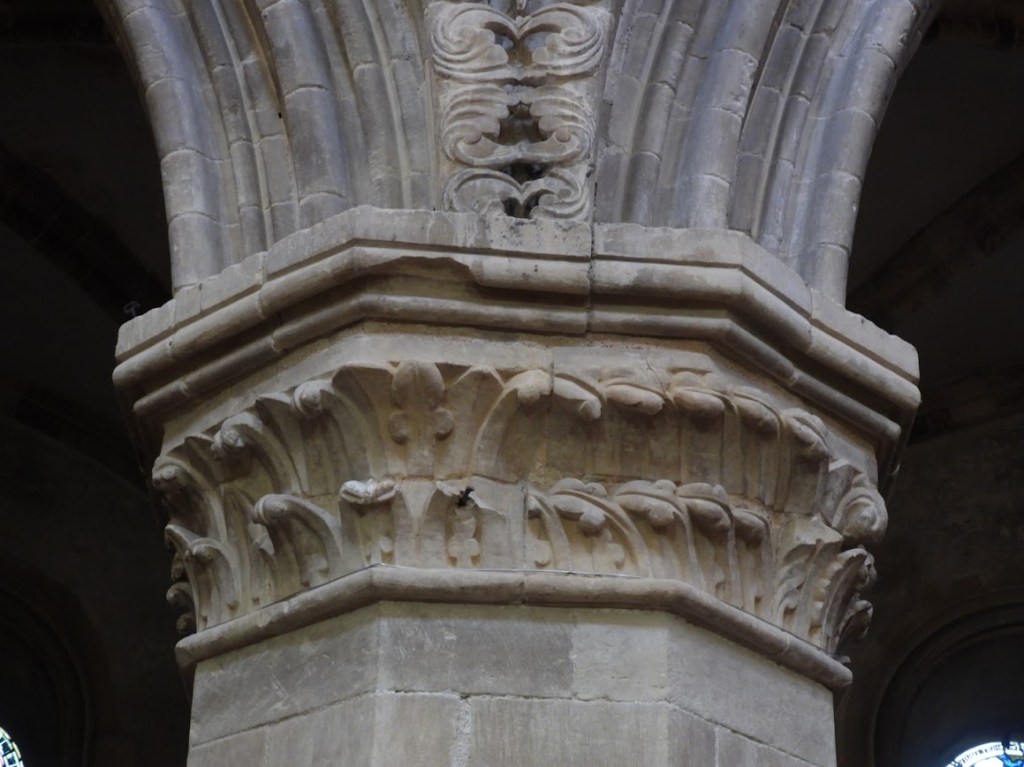
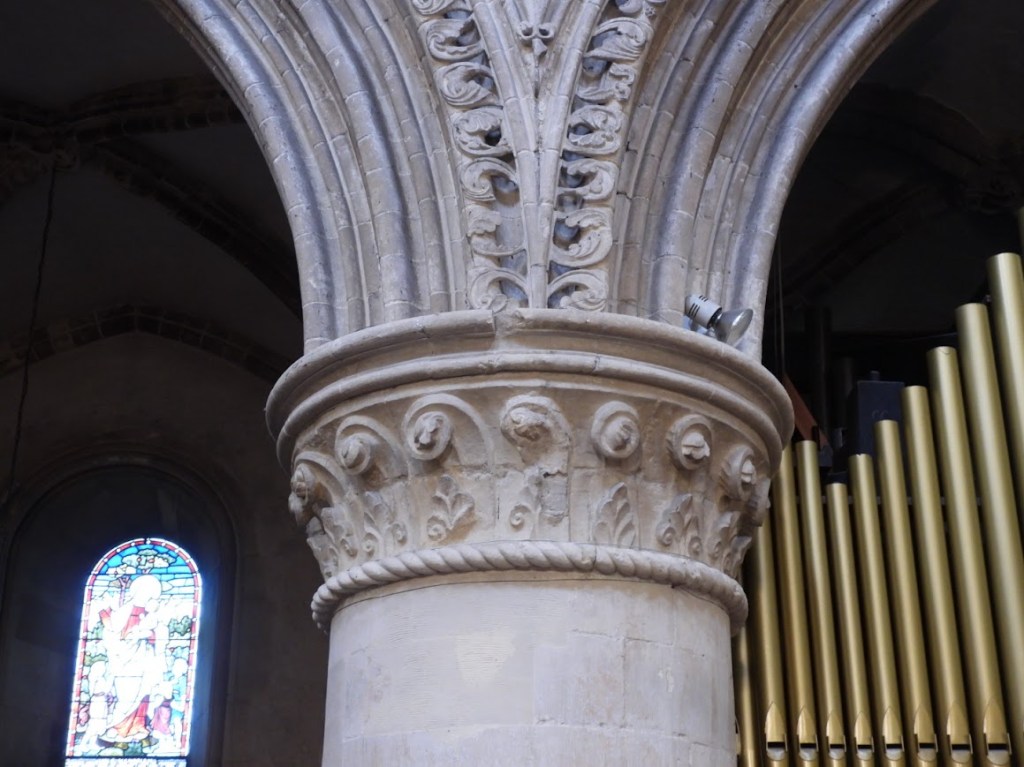
The capitals of piers of north arcade some round, some hexagonal, show a rich variety of geometrical foliage, as do the arches that the piers support.
Two of the bosses of the ribbed vault of the south aisle of the nave are decorated with foliated head (often called Green Men)
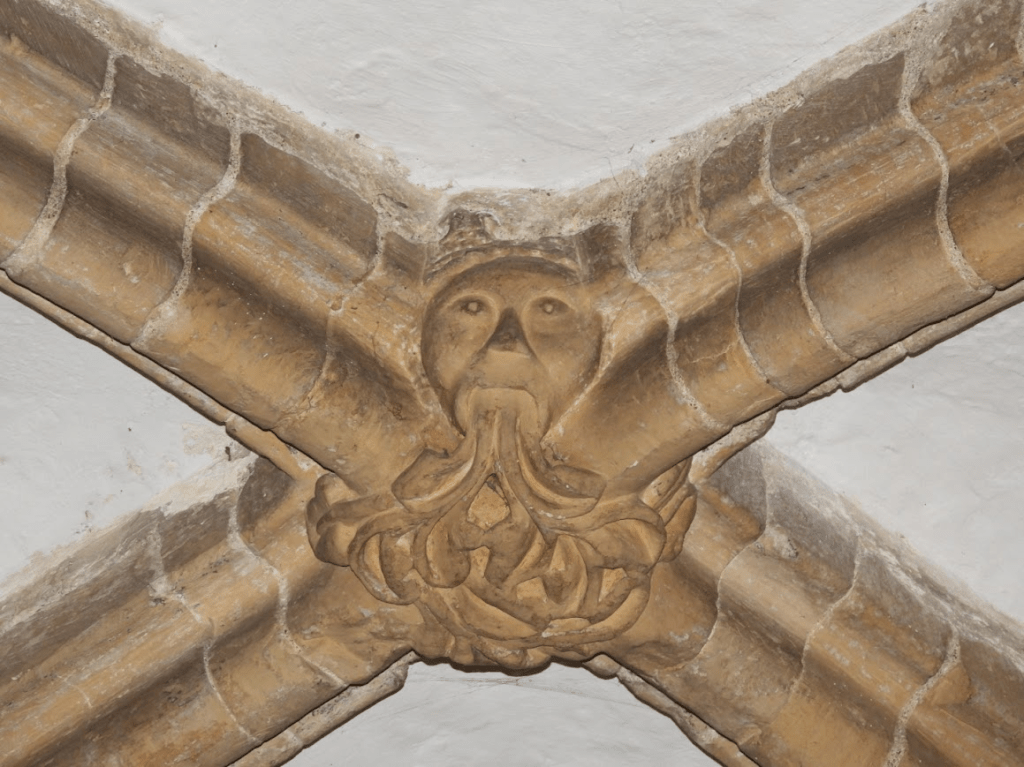
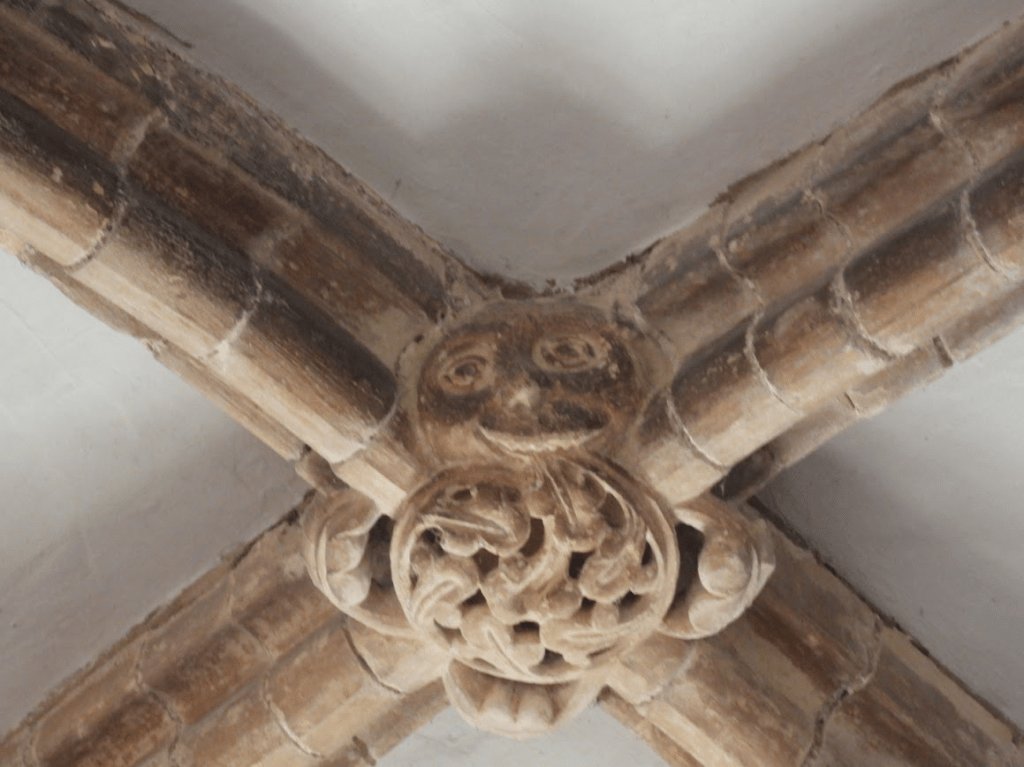
Green Men stir deep associations with the land and pre-Christian pagan worship of nature, but to use the phrase Gredn Men to describe these bosses is historically anachronistic as the label was coined by the folklorist Lady Raglan, Julian Somerset, in her 1939 article, “The ‘Green Man’ in Church Architecture.” Folklore, vol. 50, no. 1, 1939, pp. 45–57. JSTOR, http://www.jstor.org/stable/1257090. Accessed 4 Jan. 2026.

Whilst I would love to believe that foliate heads demonstrated a persistence of pagan beliefs (fertility cults etc.) in Christian spaces; I think it is much more likely that masons thought of foliate heads as Christian symbols. Kathleen Basford, a botanist and folklore historian, in 1978 book, The Green Man – the first academic monograph of Green Men – suggests that foliate heads had previous pagan symbolic significance; but when used in churches it is likely that foliate heads symbolize Christian themes. They represent a sort of vernacular Christianity according to Stephen Winick, a folklorist at the American Folklife Center of the Library of Congress, who suggests, in The Green Man, Vernacular Christianity, and the Folk Saint (Library of Congress blog 2022) accessed 04.01.23 that foliate heads symbolize the rebirth of Christ and the promise of eternal life; connection to the Tree of Life growing from Adam’s mouth and life’s cycle: the continuous cycle of nature, death, and renewal. Winick notes that more general sense, the idea of greenness, verdure, or viriditas has been part of Christian philosophy at least since the writings of Gregory the Great, specifically his treatise Moralia in Job, circa 580-595 CE. As Jeanette Jones has shown, Gregory posits greenness (viriditas) and plant growth in the book of Job to be a metaphor for the coming of Christ. It is probably this notion that underpins the use of green foliate ornamentation in Norman churches.

Foliate capitals of the quadripartite pillars supporting the cross of the choir, aisle and transects; thick so they can old up the tower above. Highly complex foliate forms made possible by the function of pillars: weight bearing.
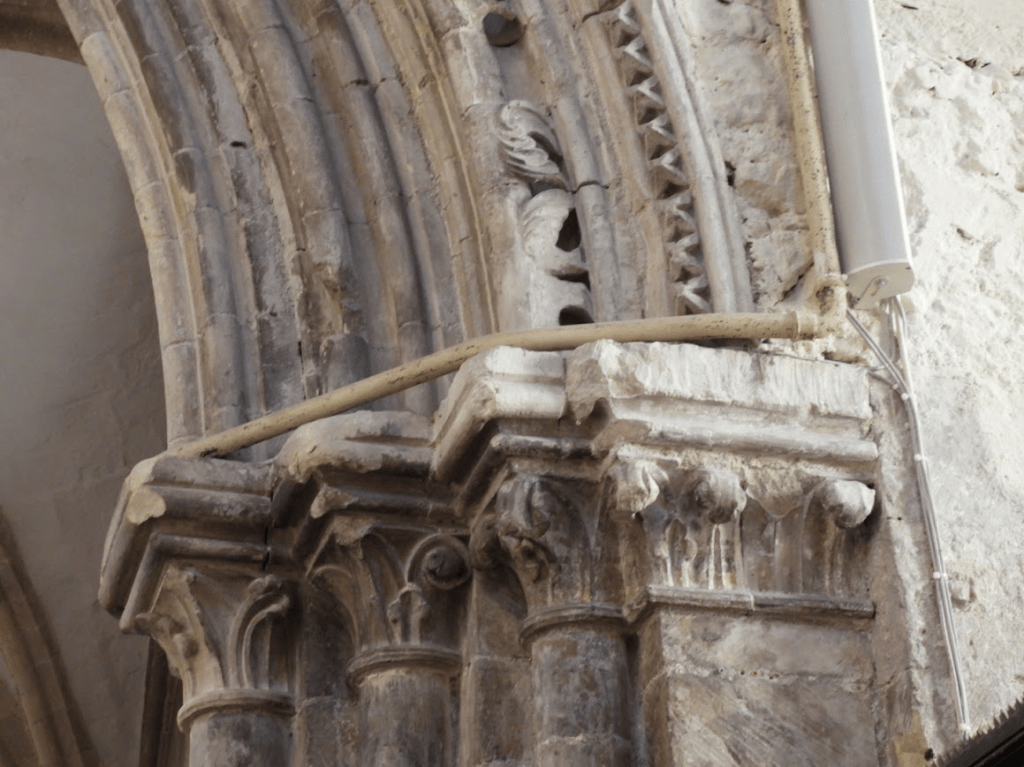
The south side of the Norman font depicts stars, another aspect of the natural world. English Romanesque, Norman, architecture and art is known for its robust construction and distinctive ornamentation, including geometric patterns like the zigzag (chevron) and stars or rosettes.
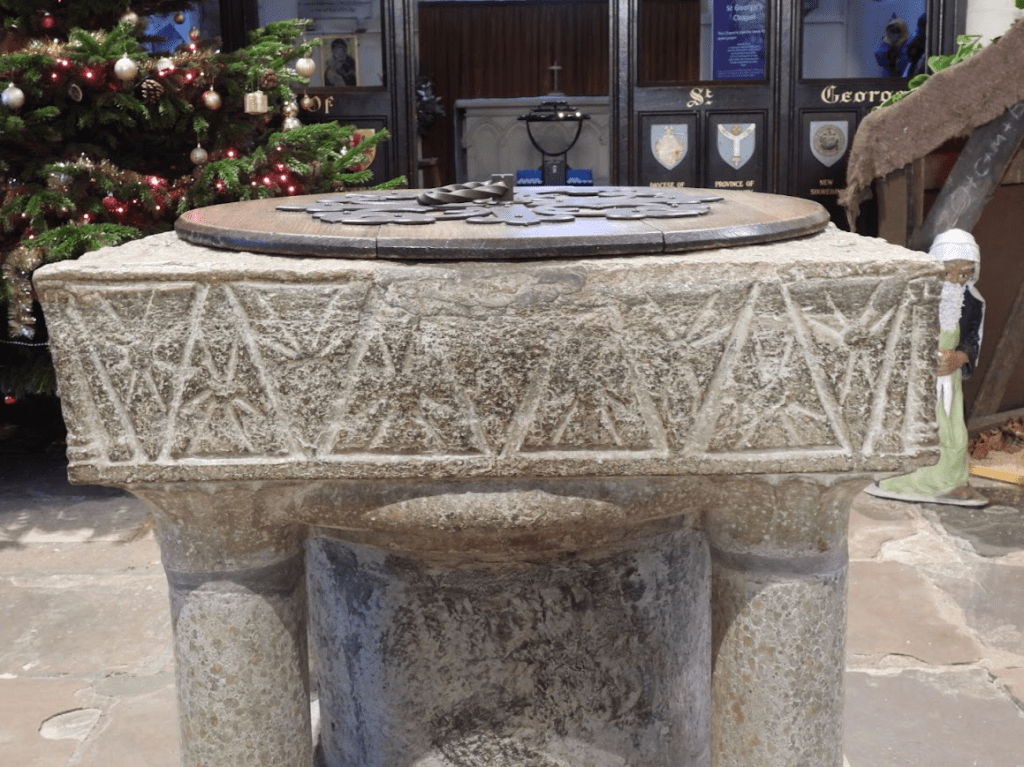
But perhaps these are more than just patterns? Patterns are seen on the doorways of village churches, throughout greater churches and in secular buildings. Pattern-making was typical of traditional art, while geometry, symmetry and order were considered by theologians to reflect heavenly perfection. It is suggested that geometric patterns, sometimes described as rosettes, diaper, zigzag, scale and arcading, were used in English Romanesque sculpture in a coherent series to build up a cosmographic diagram. The comprehensive building programme that followed the Conquest allowed the language of geometric patterns to be used more intensively in England than appears to have been the case on the Continent. Wood, R. (2001). Geometric patterns in English Romanesque sculpture. Journal of the British Archaeological Association154(1), 1-39. Abstract

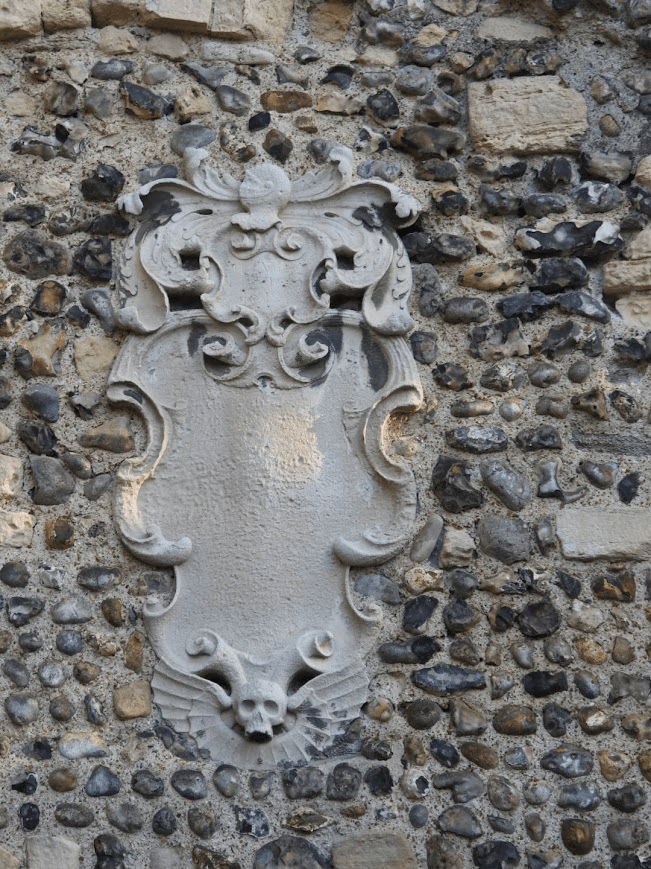
Whist foliage in the broadest sense symbolises life, in contrast, a memorial plaque (cartouche), on the west exterior wall of the church, signifies bodily death. The name of the person memorialised has eroded away by the salty westerly winds of the Channel. But its baroque style and the helmet suggest that this is a memorial to a now unknown C18 peer of the realm
Boxgrove Parish’s historic landscape & built environment; focusing on the painted & carved foliage in Boxgrove Priory Church of St Mary and St Blaise. 28.11.25

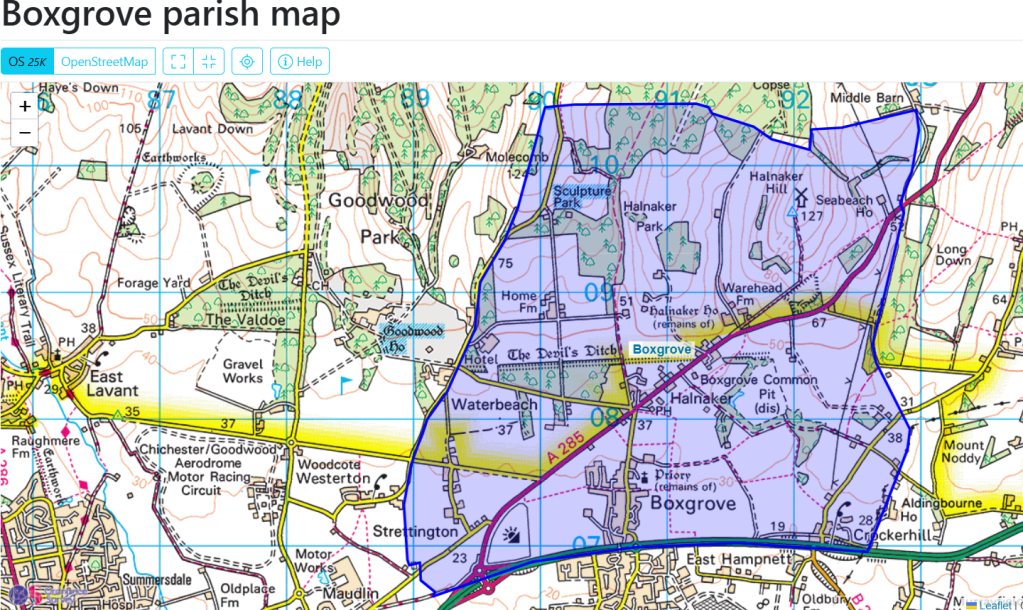
When you walk around the parish of Boxgrove, West Sussex, history collides in the landscape and the built environment; with extraordinarily diverse and interesting physical evidence of building and other human activity from the Neolithic, Iron Age, Roman Occupation, Norman, Plantagenet and Tudor periods.

The landscape of the Downs, itself formed by human activity – human introduced sheep grazing – is stunning beautiful; as are the ancient chestnuts of the Halnaker medieval Deer Park (which gets its own post). The importance of sheep to the creation of the South Downs, and the medieval economy of Sussex, is referenced in the name of the Boxgrove Priory Church: St Blaise is the patron saint of wool carders.

Sheep were vital to the medieval economy of Sussex, providing the primary raw material for the region’s thriving wool and cloth industry, which was the backbone of the national economy. Beyond wool, sheep provided other valuable resources like meat, milk, and manure, and their management was integral to the agricultural practices that made the area one of the wealthiest in England. P.F. Brandon (1971) Demesne Arable Farming in Coastal Sussex during the Later Middle Ages  Agricultural History Review 

The pinnacle of its built environment is the Plantagenet and Tudor Boxgrove Priory Church with the De la Warr Chantry being of international art historical importance.

It is a magical church full of echoes of French influence along the Sussex coast. Its crossing is a mystery of light and dark and the great chancel is alive with Tudor roses and heraldry. The De La Warr chantry contains beautiful early French motifs from a Book of Hours. These must be some of the best renaissance carvings in any English church. They make Boxgrove very special. Sir Simon Jenkins

There are later building of historical importance too, specifically the 18th century tower Wind Mill on Halnaker Hill (1740) and Sir Edwin Lutyens’s Halnaker Park, built in 1938. 

From the Saturday Walkers Club maps

On Halnaker Hill is a neolithic (10000 BC – 2200 BC) causeway enclosure. Below Halnaker Hill. is the late Iron Age Devil’s Ditch; it dates probably from the late Iron Age (ca. 100 BC – AD 43). The Ditch terminates where it meets Stane Street. The Roman Stane Street may have been built shortly after the Devil’s Ditch in the first decade of the Roman occupation of Britain (as early as 43–53 AD). There was an Anglo-Saxon church at Boxgrove (recorded in the Doomsday Book) but there are no physical remains of it. Over it was built an early Norman Benedictine Priory, completed ca. 1170.; its nave is now ruined but the Priory Church of St Mary and St Blaise remains, with the addition of a C14 porch and a C15 vestry, and the addition of outstandingly beautiful C16 C De la Warr chantry (ca 1530).

In the north of the parish of Boxgrove is the Halnaker medieval deer park (grant of land 1283.) with the ruins of the C14-C15 fortified Manor House of the De La Waar family. A very noticeable feature of the landscape is the outstanding cluster of ancient Sweet Chestnut trees in the medieval deer park and the ruins of Old Halnaker House built by the de Haye family in the thirteenth century, see The degradation of the ancient Sweet Chestnuts trees of Halnaker Park, due to change of land use from pasture to intensive arable farming. 28.11.29 for more on the chestnuts and the house.

simelliottnaturenotes.blog/2025/12/01/the-degradation-of-the-ancient-sweet-chestnuts-trees-of-halnaker-park-due-to-change-of-land-use-from-pasture-to-intensive-arable-farming-28-11-29/

Ruins of the De Lar Warr Manor House

House Sweet Chestnut

One of the ancient Sweet Chestnuts; now is very poor condition.

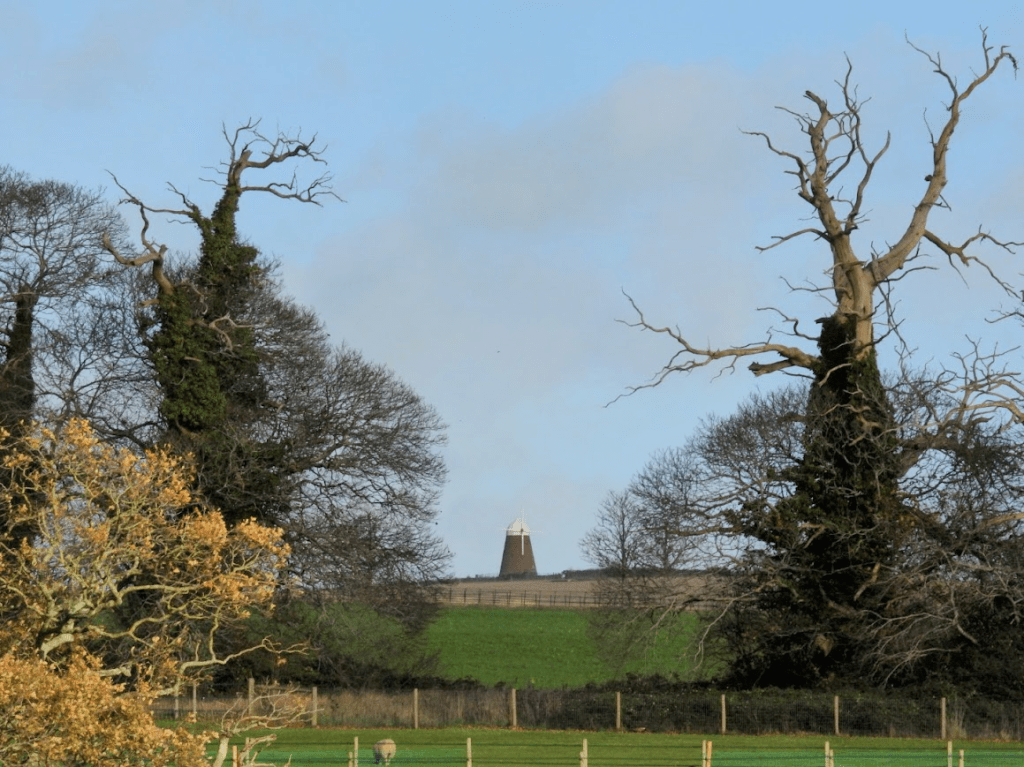
Halnaker Hill’s Windmill from the Deer Park – in this perspective its looks dwarfed by the ancient Sweet Chestnuts!

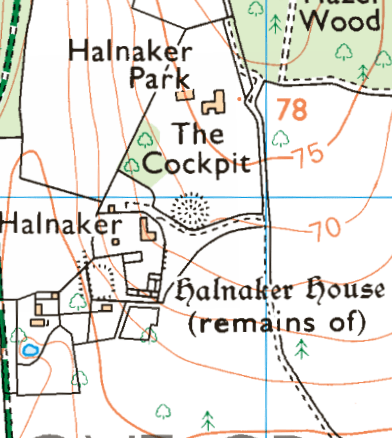
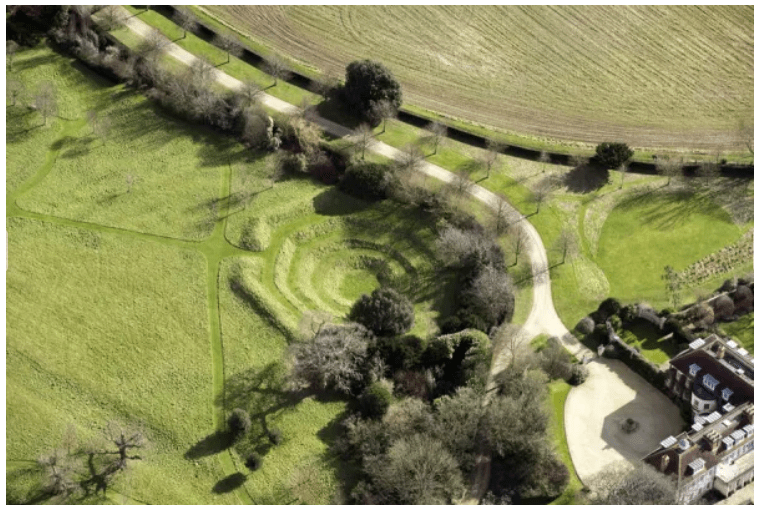
A fascinating man-made feature of the parish is the octagonal reservoir in the Halnaker House. This is not accessible publicly. The OS map calls it a cockpit; but it may not have been.

Photograph from Historic England

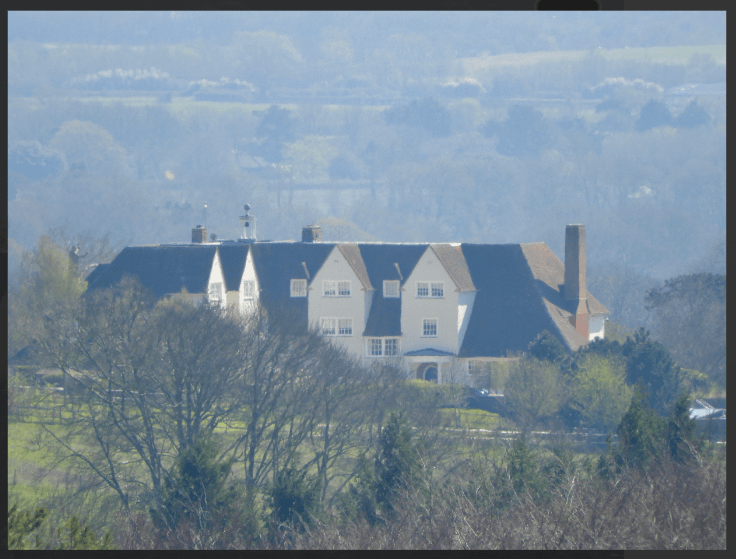
A later and important part of the landscape is house of Sir Edwin Lutyens, built in 1938, see Historic England Halnaker Park but this listed building is invisible from roads and public footpaths and is hidden from view by the trees of the medieval deer park in which it is located; and it is private.

Lutyen’s Halnaker Hall, photo by Robert Palmer on Historic England listing on-line

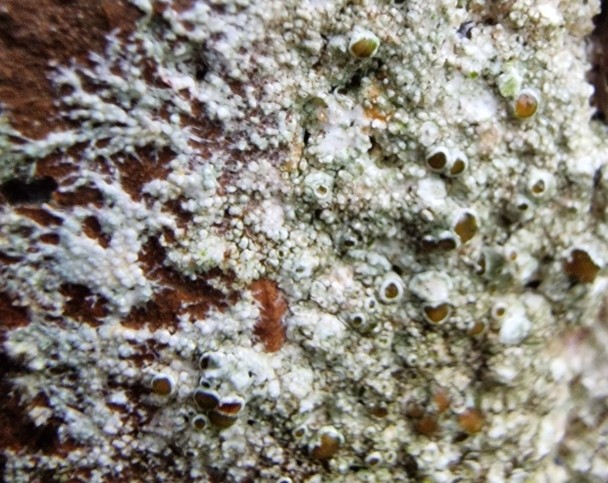
The occasion of the Second World War added to the historic melange of Boxgrove Parish’s Halnaker Hill concrete and octagonal brick structures which formed the base of searchlight emplacements. All that remains of these structures is parts of the bases; this are particularly ugly but are of historical importance and are listed by Historic England However, the brick and concrete does provide a substrate for some beautiful lichens e..g the very common Lecanora campestris which I photographed there on 07/12/2024 

There are some interesting sixteenth to nineteenth century vernacular houses in the parish; these are excellently described, with photographs, by John Bennett and Beryl Bakewell, available at January 2021 – Boxgrove and Halnaker Listed properties

Halnaker Hill Causeway Enclosure

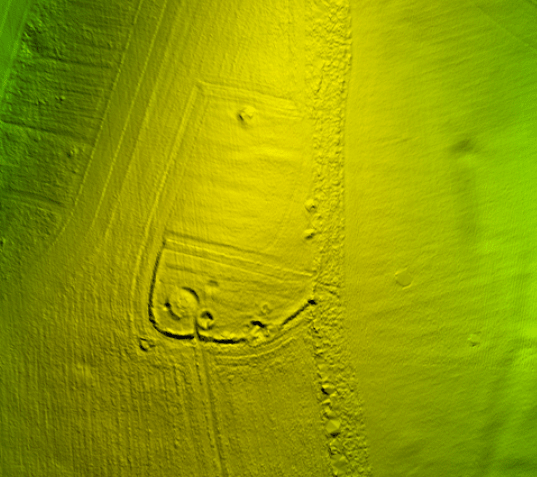
The oldest feature of the landscape is the neolithic Causeway Enclosure on the top of Halnaker Hill, close to the Halnaker Mill. Between 50 and 70 causewayed enclosures are recorded nationally, mainly in southern and eastern England. They were constructed over a period of some 500 years during the middle part of the Neolithic period (c.3000-2400 BC) but also continued in use into later periods. They vary considerably in size (from 0.8ha to 28ha) and were apparently used for a variety of functions, including settlement, defence, and ceremonial and funerary purposes. However, all comprise a roughly circular to ovoid area bounded by one or more concentric rings of banks and ditches. The ditches, from which the monument class derives its name, were formed of a series of elongated pits punctuated by unexcavated causeways. Causewayed enclosures are amongst the earliest field monuments to survive as recognisable features in the modern landscape and are one of the few known Neolithic monument types. Due to their rarity, their wide diversity of plan, and their considerable age, all causewayed enclosures are considered to be nationally important. Historic England Causeway Enclosure, World War II searchlight emplacements and associated remains on Halnaker Hill

LIDAR image of the Causeway Enclosure, posted by Grahame Hawthorn on the posts and comments of the Historic England website

Devil’s Ditch

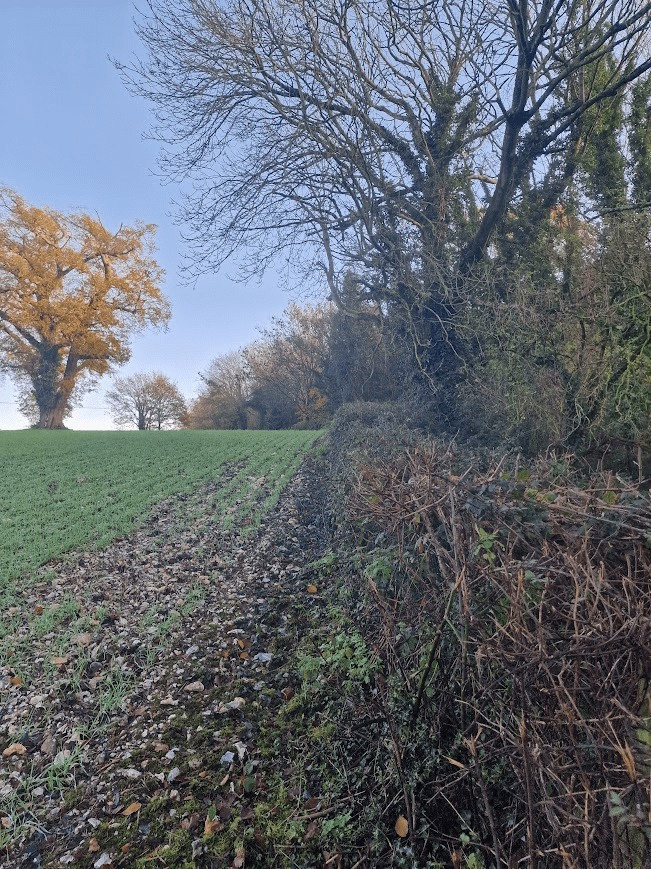
The Devil’s Ditch consist of a banked ditch, the bank being wooded mostly with Pedunculate Oak and Field Maple

The Devil Ditch forming the south boundary of the Halnaker Deer Park:

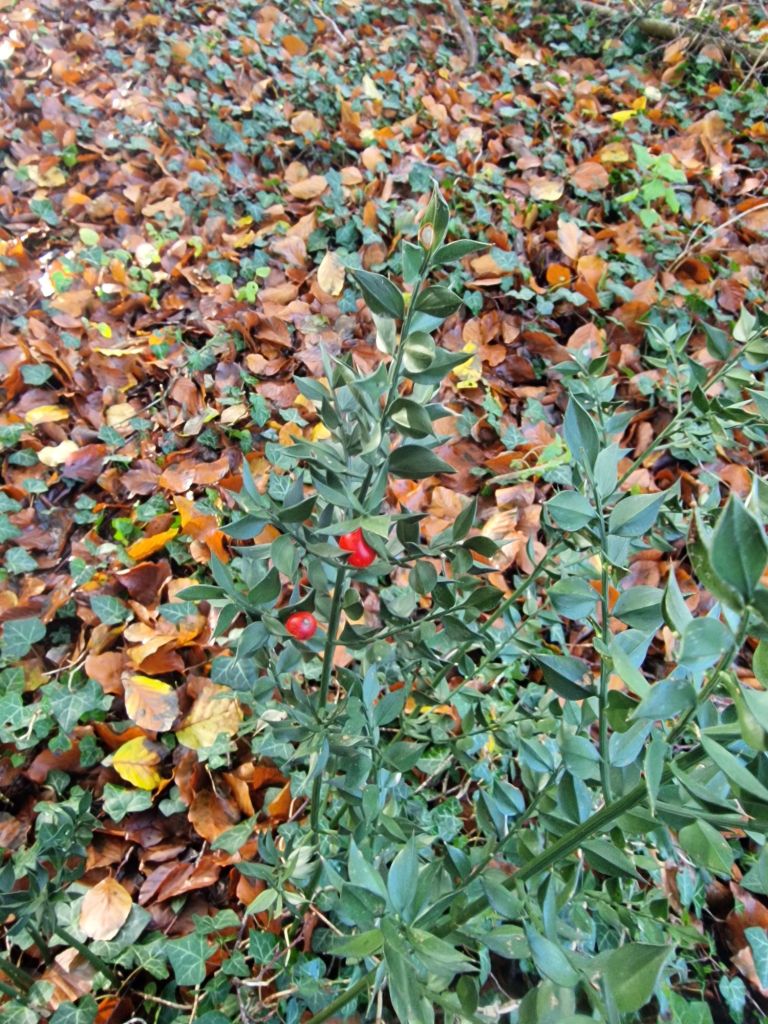
Butchers Broom in the ditch.

The bank and ditch of the Devil’s Ditch is continuously wooded mostly with Pedunculate Oak and Field Maple. Butcher’s Broom is an ancient woodland indicator species ; so the Devil’s Ditch has biological importance as well as historic importance,

The earthwork is denoted by a bank and a ditch, which grows fainter as it heads east. It runs west to east, forming a boundary at the northern edge of Redvins Copse, passes north of Oak Cottage and Stanefield house before it ends at Stane Street Roman Road. At the eastern end it forms the southern boundary to Halnaker Park. Towards the western end, the bank is about 2.5m above the bottom of the ditch, which is about 6m wide. At the eastern end, near Stane Street, the ditch is wide and shallow indicating that it may have been recut at a later date and possibly used as an early trackway.

The Devil’s Ditch in Sussex has been documented by antiquarians since at least the 18th century. It is part of a group of linear earthworks on the gravel plain between the foot of the South Downs and Chichester Harbour. The entrenchments run from Lavant to Boxgrove and appear to enclose the area of the coastal plain to the south. It has been suggested that these marked out a high status, proto-urban tribal settlement (or ‘oppidum’) preceding the Roman invasion. The Devil’s Ditch is thought to date to the Late Iron Age (about 100 BC – AD 43) but was recut and extended in places during the medieval period. The name of the entrenchment is derived from a local tradition, which holds that the ditch was the work of the devil in an attempt to channel the sea and flood the churches of Sussex. Historic England Devil’s Ditch, section extending 1730yds (1580m) from Stane Street to NW end of Redvin’s Copse

Stane Street and the Halnaker “Tree Tunnel”

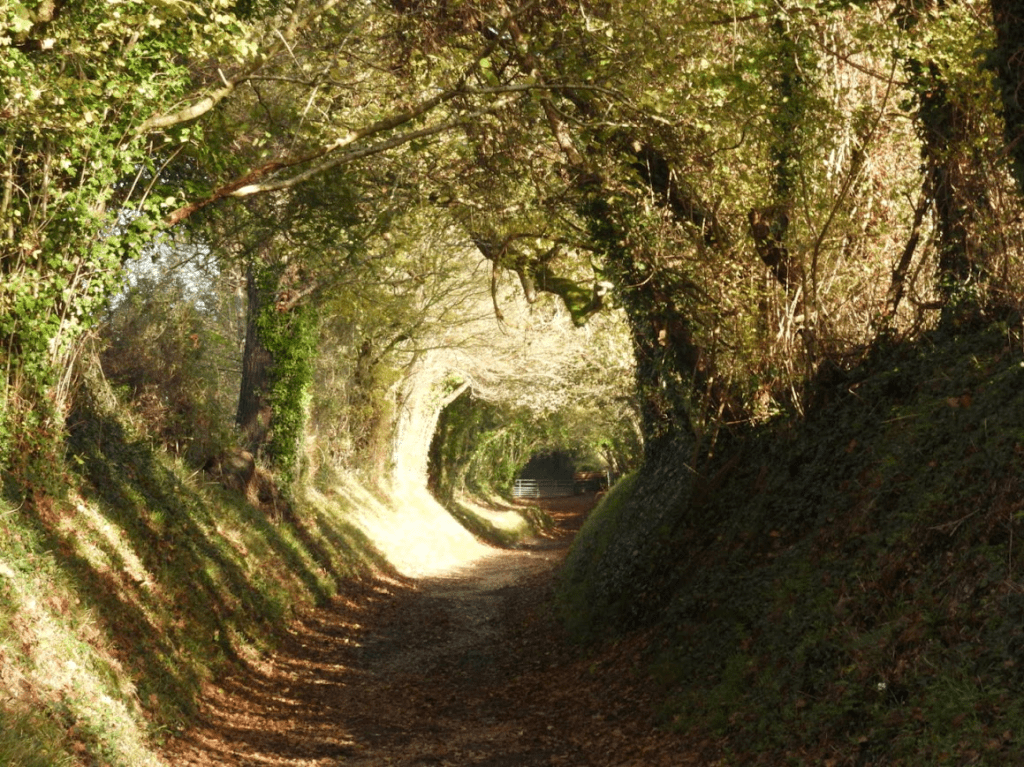
Stane Street linked London (Londinium) to Chichester (Noviomagus Reginorum); and runs through the South Downs. Stane is an old spelling of “stone” (Old Norse: steinn) which was used to differentiate paved Roman roads from muddy native trackways. At Halnaker Hill, Stane Street becomes a “tree tunnel”; which is famed on social media, with may photographs like mine below. There are far better photos of the tree tunnel than mine; just Google Halnaker Tree Tunnel and you will see them. Whilst the Halnaker Tree Tunnel is beautiful, from my experience of walking in Sussex there are far more beautiful and historically significant sunken trackways (hollow-ways) in Sussex than this tree tunnel; but for some reason Halnaker Tree Tunnel has “gone viral”; which shows how social media can distort public attention to what is important in the country side.

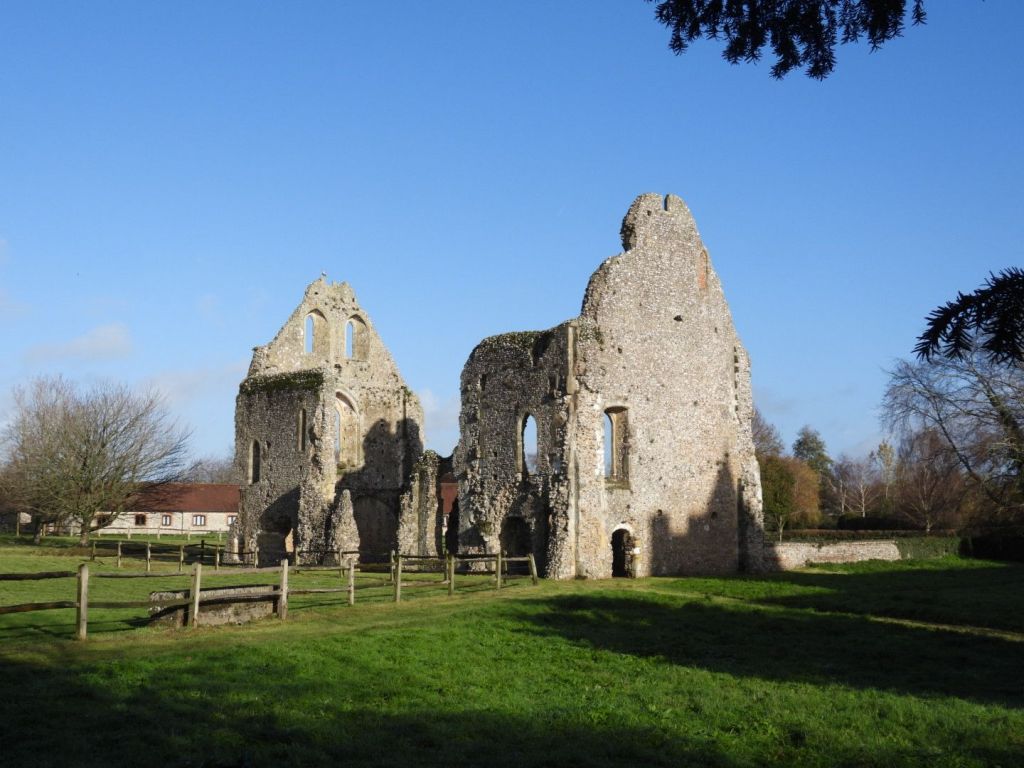
Remains of the Priory

The small Benedictine priory of Boxgrove in West Sussex was founded in about 1107, originally for just three monks. In a beautiful setting at the foot of the South Downs, the principal remains include a fine two-storey guest house, roofless but standing to its full height at the gable ends. The eastern parts of the priory church became Boxgrove’s parish church after the Suppression of the Monasteries. English Heritage Boxgrove Priory

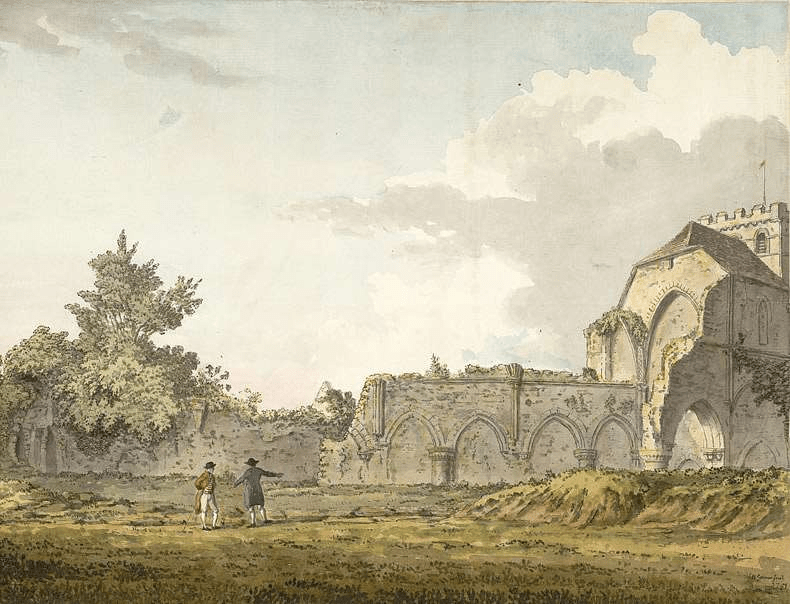
The importance of the ruins as a picturesque spectacle drew tourists, artist and antiquarians throughout the 18th and 19th century; perhaps enhanced by William Gilpin, who in the eighteenth century wrote essays that explored the picturesque as a new aesthetic concept

Starting in the 18th century, the history of the priory and its ruins attracted the attention of antiquarians and artists. The latter included Samuel and Nathaniel Buck, who in 1737 published an engraving of the church and surviving portions of the roofless monastic buildings. English Heritage Boxgrove Priory

Below, a watercolour view of the ruins of the nave of Boxgrove Priory, seen from the churchyard, by Samuel Hieronymous Grimm, 1781

Samuel Hieronymus Grimm (18 January 1733 – 14 April 1794) was an 18th-century Swiss landscape artist who worked in oils (until 1764), watercolours, and pen and ink media. Grimm specialised in documenting historical scenes and events; he also illustrated books such as Gilbert White’s The Natural History and Antiquities of Selborne. Tate Samuel Hieronymus Grimm

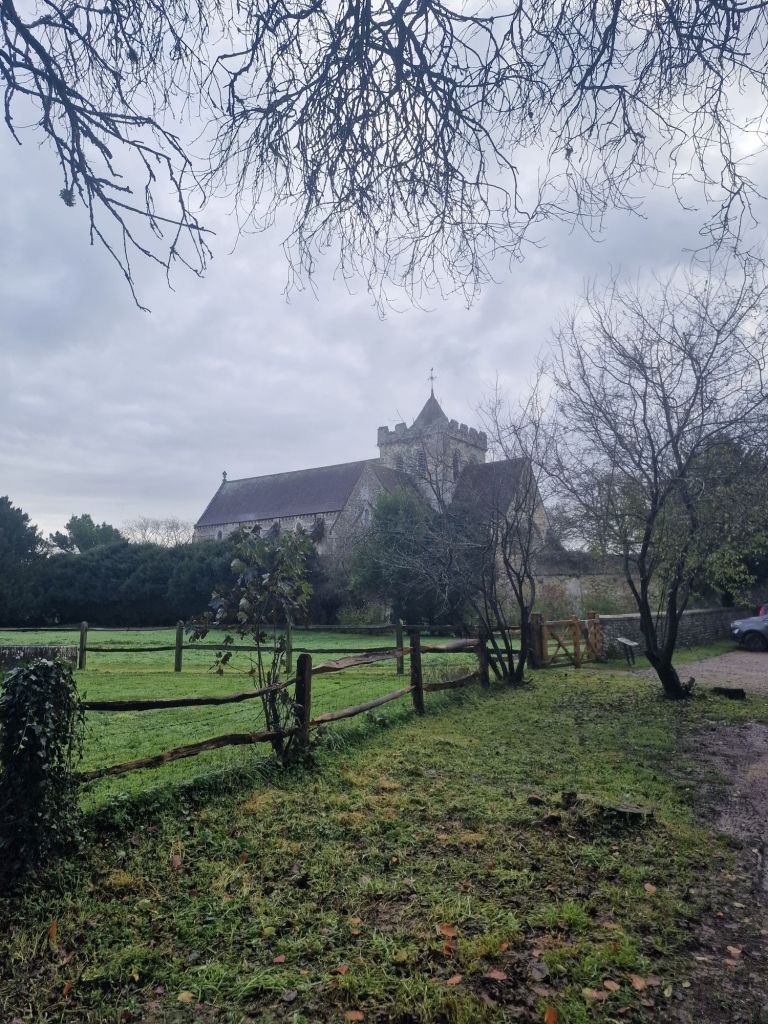
Priory Church of St Mary and St Blaise, Boxgrove.

For an in-depth history of the Priory and Priory Church see British History Online Boxgrove

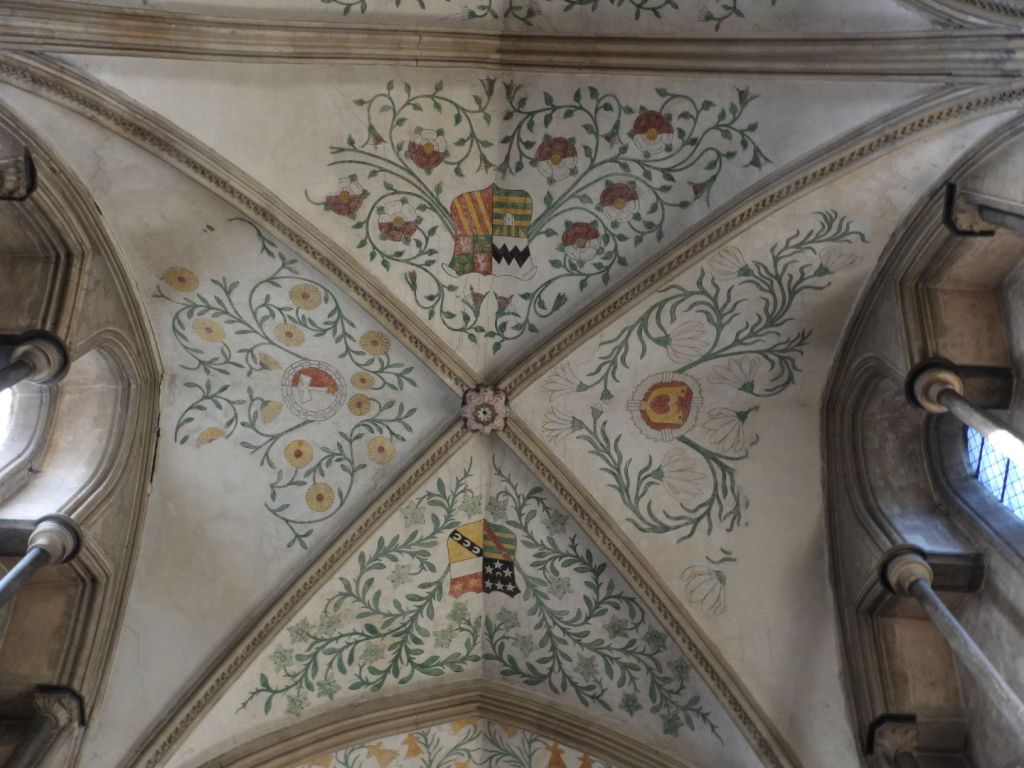
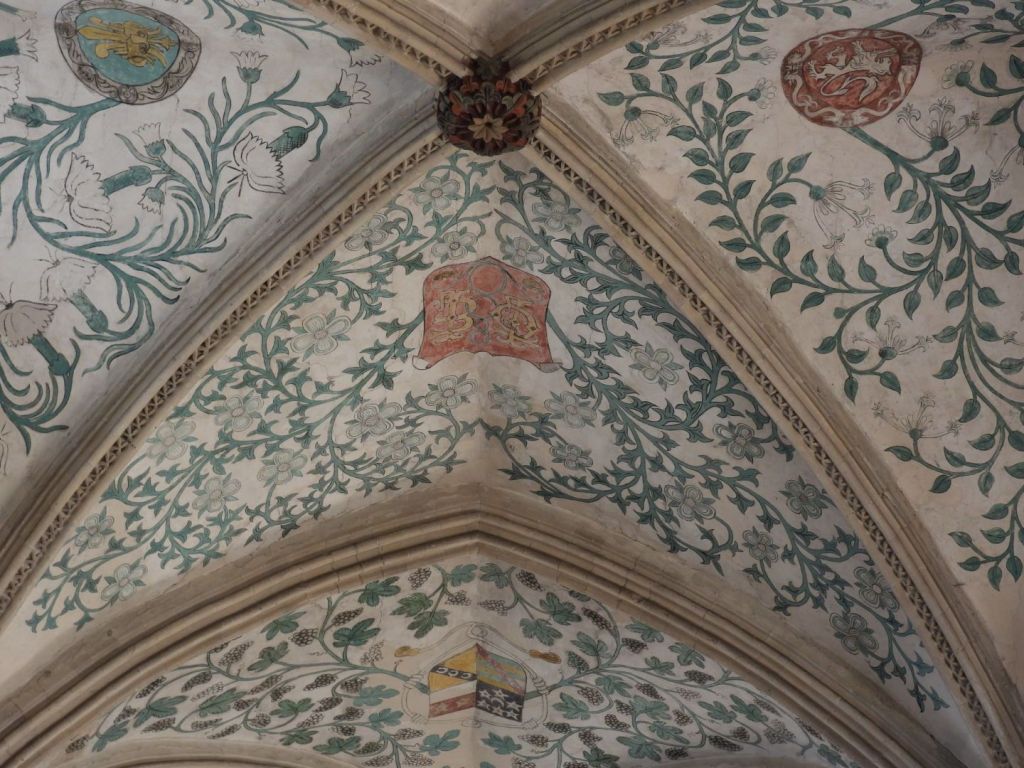
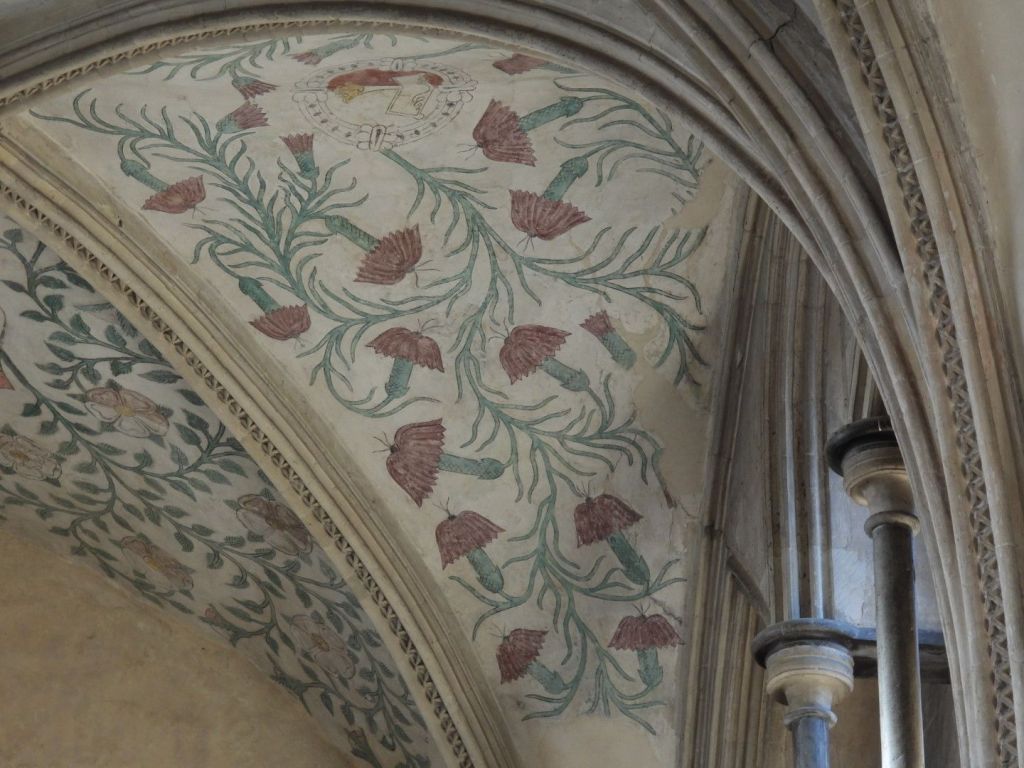
The decorations by Lambert Barnard of the choir vault and the sculpture of De La Warr Chantry are of international art-historical importance.

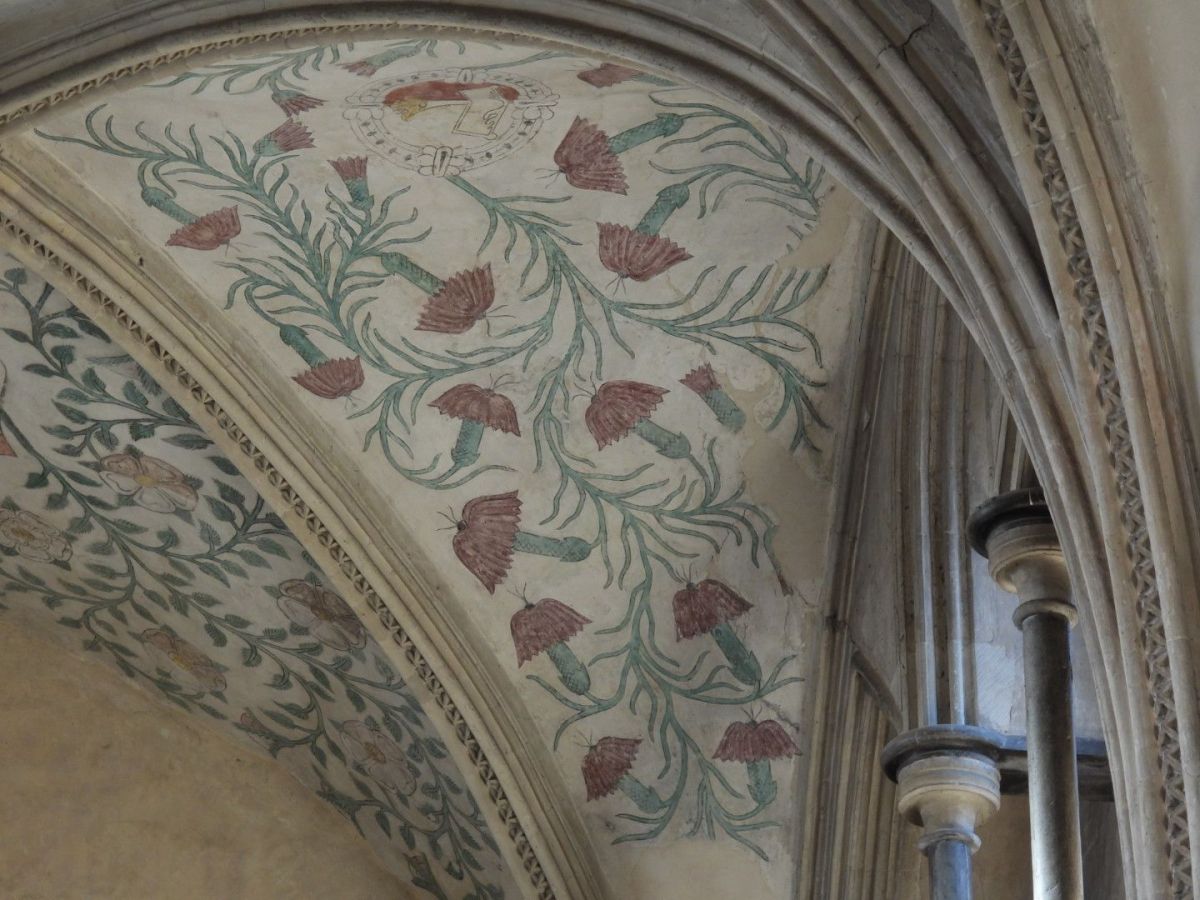
On the choir vault there are decorations by Lambert Barnard for Lord de la Warr (Croft-Murray p112), probably linked with his chantry.  Naturalistic foliage, interspersed with the arms of de la Warr and relatives. Sussex Parish Churches Boxgrove Priory Church. Lambert Barnard (d1567/68) did much work for Bishop Sherburn (1508-38), notably in Chichester cathedral.  Little is known of his life, but stylistically, if not by birth, he had Netherlandish links. E Croft-Murray: Lambert Barnard: an English Early Renaissance Painter, AJ 113 (1957) pp 108-25 Sussex Parish Churches Architects and Artists B

It is hard to know what particular species the flowers depicted on the C16 ceiling painting, commissioned by Thomas West, the 9th Lord de la Warr, are intended to be. They are described as  a “delightful mix” of various local plants; but I think it more likely that they are a symbolic representation of the importance of flora to Thomas Wests beliefs; with their decorative pattern being more important than close observation of actual flowers. Botanical accuracy in botanical art was a feature of 17th and 18th century still lives and botanical illustration for florae. The flowers on this 16th century ceiling were probably not meant to be accurate representations of local plants, even if they were inspired by them; they are more symbolic than representational. The symbolic religious use of flowers as symbols of God’s creation was common in medieval churches, as I reminder that all of creation praises God, and perhaps representing the Garden of God, Eden, or the beauty of heaven. Considering that 9th Baron De La Warr was expecting to be buried in this church, it is likely they he wanted them to represent his ascent into heaven.

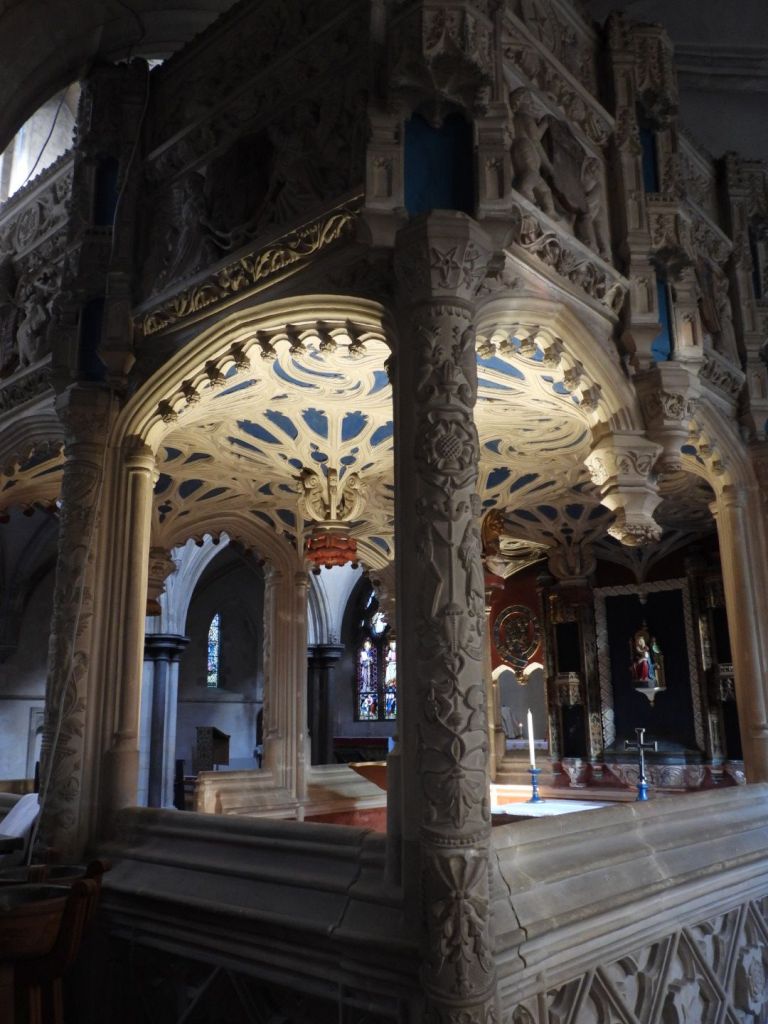
The chantry in the choir was built by Thomas, Lord de la Warr for himself and his wife between 1530 and 1535 and led to a major internal alteration.  …  [A chantry is a chapel or area within a church where a priest who would say daily masses for the donor’s soul] The chantry is more a piece of architecture than a monument in any conventional sense.  Ironically, …  de la Warr was buried at Broadwater in 1554.  This was probably because he fell out of favour and was compelled by the King [Henry VIII] to exchange the manor of Halnaker in Boxgrove for Wherwell in Hampshire in 1540 and thus had no further link with Boxgrove, …. Added to this was the abolition of chantries in 1547, which meant that by the time of de la Warr’s death this could only have functioned as a tomb. 

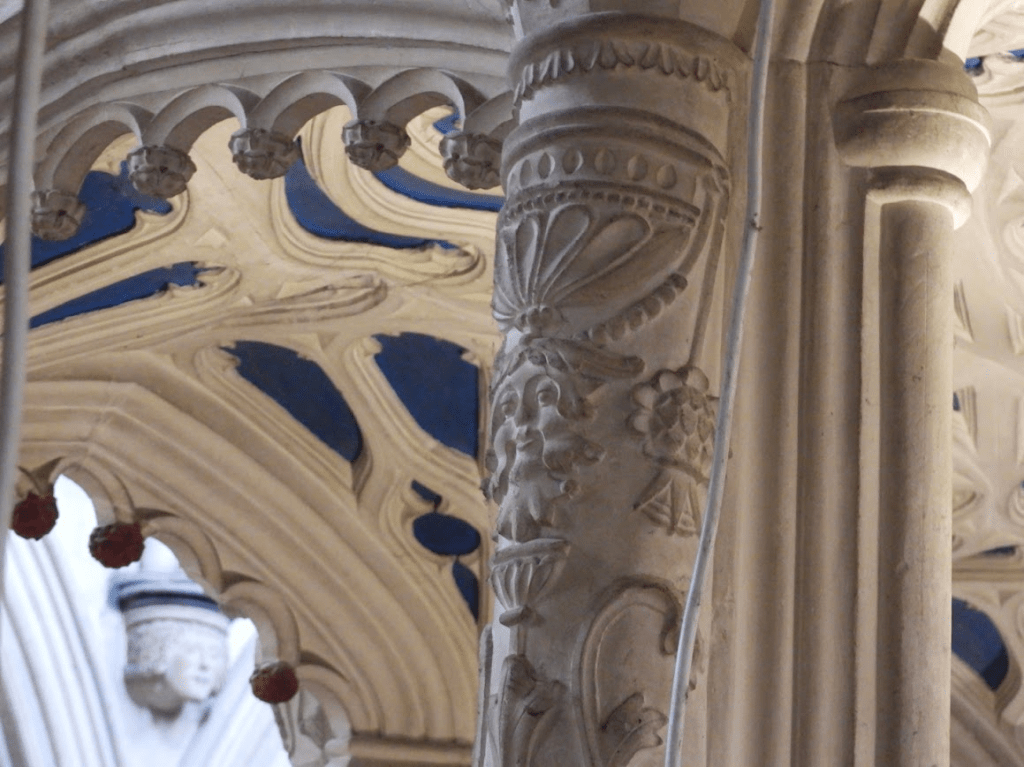
The plan is rectangular with two bays on the long sides, each with pairs of cusped arches separated by pendants, which are also present on the vault inside – the short ends have none.  The base is essentially gothic, decorated with shields within lozenges.  The upper part, especially the corner-shafts and those between the bays, is covered in Renaissance ornament of shallow incised figures and foliage, some based on Paris woodcuts of c1500  The canopy also combines such decoration with gothic elements – pairs of angels and putti hold shields with straight heraldic decoration.  Tiered niches for statues, if ever filled, are now empty.  Inside, the reredos has more empty niches, either side of a blank space intended for a carving.  Each side of the reredos is an opening, of which that to the main nave of the church served as a squint.  The purpose of the recess to the south was probably to provide symmetry.  A small opening on the south side but lower down is too small for a piscina and its purpose is uncertain.  The painted interior is mostly restored and the iron gates survive. Sussex Parish Churches Boxgrove St Mary and Saint Blaise

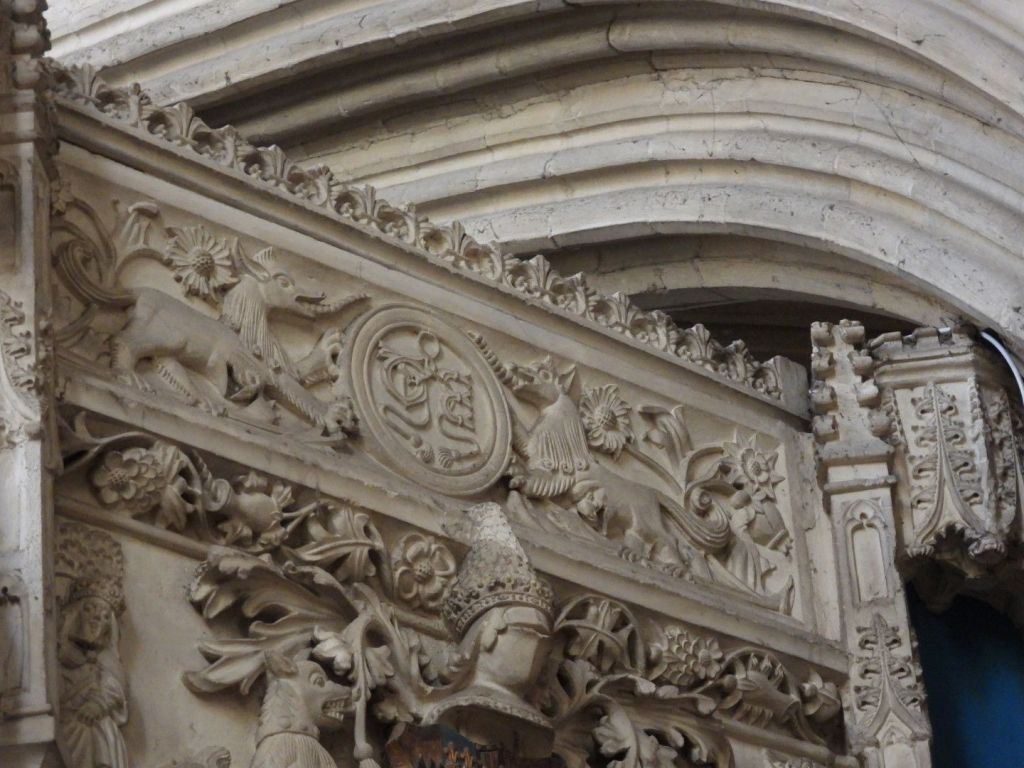
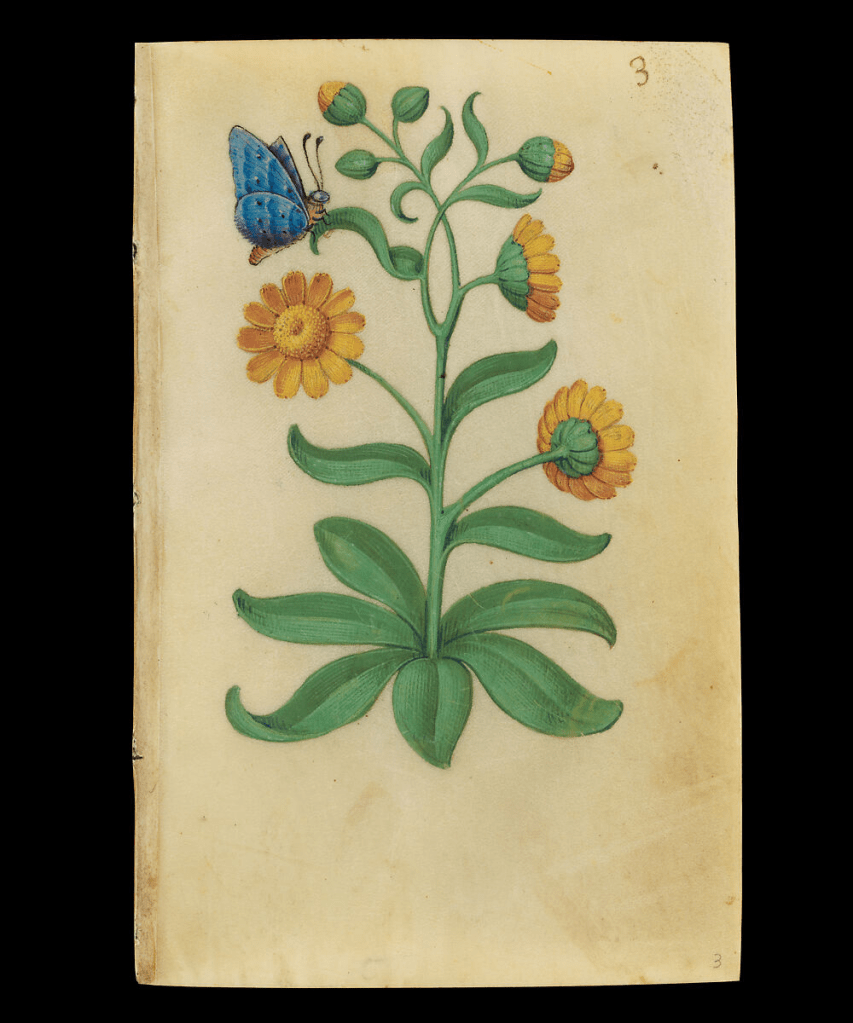
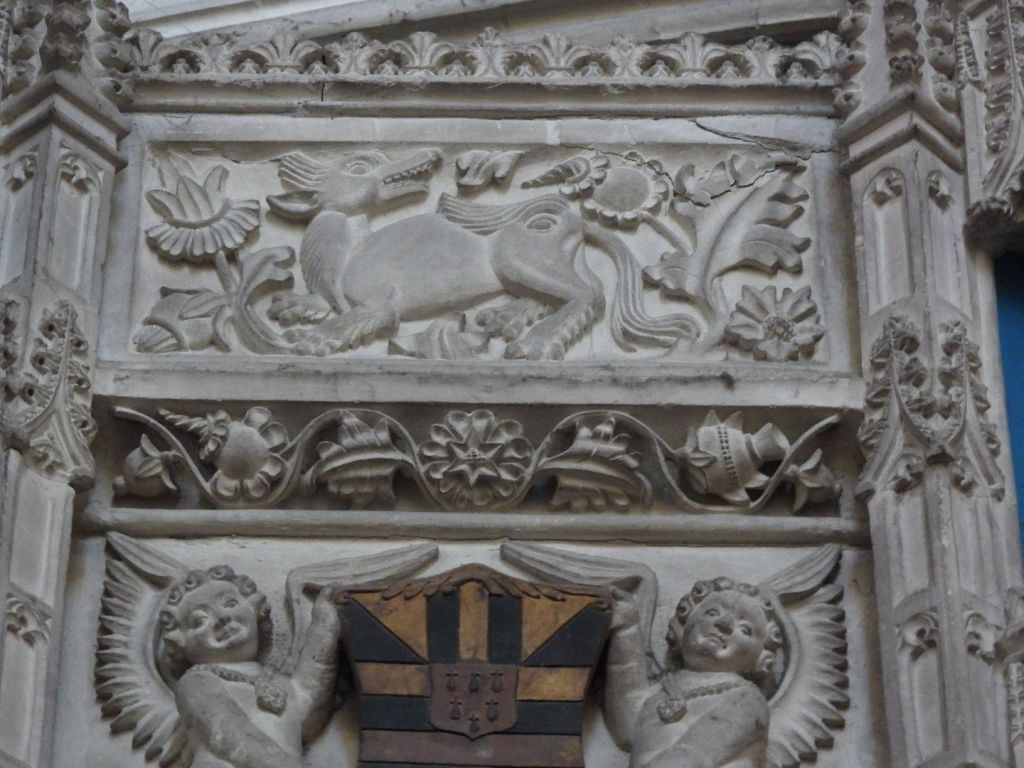
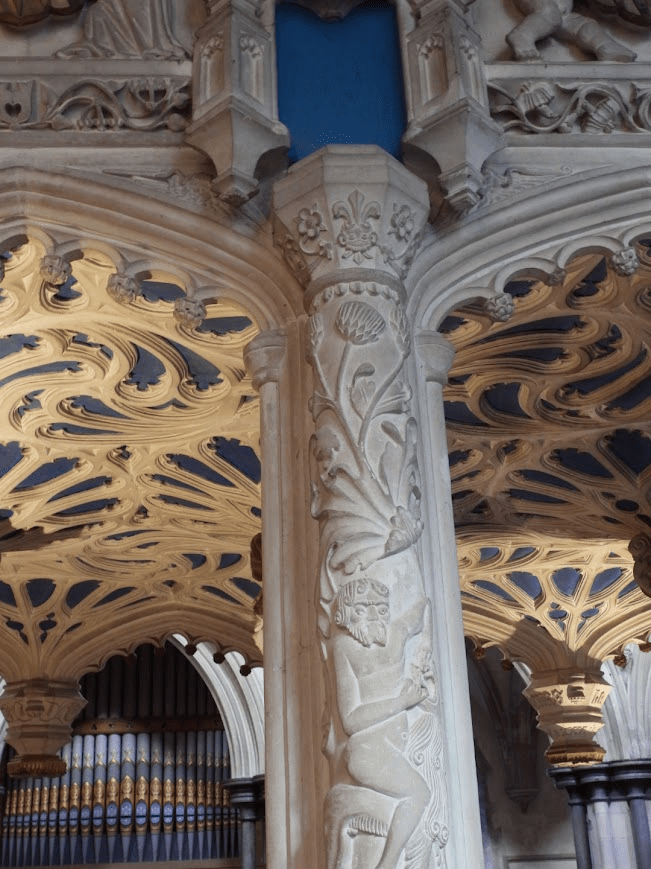
Foliage is a key aspect of the iconography of the chantry It is believed that the animals (real and fictious) come from a French Book of Hours (which one not known); but there are other sixteenth century resources that could be a source for the sculptured imagery e.g. Master of Claude de France’s Book of Flower Studies (ca. 1510–1515); some of the studies can be viewed on-line from the Metropolitan Museum of Art collection in New York see Book of Flower Studies Master of Claude de France ca. 1510–1515

The flowers above these imaginary beasts look very similar to the marigolds

in Master of Claude studies image from: https://www.metmuseum.org/art/collection/search/823979

but that does not mean that the anonymous sculpture of the De La Warr used this study as a pattern, as images of all flowers in the 16th century are very stylised; the idea could have come from many manuscripts depicting flowers

The marigold was nicknamed “Mary’s Gold” due to several legends linking it to her. One story claims that when Mary’s purse was stolen on the flight to Egypt, all the thieves found were petals, so early Christians left marigold petals around her statues as a substitute for coins. Jonathan Hoyle, Society of Arts, Medieval Natural Symbols

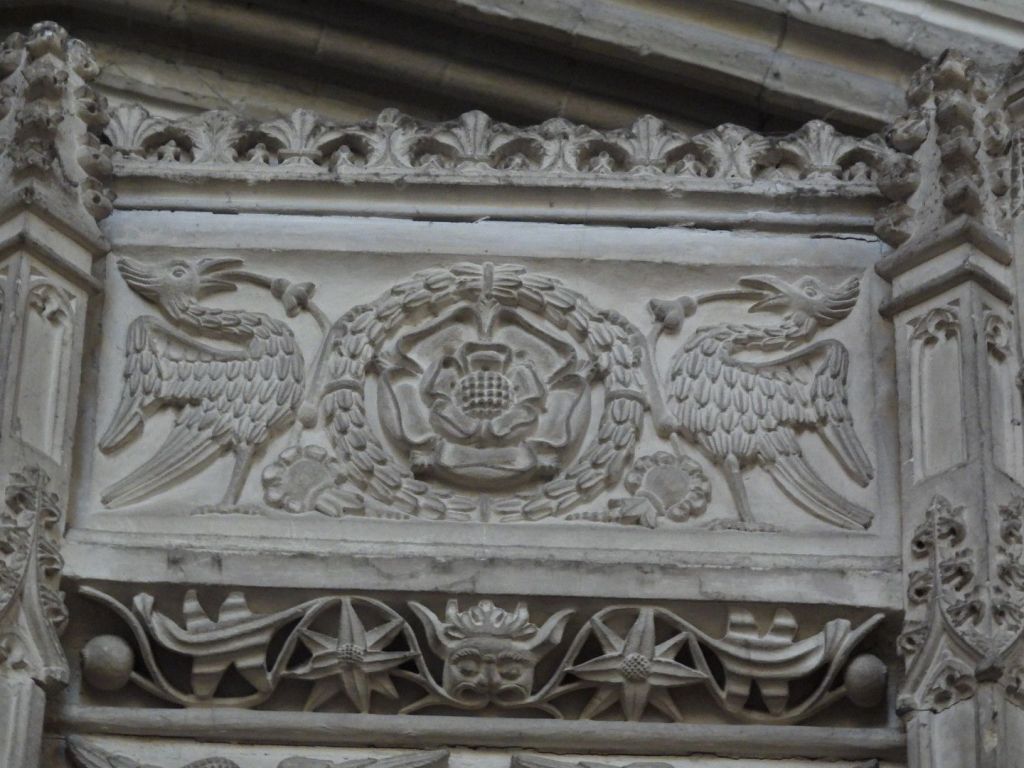
Heaven is often depicted as a return to the garden of Eden in Medieval and Early Modern manuscripts. So the intent of the artist in including much foliage in the chantry may have been to suggest that heaven was where Thomas, Lord de la Warr would go after death. The Tudor roses on the Chantry show Thomas’s allegiance to Henry VIII; opponents of Henry often had their earthly lives shortened by judicial or extrajudicial execution

The flowers on to the left of this beast may be chicory

they are similar to Master of Claude’s chicory. Pre-reformation church sculpture was typically polychrome, often painted painted in gaudy colours but the colour wears away over the years; the colour of sculptured plants would make it easier to assign to possible specific botanical species

The plant’s ability to thrive along roadsides in difficult, disturbed soil, coupled with its strong, deep taproot, made it a symbol of Christian perseverance and resilience in the Middle Ages. The plant’s steadfast nature, even through cold winters, linked it to the endurance of faith. Riklef Kandeler, Wolfram R. Ullrich, Symbolism of plants: examples from European-Mediterranean culture presented with biology and history of art: NOVEMBER: Chicory, Journal of Experimental Botany, Volume 60, Issue 14, October 2009, Pages 3973–3974, https://doi.org/10.1093/jxb/erp248

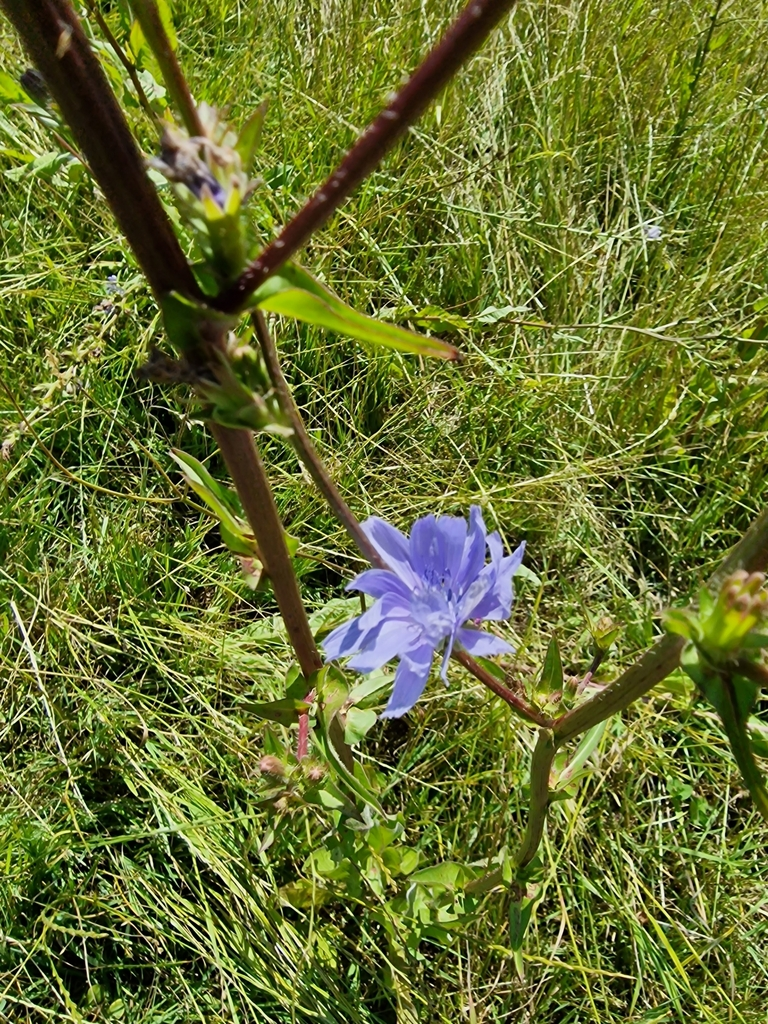
Here is some Chicory I photographed at Singleton; close by Boxgrove, in 2024. Chickweed was grown for its seed; and it is common in Sussex as a arable weed.

Though C. intybus was formerly regarded as a native, at least in England and Wales, doubt is now cast on that status in most counties, and it is almost always treated as a relic of cultivation. Historically, it was cultivated for its seed (subsp. intybus) British and Irish Botanical Society Plant Atlas 2000 It would have been common in the arable fields around Boxgrove in the C16

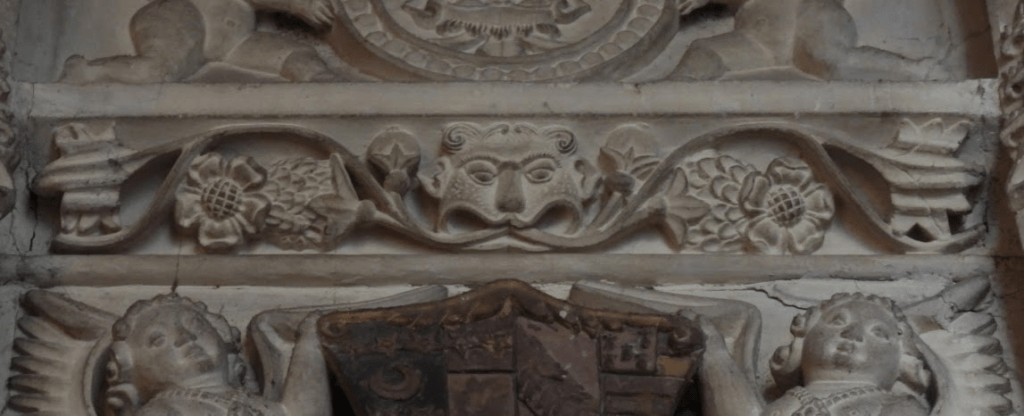
There are foliate heads. often called Green Men;, carved in the chantry, although the second of these images looks more like a foliate head of an animal or mythical beast. Lady Raglan only coined the name Green Men in 1939; it has no historical heritage

There is voluminous writing on the Green Man motif representing a pagan mythological figure, as proposed by Lady Raglan in 1939 Raglan, Lady. “The Green Man in Church Architecture.” Folklore, vol. 50, no. 1, 1939, pp. 45–57. doi:10.1080/0015587x.1939.9718148 but her view is not supported be the evidence. Many folklorists believe that foliate heads indicate a perseverance of pagan beliefs after the Christianisation of England. However, as De La Warr had gone to great expense to have the chantry built and have priests pray for his soul (although did not happen because of Henry VIII’s reformation) he would hardly have risked his salvation with what might have been be perceived as pagan imagery. It is far more likely that foliate heads in churches were Christianised symbols of resurrection, as I J B S Corrigan (2019) points out in The Function And Development Of The Foliate Head In English Medieval Churches. Unpublished theses, University of Birmingham accessed 30.11.25 https://files.core.ac.uk/download/pdf/323305511.pdf, which includes consideration of the Boxgrove foliate heads.

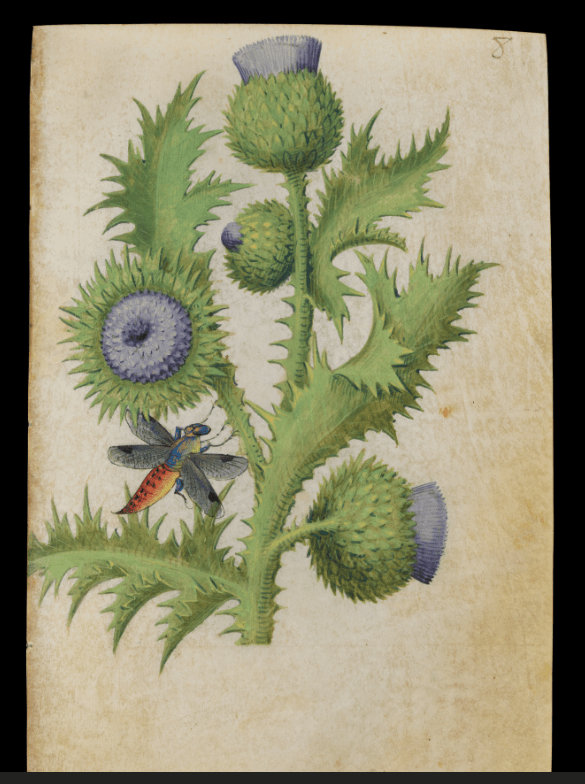
This appears to be a thistle

Master of Claud’s thistle

Thistles are associated with the Virgin Mary, It is impossible to say which form of thistle is sculpted on the Chantry but Milk Thistle, Silybum marianum, Also known as the Marian or Mary Thistle, the species name Marianum comes from the Latin and refers to a legend that the milky white streaks on the spiny leaves of this species of thistle came from the milk of the Virgin Mary nursing her child whilst fleeing to Egypt. Bolton Castle Plants

Whether the foliage painting and carvings are attempts at botanical verisimilitude or are entirely symbolic – or something in between – does not bother me – as all you need to do to enjoy the art of Boxgrove Priory Church is visit and look at its art yourself.

A Footnote

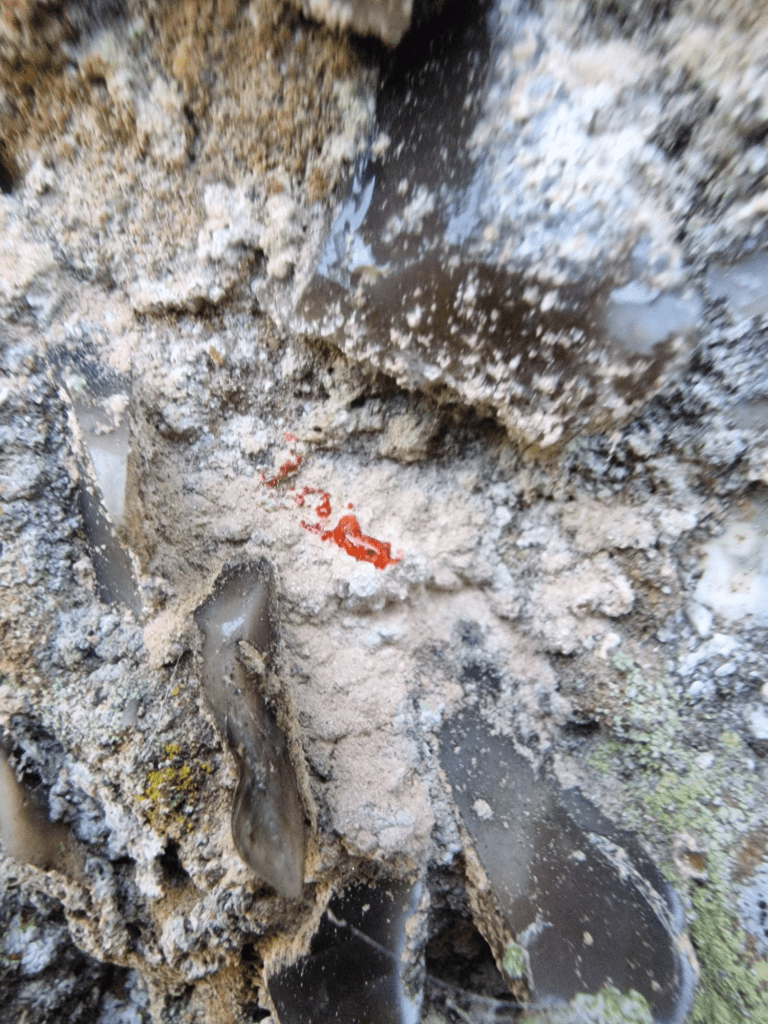
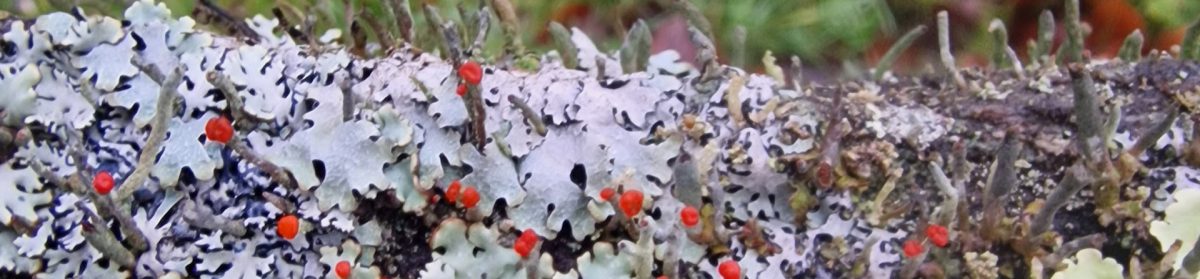
Boxgrove Priory Church not only has outstanding Renaissance ceiling painting and Chantry carving, it has some cracking lichens on its external walls, including Ingaderia vandenboomii, which is deemed a “Nationally Scarce” by the British Lichen Society. But it is not that scarce on the north walls of old (mostly Saxo-Norman) coastal churches in Sussex.

Ingaderia vandenboomii has a pink thallus i.e body (the red is a reaction to a chemical reagent spot test used to confirm its identity.