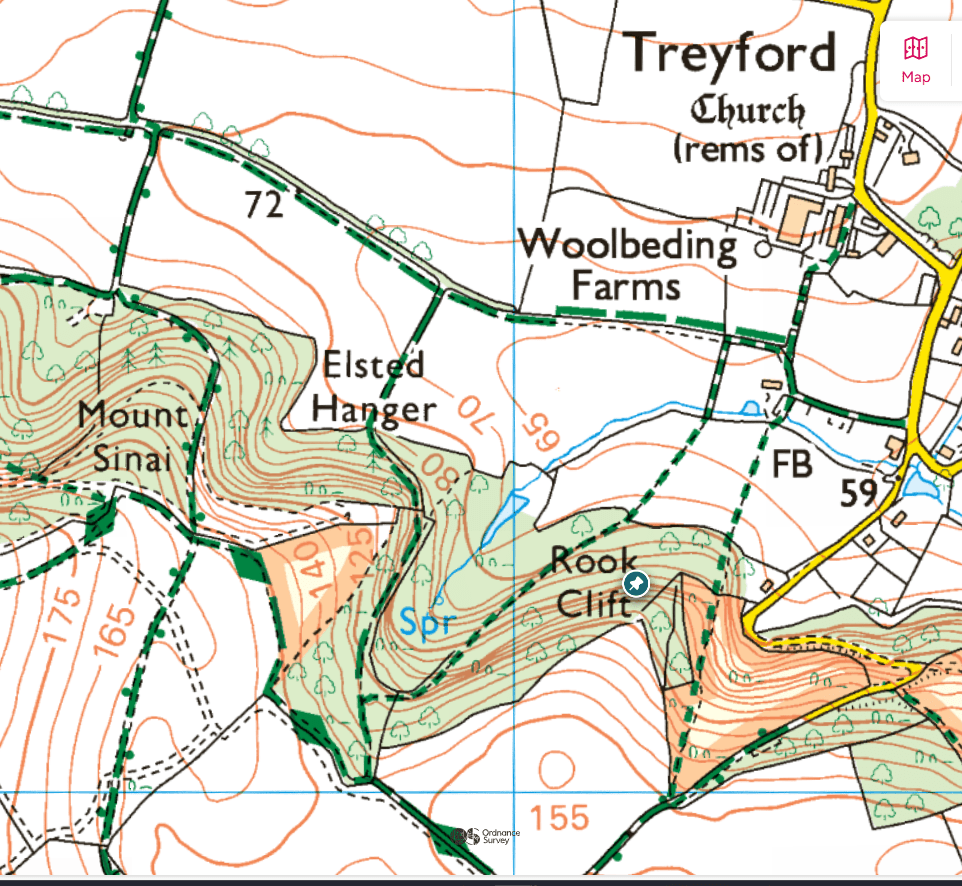
This is the follow up to my post of 28.10.25 Large-leaved Lime and Wych Elm at Casey’s Copse and Rook Clift, nr. South Harting, West Sussex. Part I Today I visited the group of Large-Leaved Limes at Rook Clift at SU821182 that I didn’t have time to visit on 28.10.25; listed in the Sussex Rare Plant Register as ca. 80-100 stool and maidens, at SU 822183, in agreement with Rose’s 1991 enumeration. They are to the east of the main path. But it is necessary to walk nearly to the the top of the main path, then walk east then north above the main path. There is a large ditch with a very steep slope between the main path and where the cluster of Large-leaved Limes are.
The pin shows the location of the cluster.
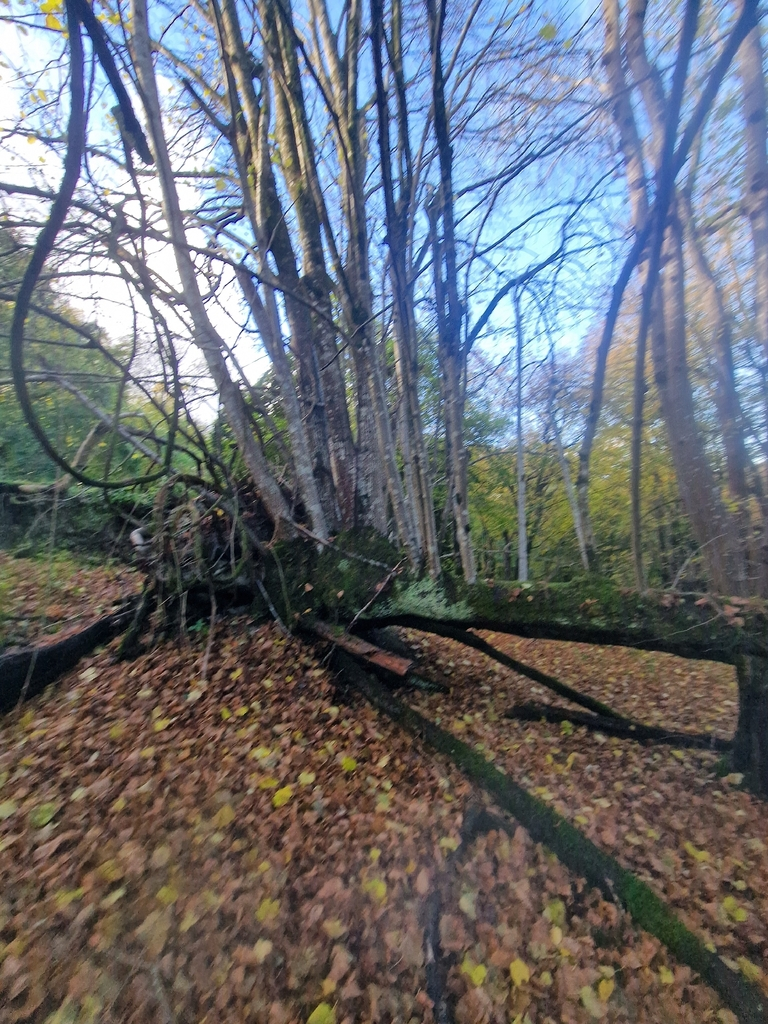
I could not find anywhere near 80-100 Large-Leave Limes; I found far less. There may have been much change since they were first recorded, or may be I didn’t see the extent of the stand
It is worth quoting all of what Francis Rose says of Large-leaved Lime in The Habitats and Vegetation of Sussex (1991) Booth Museum of Natural History, Borough of Brighton
Tilia platyphyllos is now known to occur in at least 16 separate populations along the lower part of the escarpment of the western South Downs, from the Hampshire border (where one ancient tree exists on the actual bank of the ancient county boundary at the Miscombe) east to Springhead Hill southwest of Storrington (TQ 070127), in ten tetrads. It occurs always in ancient, former coppice woodlands, within ancient boundary banks along the lower part of the scarp, never in the (often quite mature) secondary woodland on what was former opensheepwalk. Most of the trees are ancient coppice stools, though on a few sites, what look like ancient pollards occur. Dr Donald Pigott, the authority on Tilia, has visited several of the populations with me, and says that the trees have the characters of the native form of T. platyphyllos, and some of the huge stools may be upwards of 1000 years old. Tilia cordata appears to be absent from the Sussex Chalk scarp in natural situations (though it does occur further west on the Hampshire Chalk).
The best locality so far discovered for T. platyphyllos is at Rook Clift, south of Treyford (SU 822183) where between 50 and 80 trees occur in an almost pure stand, alongside Wych Elm (Ulmus glabra), Field Maple (Acer campestre), Hazel (Corylus avellana) and Whitebeam (Sorbus aria). There is little Ash (Fraxinus excelsior) and Beech and Yew are rare and marginal. This type of Tilia-Ulmus-Acer-Corylus woodland was possibly the dominant tree cover of the South Downs escarpment and of other Chalk scarps in southern England in early, perhaps pre-Neolithic times, though then of course, as high forest not coppice; pollen evidence strongly suggests that the present abundance of Beech is comparatively recent and much of it on the Chalk scarps today may derive from earlier plantings.
Whilst there was little Ash, Beech and Yew within the stand of Long-leaved Lime, Wych Elm, Field Maple; there is much Ash, Beech and Yew within the wider area of Rook Clift. I saw no Whitebeam within the stand. From my experience there is little Whitebeam in the lower parts of ancient scarp-face woodland; it is now mostly towards the top of scarp-face woodland and as isolated trees or small groups on the short-grass pasture on the summit areas of the west South downs.
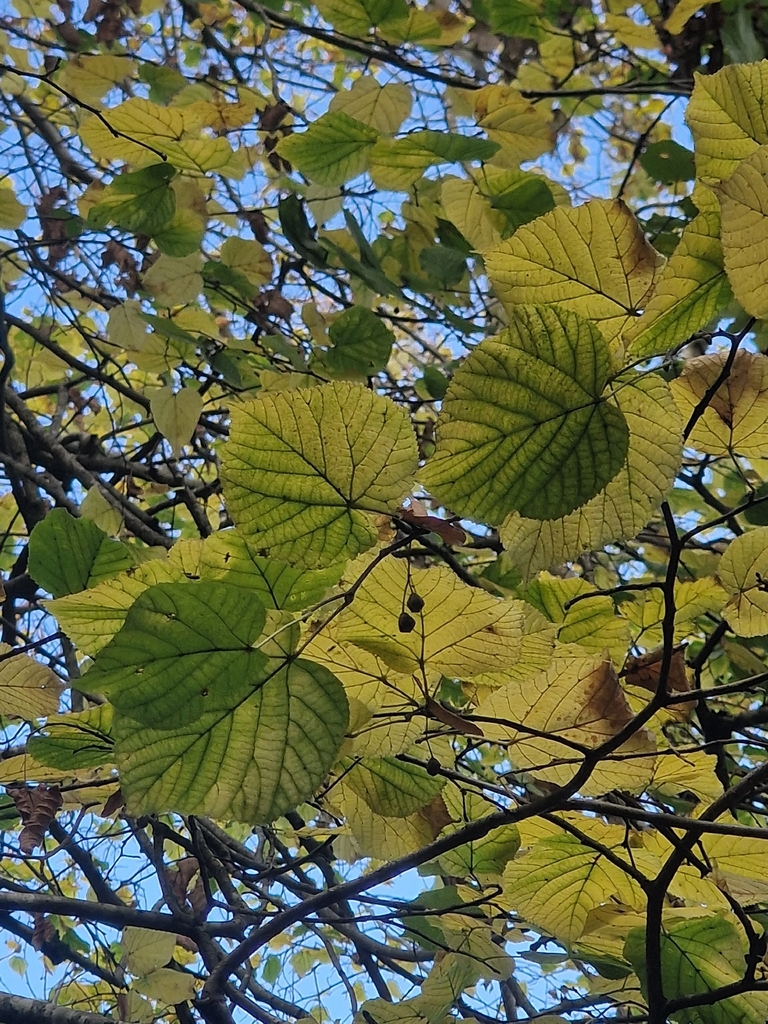
Large-leaved Lime


Wych Elm
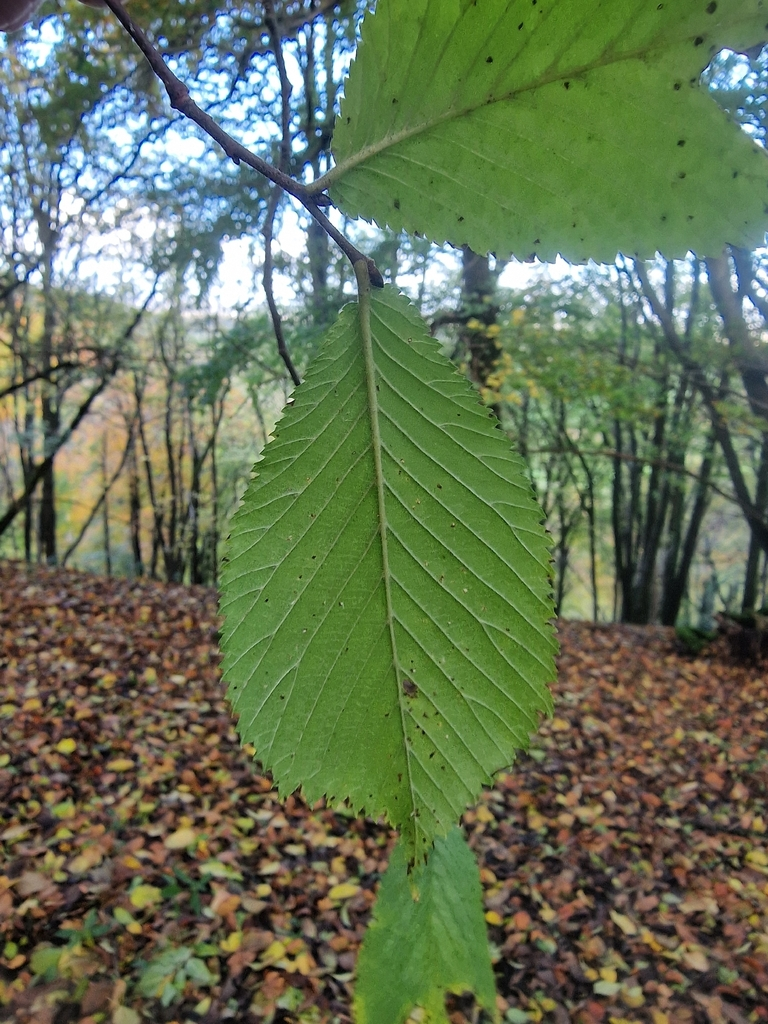
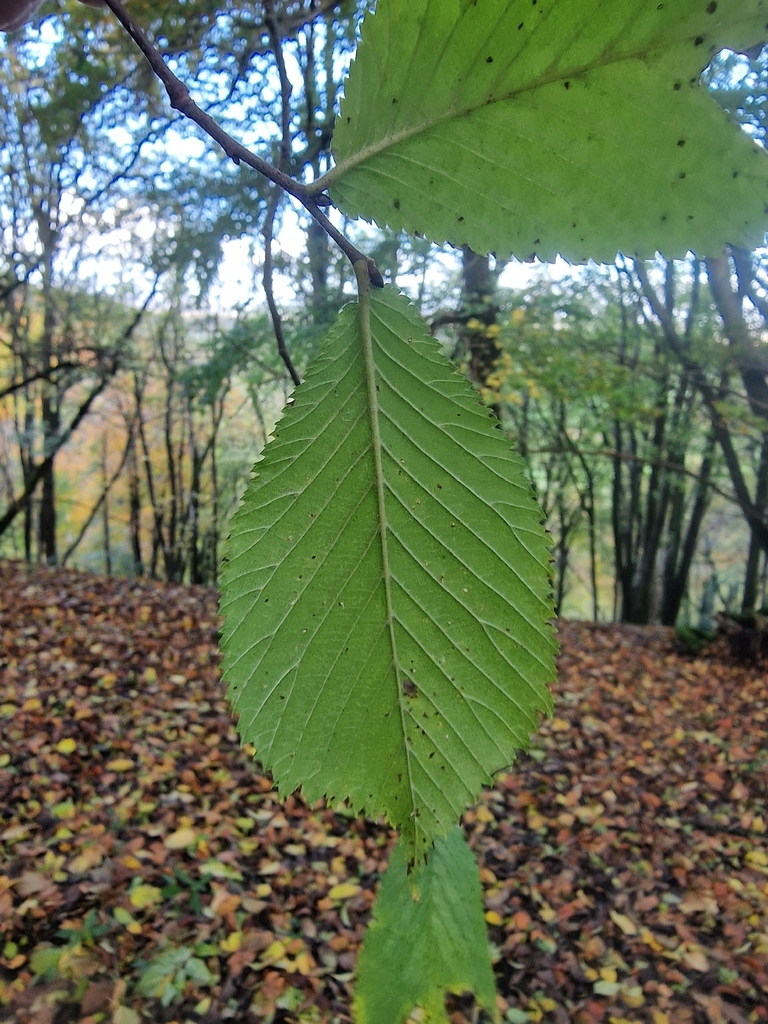
Field Maple

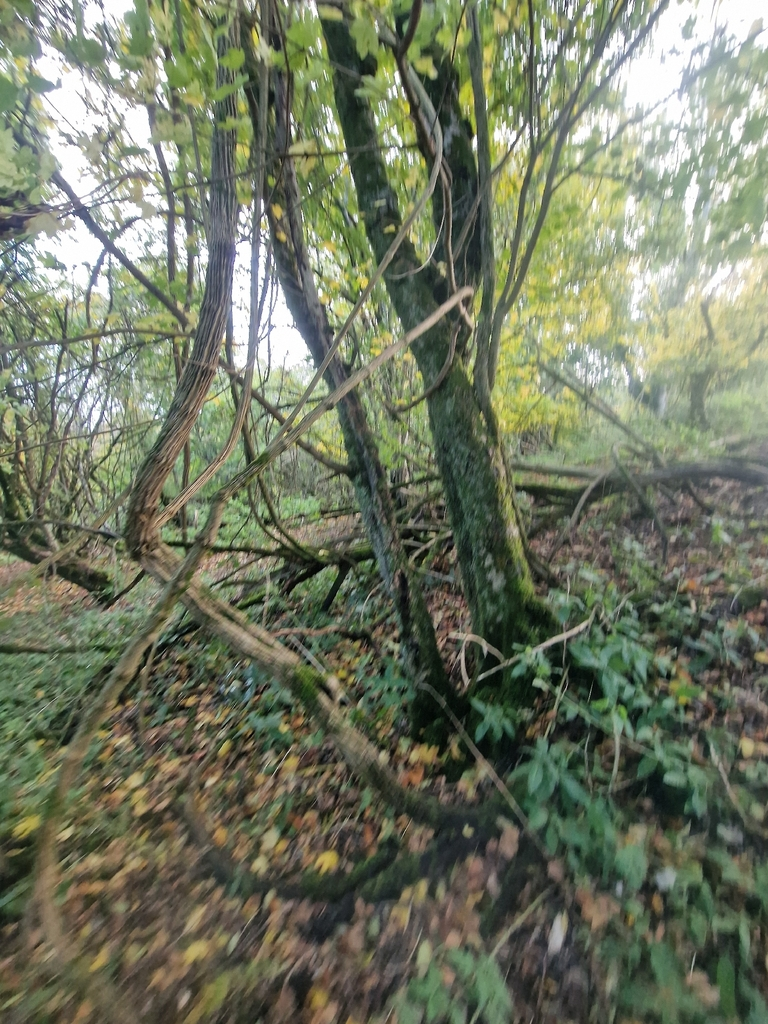
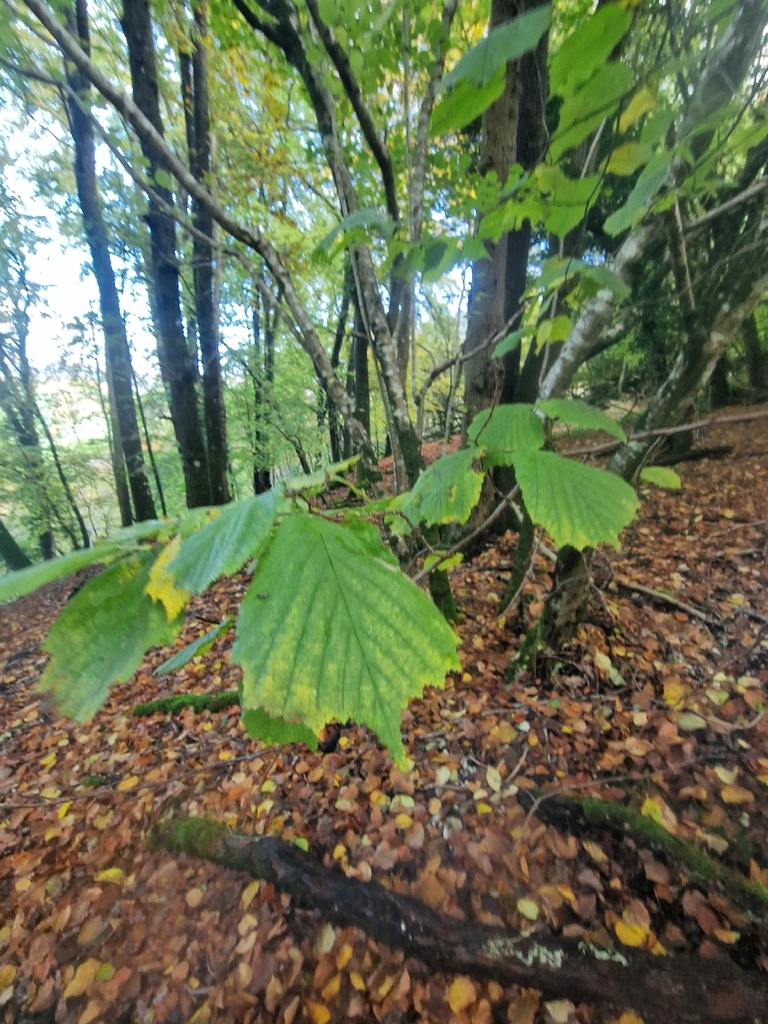
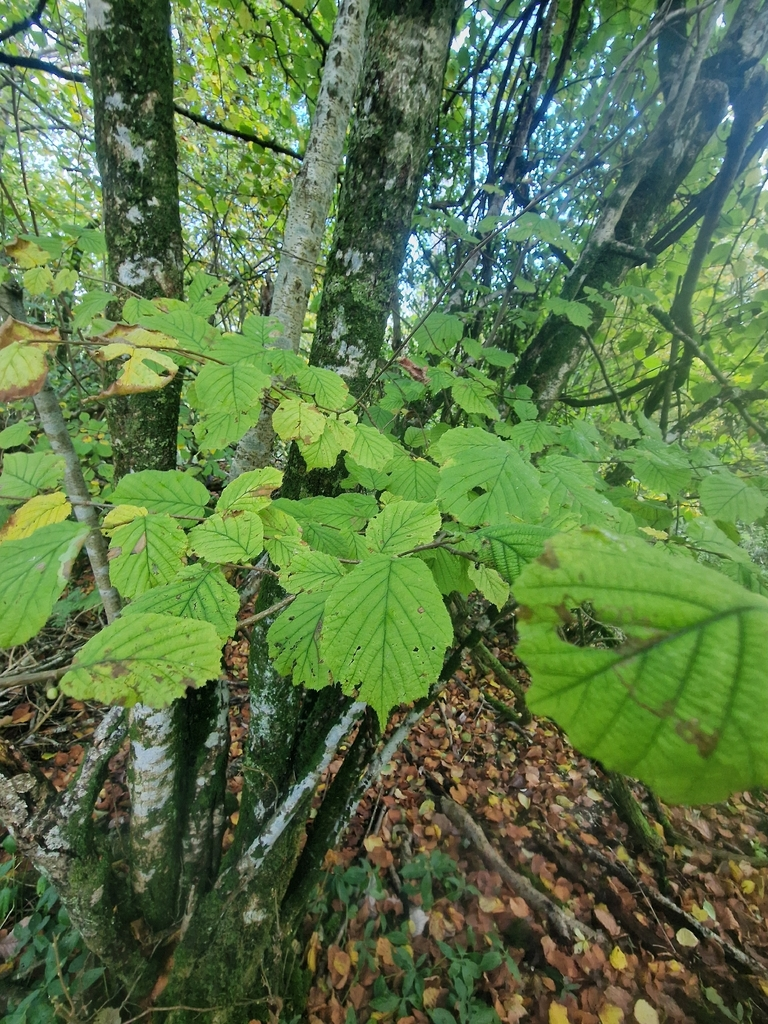
Hazel
 Sim's Nature Notes