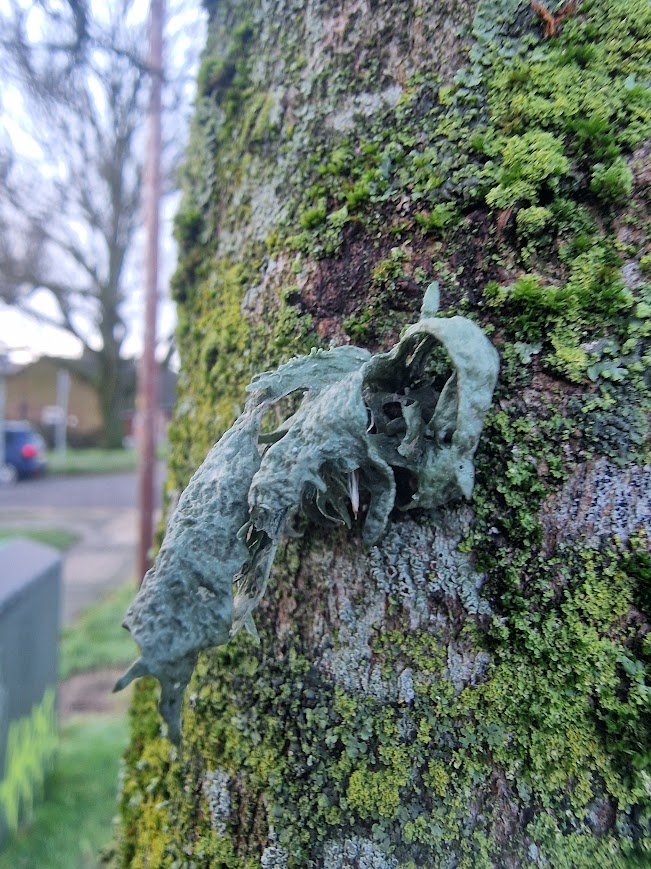
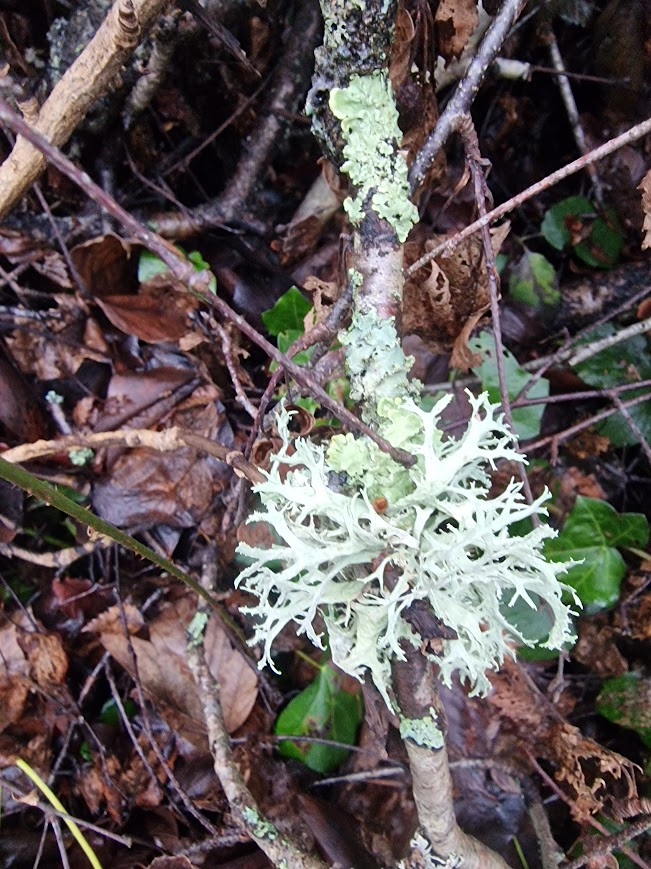
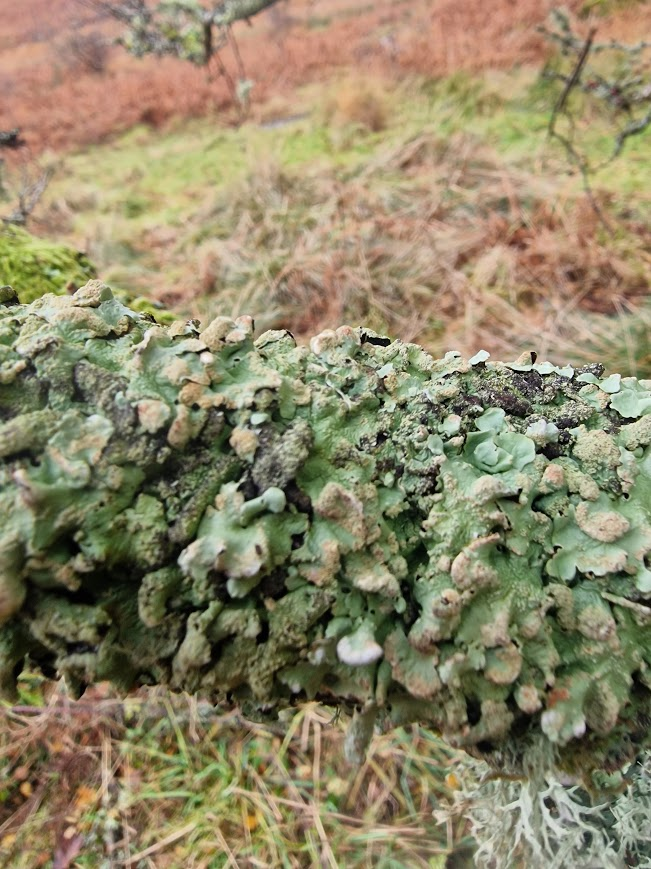
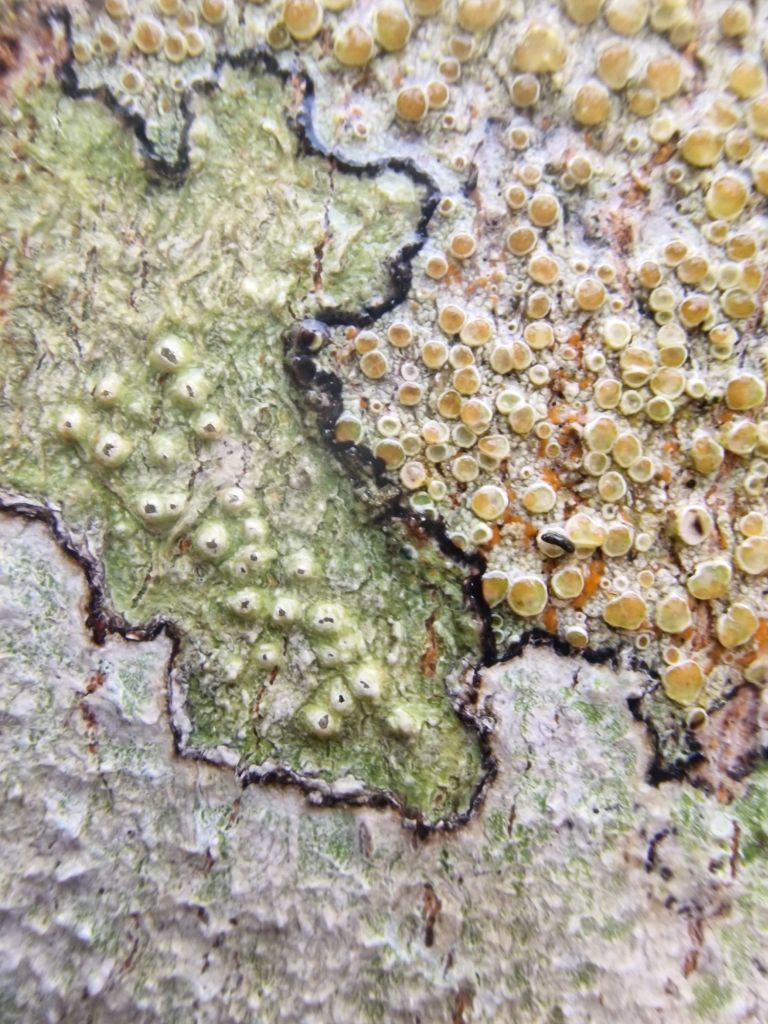
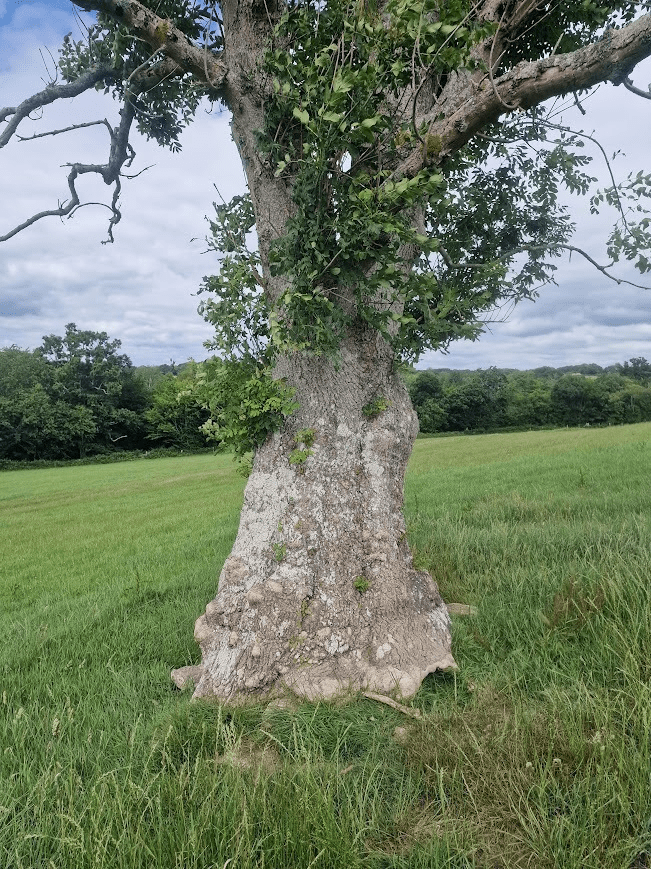
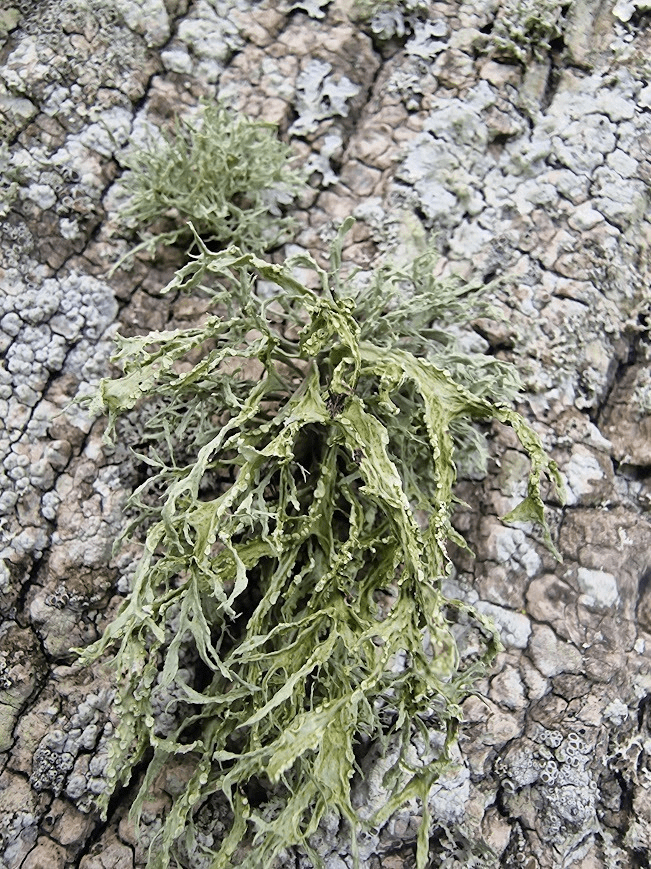
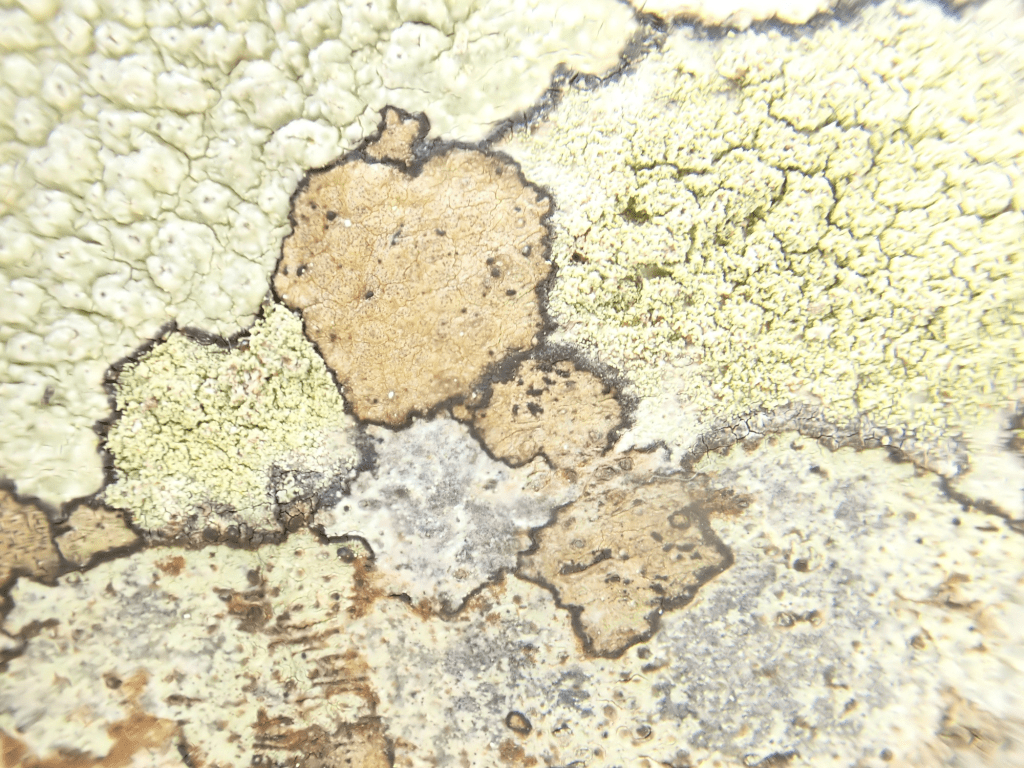
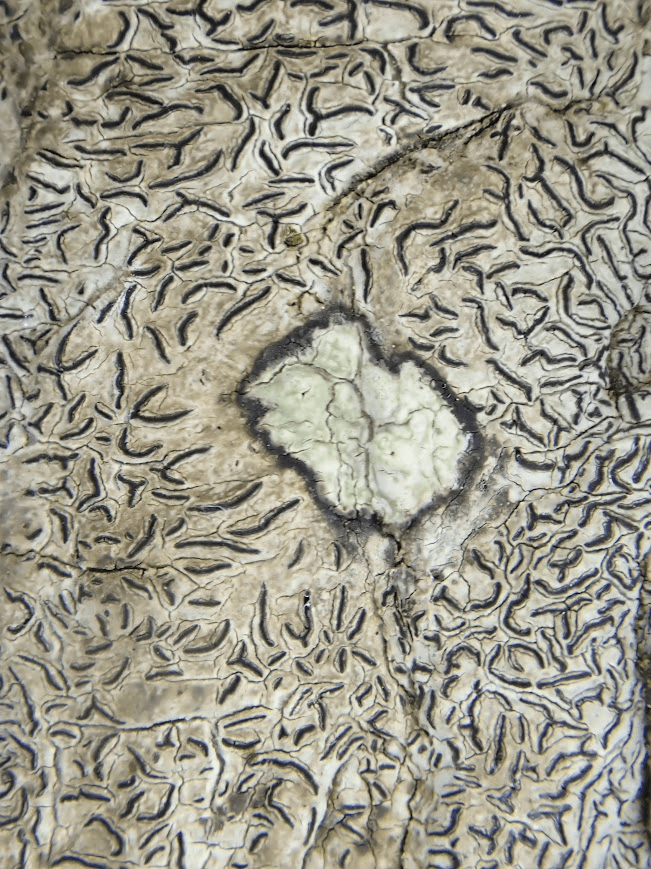
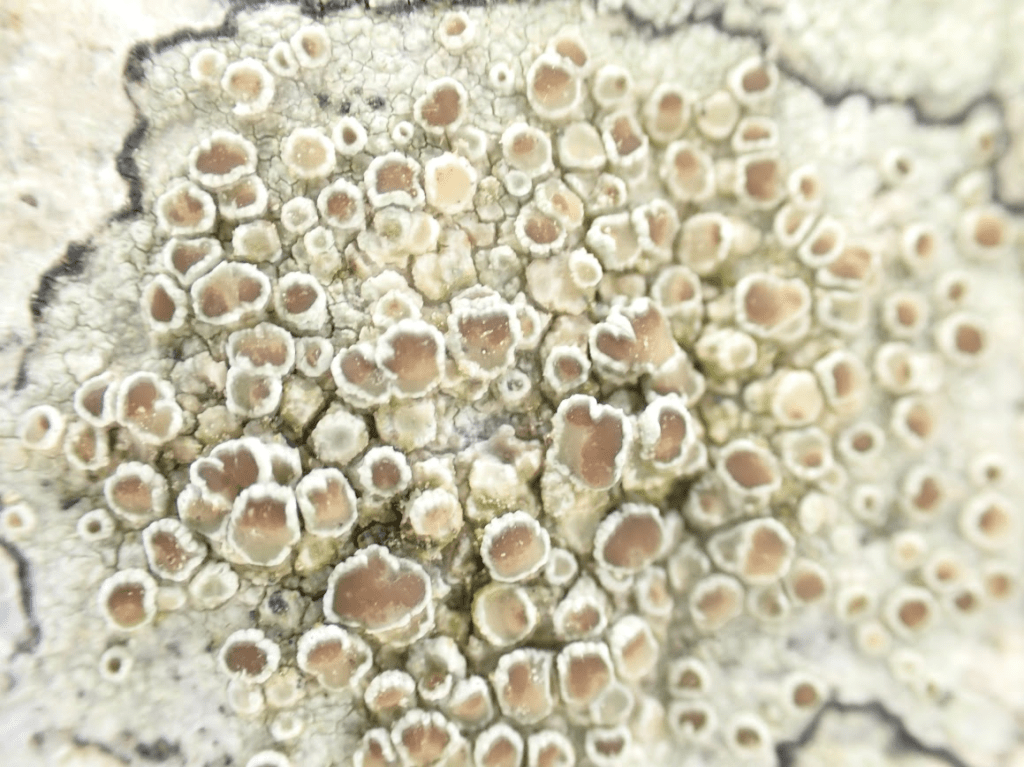
On Sycamore, on verge on Queensway, Craven Vale Estate, Brighton; surrounded by Xanthoria parietina, Lecanora chlarotera s.l., and Arthonia radiata
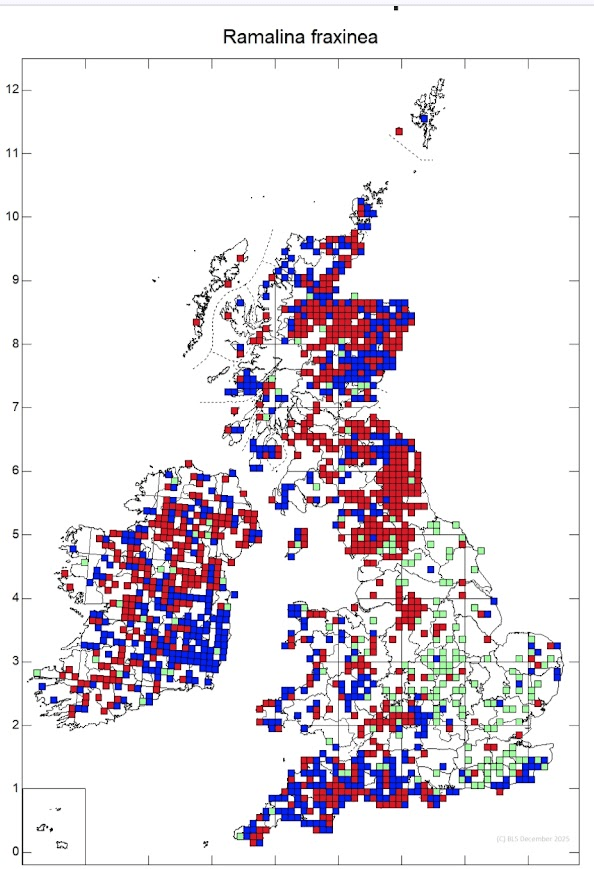
Habitat: Locally frequent on well-lit trees with basic bark. Now rare in many areas. Very sensitive to SO2 pollution and fertilizer-enrichment.
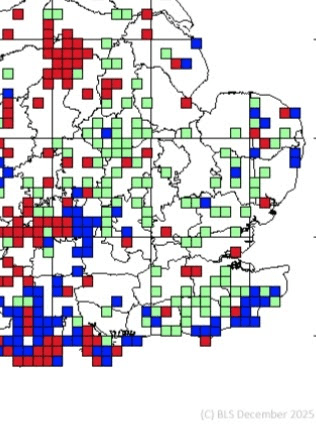
Distribution: East and South England (much decreased), northern England (increasing), Central and East Scotland and East Ireland.
Threats & Status: Declined in areas impacted by sulphur dioxide pollution in the 20th century, with limited recovery as yet, but some recolonisation has been noted
The term “International Responsibility” (IR) refers to lichen species whose populations in a specific country (e.g. the UK) are internationally significant. Because the national population is so important to the overall survival of the species, the nation has a special responsibility to protect it from extinction or decline.
A country can only look after an IR species if we know where they are. This lichen is not on the BLS database yet (I will record it). But we don’t know where important lichens are because there is inadequate recording of lichens in the UK.
There are 62946 individual lichen records on the British Lichen Society’s database for East & West Sussex (as of 2022). All of these appear to be from rural areas; mostly woodlands, churches and deer parks; none of these records appear to come from urban areas. This is a result of an unconscious bias for rural areas and against urban area, that I am guilty of too. I would much rather walk around a beautiful ancient deer park or a wood or a churchyard than a town. I have seen R. fraxinea in two places in Sussex – in the High Weald countryside, on the Ashburnham Estate, and in the town, in the Craven Vale council estate, Brighton. From this statistically insignificant sample size; you could conclude that you are as likely to see R. fraxinea in an urban setting as a rural setting!
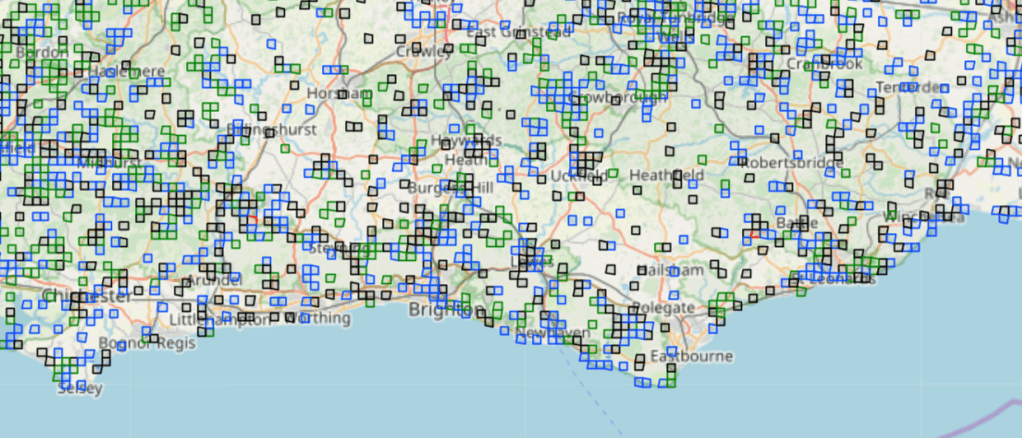
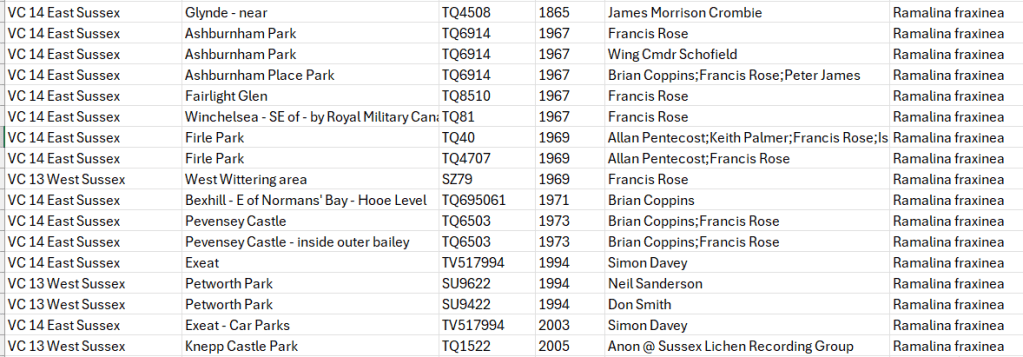
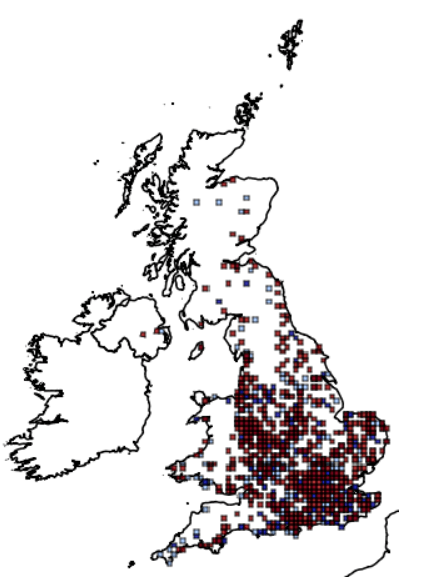
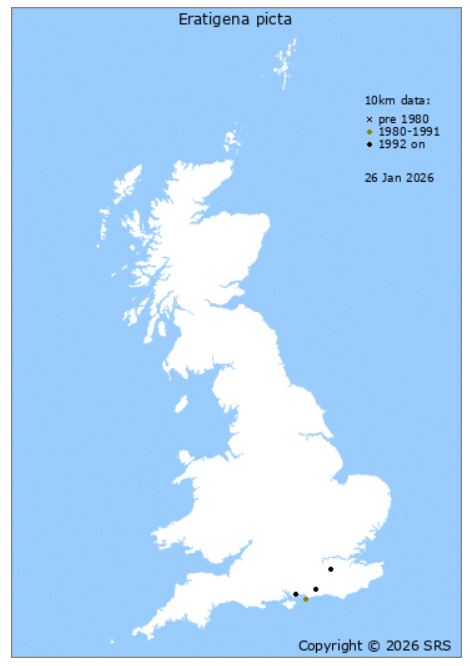
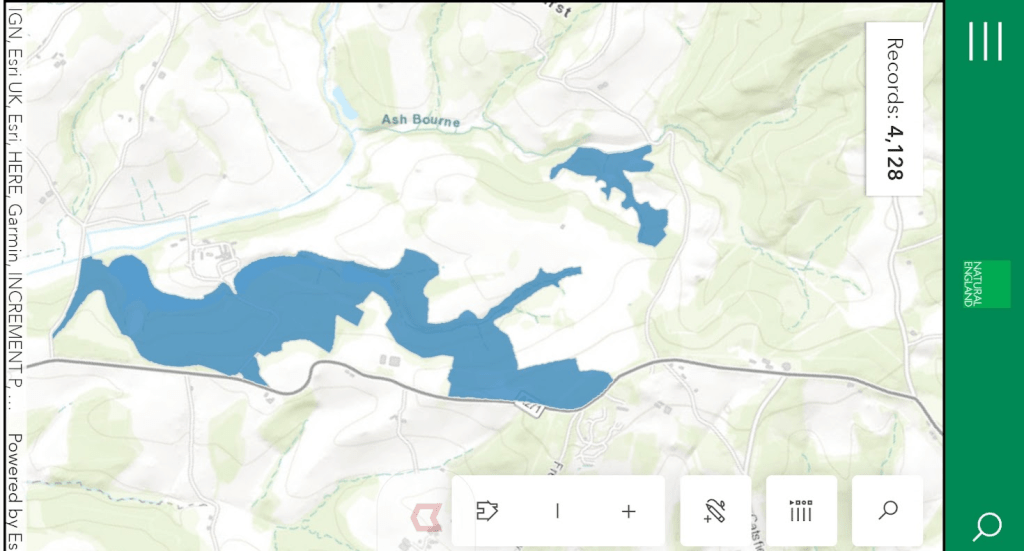
These are the Sussex records for Ramalina fraxinea. They are only 17 R. fraxinea records in 12 places; all of them rural.
I
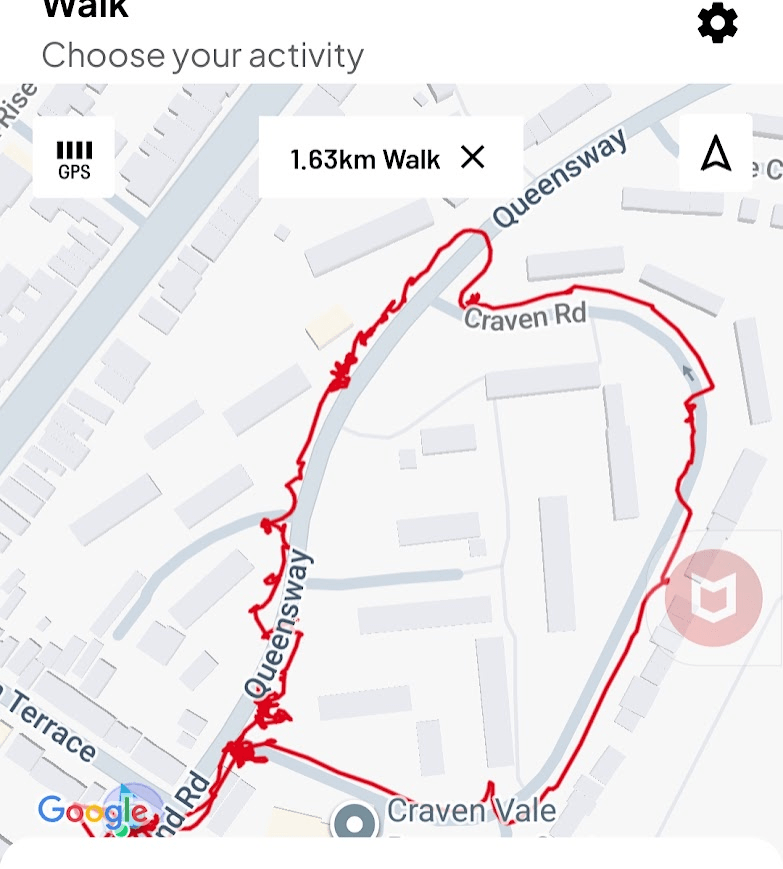
n one hour of walking round the Craven Vale estate this afternoon I saw 25 lichens, many in large abundance, on road trees, brick walls, recycled plastic (street signs), and worked wood (bollards and seats)
Looking up from my house. The large tree is an English Elm (Ulmus procera); these do not exist in the UK countryside any more as they have been killed by Elm Disease. It only survives because of the cordon sanitaire thrown around the town in 1970 by Brighton Borough Council. This tree started its life probably as a field tree, in the land enclosed in ca. 1825 as agricultural land called Bakers Bottom (now called Craven Vale) a coombe sculptured out Sheep Down (now called Race Hill) by glacial melt water. The tree survived the land being turned into municipal allotments in 1923 and the building of the housing estate in the 1950s. That tree was around when my grandparents and great grandparent grew up in East Brighton.
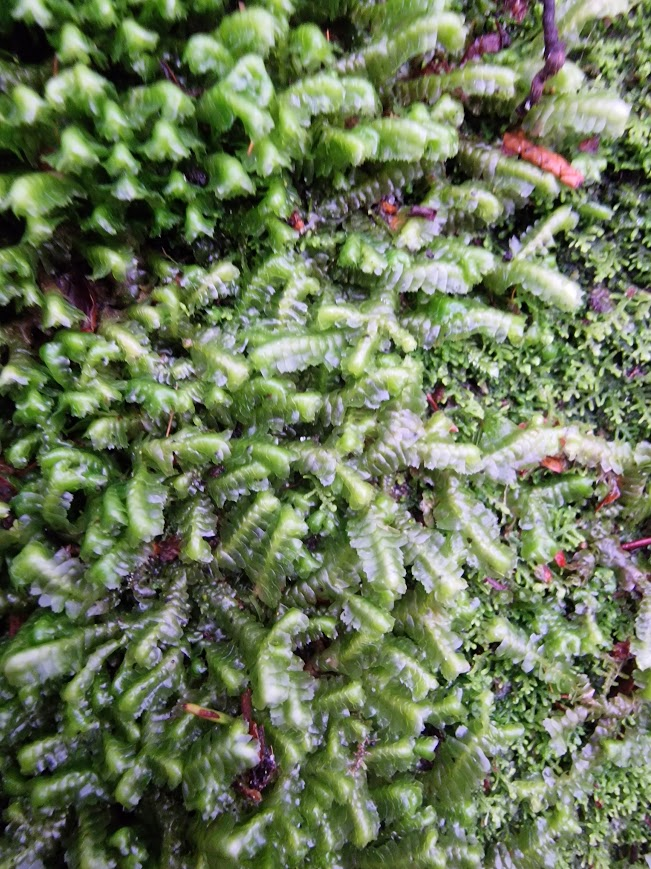
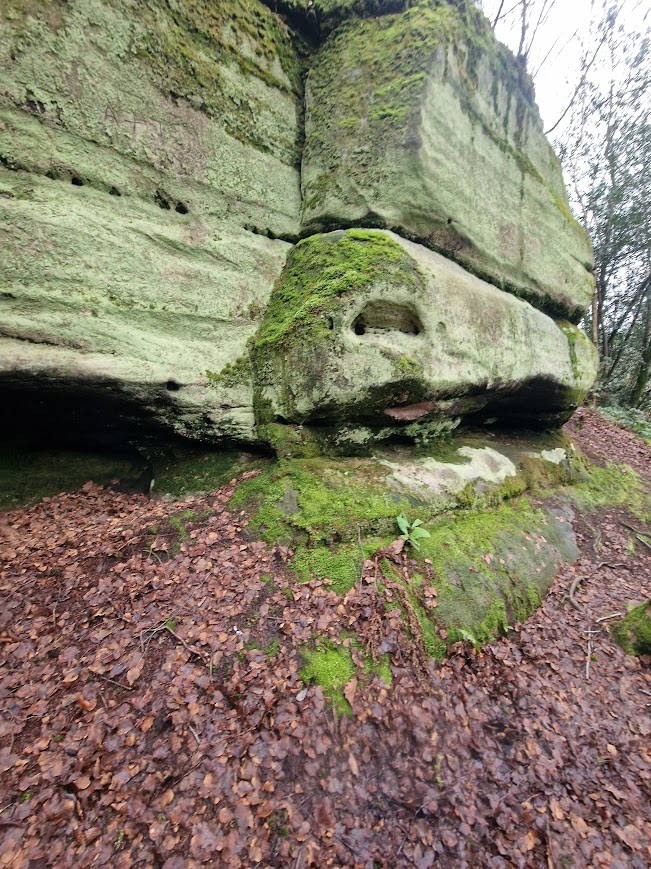
This is the first time I have seen B. trilobata in Lake Wood
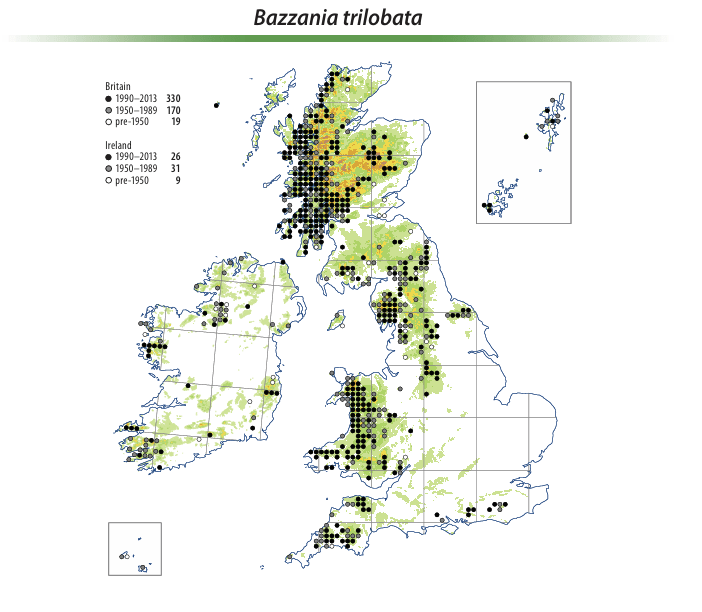
A calcifuge, particularly characteristic of western oak woodland, where in humid conditions it can be locally dominant in the bryophyte layer, forming large, deep cushions on banks, boulders, cliffs and rocky outcrops. Plagiochila spinulosa and Scapania gracilis are common associates. It also grows on deep humus and brown earth soils, especially in grazed woodland, as well as on logs; it is occasionally arboreal. In SE England it is mainly associated with sandstone rocks in shaded valleys. British Bryology Society Bazzabia trilobata
I have only seen B. trilobata in two other places in Sussex: Eridge Rocks and Chiddingly. All of these three locations are High Weald ghyll woods; a location which matches the humidity level of Atlantic Woodland because of its ghyll, despite lower precipitation.
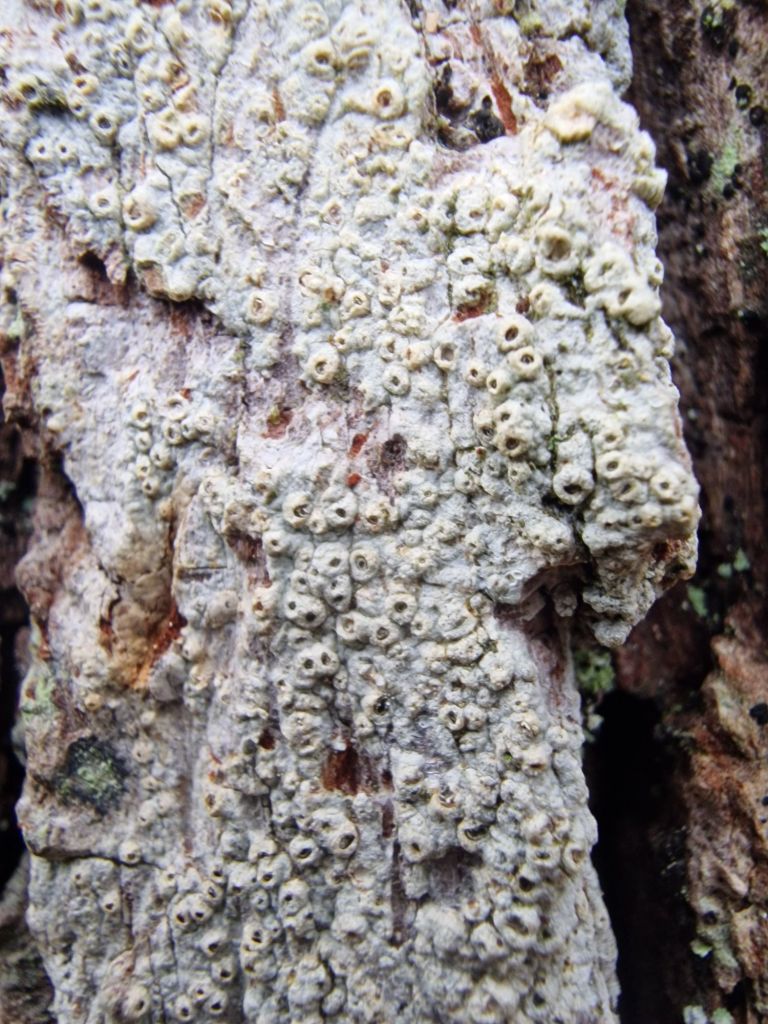
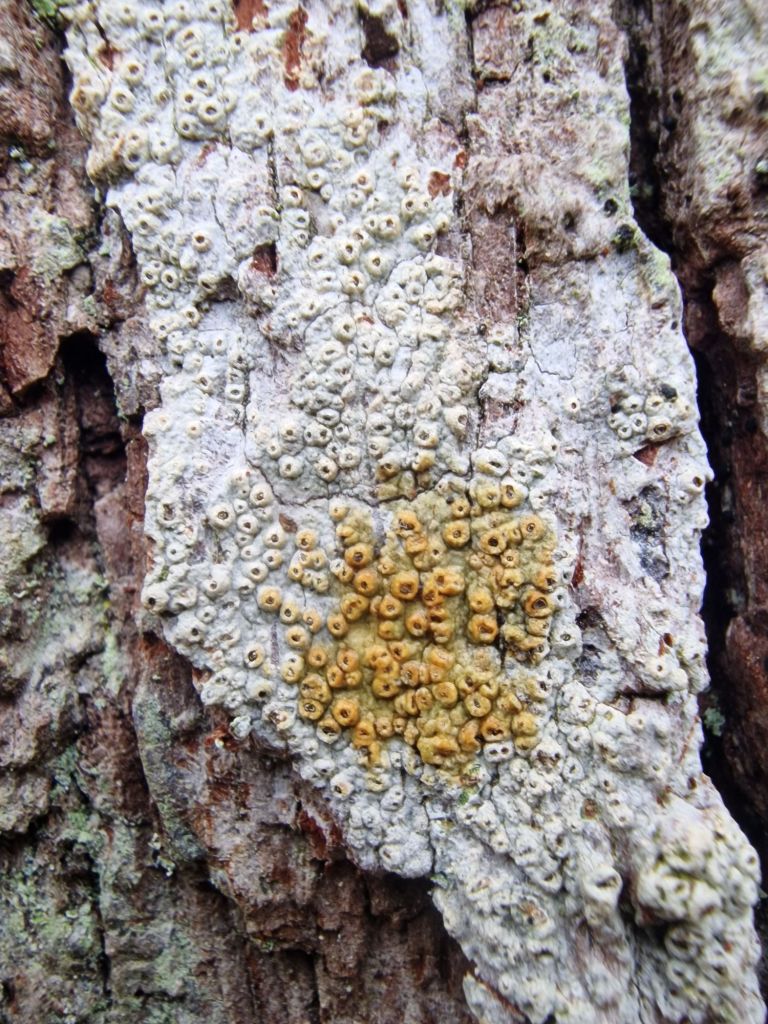
Thelotrema lueckingii
Previously I thought this huge patch of Thelotrema on Quercus robur was Thelotrema lepadinum but I hadn’t tested it with chemical reagents. Today I tested its thallus with potassium hydroxide; it was dark yellow. T. lepadinum tests negative to potassium hydroxide; but T. leuckingii tests red to potassium hydroxide. This tested dark yellow. So it may be Thelotrema lueckingii?
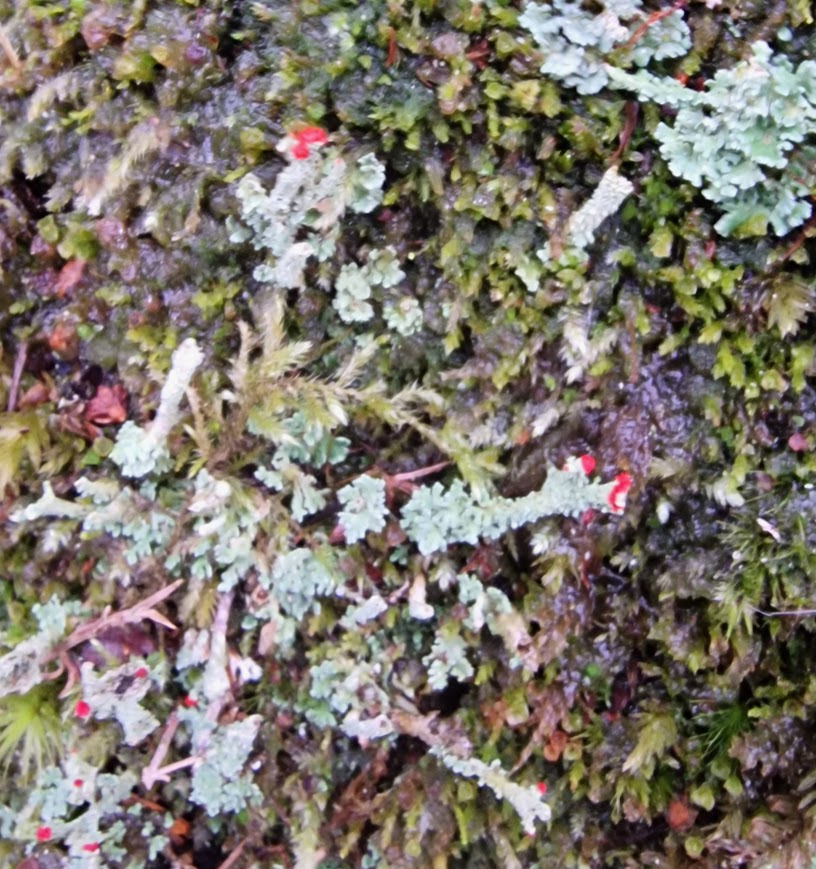
Cladonia polydactyla
On mossy bank (over Ardingly sandorck)
Pertusaria pertusa
On Hornbeam
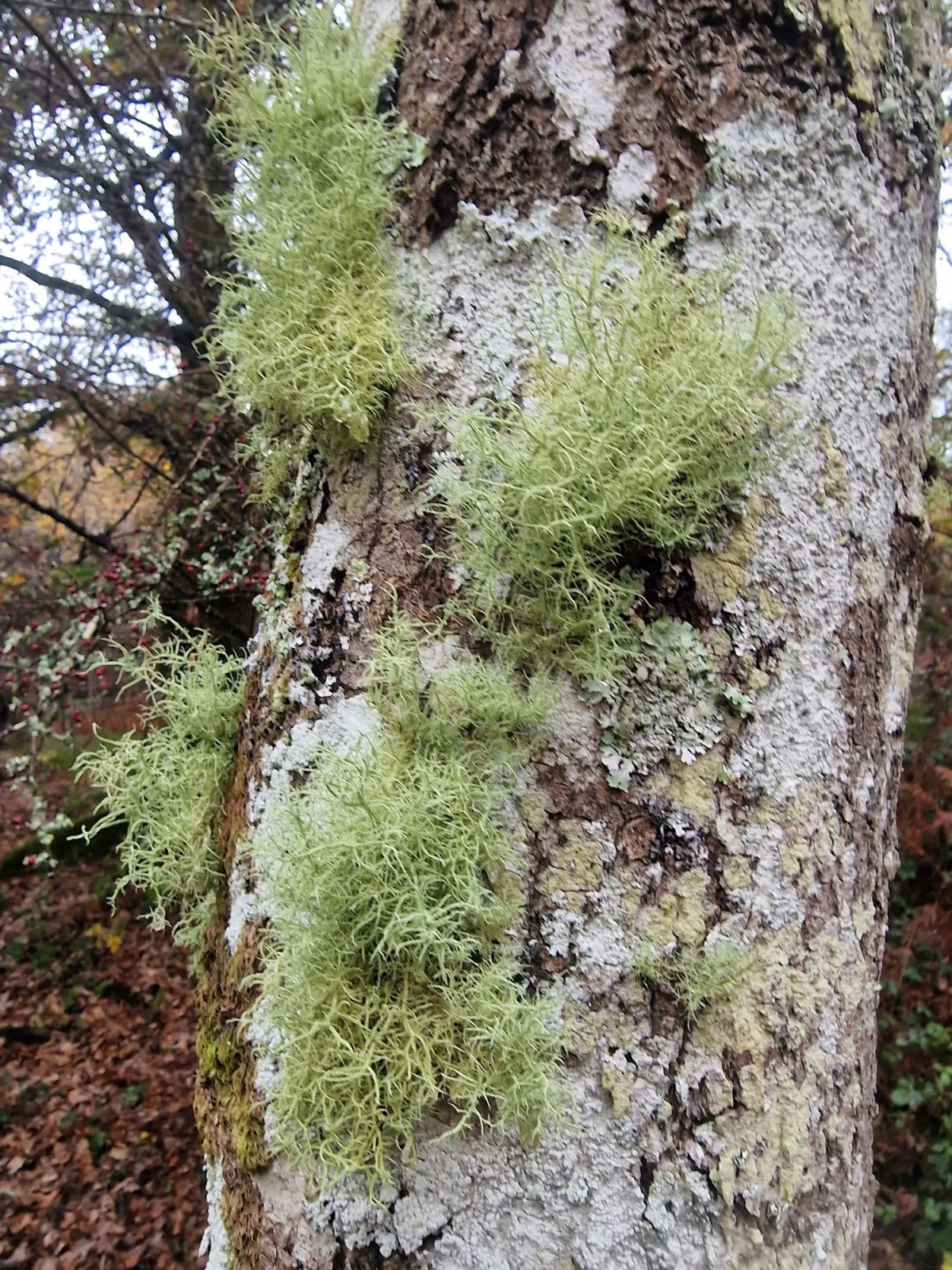
Usnea cornuta
On Pedunculate Oak
Cladonia coniocraea
On dead tree stump; the most likely place you’ll see C. coniocraea in Sussex.
These organisms were found on a British Bryological Society South East Group (Sussex Bryophytes) field meeting. I would really recommend attending these meetings; they are very friendly and very accommodating of beginner bryologists (like me!). With us yesterday was pan-species listing guru Graeme Lyons. The bryologists Ben Bennat, Sue Rubinstein and Brad Scott made all the bryophyte identifications. My specific interests in natural history are birds and lichens; but I am trying to take a pan-species listing approach. No one can be an expert in everything so taking a pan-species listing approach is also an opportunity for social natural history; learning from others who know much more about specific areas of biology than you. My interest in pan-species listing is not the opportunity it provides for listing large numbers of species, but the opportunity it provides to learn more about your own patch and thus travel less, and thus minimise your carbon omissions. Local pan-species listing in your own patch means there will always be more things to find without having travel miles.
Lichens of southerly downland churches: Sullington St Mary’s Church
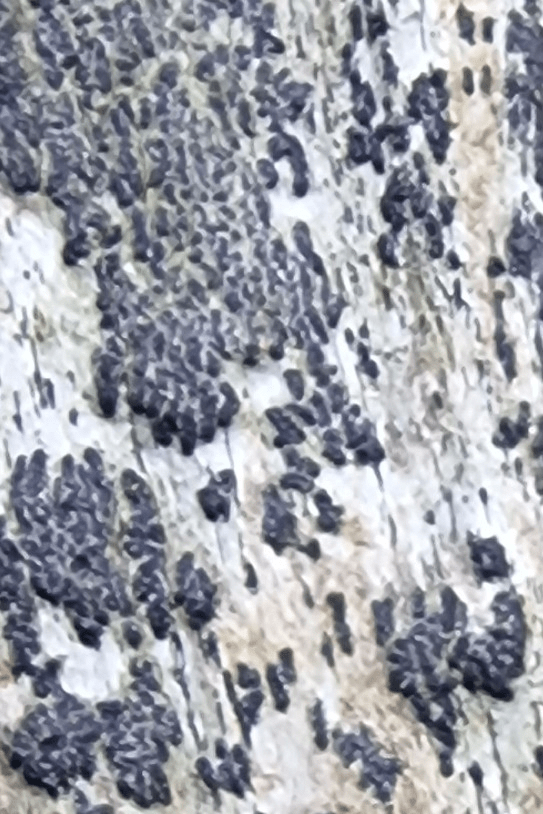
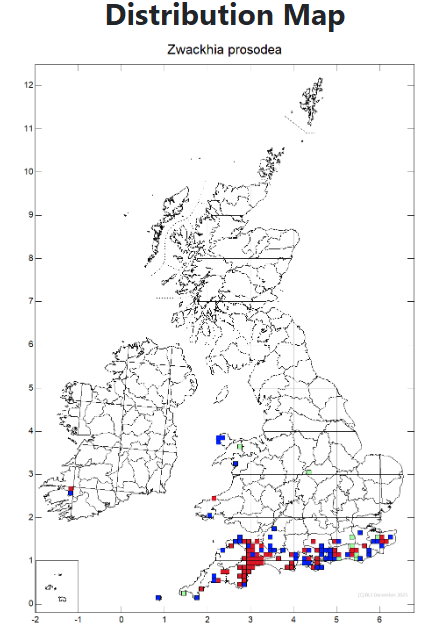
Zwachhia prosodea on ancient yew. A Near Threatened (Red List) Nationally Scarce lichen. This is not a species specifically of chalk but it is very much a species of the south. It grows on ancient trees – mostly Pedunculate Oak and Yew; but I have only seen in on Yew, all in church yards – East Chiltington, Coldwalhtam and Sullington. It is a Graphidaceae family lichen. Typically this family of lichens can only be identified by spore microscopy; but Z. prosodea has such distinct lirellate apothecia (writing-like fruiting bodies) it can be identified morphologically.
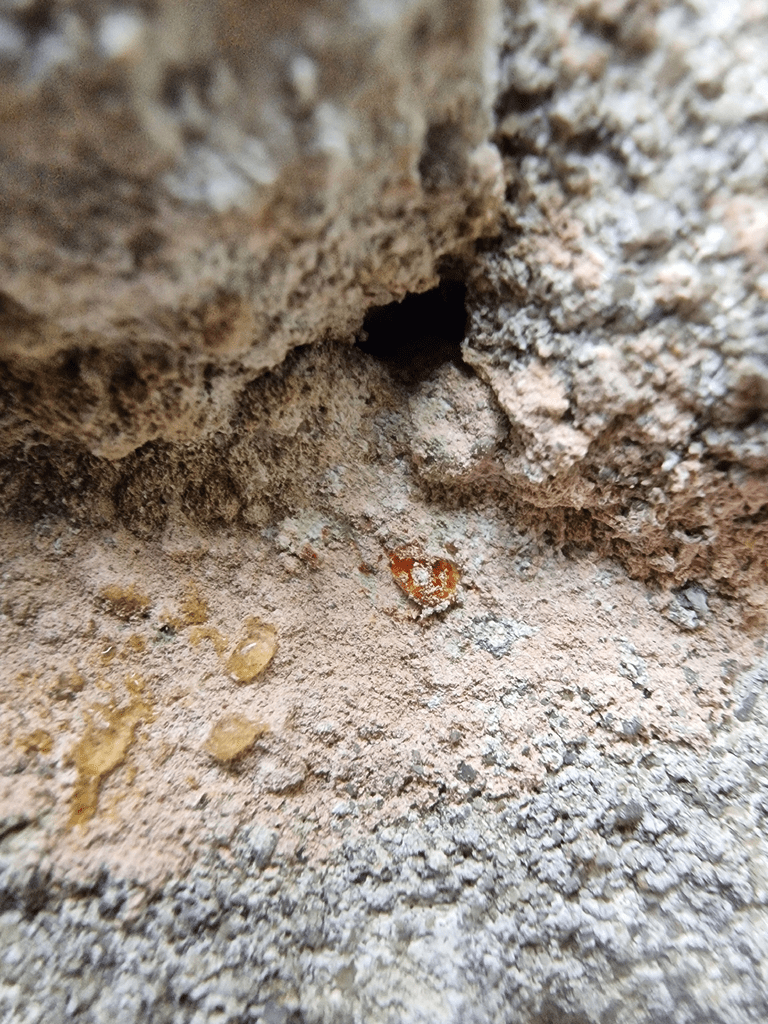
Ingaderia vandenboomii on north wall of church. Again not a species of chalk but a species of the far south. A Nationally Scare lichen but I find it quite often on the north walls of Sussex flint and mortar churches near the coast; I have seen it on the north walls of St Peter’s, Southease; St Thomas à Becket’s, Pagham; St Nicholas Church, Bramber; and St Mary the Virgin, Stopham. Identification of this lichen is by spot reagent chemical tests. It doesn’t react to potassium hydroxide (left drops on photo); but turns red immediately to sodium hypochlorite (centre drop on photo)
Lichens of Chalk Downland
Cladonia furcata. Not a species specifically of chalk, but one of the few Cladonia species found on chalk grassland.
Enchylium tenax Distributed throughout the British and Ireland but more common in the south. Not a lichen specific to chalk; but one of the few jelly lichens that grow on chalk
Verrucaria muralis Very widely distributed. Not a lichen specific to chalk; but one of the few lichens that grow on chalk pebbles, and is abundant on chalk pebbles. Oliver L. Gilbert (1993). The Lichens Of Chalk Grassland Lichenologist 25(4): 379-414 is one of the very few articles on lichens of chalk. This is a provisional identification as spore microscopy is required to confirm the identification; but its morphology and its abundance on chalk pebbles according to Gilbert make it highly likely that this is V. muralis
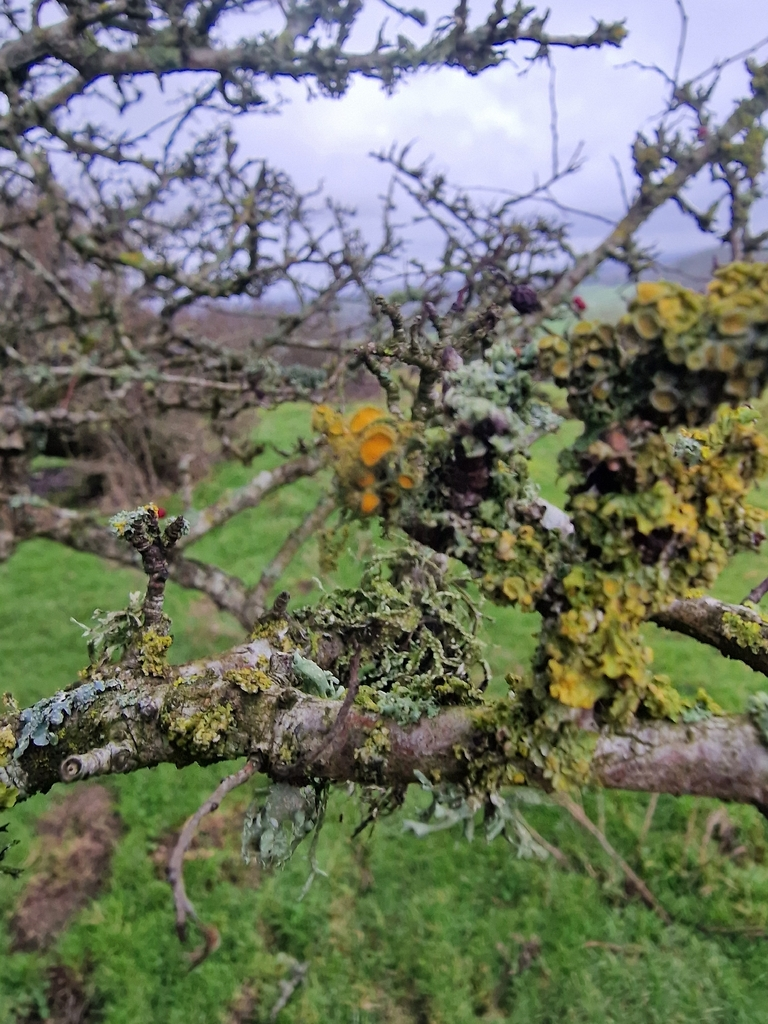
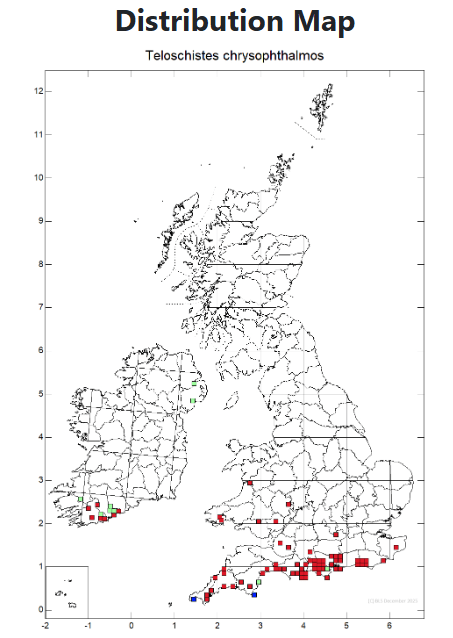
Teloschistes chrysophthalmusGolden-eye Lichen on Hawthorn. I see Golden-Eye frequently on Hawthorns of the South Downs, particularly on the downs north of Brighton and Lewes
None of these identifications were made by me; they were all made by Ben Bennat, Sue Rubinstein and/ Brad Scott
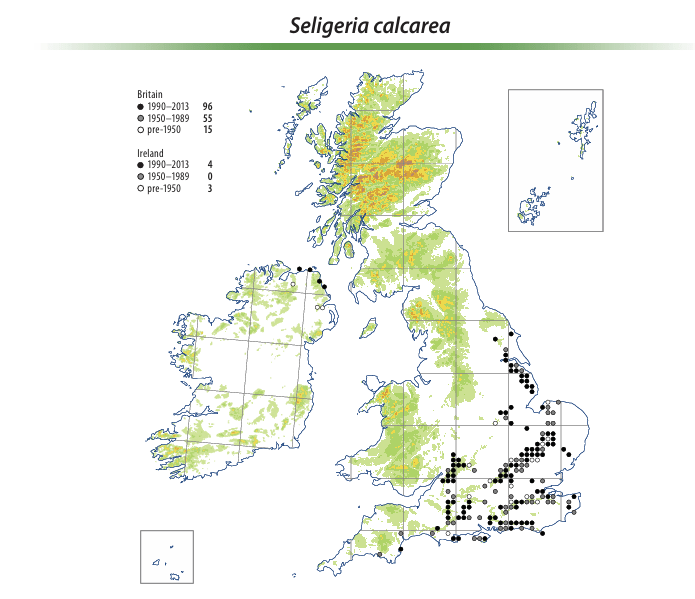
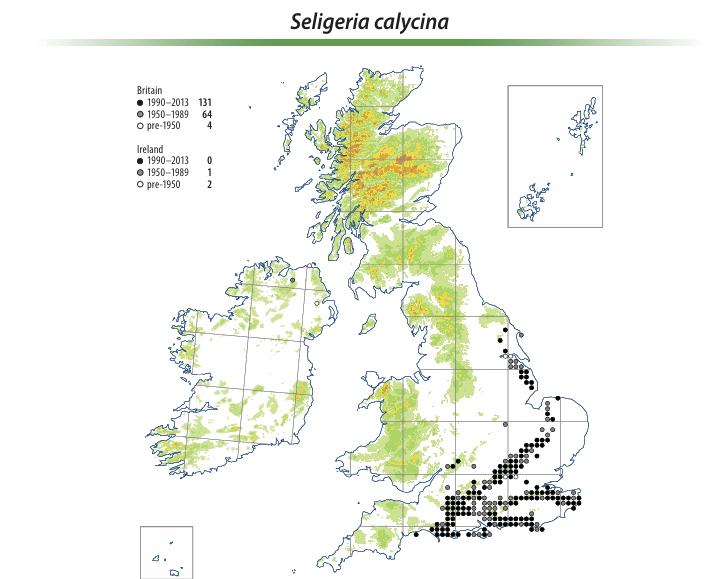
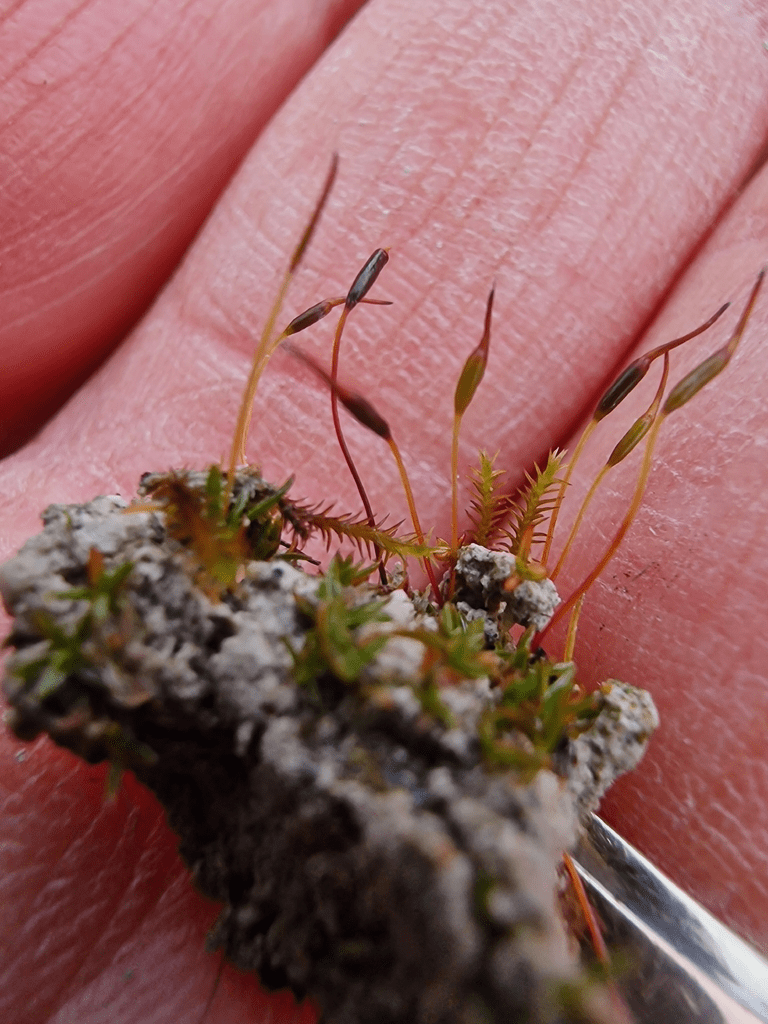
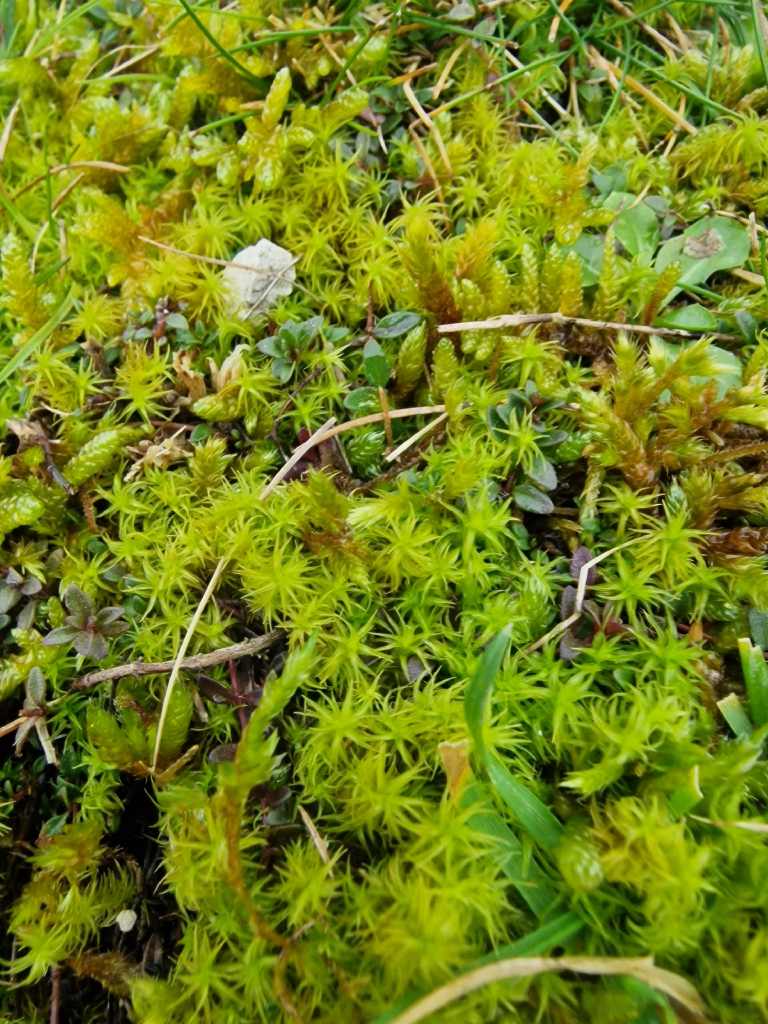
Seligeria calcarea Chalk Rock-Bristle orS. calycina English Rock-bristle – to be confirmed. on a shaded chalk bank in a holloway bostal
A Seligeria on chalk fragments in a sheltered place, such as a north-facing holloway bank or a woodland floor, is almost certainly going to be either this species or S. calycina. Because the plants are so small, this species pair is not always easy to separate in the field, unless dehisced capsules are present (usually March to April). Then you will easily see that the capsule of S. calcarea is widest at the mouth. Capsules of S. calycina characteristically narrow a little at the mouth when mature. Beware though – like many mosses, capsule shape does not develop fully until the spores are ripe.British Bryological Society Seligeria calcarea
Aloina aloides Common Aloe-Moss
Not solely chalk but A species of bare but not regularly disturbed ground and soil in a variety of situations, usually base-rich, but occasionally on ground that appears to be circumneutral. The most characteristic habitat is in old pits and quarries on chalk and limestone, growing on the floor or on earthy rock ledges, but it is also frequent in some districts on old or weathered mortar on walls and ruined buildings. .. It is occasionally found on bare patches in calcareous grassland and on soil on natural rock outcrops; other habitats include chalky and earthy banks by lanes, coastal slopes and cliffs, clay in brick pits, calcareous dune sand and gravel, and path edges and earthy rubble (here often only as a temporary colonist). British Bryological Society Aloina aloides
Pleurochaete squarrosa Side-fruited Crisp-moss
Grows loosely tufted or scattered and mixed with other plants on sandy or calcareous ground. Usually found in unshaded habitats in sand dunes, maritime grassland on cliffs, chalk and limestone grassland, and in chalk and limestone quarries.British Bryology Society Pleurochaete squarrosa
Orthotrichum anomalum Anomalous Bristle-Moss
OK! Not a chalk moss; but what a beauty; on a tomb stone in Sullington churchyard. more or less ubiquitous on concrete, gravestones, wall tops and other man made structures except in the most polluted parts of Britain. Also common on exposed limestone, but absent from chalk. British Bryology Society Orthotrichum anomalum
Invertebrates
All identified by Graeme Lyons
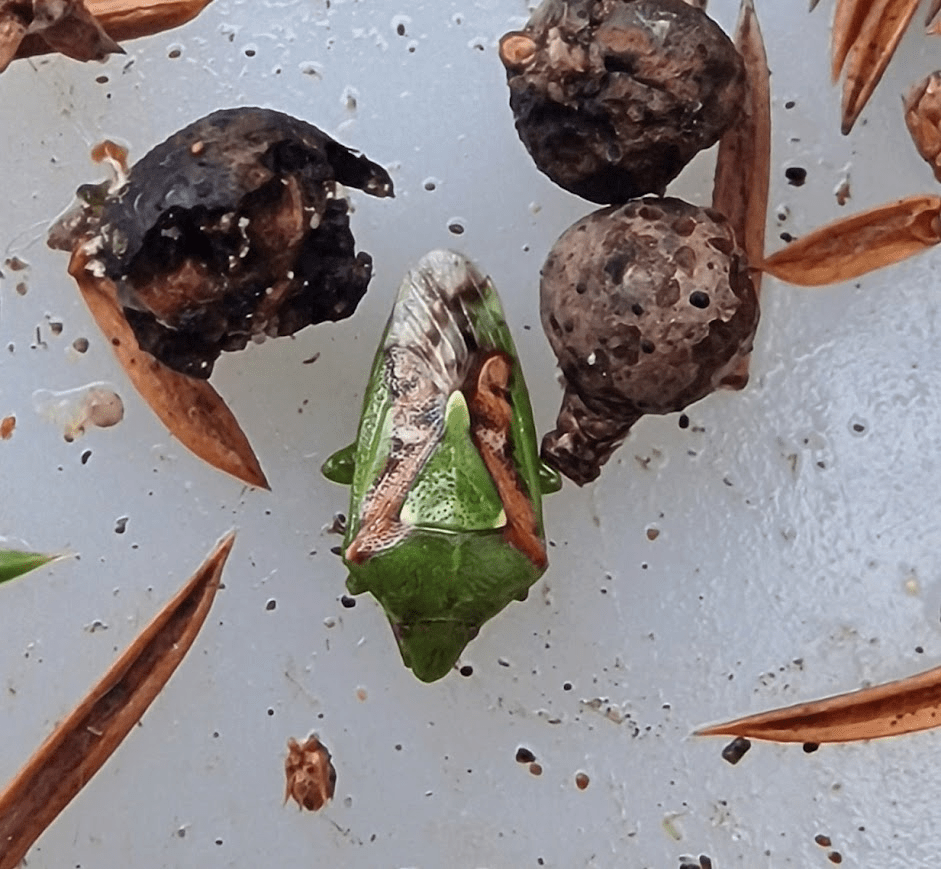
Cyphostethus tristriatus Junipers Shield Bug.
Formerly a southern shieldbug but has had a significant range extension of late. Formerly restricted to Juniper woods in southern England, the Juniper Shieldbug (Cyphostethus tristriatus) is now common across southern and central England, having colonised planted Junipers and Cypresses in gardens. It has also been recorded on native Juniper in northern England and Scotland.North West Invertebrates, Juniper Shieldbug
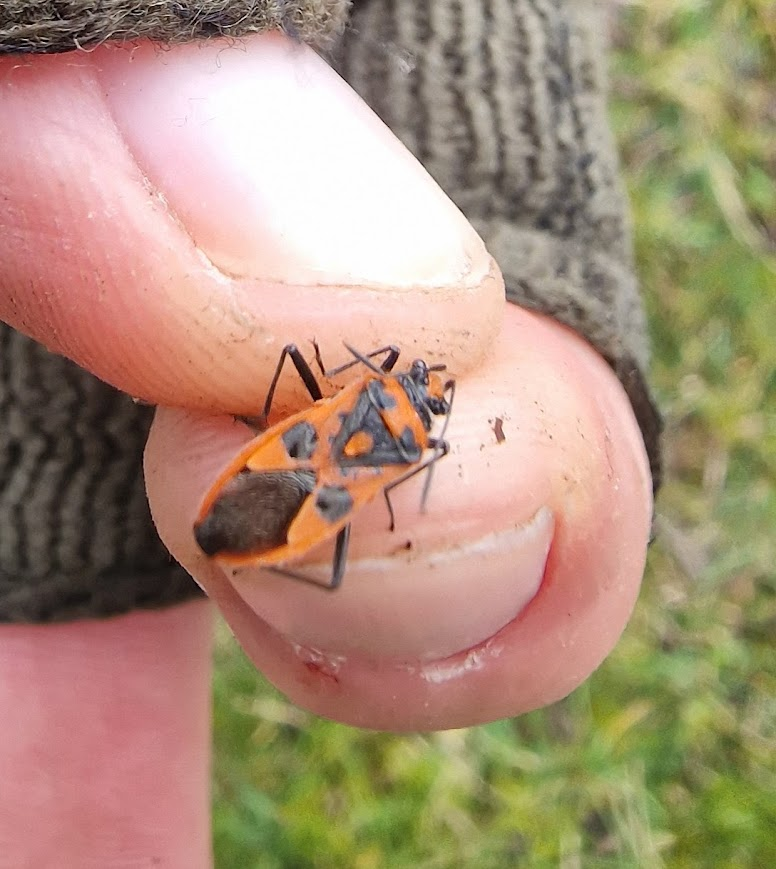
Although historically confined to the coasts of southern Britain, this species is now found inland throughout England and Wales as far north as Yorkshire. It is associated with a range of plants, and overwinters as an adult, the new generation appearing in August-September. Nymphs are yellow/red-brown in colour and also rather hairy.British Bugs Corizus hyoscyami
I took the photos in this blog post to bring your attention to some marvellous things in nature, in Sussex, that are hidden from the public. I will not name the Sussex wood I trespassed in to take these photos.
If you go down to the woods today, you’re in for a big surprise: a third of England’s woodlands are owned by just a thousand landowners.
That’s the central finding of my new investigation into who owns England’s woods. The analysis also raises questions how private woods are used – with many of them kept off-limits to the general public in order to maintain them as pheasant shoots, despite receiving public subsidies. https://whoownsengland.org/2020/11/02/who-owns-englands-woods/Guy Shrubsole accessed 16.11.15
The ownership of land in Sussex
Much land in Sussex is in private ownership and walking in significant amounts of that land is currently prohibited by signs denying public access; often this is associated with pheasant shooting. But pheasant shooting also effects land with public access as well as private land where shooting occurs. I recently walked through a public-access SSSI scarp-face ancient wood in West Sussex, adjoining a private wood used for pheasant shooting. I saw and heard many pheasants in this wood I was walking through. I had a lunchtime half pint of cider in the nearest pub to the wood, and in the pub there was a group of pheasant shootists there bragging (loudly) about how many pheasants they had shot. The existence of private woodland for pheasant shooting has a negative impact on much woodland – private and public.
For many years, we have been concerned with the impacts of two of the most intensive forms of shooting: driven grouse, and the high-density release of Pheasants and Red-legged Partridge for shooting. Our studies have identified that various key practices are causing particular ecological harm, with implications for both biodiversity and the climate emergency. The big issues: the illegal killing of birds of prey, the use of lead ammunition, the burning of peatland habitats and the release of millions of non-native Pheasants and Red-legged Partridges into the natural environment. RSPB The Facts about Intensively-Managed Game-Bird Shooting. RSPB The facts about intensively-managed gamebird shooting
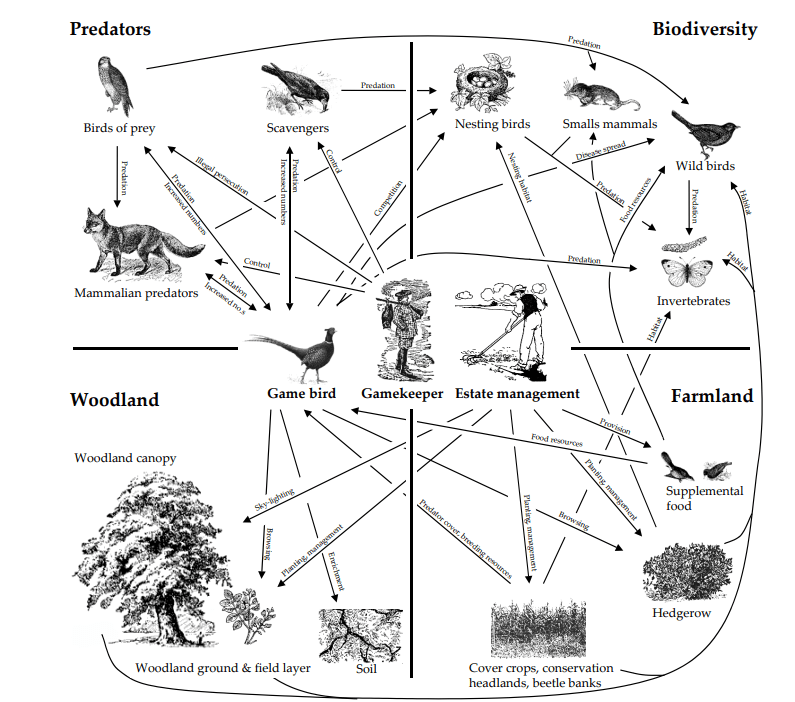
Many of the potential impacts of gamebird releasing are poorly studied and understood, and are often under-represented in the peer-reviewed scientific literature. A common theme emerging from these reviews is that the ecological impacts of gamebird releasing appear to be strongly polarised, withpotential negative effects associated with the released birds (e.g. enhanced predator abundance and predation, increased disease transmission, altered habitat structure, reduced invertebrate abundance. Mason, L.R., Bricknell ,J.E., Smart, J. & Peach, W. J. (2020) The impacts of non-native gamebird releasein the UK: an updated evidence review. RSPB Research Report No, 66 RSPB Centre for Conservation Science, Sandy UK. Downloadable from RSBP Game bird shooting – laws and impact
Screenshot from Mason, et. al (2020)
Here is an indication of how much land is in public ownership in the Western (West Sussex) South Downs. Of the top five owners of land in Sussex by acreage owned, only one is a public body. (The wood that these photos were taken in is not in West Sussex). These data are from Guy Shrubsole & Anna Powell-Smith’s excellent Who Owns England: Who Owns the South Downhttps://whoownsengland.org/2018/02/16/who-owns-the-south-downs/ accessed 16.11.25
… the current 4th Viscount Cowdray … has donated £65,000 over the past decade to UKIP, the Conservatives and Vote Leave …
2) Duke of Norfolk – Arundel & Angmering Estates: 16,000 acres
… “Since William rose and Harold fell, / There have been Earls at Arundel.” So reads a plaque in the shadow of the magnificent Arundel Castle, stronghold of the Earls of Arundel, whose proximity to power down the centuries eventually also earned them the Dukedom of Norfolk. ..
“When the 15th Duke stood on the battlements of his newly repaired keep in 1910, he would have had the satisfaction of knowing that almost everything he could see in all directions belonged to him.” Although the Ducal estate is thought to have diminished in size since then, it is still… The Estate’s origins go back to the Norman Conquest.”
3) National Trust properties across the South Downs: 15,151 acres
…his family estate also includes 3,000 acres in Cumbria ….
5) Duke of Richmond – Goodwood Estate: 11,500 acres
As the [Independent, Sean O’Grady Thursday 30 July 2009. Earl of March: A glorious example of the landed classes; says [The Duke of Richmond] has “leverage[d] Goodwood’s formidable competitive advantages – the things that cannot be replicated elsewhere (except by other landed families, presumably): vast (and beautiful) space and a magnificent stately home”. But these modern businesses depend on owning land inherited down the centuries: “Even if they wanted to, it is difficult to imagine any company, oligarch or Middle Eastern princeling acquiring such an enormous chunk of southern England [nowadays].”
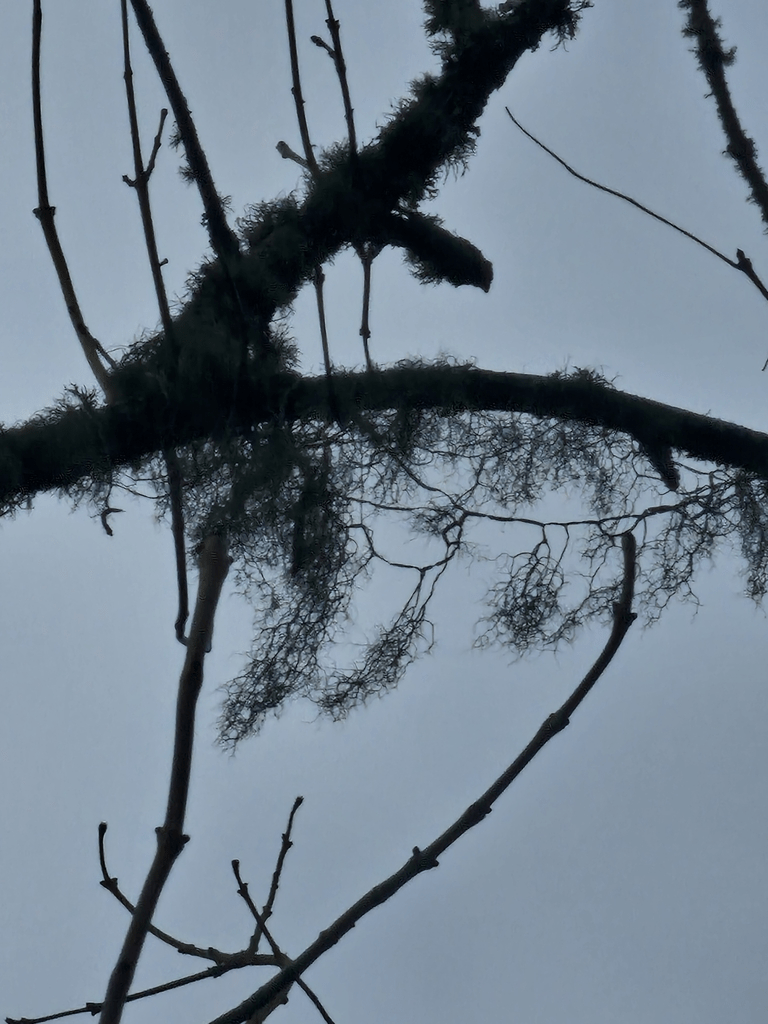
I have trespassed in an SSSI wood owned by one of the above, which the public are denied access to. It has outstanding and rare natural heritage, including this Usnea articulata String-of-Sausages Lichen, extremely rare in Sussex. This wood is regularly used for pheasant shooting. As I was walking around it I saw dead pheasants that had been left on the ground from a hunt of a few days before.
In an ideal world land would not be owned by individuals; but in the absence of a change to the ownership of land, I believe:
(2) the ownership of land should be taxed through a Land Value Tax, see: Labour Land Campaign What is Land Value Tax (accessed 16.11.25)
I am not urging you to trespass. If you choose to trespass, please follow the guidelines from the Right To Roam that are cited at the end of this post
The wood that I trespassed a few days ago and its natural wonders
This woodland is a Site of Special Scientific Interest that is believed to have been continuously wooded since medieval times. The wood’s soil is clay; and the wood is dominated by sessile oak, pedunculate oak, hornbeam and hazel with some ash and alder, with an understory of holly and bramble. The hornbeam and hazel have been previously coppiced. The sign on the gate as well as saying the land is private warns of shooting occurring in the wood.
The rides are lined by goat willow, aspen, blackthorn, hawthorn and silver birch
There is a boundary bank and ditch planted mostly with coppiced hornbeam, that exactly follows the parish boundary shown on the OS map
Honrbeam
Sessile Oak and Hornbeam
Graphidaceae family lichen possibility Graphis scripta on a Hornbeam
Sessile Oak in “tall forest” woodland
Hazel
Holly
Sessile Oak, with a sheet of the lichen Dendrographa decolorans on the dry side of the tree
Sessile Oak leaf on the base of the tree above
The lichens Lecanactis abietina (an old tree lichen) and a Chrysothrix sp. (Gold Dust Lichens) on a Sessile Oak
Coppiced Hornbeam
Clouded Funnel fungi
Sessile Oak
Bark Barnacle Lichen on Sessile Oak
Brnacle lichen is found mainly on the bark of living trees in ancient woods, and it is indicative of longstanding woodland conditions. Woodland Trust Bark Barnacle Lichen
Sessile Oak covered in Usnea cornuta
Parish boundary bank with coppiced Hornbeam
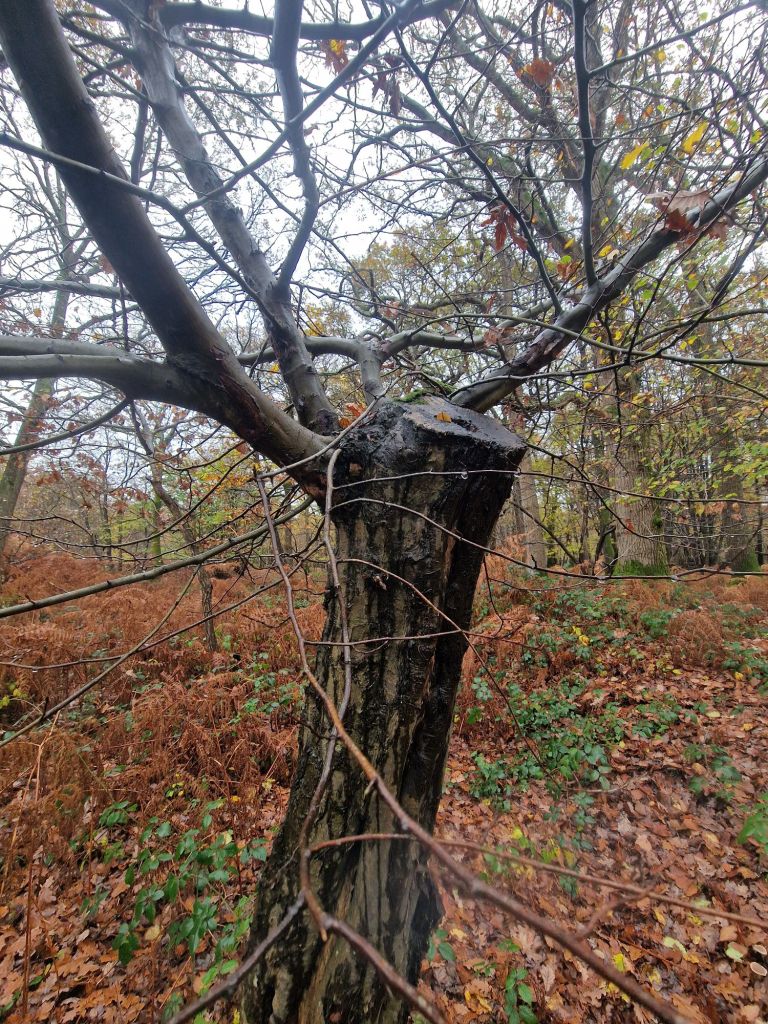
A recently pollarded young Hornbeam – showing continuity of ancient woodland management practices
Coppiced Hornbeam
A Hornbeam with a range of Pertusaria spp. Hornbeams often have many genus Pertusaria and family Graphidaceae
Lepra (formerly Pertusaria) amara, Pertusaria pertusa and Pertusaria leioplaca. Terrestrial molluscs love eating the apothecia of Pertusaria. L. leioplaca seems their favourite; it must be their caviar.
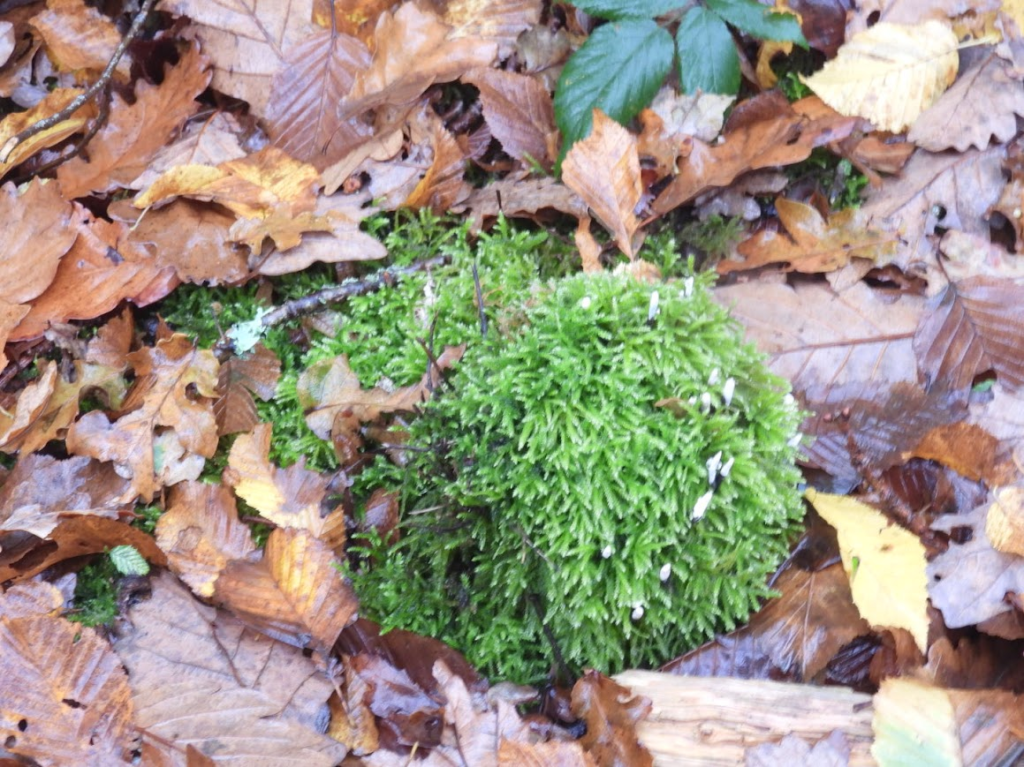
Ball of Common Striated Feathermoss with Candlesnuff fungus,
You’ve all seen signs claiming ‘Trespassers Will Be Prosecuted’. They’re a lie.
In the UK, ‘trespass’ is a civil offence, provided you don’t infringe certain conditions. You cannot face criminal prosecution simply for being on someone else’s land without permission (or away from a designated Right of Way, open access land or land where any bylaws permit public access). The dispute is solely between you and the landowner, and the police cannot get involved.
That landowner could theoretically take you to civil court. But they’d have to know who you are, and it would most likely be a waste of their time.
Likewise, any ‘damages’ would have to be proportionate to the damage you’ve caused, which if you follow our principles of trespass below, should be zero.
However, the legal situation changes if you do any the following when trespassing on land:
Cause damage to property
Disrupt lawful activity
Conduct yourself in a threatening or abusive fashion
Bring a vehicle, intending to reside & cause damage
Enter land with special restrictions* (see below)
That would be classed as ‘criminal trespass’, which is a criminal offence, leaving you potentially subject to police enforcement.
*Important Note: there are certain sites with special trespass designations which do make your mere unauthorised presence a criminal offence. The penalty for violation can be serious. Mostly, these are common sense. Avoid military sites, essential infrastructure (e.g. railways, airports, nuclear facilities) and stay away from the sorts of places the King might be having a cup of tea (or the Prime Minister hosting an illegal party).
Right to Roam follow some key principles when accessing land without permission. We do not condone actions which break these rules, as these will simply undermine our campaign.
Take responsibility for your own actions
Respect people’s privacy, domestic property and gardens
Don’t walk where crops are growing (stick to field margins or use alternative routes)
Avoid places that don’t feel like open countryside (e.g. have buildings or machinery)
Respect livestock and other animals kept on the land such as ponies and horses (i.e. avoid closed paddocks). Remember that cattle – especially bulls or cows with calves – can be dangerous
Care for nature (avoid fires, wildlife disturbance or damage to flora)
Since civil trespass (i.e. simply existing on land) is not a criminal offence it is especially important that it does not become associated with criminal activity. Damage nothing. Disrupt no lawful activity. Peacefully enjoy what you came to experience.
Voices from the seventieth century
The gentrye are all round stand up now, stand up now The gentryeare all round stand up now The gentrye are all round on each side the are found Their wisdom so profound to cheat us of our ground.
The Diggers Song, Gerald Winstanley, 1650 True Levellers (Diggers)
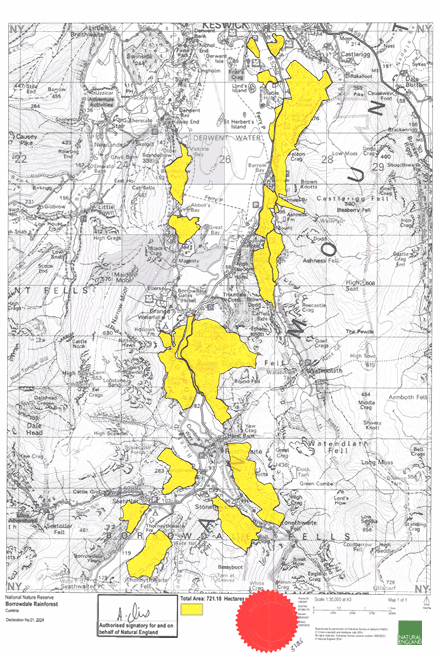
At last the bus 78 to Seatoller was running after the road flooding had subsided! I could visit the woods at the south of the Borrowdale Rainforest NNR that I had intended to visit on 03.10.25
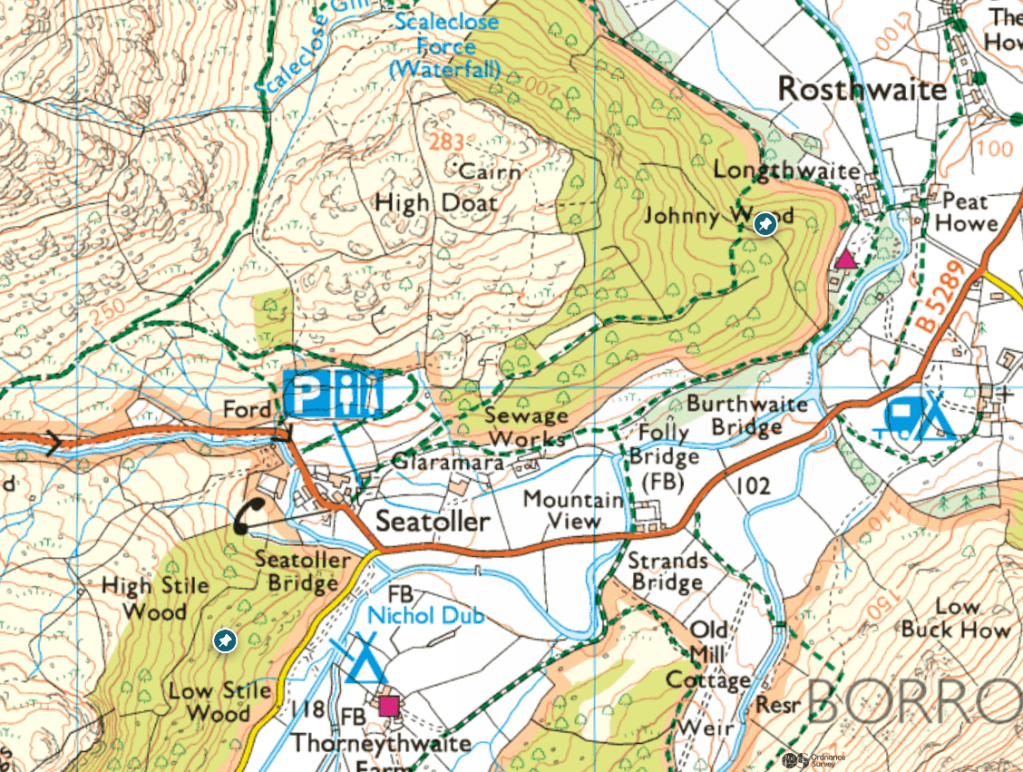
Getting off at Seatoller, I decided to visit some of southernmost woods of the NNR: High Stile and Low Stile Woods; named as “Seatoller Wood” on the Natural England map of ancient woodland, . When I got to these woods they were fenced off with “private” signs, despite them being marked as public access land on the OS map. As I said in my post of 03.11.25, I had had to do lots of research to find where the constituent parts of the NNR are. The National Trust website on the NNR doesn’t have a map of the NNR, and there is no Natural England visitors’ guide, as there is for other NNRs. There is also no information on which parts of the NNR have public access and which don’t. The only way to find out whether or not there is no public access is to visit the woods and find out for yourself, when you have found out where the constituent woods in the Borrowdale Rainforest NNR are.
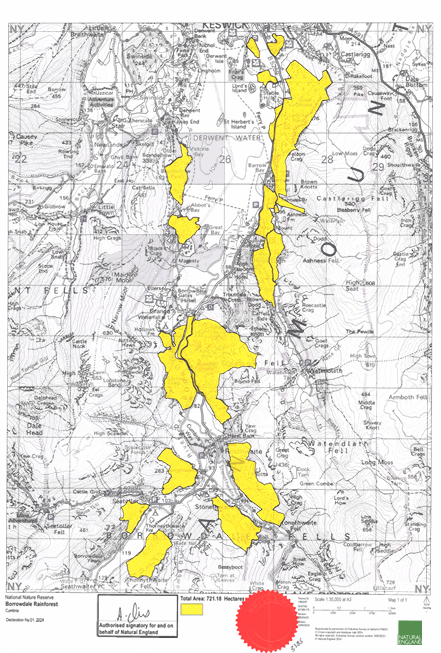
The only way I found out where the constituent woods of the NNR were, was by looking at the declaration of NNR map on the government’s website. I then had to cross reference this map with the OS map to find the names of the constituent woods of the NNR.
I support the right to roam (visit Right To Roam) but in the absence of a right to roam, the very least public bodies administrating NNRs should do is to tell the public where parts of NNRs are and which can be visited
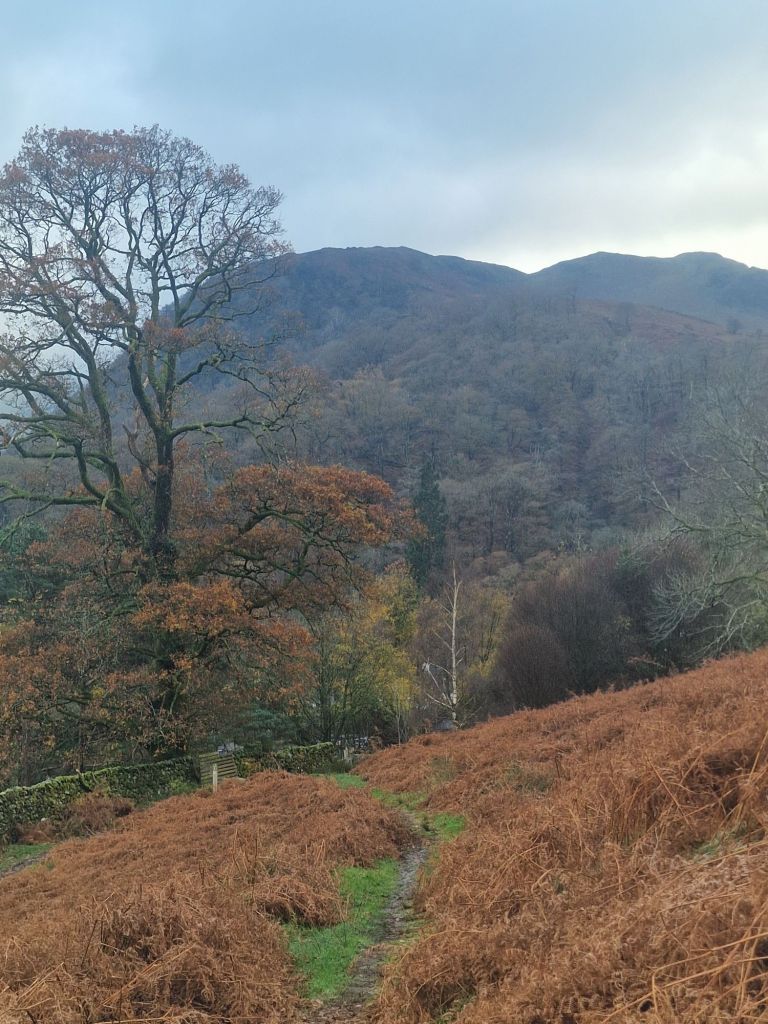
High and Low Stile Woods from Johnny Wood
Johnny Wood
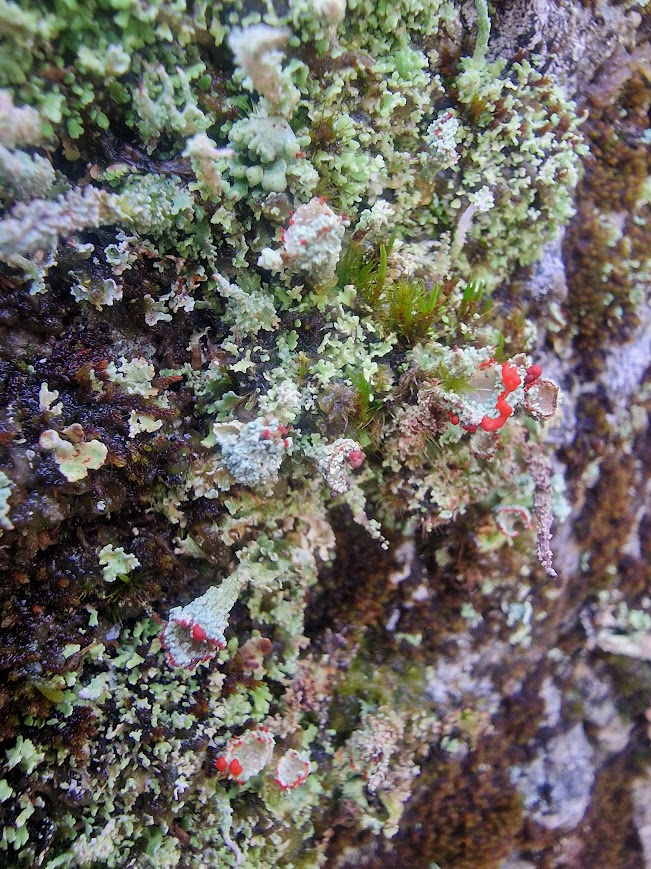
Lichens on a dry stone wall at the beginning of the wood
Probably Cladonia polydactyla, with bright red apothecia (fruiting bodies) on the edges of its cups; growing with/on moss
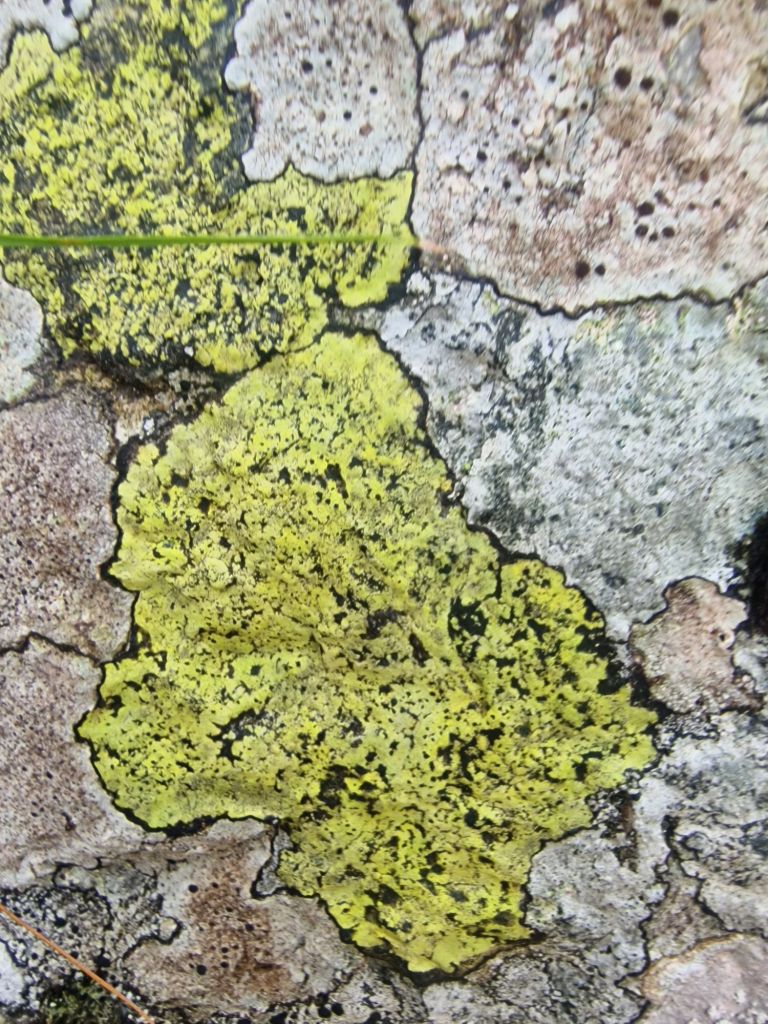
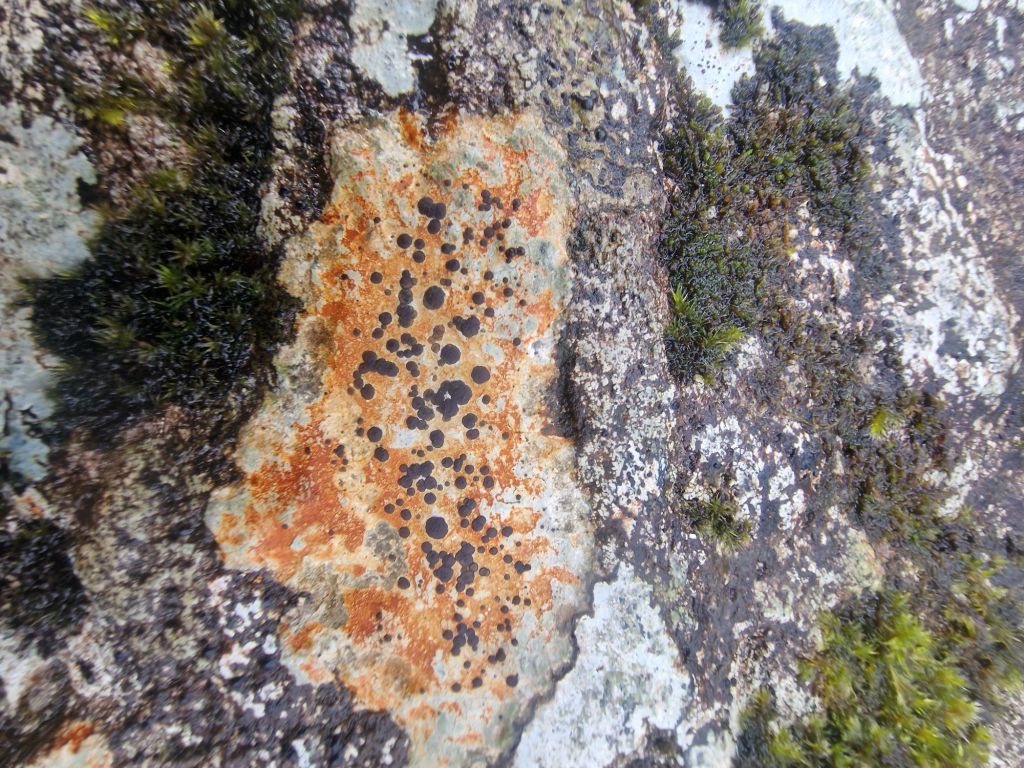
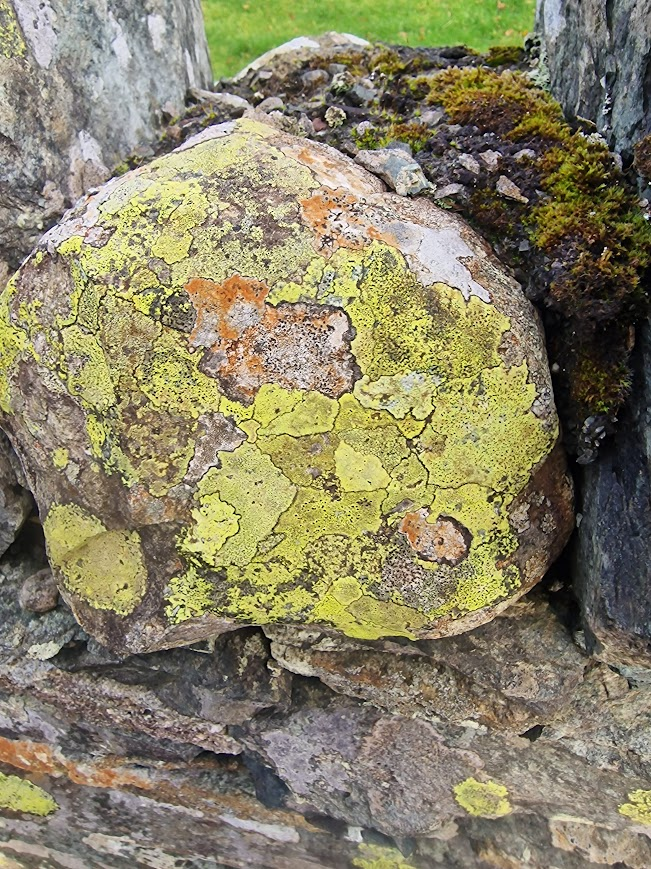
Rhizocarpon geographicum (green and black) in a mosaic with Lecidea lithophila (white thallus with red tinge and black apothecia) and an other lichen
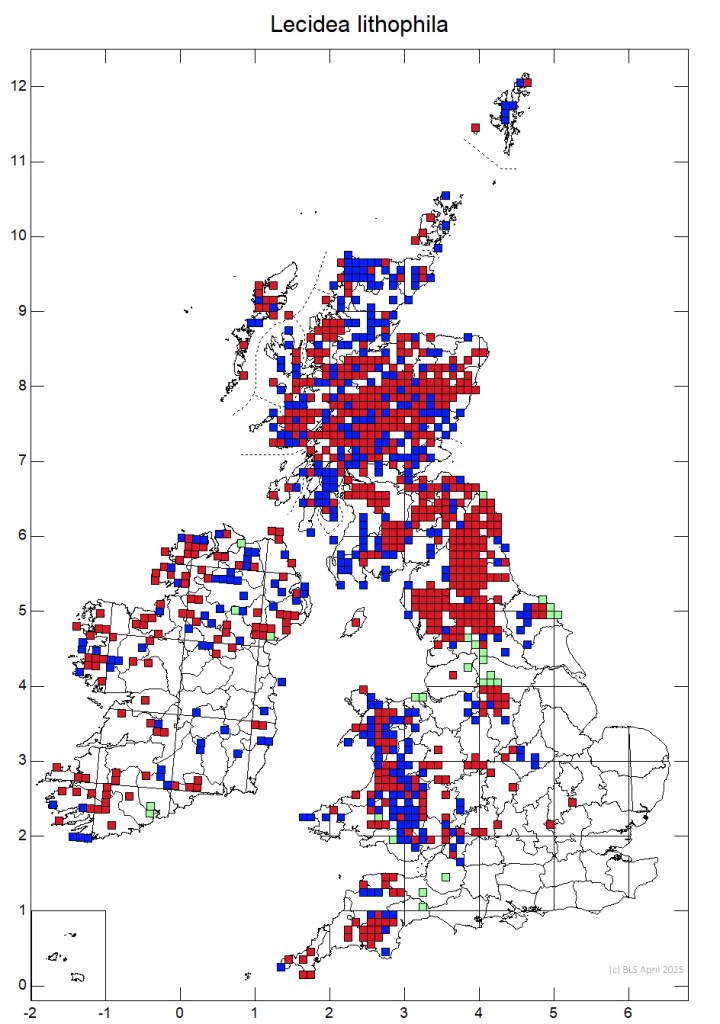
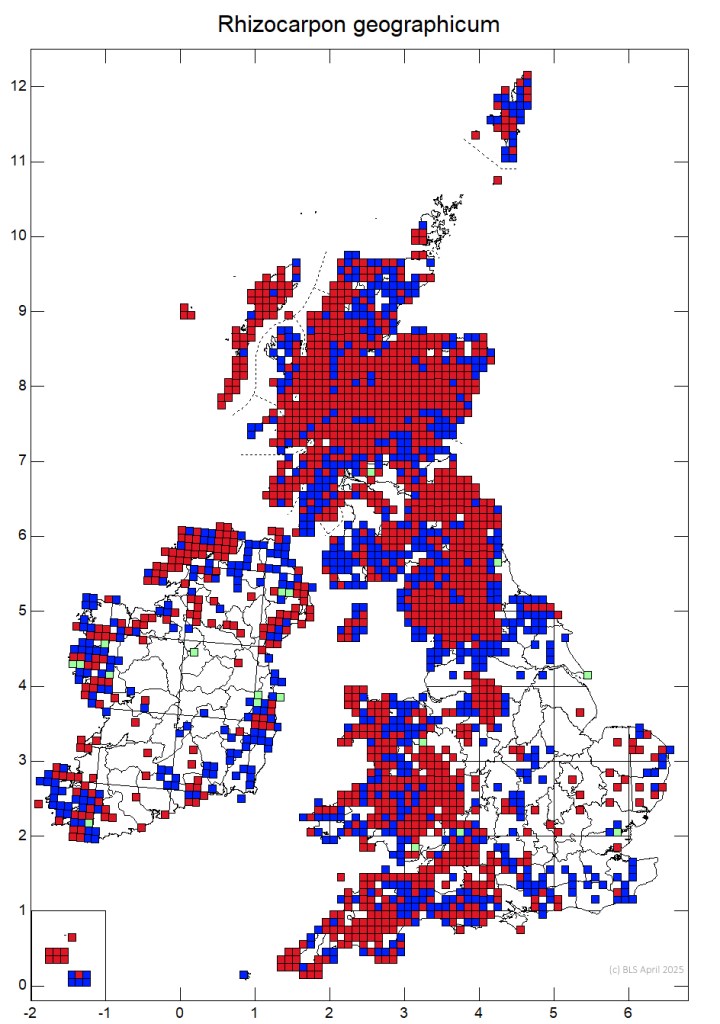
Rhizocarpon geographicum and Lecidea lithophila are extremely common in Borrowdale; in Sussex (where I live) Rhizocarpon geographicum is rare, and restricted to church yards, Lecidea lithophila is non-existent in Sussex. North-West lichen enthusiasts are probably not that excited by seeing these lichens but as a Southerner seeing these was very interesting.
Distribution Maps (British Lichen Society) Lecidea lithophila & Rhizocarpon geographicum
Lecidea lithophila
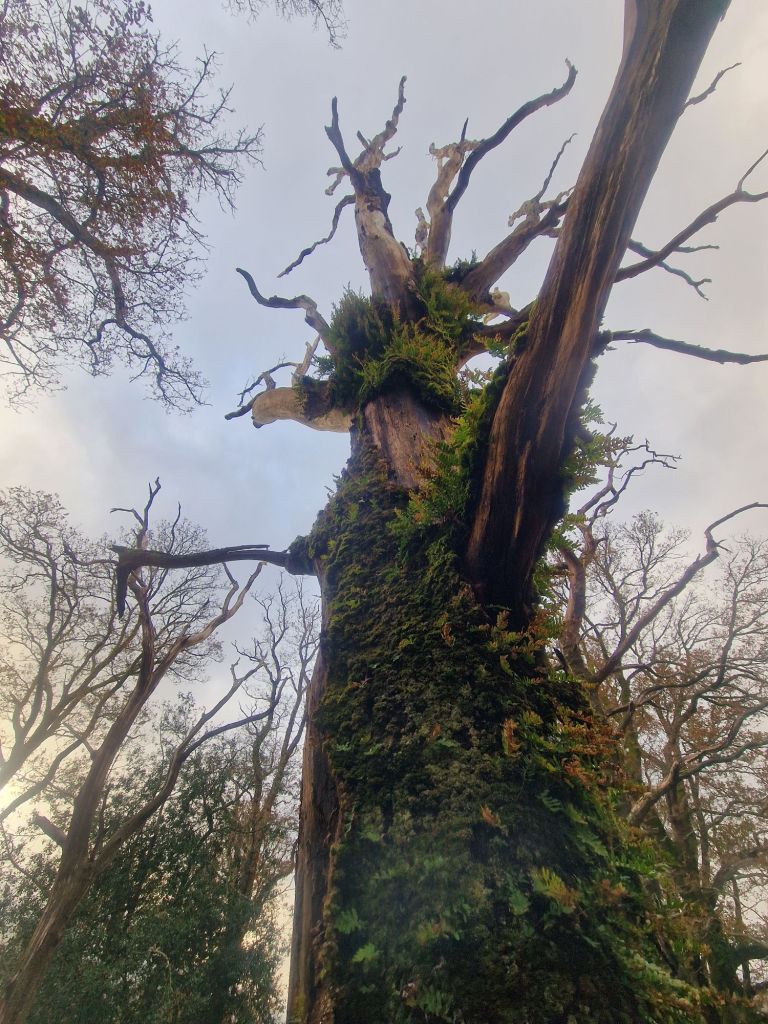
A dead Sessile Oak
which reminded me of the Statue of Liberty
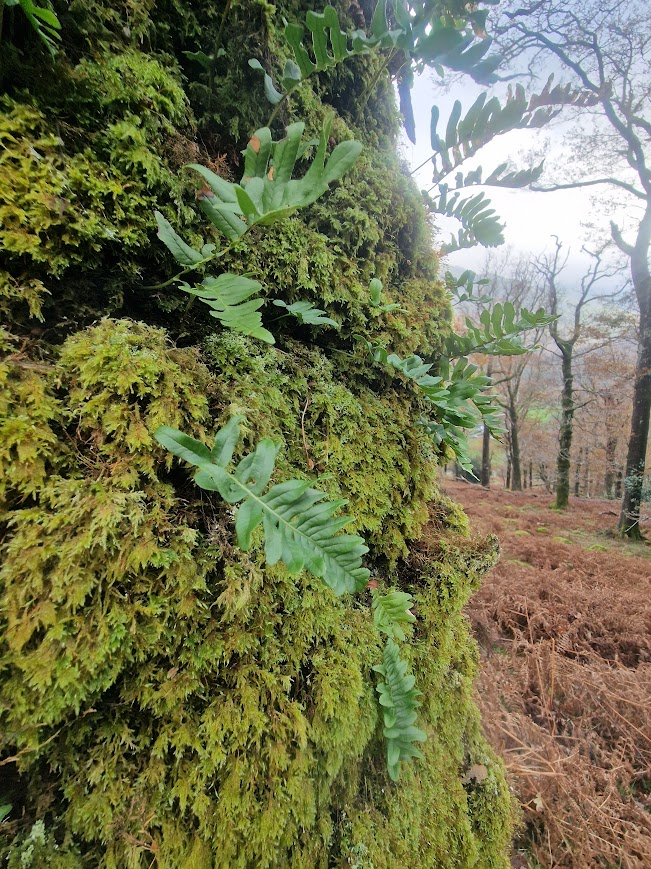
The trunk of this tree is still a viable substrate for epiphytes (because epiphytes take no nutrition from their substrate) including mosses, polypody ferns and lichens
Polypody fern
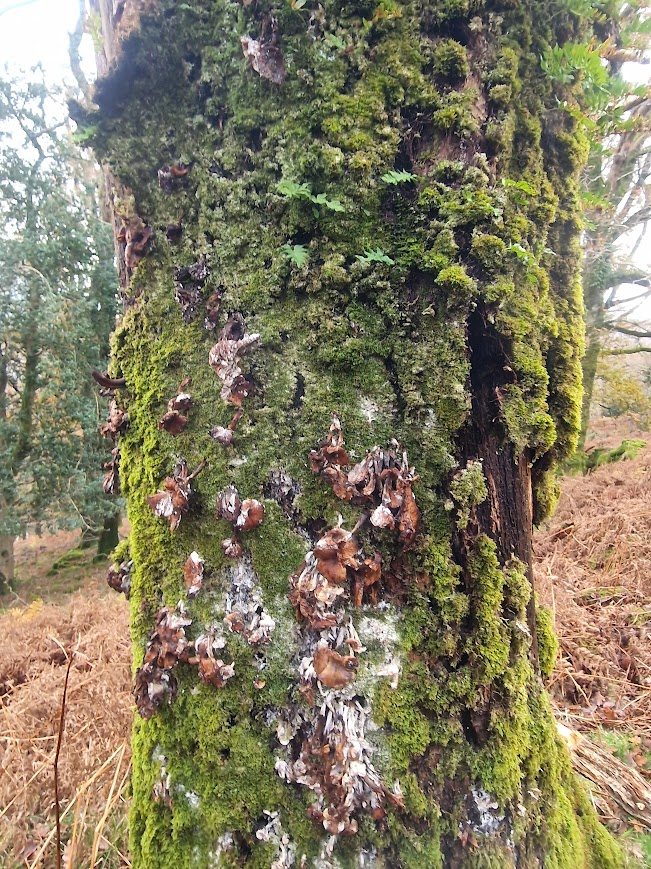
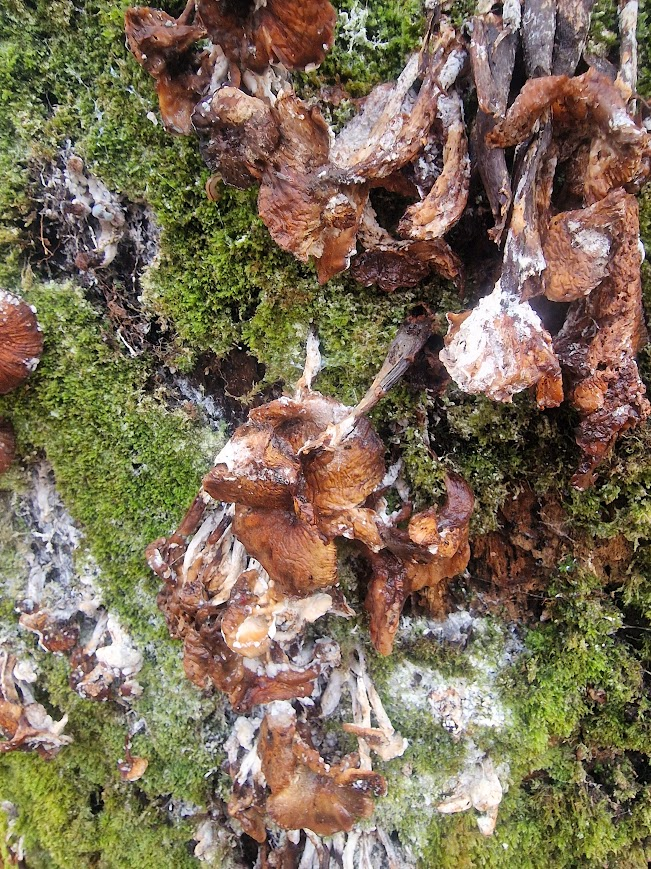
Physalacriaceae family fugus on tree
Physalacriaceae spp. are saprobic; i.e. they obtain nutrients by breaking down dead and decaying organic matter, serving a useful ecological function
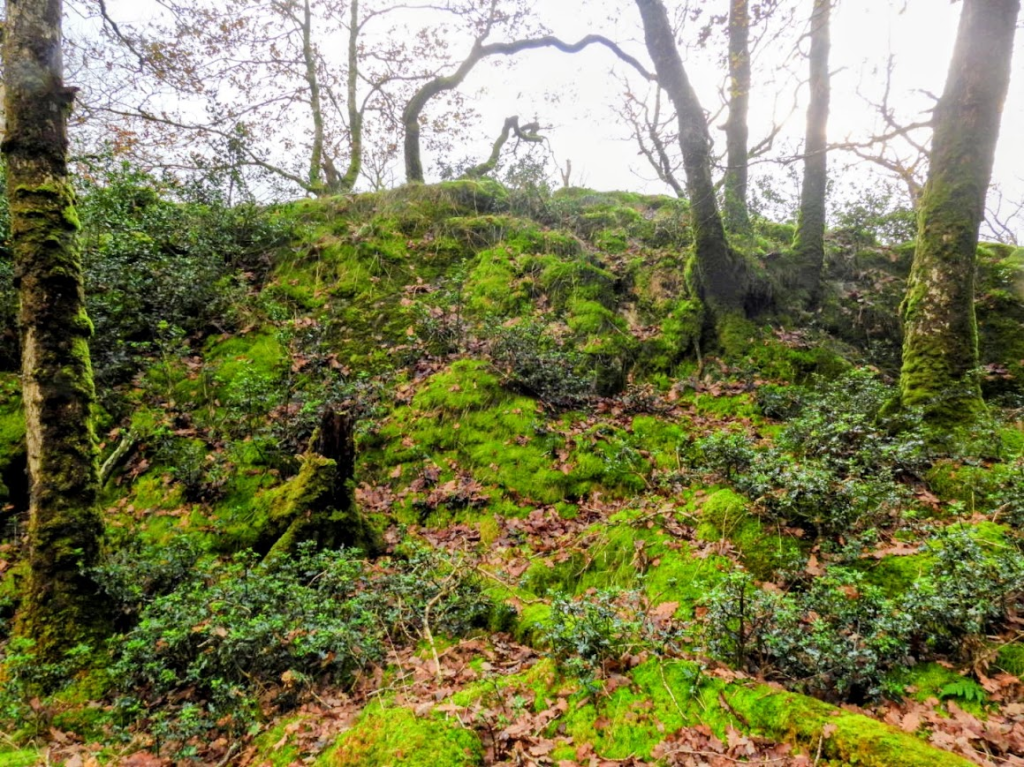
This rocky bank as covered in mosses
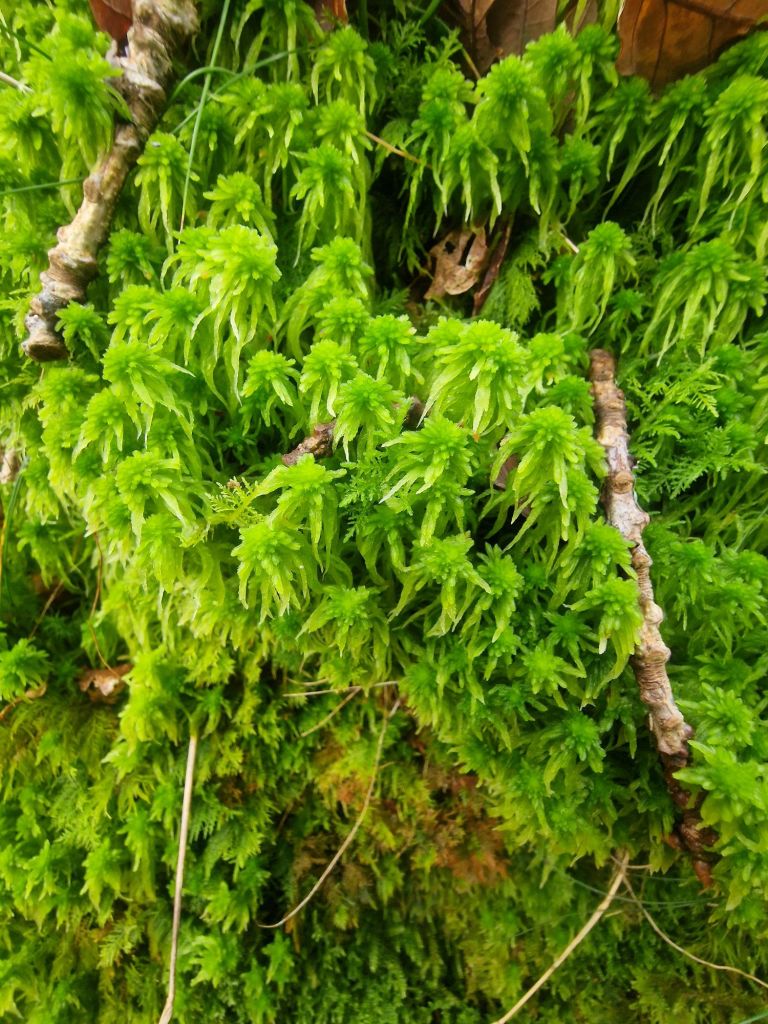
A sphagnum moss probably Sphagnum palustre was at the top of this bank.
The demonstrated the difference between habitat in the south (where I live) & the north-west temperate rainforest. Sphagnum palustre in Sussex is found in bogs and wet flushes with a supply of water from springs or streams. In Borrowdale, it is also at the top of this rocky mound because it rains a lot ; in the south, it doesn’t rain enough for that.
Seathwaite, Borrowdale: This village is the wettest inhabited place in England, receiving around 3,500 mm (138 inches) annually.Visit Cumbria Weather in the Lakes
The average annual precipitation in Sussex is around 914mm (36 inches)Climate Data Sussex
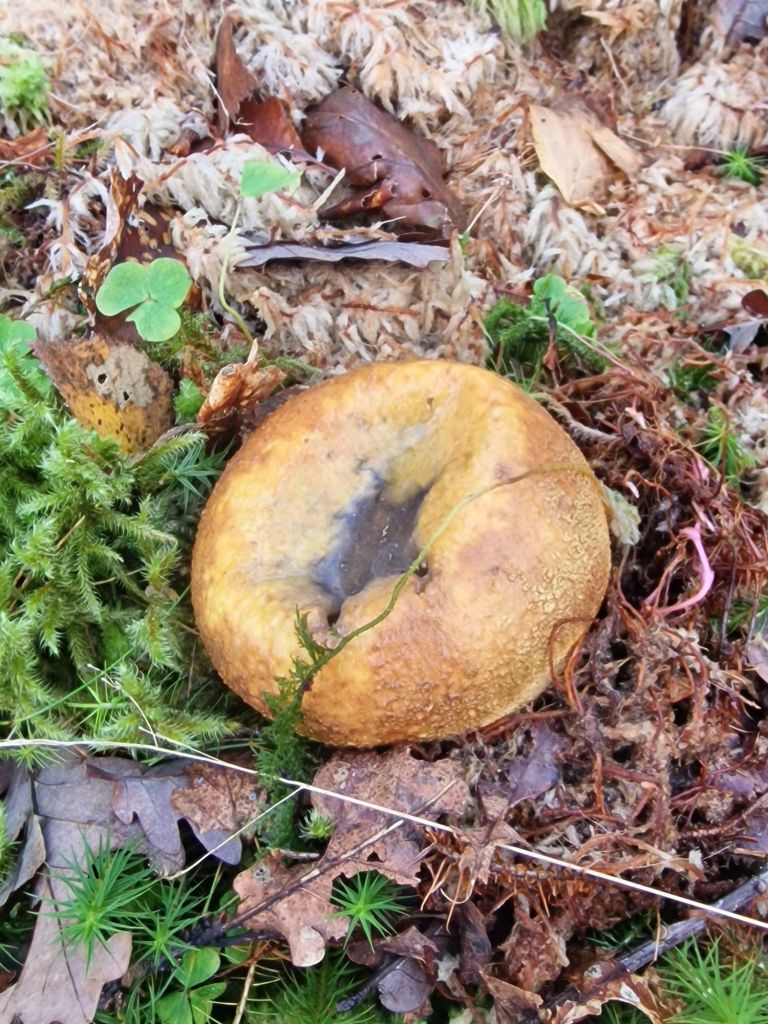
Scleroderma citrinum Common Earthball
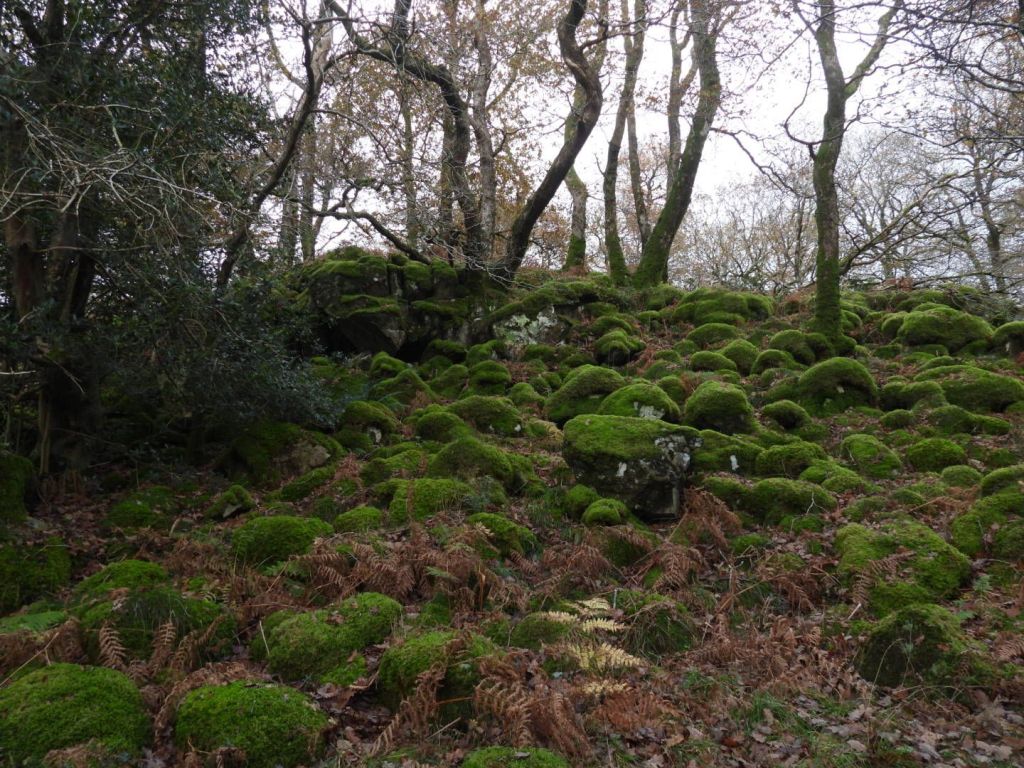
Mossy boulders
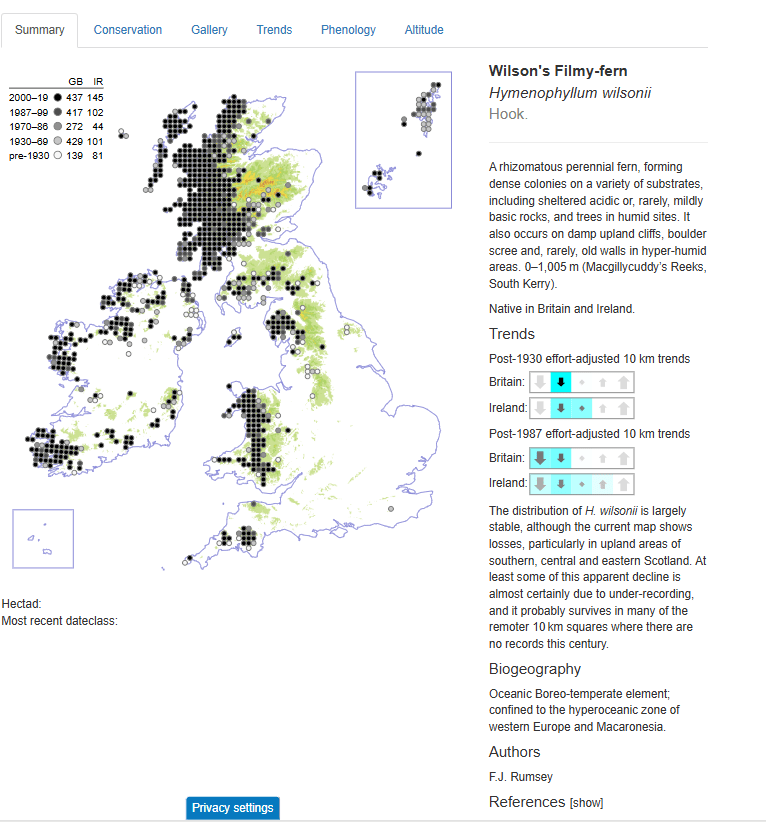
In Johnny Wood, Wilson’s Filmy-fern can be found. I have never seen it. So I explored likely filmy-fern outcrops to try and find it.
Filmy Ferns are characteristic of temperate rain forest
Wilson’s Filmy Fern has a similar distribution to Tunbridge Filmy Fern
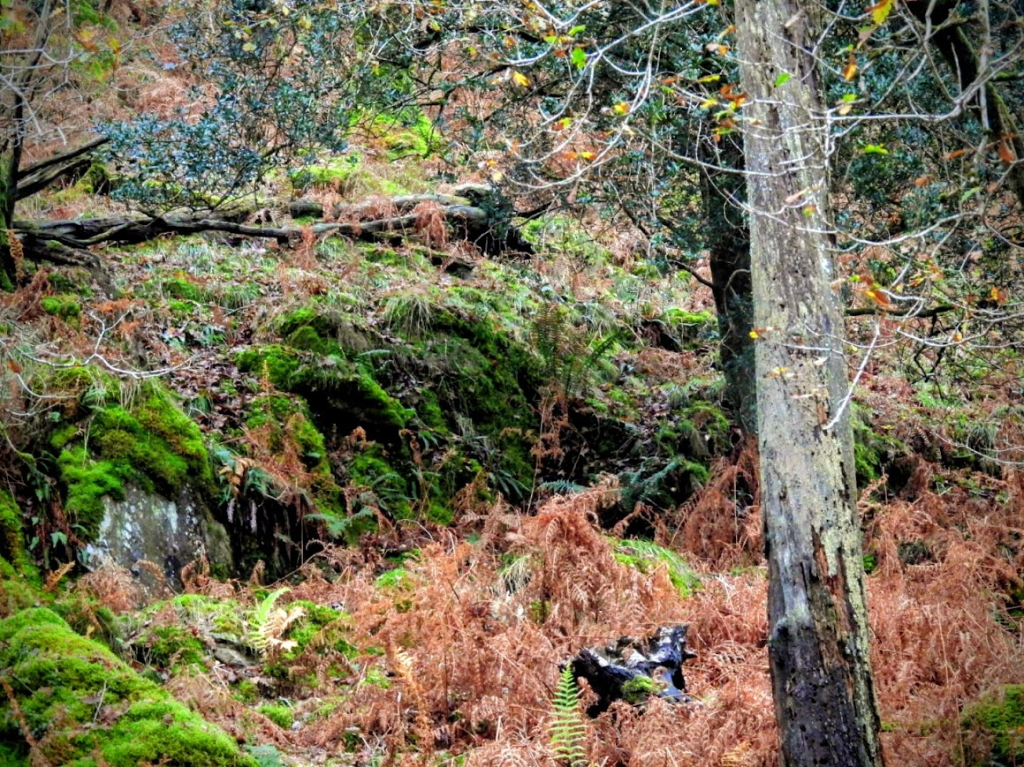
Following my success in finding Tunbridge Filmy Fern in the High Weald (an outlier population in the of Sussex where the These unique geological features of the High Weald produce create a localized, hypo-oceanic microclimate that supports plant species typically of western Atlantic woodland), I explored rock outcrops like those ones I have seen Tunbridge Filmy Fern on for Wilson Filmy Fern, like this one:
But when I climbed up to this rocky outcrop below, I “only” found common bryophytes e.g. White Earwort & Tamarisk Moss. But many “common” bryophytes are beautiful. I saw no Wilson’s Filmy Fern in any of the rock outcrops I explored.
White Earwort
Common Tamarisk-Moss
But as I have said before, I am never tire of seeing common beautiful things.
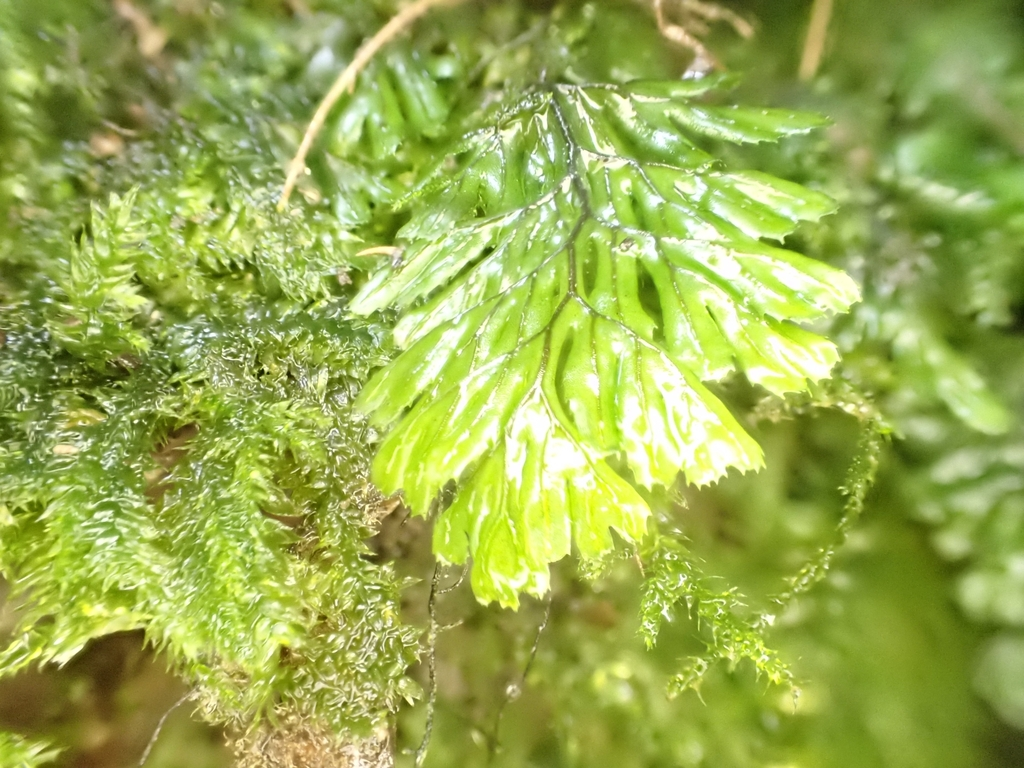
Here is some Tunbridge Filmy Fern I saw in Sussex to give you an idea of what Filmy Ferns look like!
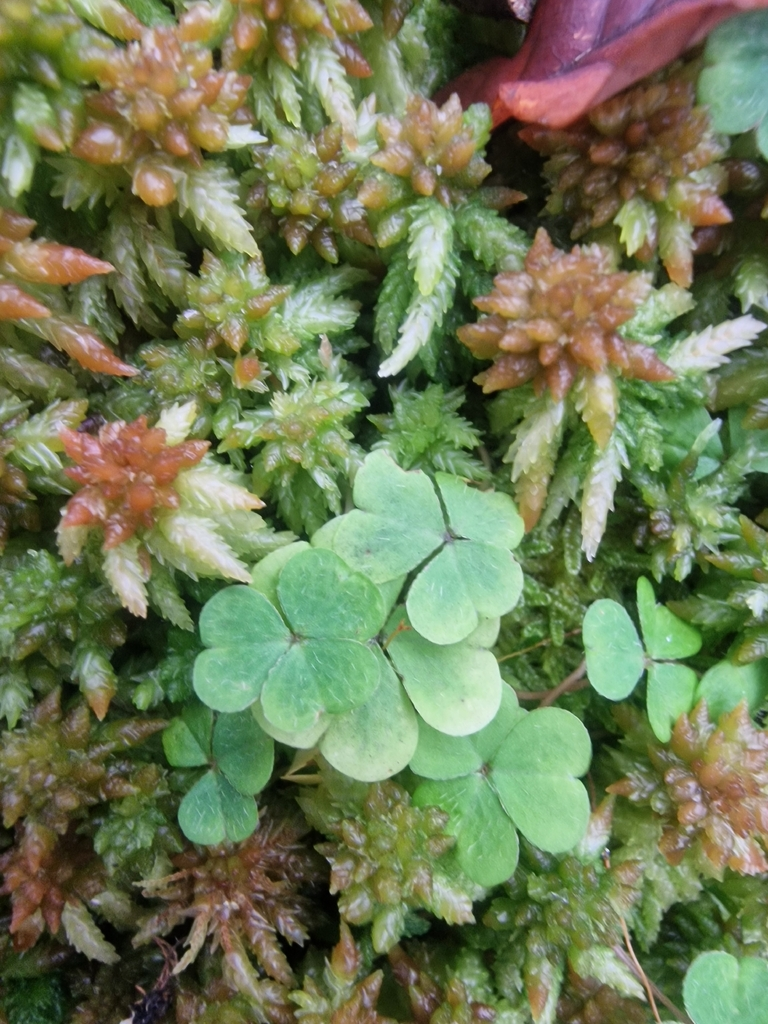
The leaves of Wood-Sorrel, an ancient woodland indicator species, growing though Sphagnum palustre
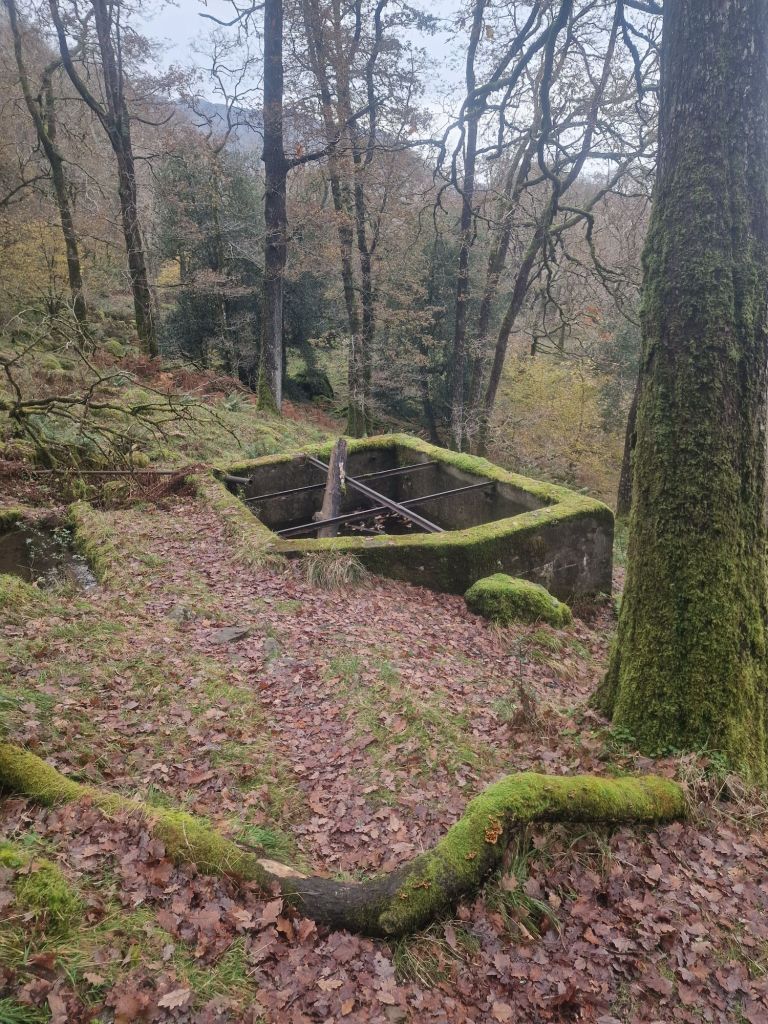
Concrete water reservoir. Ancient temperate rainforest woods in the UK are not untouched by human intervention. Most have always been part of living, changing landscapes formed by human-nature interaction.
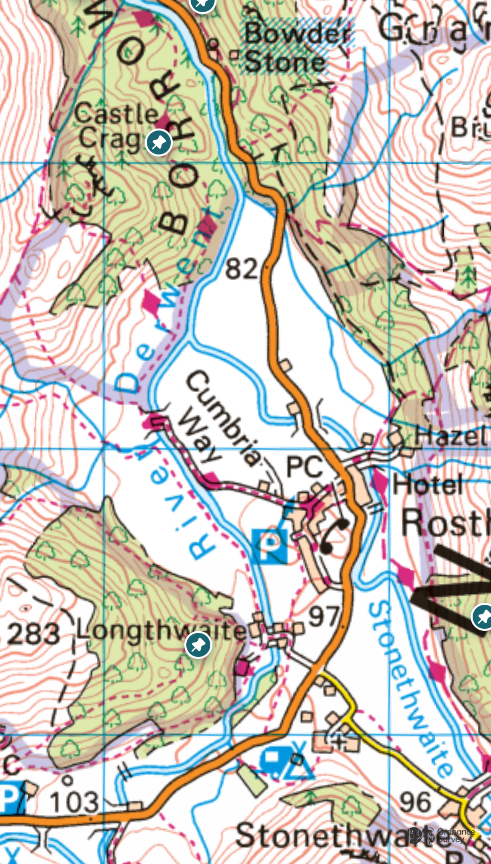
Waling along the River Derwent from Johnny Wood to the Bowder Stone
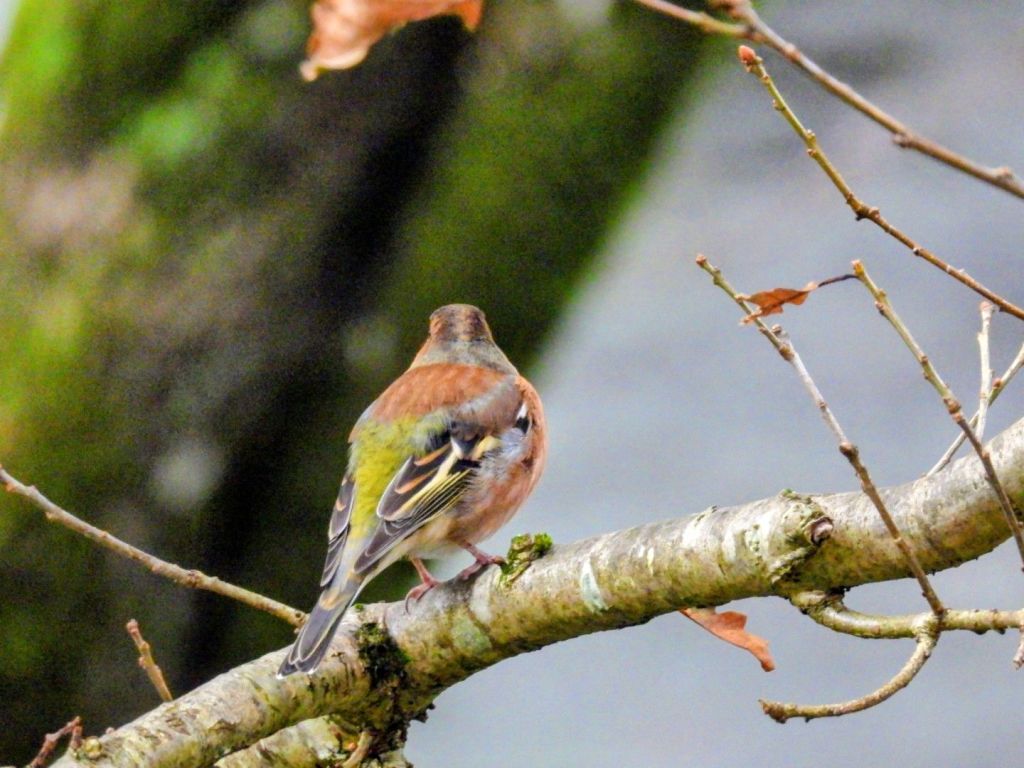
Walking along the Derwent I saw many birds, including this gorgeous juvenile Chaffinch
I also saw two White-throated Dippers dipping the Derwent for food. Both of them were quicky gone so I was unable to get a photo of them
Here is a Dipper I saw in the River North Esk south of Edinburgh in 2023
It is always a thrill to see Dippers
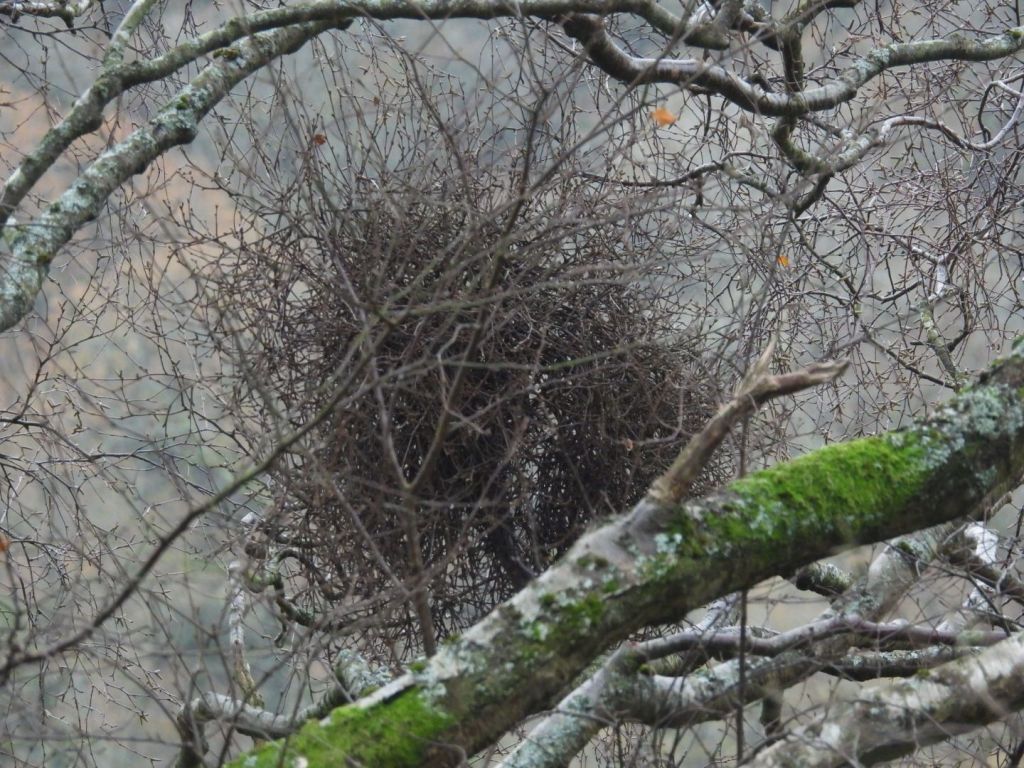
Witch’s Broom – Taphrina betulina (a fungal gall that effects the tree’s growth)
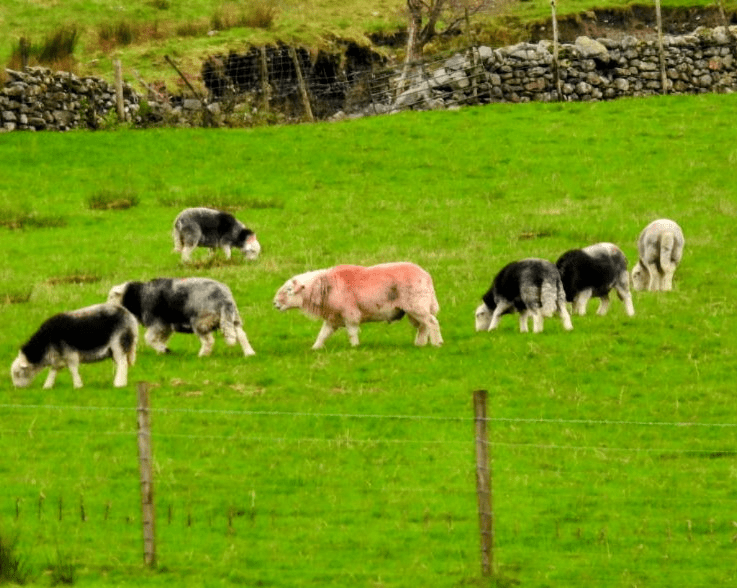
Herdwicks!
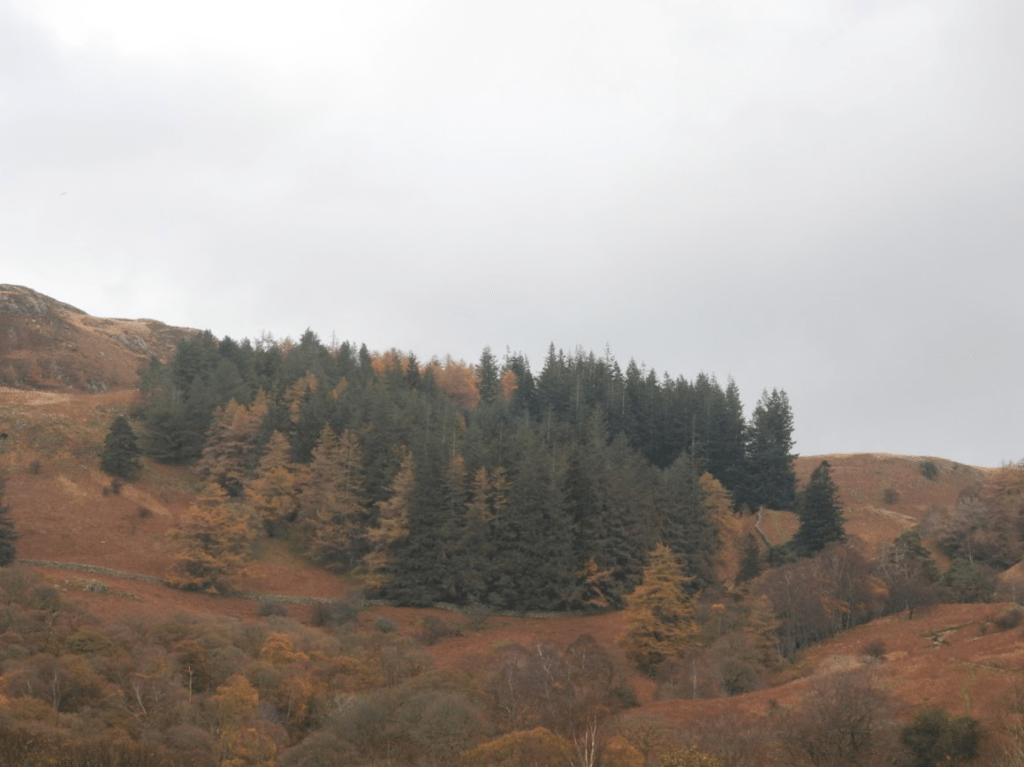
Not all of Borrowdale is Atlantic Oakwood; there is also much secondary woodland. Looking up from the valley, I could see Secondary Beech plantation
and Pine plantations
As Guy Shrubsole says: the Atlantic Oakwoods of Borrowdale remain fragmented and under pressureNational Trust Borrowdale NNR . Which makes it all the more important that the National Trust and Nature England point out to the public which fragments are Atlantic Woodland (Temperate Rain Forest)
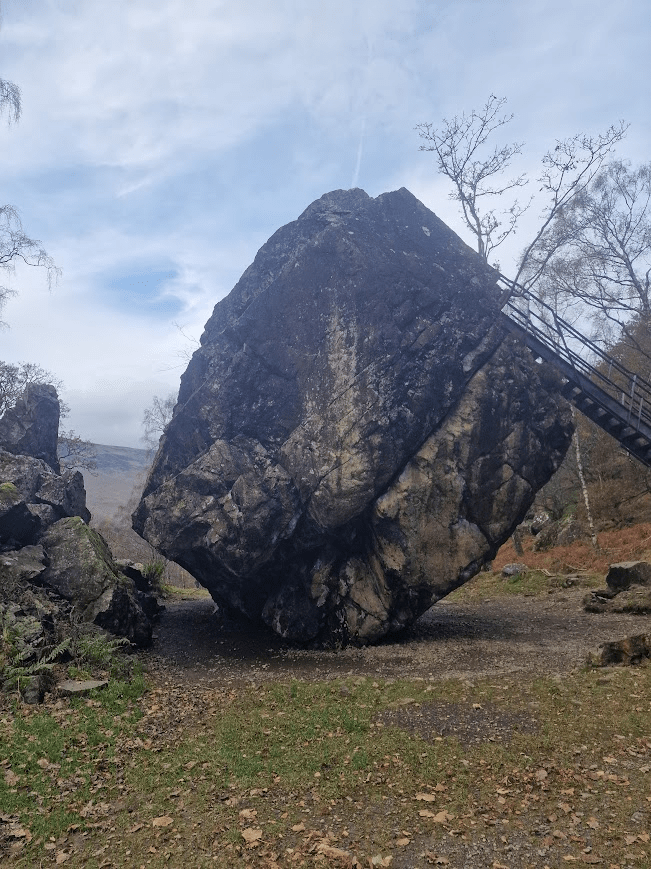
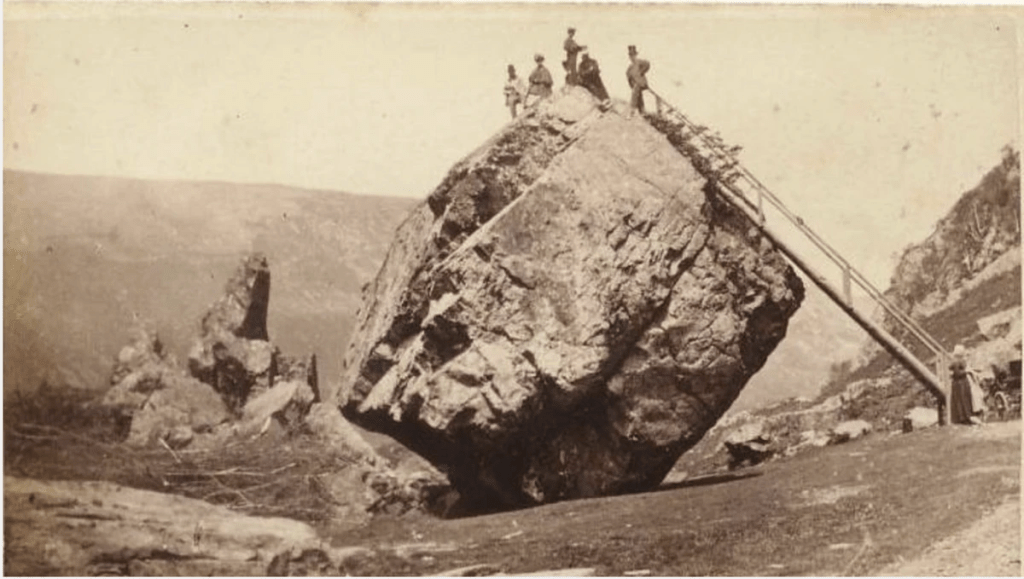
Bowder Stone
In the valley of the river Derwent, in Borrowdale, just north of Rosthwaite in a woodland clearing on the opposite side of the road from the river, stands a huge glacial boulder shaped like a human head that is one of several Cumbrian curiosities and, which has locally been called The Bowder Stone or Balder’s Stone, after the son of the Norse god, Odin (Woden). This ice-borne rock was carried down the valley by a glacier many thousands of years ago and deposited, having been trapped and then dislodged between the two side-slopes of the river valley.The Journal Of Antiquities The Bowder Stone, Rosthwaite, Cumbria
The boulder would have nestled deeply in the forests that covered the Lake District after the last ice age – the original ‘wildwood’ that predated human habitation in the Lakes. It stood unmoved through the coming of the people who built the Iron Age hillfort on Castle Crag, the Norse who created the many clearings or ‘thwaites’ along the valley for grazing, and the traditional woodland industries which coppiced and harvested the timber for firewood, building materials and leather tanning.
Two hundred years ago, the Bowder Stone was one of the most prominent landmarks in the valley – a huge boulder that awed visitors with its sheer size and mass that stood out against the sky as the road wound towards it .Balanced improbably on one edge, it was popular with Georgian tourists for the ‘pleasurable terror’; they enjoyed wild, romantic scenery and the frisson of experiencing danger from a safe distance.National Trust History on the Borrowdale Valley
The area around the Bowder Stone is now designated by Nature England and the National Trust ancient (oakwood) rainforest; but the immediate area around the stone has clearly not been continuously wooded
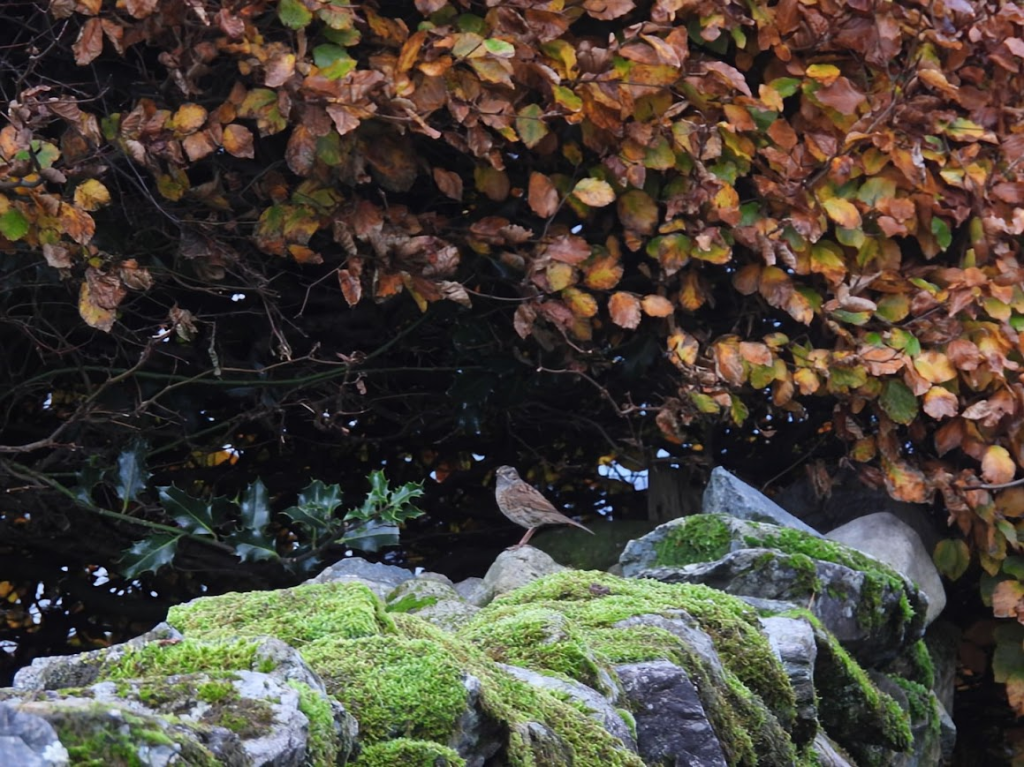
Dunnock on dry stone wall.
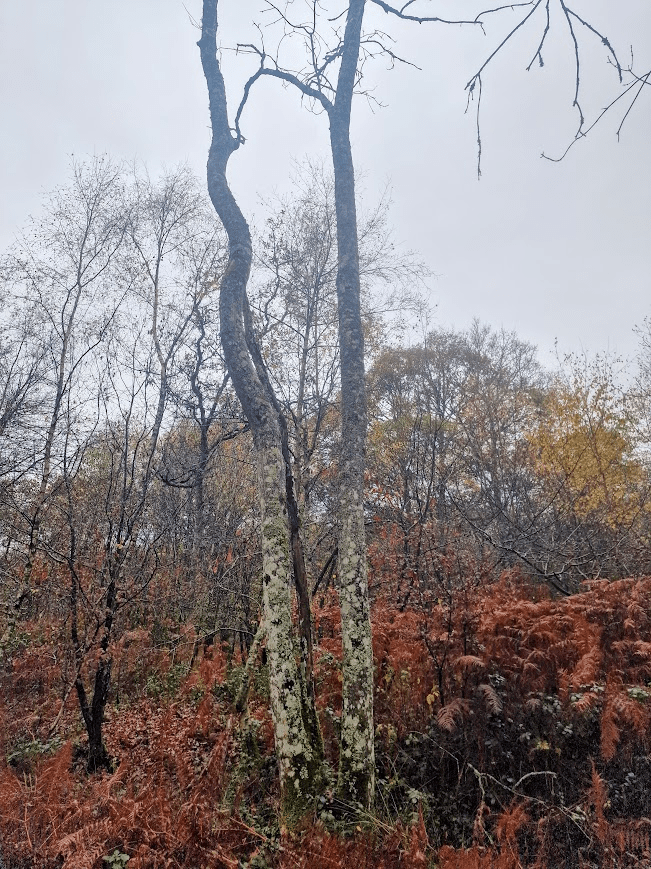
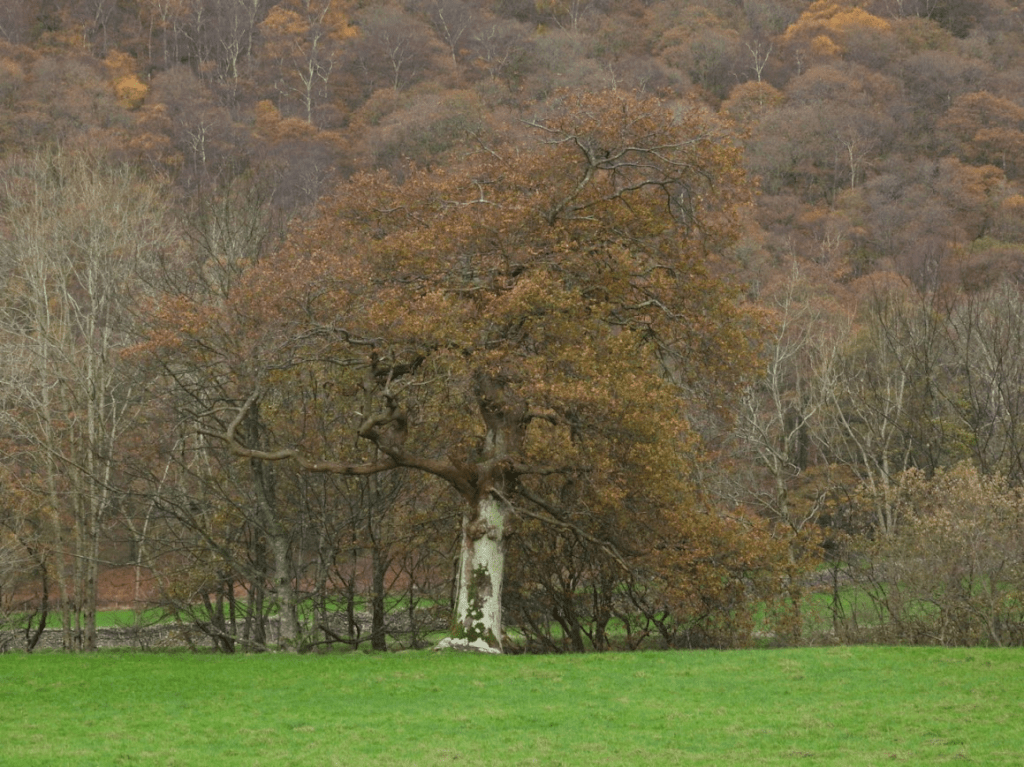
A Sessile Oak with “white” bark from a distance
The white bark is probably lichens of the Mesic bark community (the Pertusarietum). I am very used to this community, as it is common in the south, especially in parkland trees and trees at the edge of woods. I thought it unusual to see this in the Lake District but I did some research and found that whist it is largely southern community in the UK, …. [there is] a very important stronghold in the Lake DistrictPlantlife: Lichens and Bryophytes of Atlantic Woodland in the Lake District
More Rhizocarpon geographicum and Lecidea lithophilaon a rock. Whilst I had never come across Lecidea lithophila until Monday, by Thursday I could recognize it at 50m away
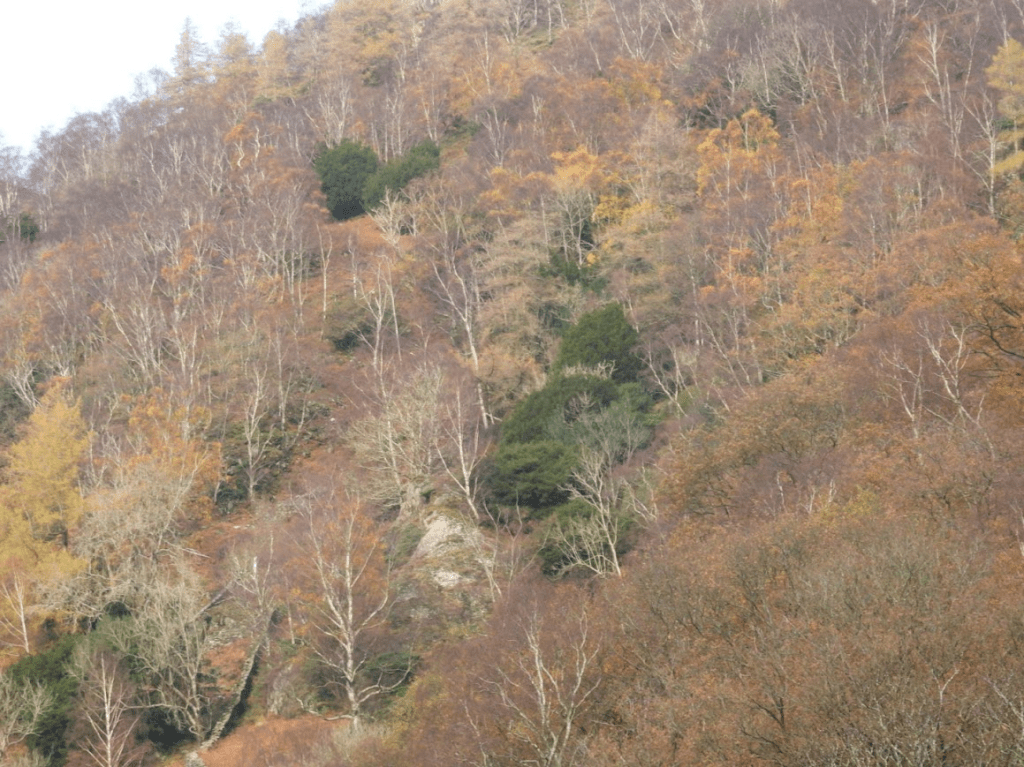
Lots of Silver Birch, Beech and Yew above the Bowder Stone
The National Trust says of Borrowdale Rainforest NNR: The Borrowdale Oakwoods are one of England’s largest remaining pieces of temperate rainforest that once spread from the north of Scotland down the west coast of England, Wales and Ireland and are part of a long standing cultural landscape
And these Silver Birch, Yew and Beech woodland are within the NNR that is described as Oakwood. But Oakwood is not all Oak
Upland oakwoods are characterised by a predominance of oak (most commonly sessile, but locally pedunculate) and birch in the canopy, with varying amounts of holly, rowan and hazel as the main understorey species. The range of plants found in the ground layer varies according to the underlying soil type and degree of grazing from bluebell-bramble-fern communities through grass and bracken dominated ones to heathy moss-dominated areas. Many oakwoods also contain areas of more alkaline soils, often along streams or towards the base of slopes where much richer communities occur. Elsewhere small alder stands may occur or peaty hollows covered by bog mosses Sphagnum spp. These elements are an important part of the upland oakwood system. The ferns, mosses and liverworts found in the most oceanic of these woods are particularly rich; many also hold very diverse lichen communities.Buglife Upland Oakwood
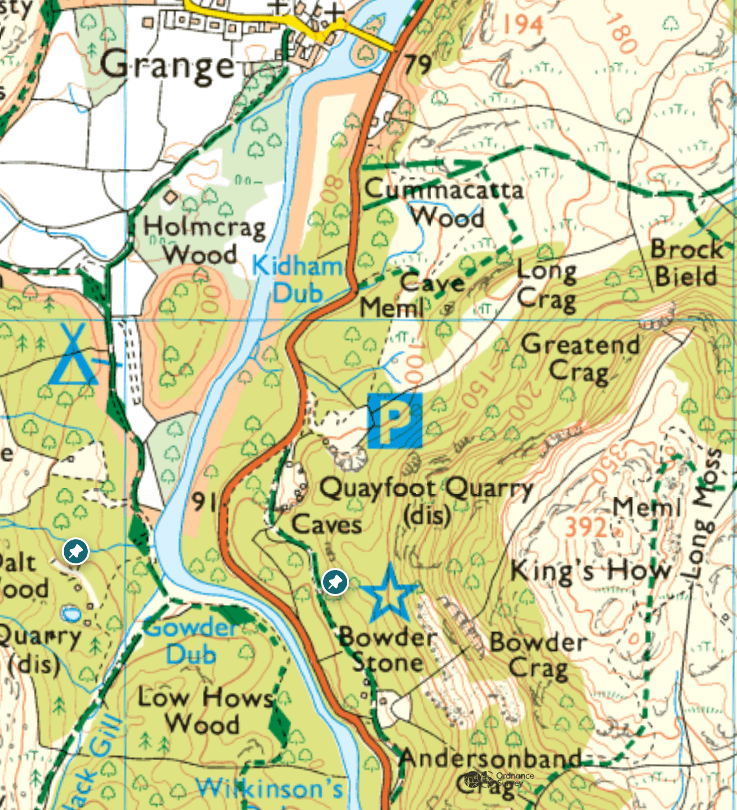
Cummacatta Wood
Cummacatta Wood is, to me, of very high biological interest (with sparse ancient trees and bog), is not in the designated NNR area, although it is probably of more biological interest than some of the woodland around the Bowder Sone which is in the Borrowdale Rainforest NNR. The danger of having an NRR that is described as a rainforest NRR is that biologically important areas that are not rainforest are not offered the protection that being part of a National Nature Reserve
Cummacatta Wood has a physical sign saying it is a National Trust property; however there is no information about it online from the National Trust or any other organisation except for one mention of the wood in a hiking apps.
It is not in the Borrowdale Rainforest NNR but it is in the geographical area of the Lodore-Tri0ttdale Woods SSSI. Although it is not mentioned in its SSSI specification by name; the sentence The site includes a number of interesting non-wooded habitats. Species-rich flushes may include Cummcatta Wood; although it is partially wooded!
Despite the deafening silence of the internet on Cummacatta Wood of its biological nature, I found it charmingly beautiful and full of biological interest. I have walked through Johnny Wood, the woods around the Bowder Stone and Cummacatta Wood just once and I wasn’t long in any of these areas; so my views on their interest is very impressionistic. I almost certainly missed many interesting species of lichens, bryophytes and vascular plants!
Cummaccatta is sparsely wooded with Sessile Oak, Silver Birch, Hazel, Yew, Juniper and Ash.
Here the beautiful and common (in North West Atlantic Woodland) liverwort Frullania tamarisci
A twisted Sessile Oak
Yew
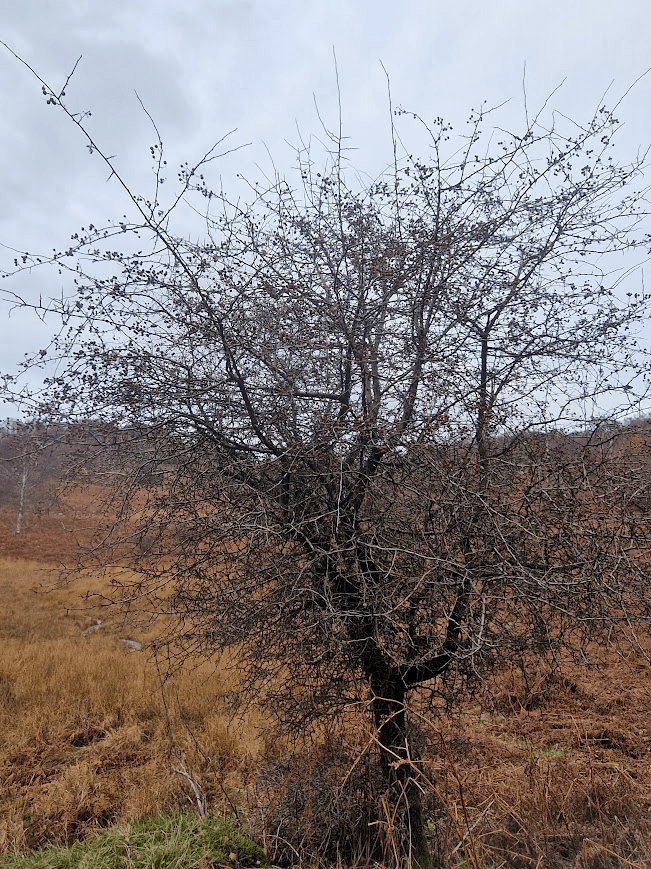
Hawthorns; as in Sussex, often have abundant (bit different) lichen. Sussex Hawthorns are dominated by Ranalina spp.lichens with few or no Usnea spp. Upland north-west Hawthorn often have more Usnea. On these hawthorns Usnea floridana is relatively common; it is very rare on South East hawthorns
Lichens on these two hawthorns
Hypogymnia physodes
Cladonia polydactyla
A liverwort not a lichen: Frullania tamarisci
Falvoparmelia caperata
Beard lichen: probably Usnea subfloridana
Usnea subfloridana
Platismatia glauca
Two stunted Yews
Juniper
Bog Pond Weed
Bog Asphodel
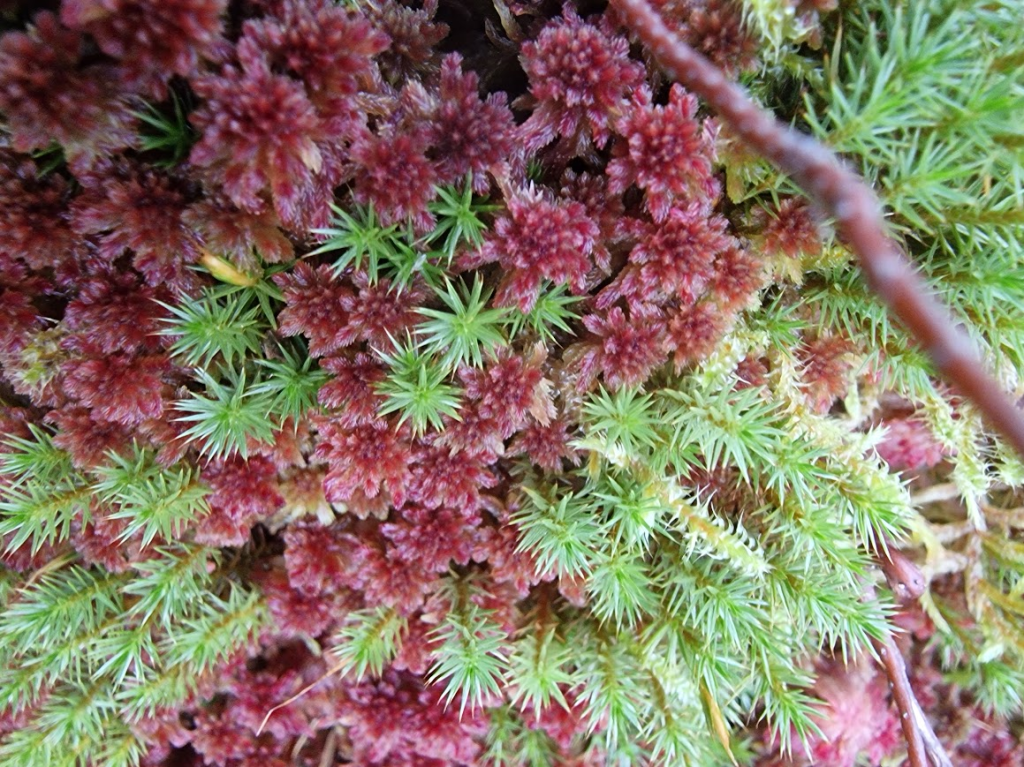
Red: Sphagnum capillifolium subsp. rubellum
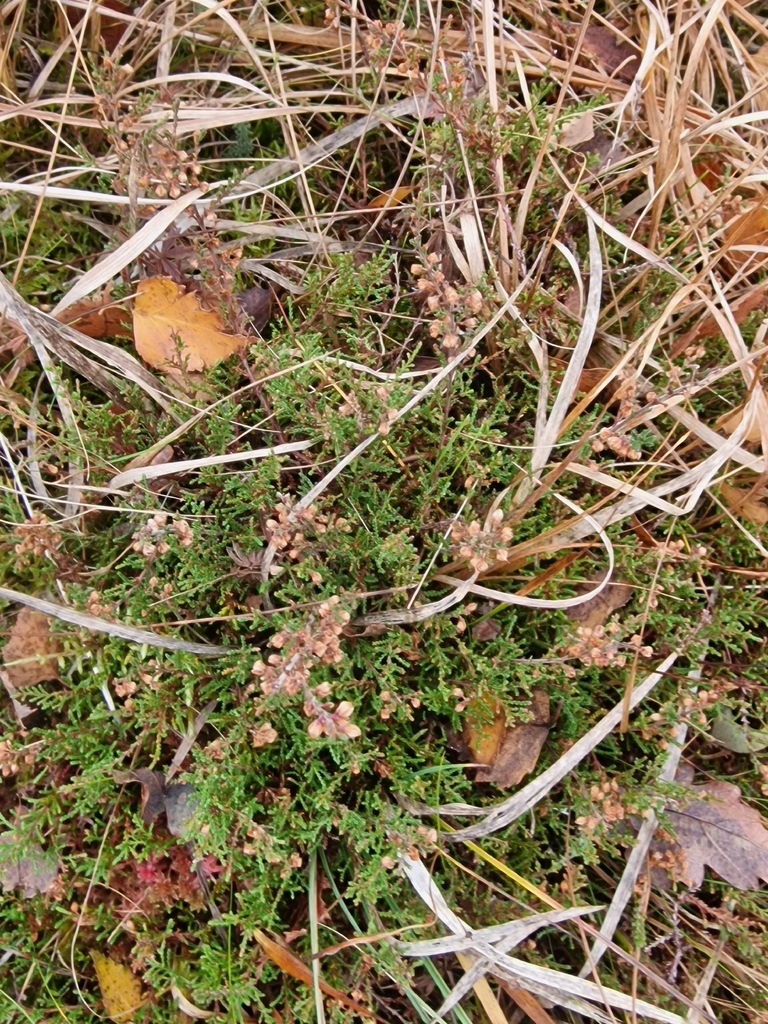
Common Heather
The way in and out of Cummacatta Wood is on the B2859, the Keswick to Seatoller road, along which the Stagecoach 78 bus runs
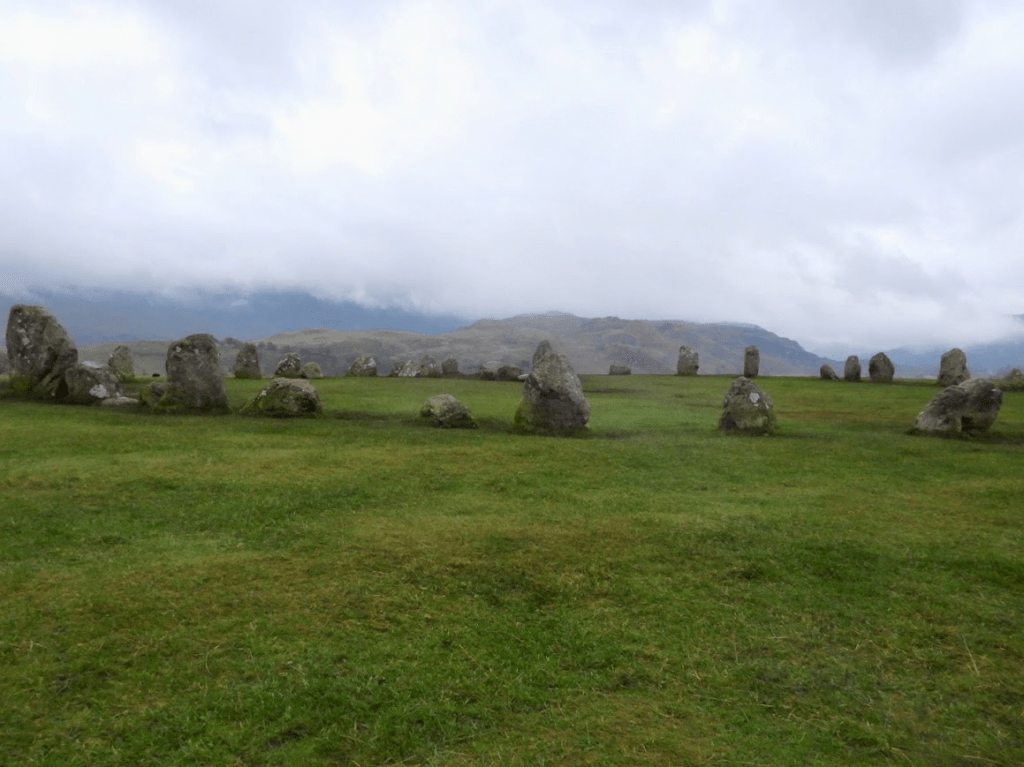
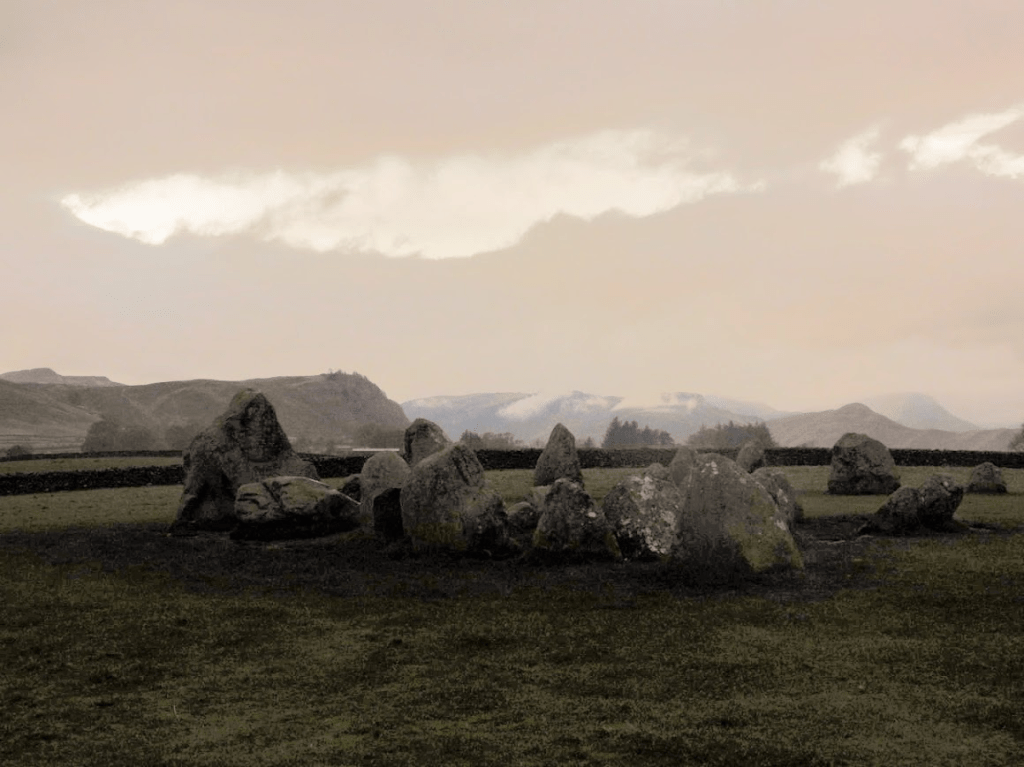
The Castlerigg Stone Circle is 2 miles from the centre of Keswick. I took the bus bus to the nearest bus stop then had to walk a mile along a narrow lane to reach the stones
There are few stone circles in Britain in such a dramatic setting as that of Castlerigg, which overlooks the Thirlmere Valley with the mountains of High Seat and Helvellyn as a backdrop. … Thought to have been constructed about 3000 BC, it is potentially one of the earliest in the country. … Although there are more than 300 stone circles in Britain, the great majority of them are Bronze Age burial monuments (dating from about 2000–800 BC) containing cremations in central pits or beneath small central cairns. By contrast, their Neolithic forebears, such as Castlerigg, Swinside in the southern part of the Lake District, and Long Meg and her Daughters in the Eden Valley, do not contain formal burials. The Neolithic stone circles also differ from those of the later Bronze Age in their generally larger size and often flattened circular shape – as is found at Castlerigg – comprising an open circle of many large stones. Castlerigg is about 97½ ft (30 metres) in diameter, and formerly comprised 42 stones. There are now only 38 stones, which vary in height from 3¼ ft (1 metre) to 7½ ft (2.3 metres).
Neolithic stone circles typically have an entrance and at least one outlying stone. The entrance at Castlerigg, on the north side of the circle, is flanked by two massive upright stones, and the outlier is presently to the west-south-west of the stone circle, on the west side of the field adjacent to a stile; this stone has been moved from its original position. It has been suggested that such outlying stones had astronomical significance – alignments with planets or stars – although examination of those in early stone circles elsewhere in Britain has shown that there are no consistent orientations for them. English Heritage Castlerigg Stone Circle
I arrived at the stone circle just as the sun was rising, I thought I’d have the stones to myself; how wrong I was!
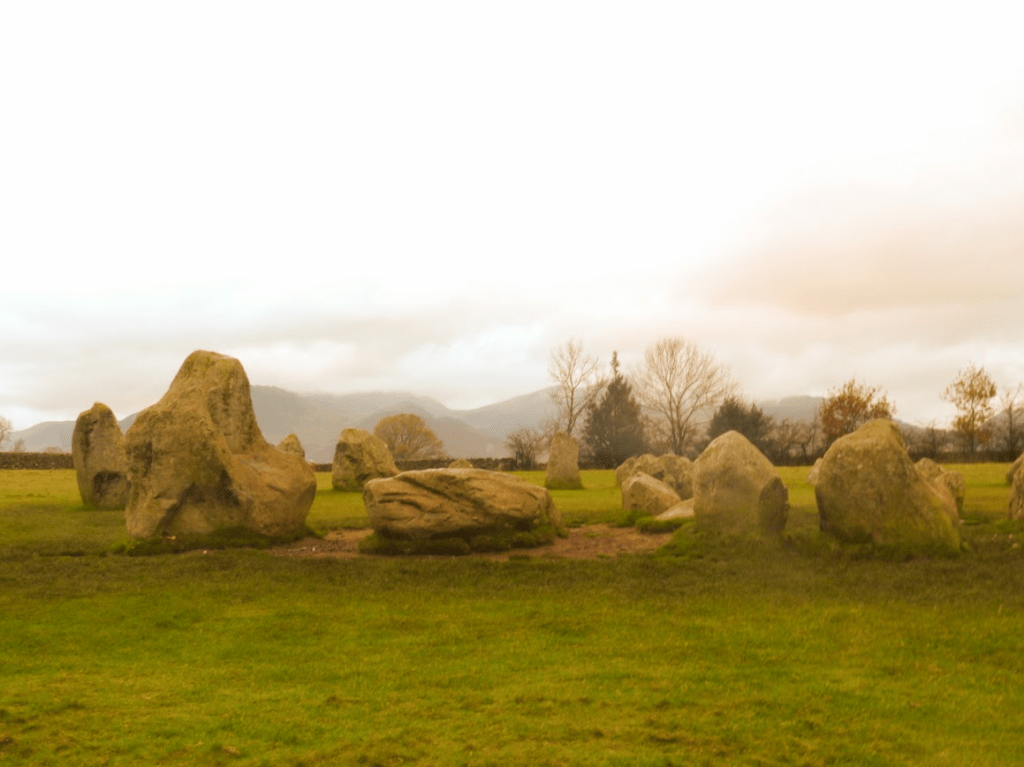
More sun!
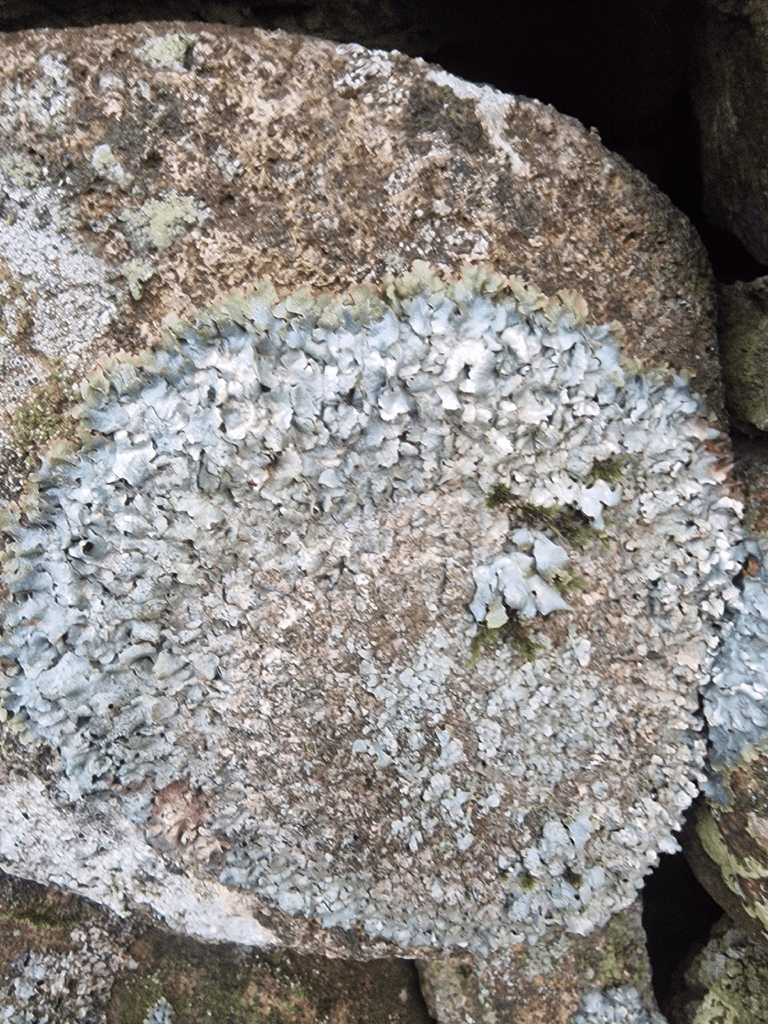
Some of the lichens on the dry stone walls on the tiny lane to Castlerigg .
Parmelia saxatilis Salted Shield Lichen
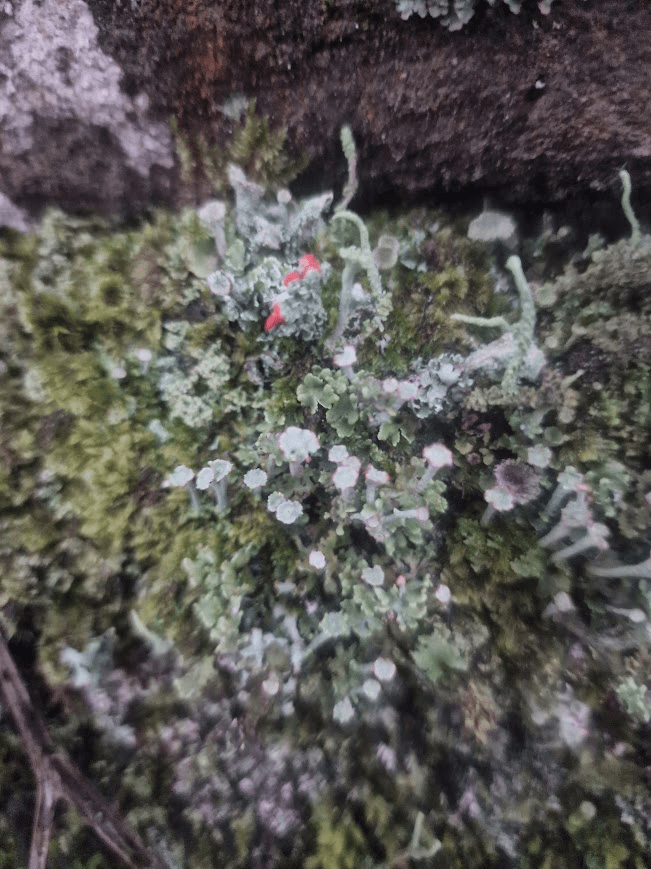
Cladonia polydactyla
Parmelia omphalodes Smoky Crottle
P. omphalodes was called dark crottle by Scots tweed makers. Gaelic “crotal”: lichens for red/brown dyes.
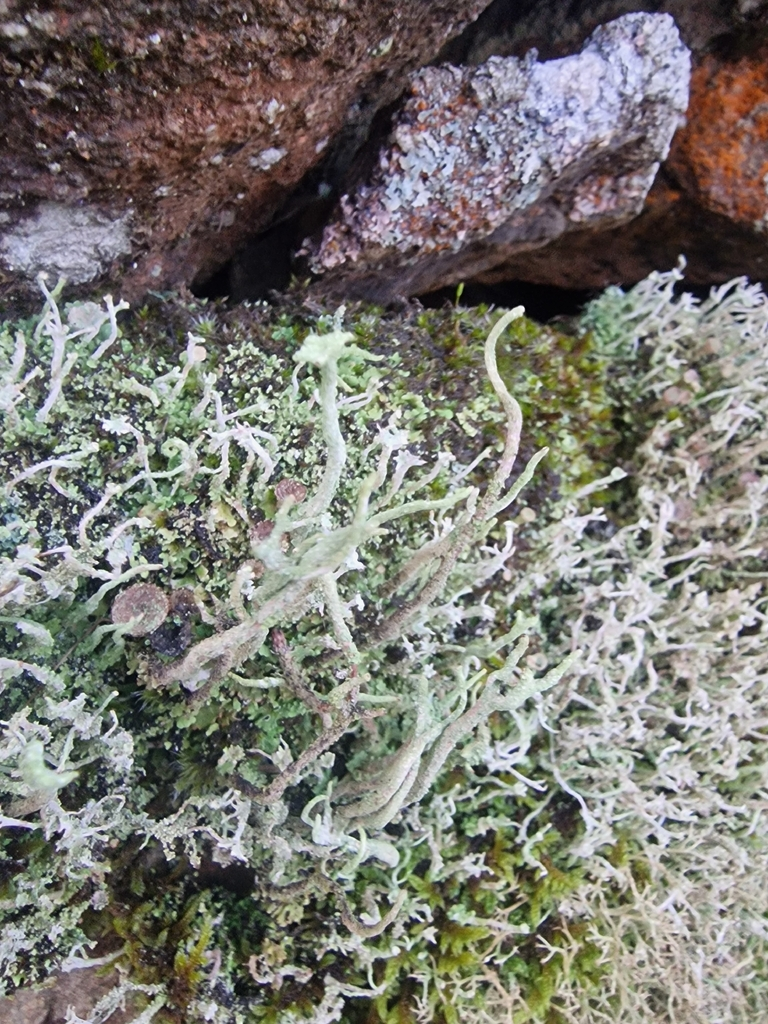
Stereocaulon vesuvianum
Stereocaulon vesuvianum is a common lichen of upland silicious rock, often on dry stone walls, and I associate it with holidays in the North West. l hadn’t seen it till the last day of my holiday – the last day of my holiday. So I can go home content now! Its pseudopotetia (sticky-up bits) could make you think it’s a Cladonia species
On this Tuesday, I was expecting to go to the southern Borrowdale woods that I hadn’t been able to see the day before, due to the bus being cancelled all day due to flooding. But the bus to Seatoller was still cancelled again due to flooding, so I decided to take the bus to Ambleside to change busses for Skelwith Bridge, where there was some interesting woods; but the bus to Skelwith Bridge was also cancelled due to flooding. The only place I could go to to see some woods, was to take the bus that goes back to Keswick and get off at Rydal.
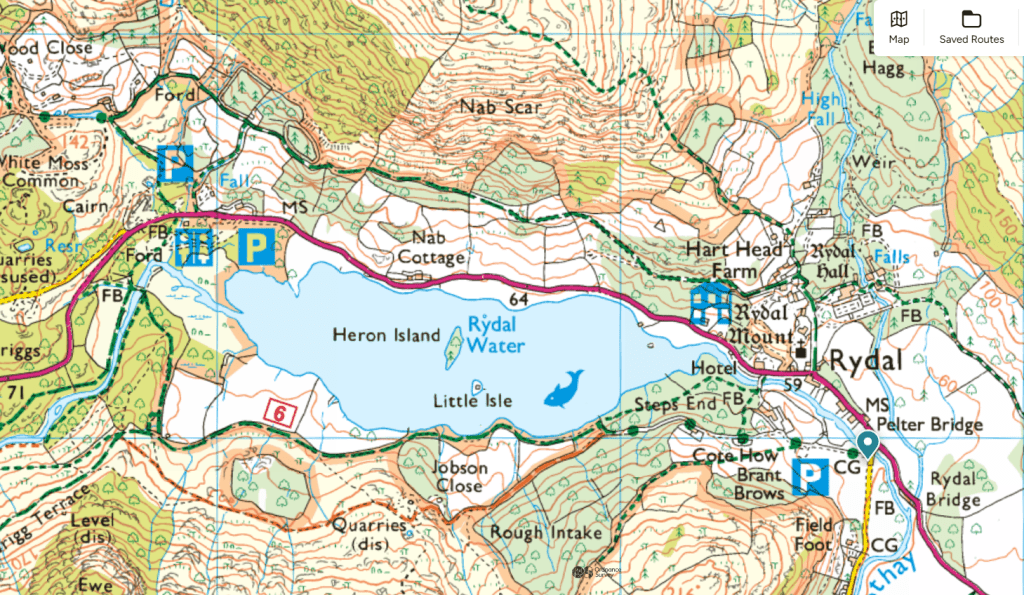
Rydal has Wordsworth’s House, the famous Rydal Falls and some unnamed broadleaf woodlands that I had noted on the OS map that could be interesting. Some of the most beautiful trees I have seen have been in woods unnamed on maps.
First, I visited the National Trust’s Dora’s Field; a field named by William Wordsworth after his daughter who died at a young age.
Next to Rydal Church stands a field known locally as ‘The Rashfield’. This was originally a wet field where rushes (“rashes”) grew and it later became known as ‘Dora’s Field’. The field was purchased in 1825 by William Wordsworth.
Provoked by the threat of eviction by his landlady Lady Anne Le Fleming who planned to replace the Wordsworth family with a member of her own family, Wordsworth bought the Rashfield, drained it and declared that he intended to build on it. … but Lady Anne withdrew the threat of eviction & Wordsworth remained at Rydal Mount until his death there in 1850.
Having already lost two children in infancy Wordsworth and his wife suffered a third blow when Dora, her father’s favourite, died aged 43 of tuberculosis in 1847. The poet never recovered from the loss of this daughter and, after Dora’s death Wordsworth, his wife Mary, sister Dorothy and a gardener planted the daffodils as a permanent memorial. A Rydal Guide: Dora’s Field
Dora’s field contained some beautiful coppiced and pollarded Sessile Oaks
Then I walked about 500m to visit the Rydal Falls; in the woodland behind Rydal Hall. A few meters aways is Rydal Mount, the “cottage” in which Wordsworth lived. Rydal Falls and Rydal Mount were very popular destination for Victorian tourists
There is not anywhere in England a drive so full of that mingled natural and human interest which makes scenery so impressive. It is well-nigh impossible for sensitive minds not to feel something of ‘the light that never was on sea or land’ as they pass the thresholds of the good and great, whose thoughts have helped our England to be pure. In this coach drive to Keswick they not only go by the homes of the thinkers and poets and philosophers, but their foreheads feel the wind and rain that gave such freshness to the seers of the last generation; the sunlight on lake or mountain head that filled their minds with glory fills ours today. The woods and waterfalls that speak to us upon our way spoke also to them. We can in fancy see their familiar forms upon the road, and, as in eastern travels the ‘weli’ or way-side tomb made the journey’s stage rememberable [sic], so we find in this pilgrim stage through poet-land that the great dead lend it a kind of solemn sweetness, and the dust of two laureates hallows the wonder-giving way. Rawnsley, A Coach-Drive at the Lakes : Windermere To Keswick (1891) , pp. 3–4 quoted in Christopher Donaldson, Ian N. Gregory, Patricia Murrieta-Flores, Mapping ‘Wordsworthshire’: A GIS Study of Literary Tourism in Victorian Lakeland, Journal of Victorian Culture, Volume 20, Issue 3, 1 September 2015, Pages 287–307.
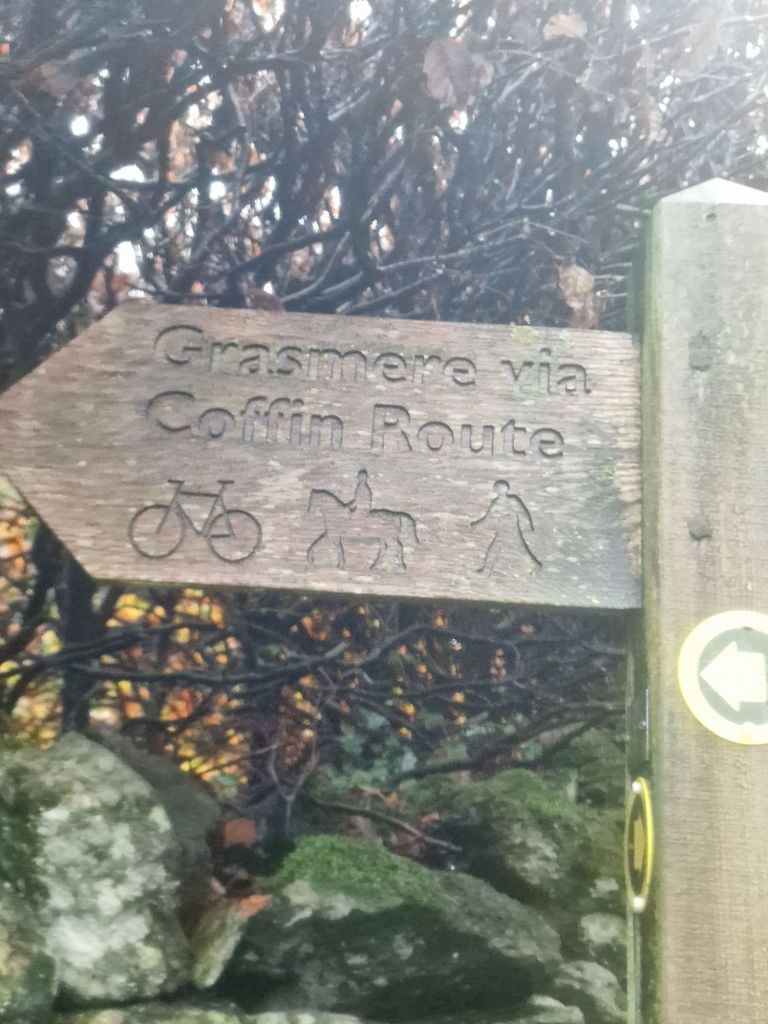
I then took the Coffin Road above Rydal Mount through the unnamed woods.
… at a higher-level running through the meadows of Rydal Park and across the slopes of Nab Scar, is an … [old] track. It dates back a very long time and is called locally, the Coffin Road, due to the fact that the only consecrated ground for burial in the area was the grave yard at St Oswalds in Grasmere and it was therefore used to convey coffins on their final journey.Visit the Lake District – Ambleside to Grasmere – ‘The Coffin Route’
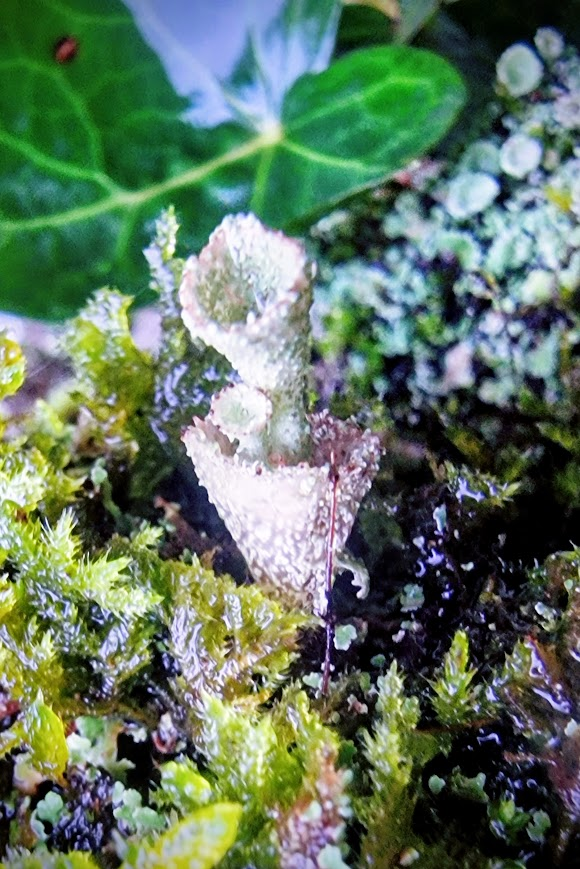
On a drystone wall next to the beginning of the route was this multi-cup “Pixie Cup” Cladonia sp. lichen, possibly C. chlorophaea s.l. (one of the C. chlorophaea aggregate). It was a veritable “Pixie Champagne Fountain”. Maybe a Pixie Wedding occurred there.
The pollarded Sessile Oaks the wood unnamed on the OS map; this looks like pasture woodland but I can find out nothing about this woodland on line
This Hawthorn had epiphytic Polypody fern
and some beautiful epiphytic lichens
Ramalina farinacea
Ramalina farinacea above can look very similar to Usnea (beard) lichens; the way to spot R arinacea is that it has prominent flour-like (farine (French) flour in farinacea) blobs (soredia) on its lobes; Usneas mostly mostly don’t have soredia, but some do, like Usnea subfloridana. Lichen are just hard.
Usnea subfloridana
Usnea ceratina
and this rain-soaked moss, Ulota bruchii. Bruch’s Pincushion
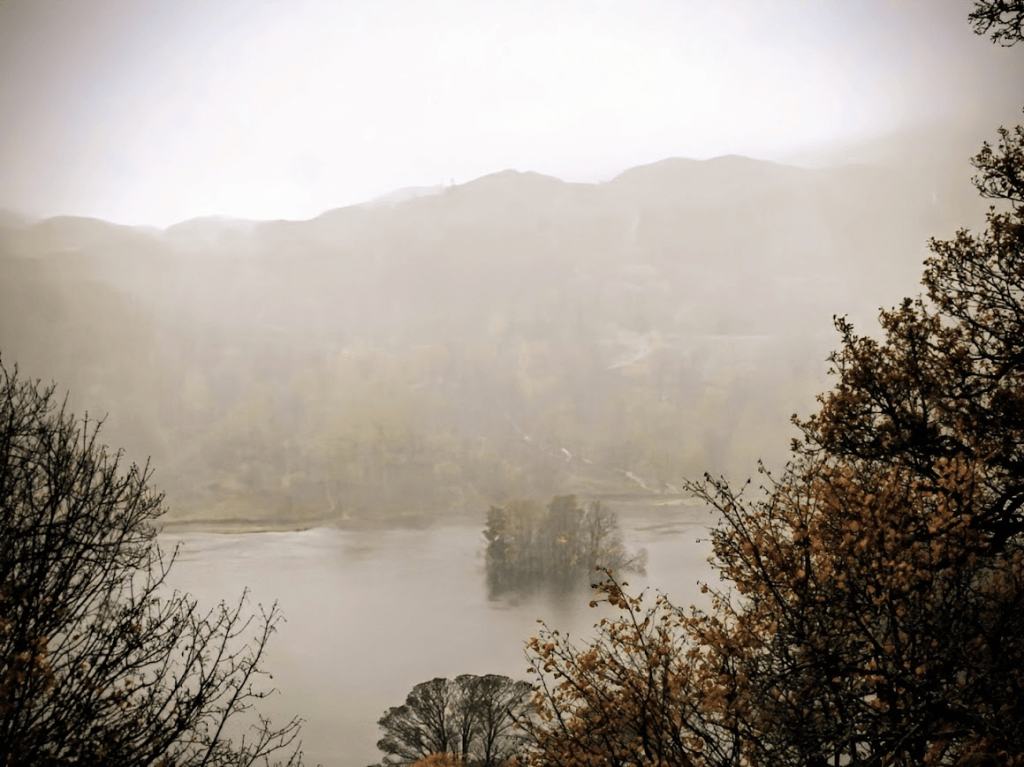
From the path it appeared as if Little Isle in Rydal Water was being engulfed by the rising water of the lake, like the medieval French legend of Ys, which was engulfed by the sea and rises occasionally; beautifully evoked in Debussy’s La Cathedrále Engloutie prelude Click: La Cathedrále Engloutie to listen.
I then walked on further west, along a dry stone wall above woodland (unnamed) under the fell Lord Crag, with fabulous views of Rydal Water
The very red apothecia (fruiting bodies) of this Peltigera sp. lichen, poss. P. horizontalis, really stood out on a dark and rainy afternoon on the very wet dry stone wall
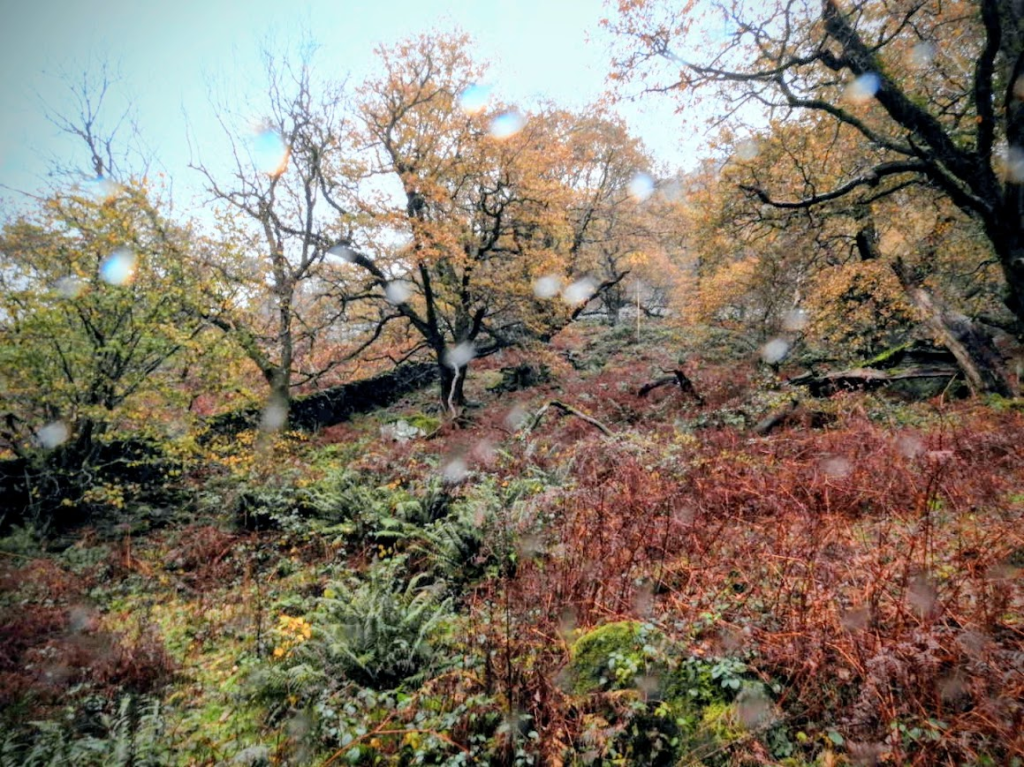
Looking up Lord Crag, pollarded Sessile Oaks. The spots are rain drops on my camera lens
Theses lonely oaks on the foothills of Lords appear “wild”; but pollarding is a human intervention; so even these “wild” veteran trees have been managed across time.
Water pouring over a dry stone wall. It rained all day this Tuesday as it did the day and weekend before
This is the public footpath down to Rydal Water not a waterfall
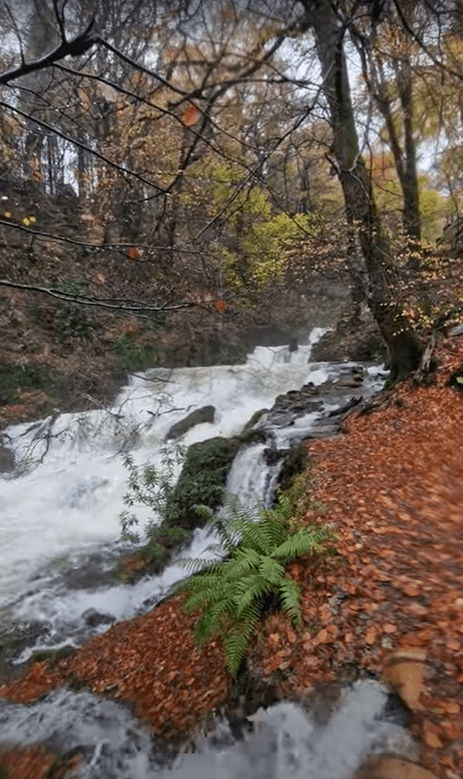
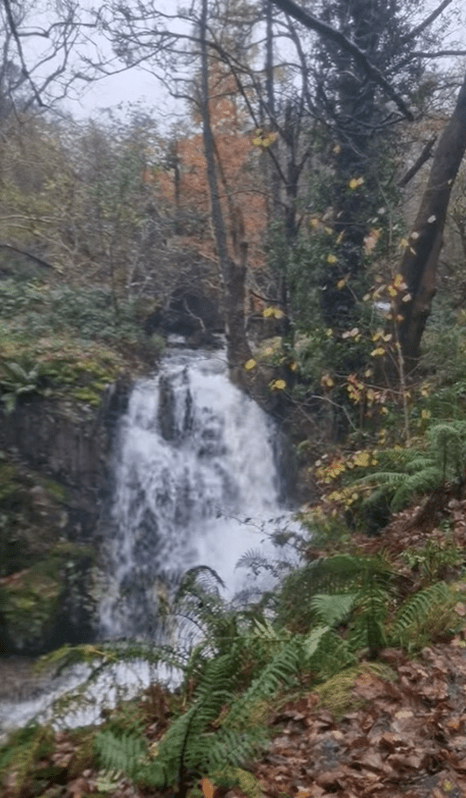
This is a unnamed waterfall just marked on the OS map as “fall”
From the car park next to the waterfall I got the bus back to Keswick
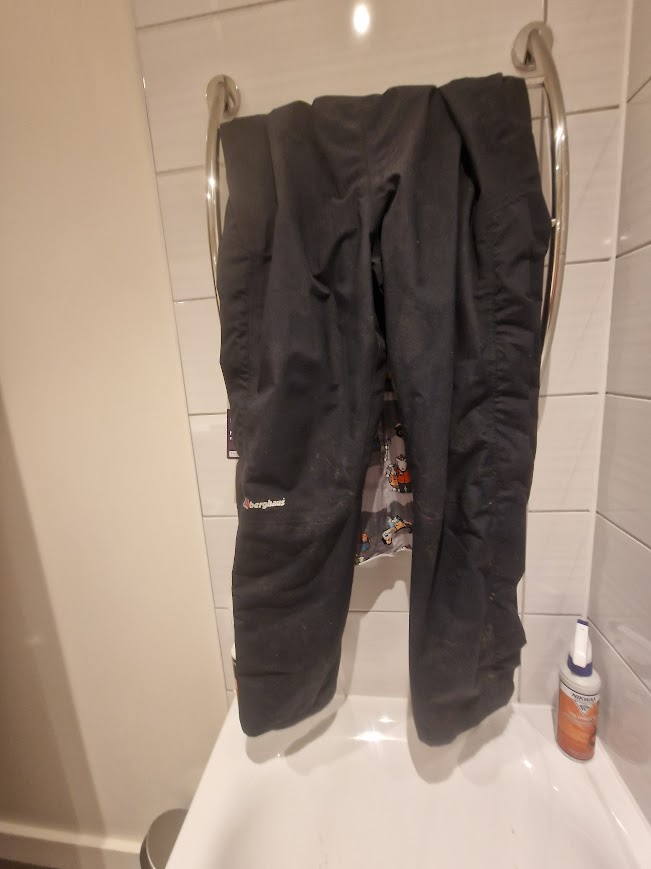
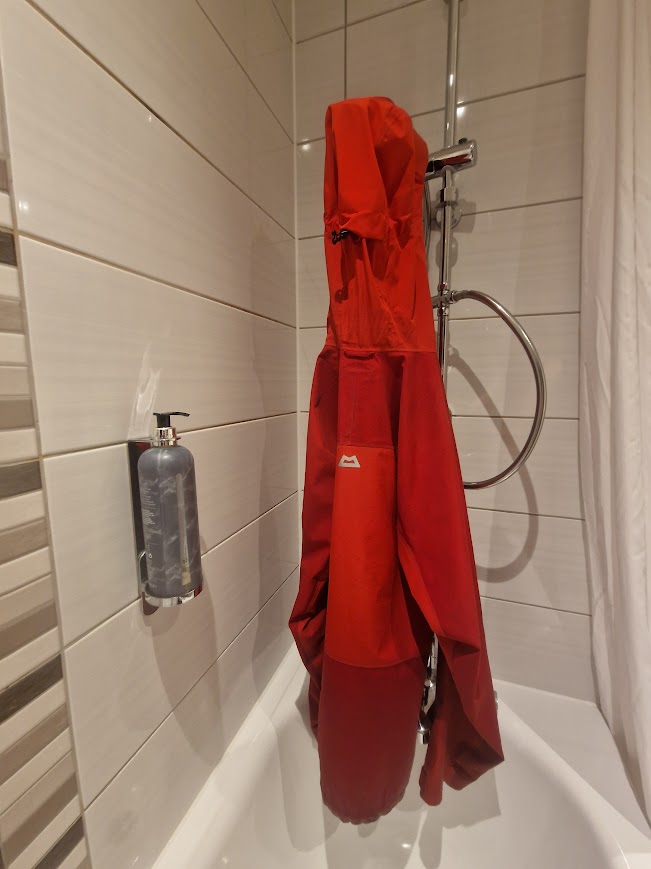
My waterproof trousers and jacket, that had given up repelling water, drying in the hotel room bathroom; after being sprayed with Durable Water Repellent. Durable Water Repellent is available in nearly the gazillion outdoor shops in Ambleside (where I bought mine) and Keswick
The first day of my five day holiday in Keswick – three of which I had planned to devote to exploring the constituent ancient woods of the NNR – started with initial disappointment. Due to the unprecedent levels of rain on the days before, the only Borrowdale bus (the Stagecoach 78) which runs between Keswick and Seaotoller) was suspended due to road flooding, and the Derwent Launch services were suspended too, because of the height of the water in Derwent Water; so there way of reaching where I wanted to go, Johnny’s Wood – by bus or boat. So, I decide to walk to Great Wood and Arnees Wood from Keswick. This is a 10 mile return walk – and it rained continuously – but it was worth it.
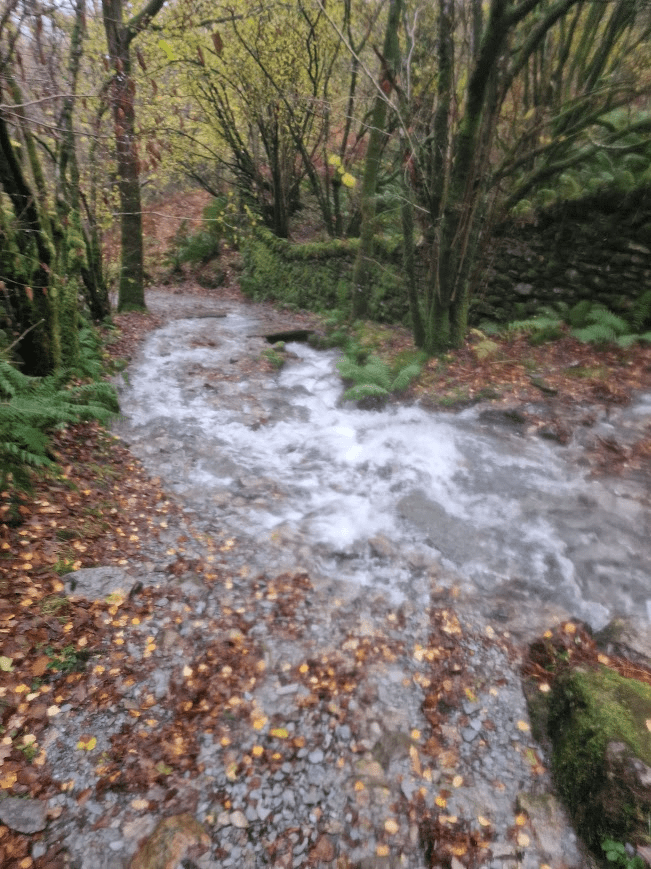
The footpath from Great Wood to Ashness Wood provided fantastic views of Derwent Water; however, as the footpath was an up-and-down path through the foothills of Castlerigg Fell, the footpath was more like a beck than a path. In some places, the water level was above my boots. However good your “waterproof” socks are, there is nothing to do about a top-down inundation. But once the water between your feet and your waterproof socks has warned up to body temperature, it’s fine, and when you are focusing hard on looking at nature you don’t notice your socks being like little swimming pools!
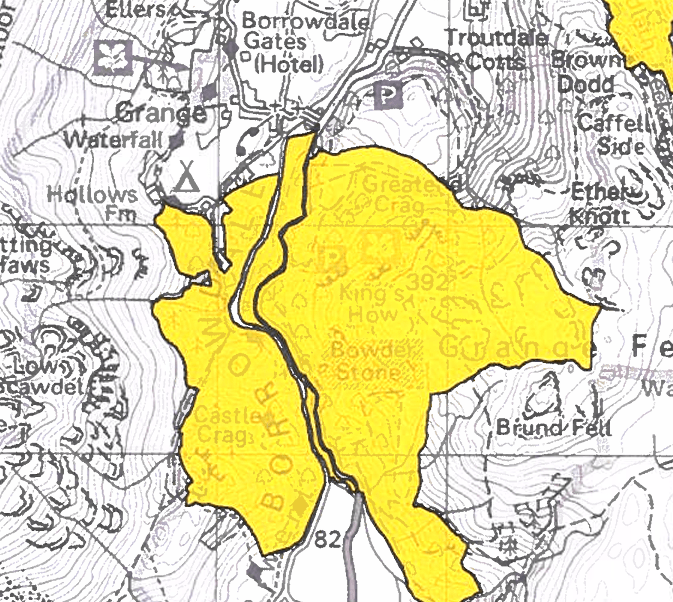
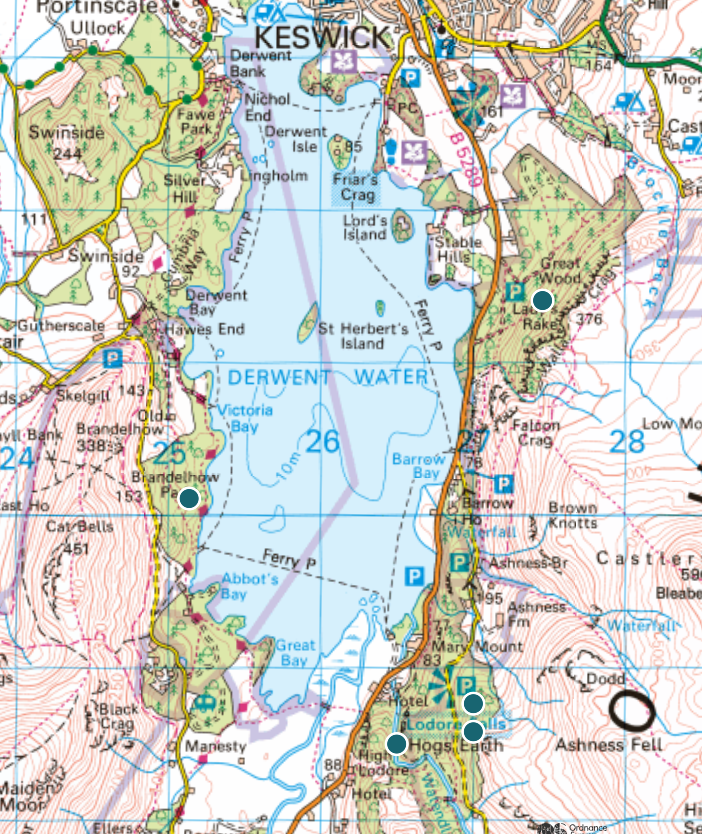
The blue circles mark the constituent woods of the new Borrowdale Rainforest NNR. There are more than those on this map.
The walk along the lake from Keswick to the start of the path up Great Wood.
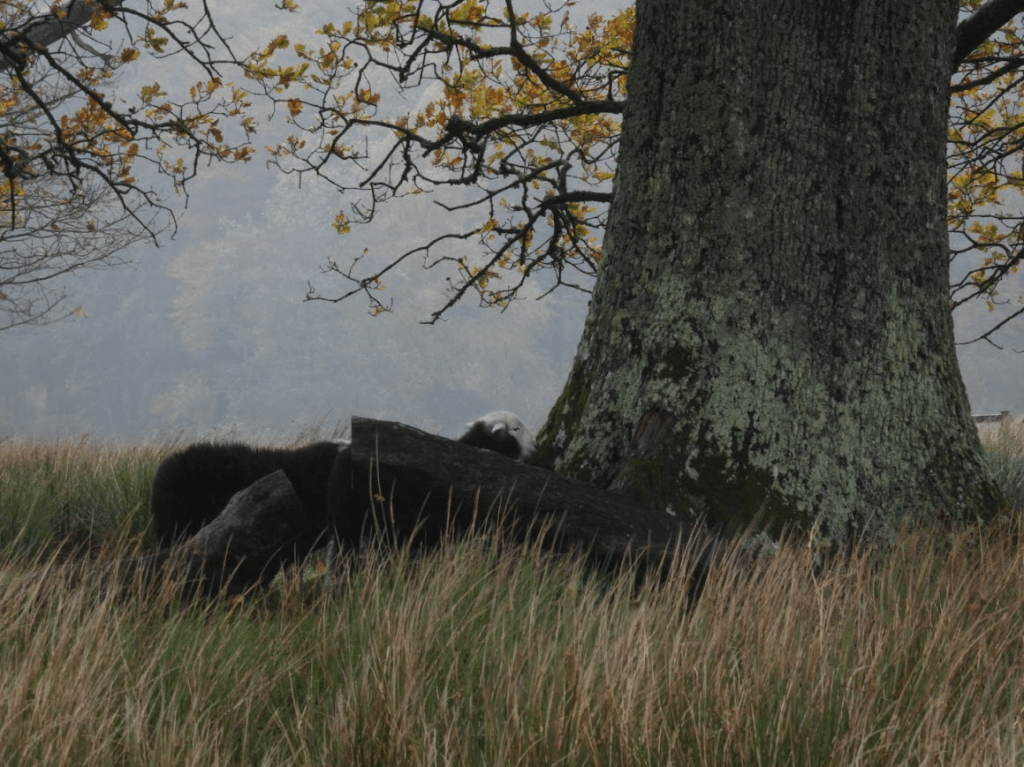
Herdwick sheep sheltering under a pollarded Sessile Oak
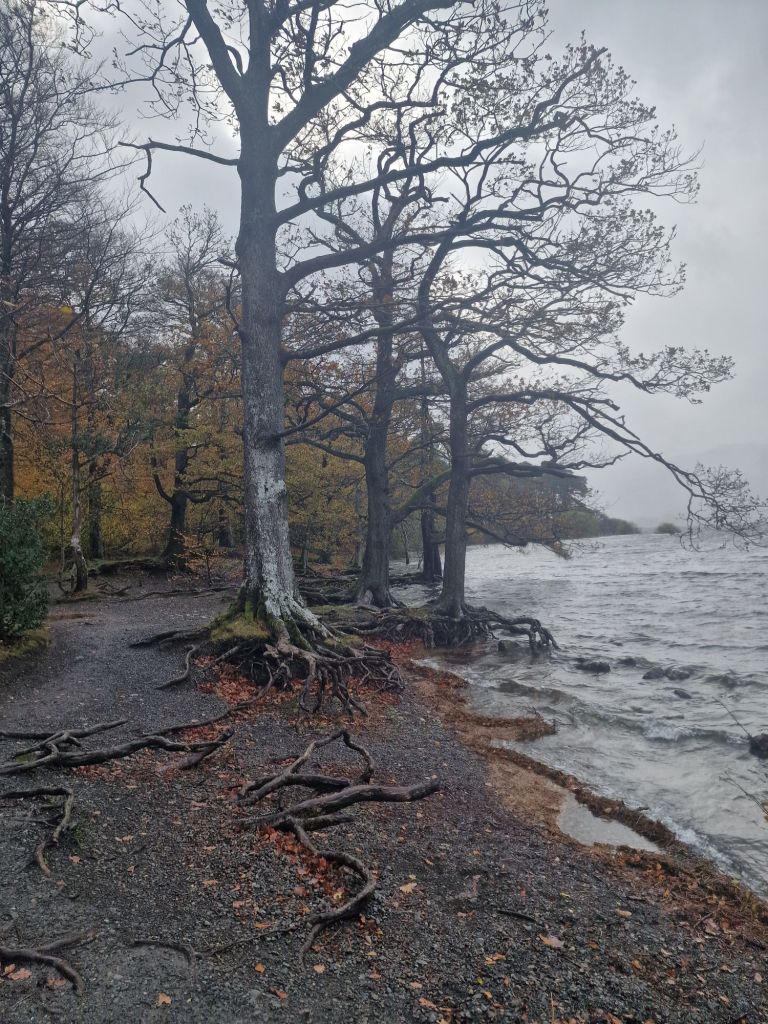
The water level was very high – these Larch were being engulfed by the rising water level
Lichen mosaic on Silver Birch. Lecanora chlarotera/hybocarpa and Putusaria hymenea shows the typical black lines of the “zone of antagonism”
Great Wood
Sessile Oaks
Beech
Polypody Fern on Sessile Oak; epiphytic polypody is characteristic of Atlantic woodland (temperate rain forest)
Overflowing beck next to this tree
Map lichen, Rhizocarpon geographicum (map lichen) on andesite outcrop; igneous rocks of the Borrowdale Formation; very common on hard siliceous rocks
Path between Great Wood and Arshess Wood
Silver Birch, looking across to the west side of Derwent Water to the Cat Bells fells
Ancient Hawthorn
Lichens on this Hawthorn
Oak Moss, Evernea prunastri;
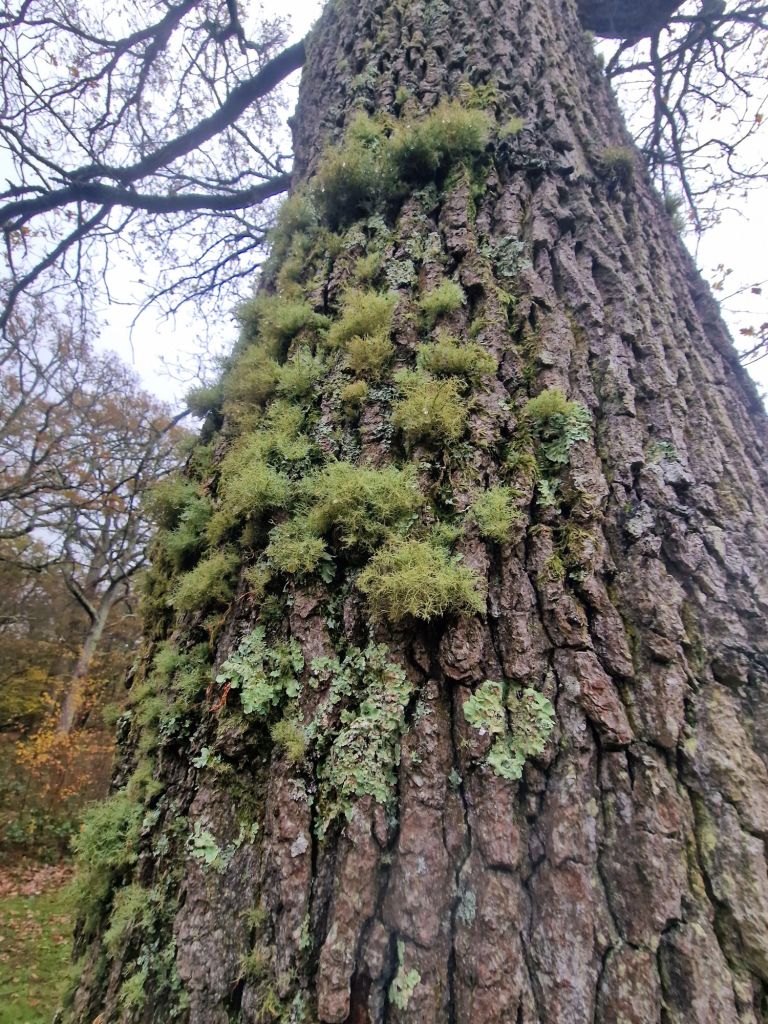
Usnea sp., probably U. cornuta
Usnea sp, probably U. subfloridana
Platismatia glauca
Boulders are always worth investigating in areas of upland siliceous volcanic rock as they are often covered in lichens and bryophytes
These are some of the species on this boulder
Cladonia strepsilis Olive Cladonia
Pleurozium schreberi Red-stemmed Feather Moss
Cladonia ramulosa Branched Pixie-cup Lichen
Porpidia tuberculosa Boulder Lichen
Frequently, it was necessary to cross mini-waterfalls crossing the path that were a consequence of the very high rain over the days proceeding my walk
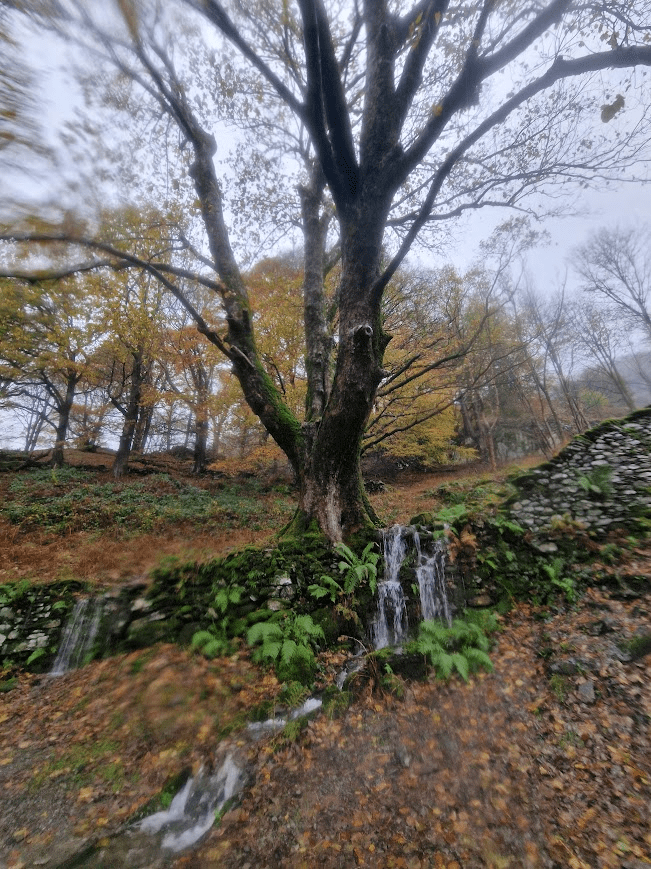
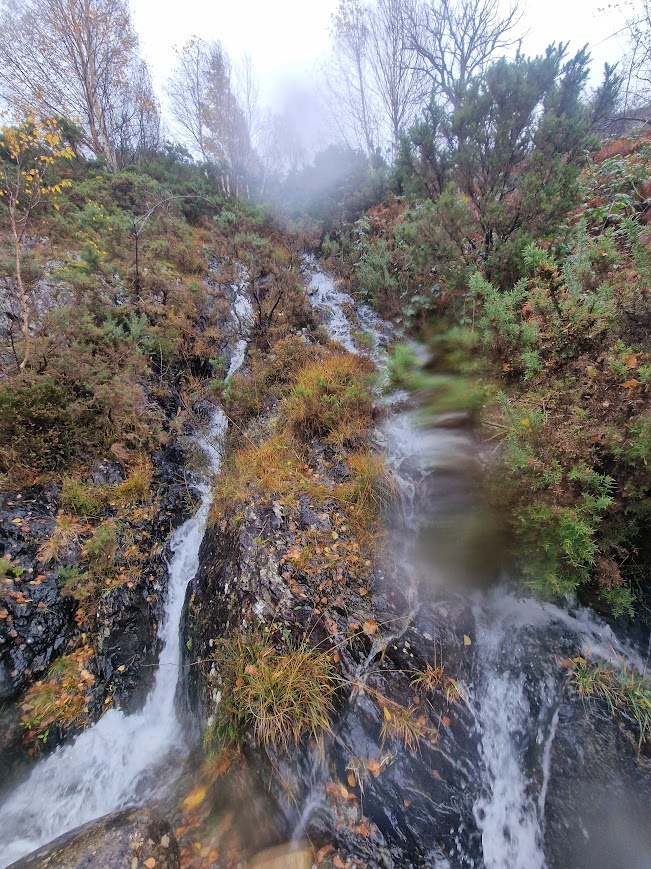
Looking up at temporary waterfalls caused by high rainfall – image blurred by heavy rain falling on the lens of my camera
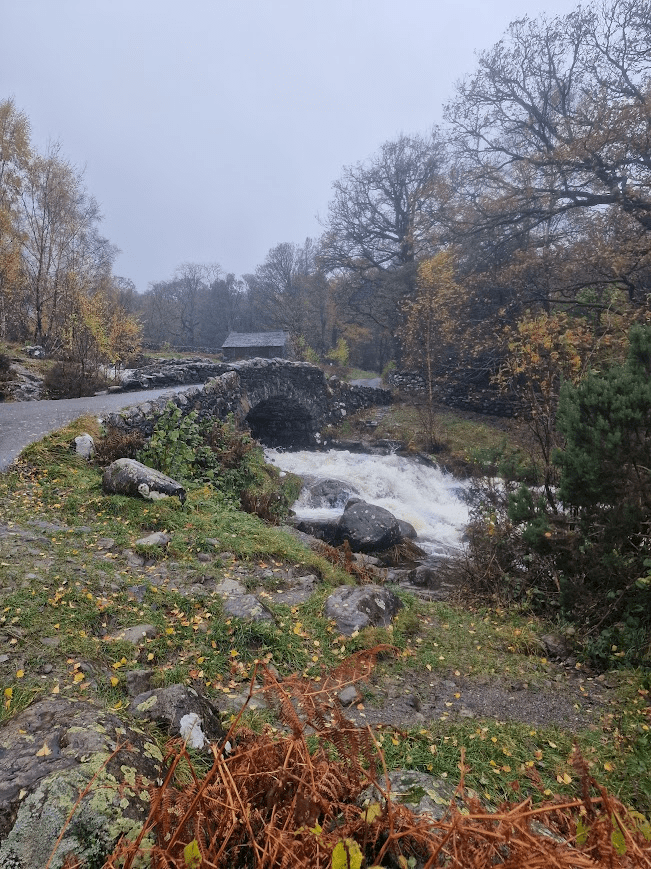
Ashness Bridge
Over Barrow Beck
Its image is often seen to be adorning biscuit tins and tea towelsVisits Keswick
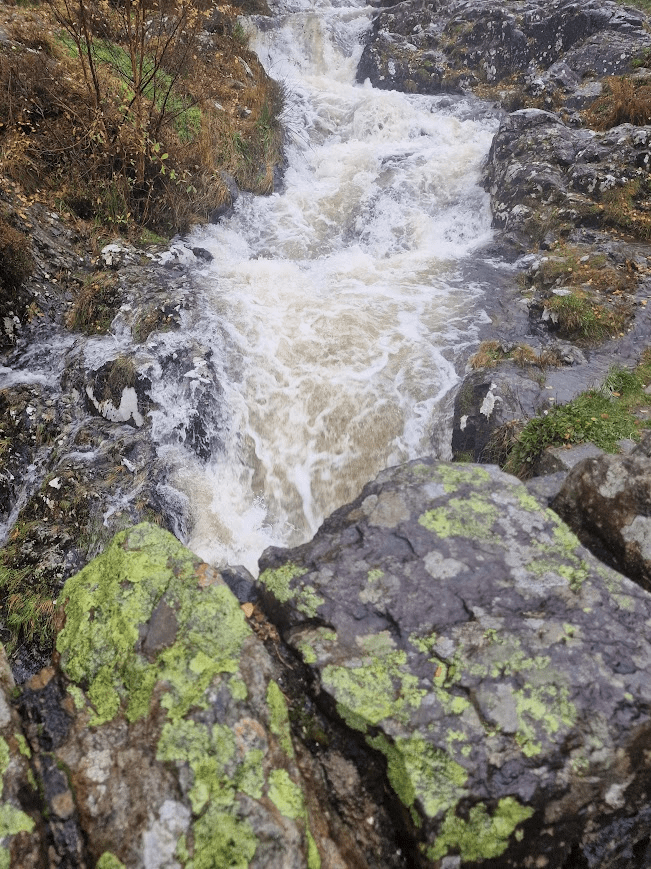
Barrow Beck above the bridge, with the bridge stones covered in Rhizocarpon geographicum; very common on upland igneous rocks
Ashness Wood
Characterised by Sessile Oak, Quercus petrea and outcrops of Grange Crags Andesite. Igneous bedrock formed between 458.4 and 449 million years ago during the Ordovician period. British Geological Survey Geology Viewer
A large patch of fertile Ochrolechia androgyna with apothecia, on Sessile Oak. Apothecia are usually absent but when present have a pink-orange disc with a pale margin.British Lichen Society. O. androgyna is present it the southeast, but it is always infertile.
Infertile on Pedunculate Oak in Petworth Park, West Sussex
Billbury Vaccinium myrtillus, characteristic of upland heathland type H12 Calluna vulgaris – Vaccinium myrtillus heath British Plant Communities 1992 Cambridge University Press pp. 492 – 503
Billbury growing epiphytically on a coppiced Sessile Oak
Waterendlech Beck, behind the above Oak
Beyond the beck, Ashness Wood becomes Mossmire Coppice. In Cumbria, “moss” can also mean mire or bog as well as a bryophyte
This part of the wood was upland heathland bog
Billbury with Sphagnum Moss possibly Sphagnum subnitens
Possibly Sphagnum girgensohnii
Bog with trees
The path, like in so many places, had become a beck
Waterendlath Beck at Ladder Brow
Walking back along the lakeside path to Keswick
A path completely flooded
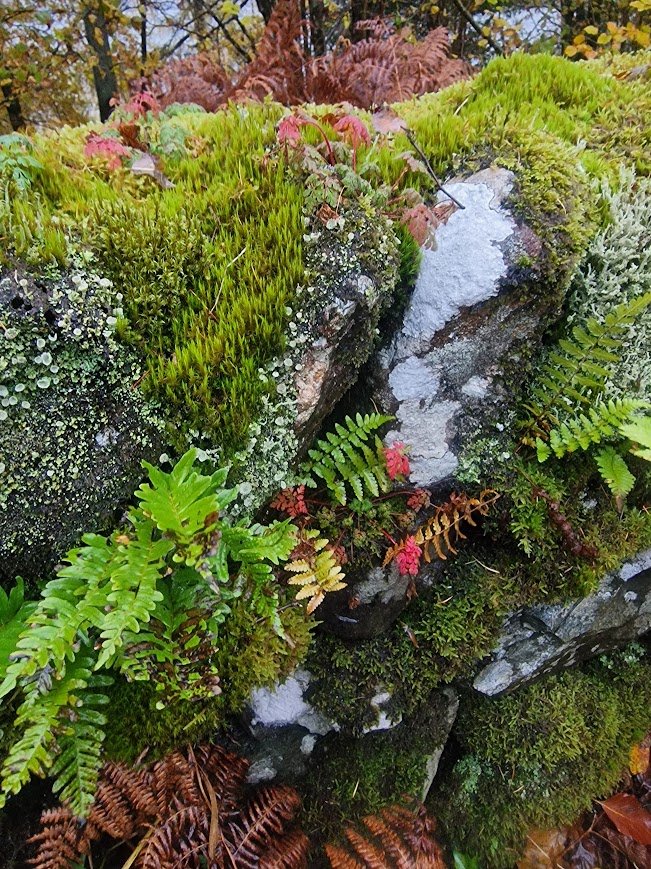
A dry-stone wall at Calfclose Bay, just south of Keswick. Dry stone walls are always worth a look in Cumbria as they often have interesting lichens, bryophytes and ferns growing on them
I got back to Keswick just as the sun was setting and was very wet. Whilst it was a good day, arriving back in Keswick was not an unalloyed pleasure. Keswick is a simulacrum of former real Lakes town; it consists of 10+ outdoor shops selling overpriced outdoor items; pubs that charge a fortune for food, and tourist shops selling Beatrix Potter and William Wordsworth memorabilia; a triumph of consumerism over the intrinsic value of the beauty and culture of the Lakes. To capital everything about the Lakes is something to sell to tourists while paying retail and hospitality workers a pittance
I didn’t see any of the lichen species that Neil Sanderson, April Windle and Andy Acton (Atlantic Woodlands in Britain & Ireland .Temperate Rainforests and Southern Oceanic Woodlands) cites as typical of upland or lowland rainforest (see below). But I enjoyed what I did see; I like common beautiful things. Scarcity does not equate to beauty or enjoyment to me.
Some thoughts on the public information about Borrowdale Rainforest National Nature Reserve (NNR). I had to do lots of research to find where its constituent parts are. The National Trust website on the NNR doesn’t have a map and there is no Natural England visitors’ guide as there is for other NNRs. The only way I found out where the parts of the NNR were was by looking at the declaration of NNR map on the government’s website. I then had to cross reference this map with the OS map to find the names of the constituent woods of the NNR.
Borrowdale is a huge geographical area round Derwent and below, that includes ancient woodland, secondary woodland & conifer plantations. I know the difference between ancient woodland, secondary woodland & conifer plantations, but not everyone does. In Keswick Tourist Information, I asked about the Rainforest NNR, they knew nothing about it! The National Trust and Nature England need to get maps and public transport details online & in TICs otherwise few people will visit. You won’t widen participation without adequate information.
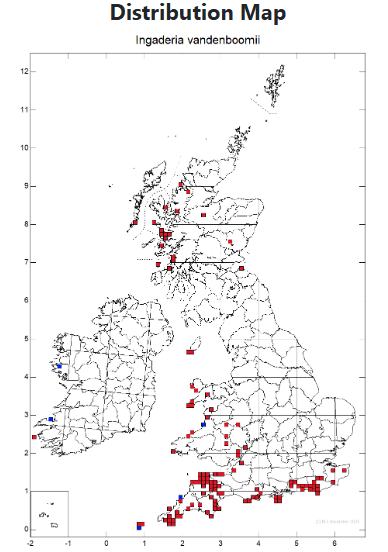
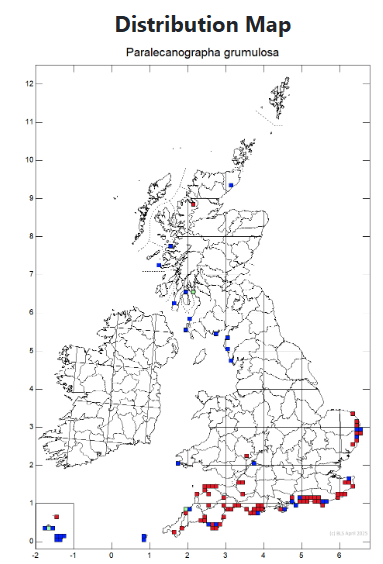
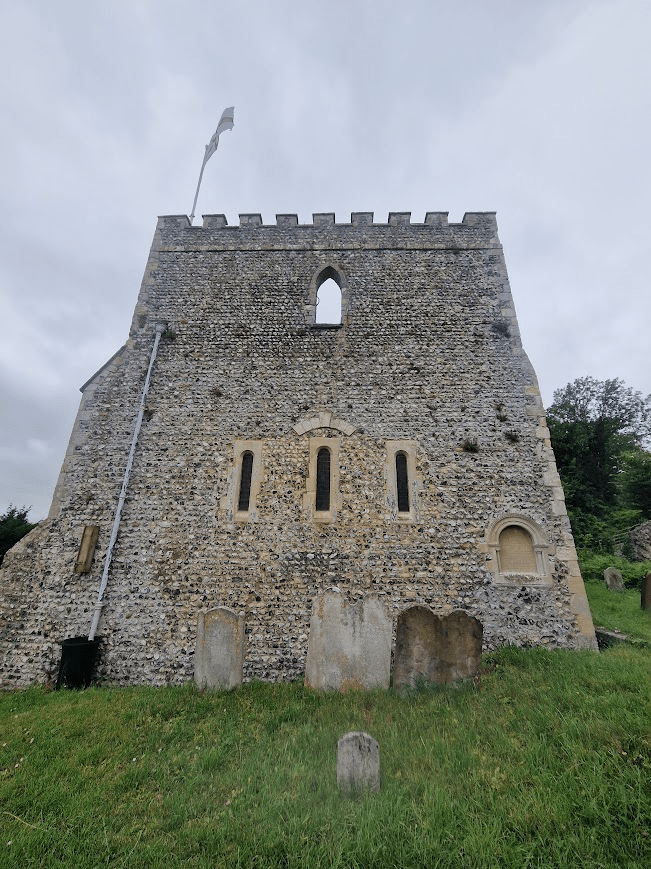
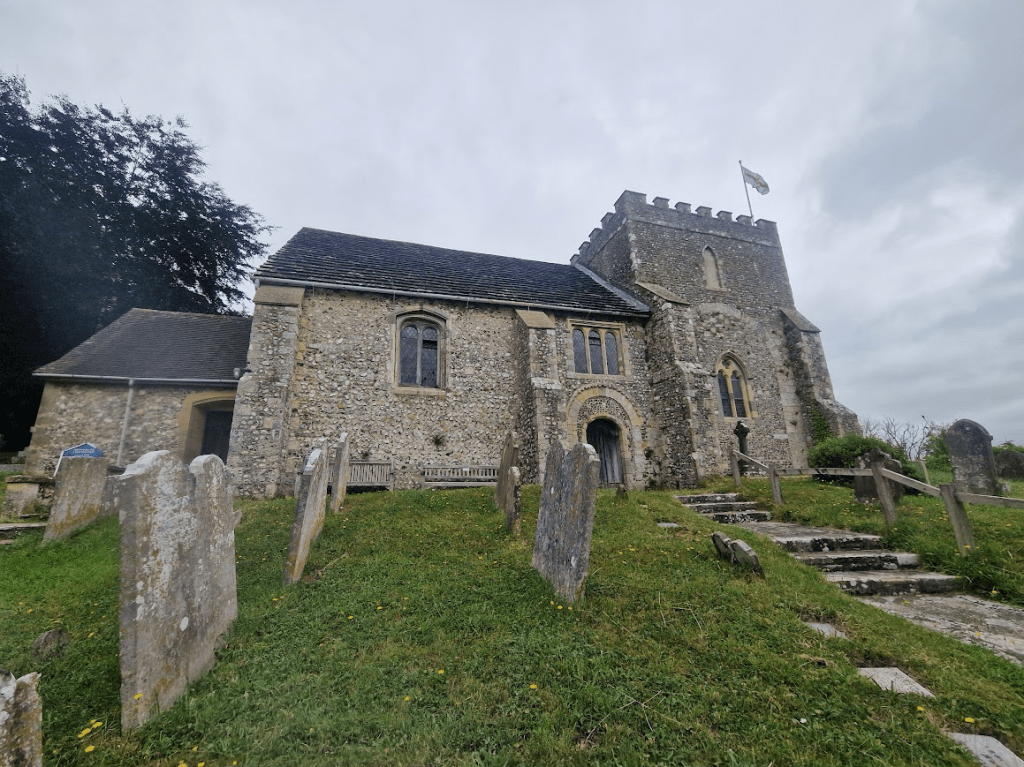
This species, which usually occurs on window ledges on the north side of churches, was first found in Sussex by Francis Rose and Peter James on mortar on Pagham Church in 1990. Since then, it has been found at several other sites in Sussex. Its British headquarters is south-eastern England.
Location / Grid ref. / Last seen West Thorney Church SU769024 1990 Boxgrove Priory SU907075 1990 Pagham Churchyard SZ883976 1993 Bramber Churchyard TQ186106 2001 Hamsey Church TQ413121 2001 Rodmell Church TQ421062 1990 Pevensey Castle TQ644048 1990 Camber Castle TQ921184 1997
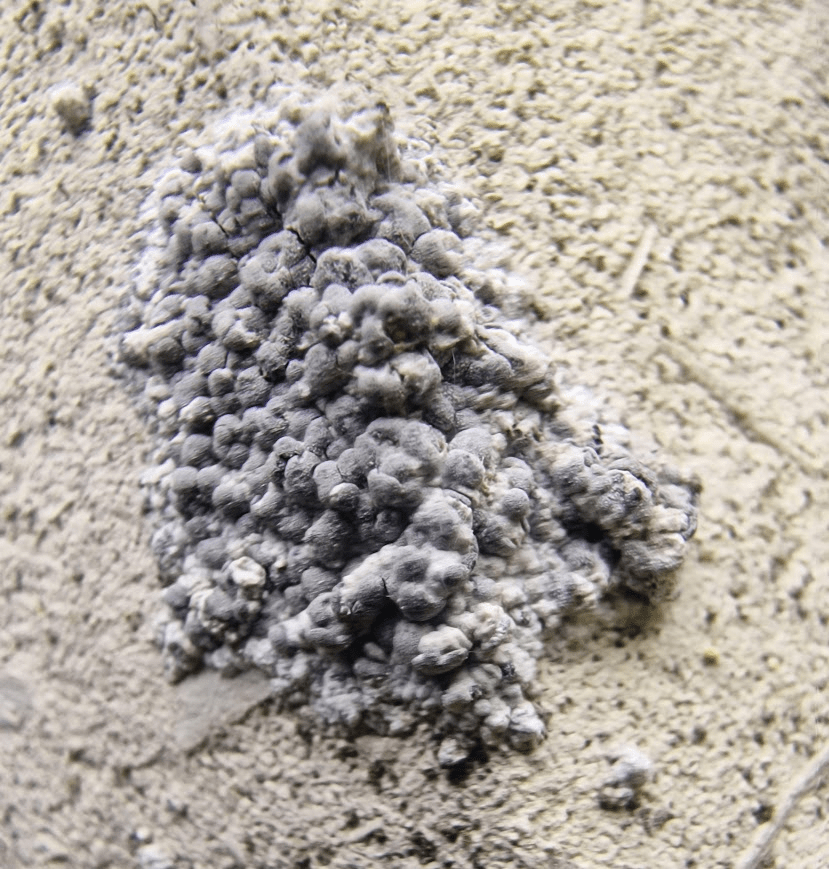
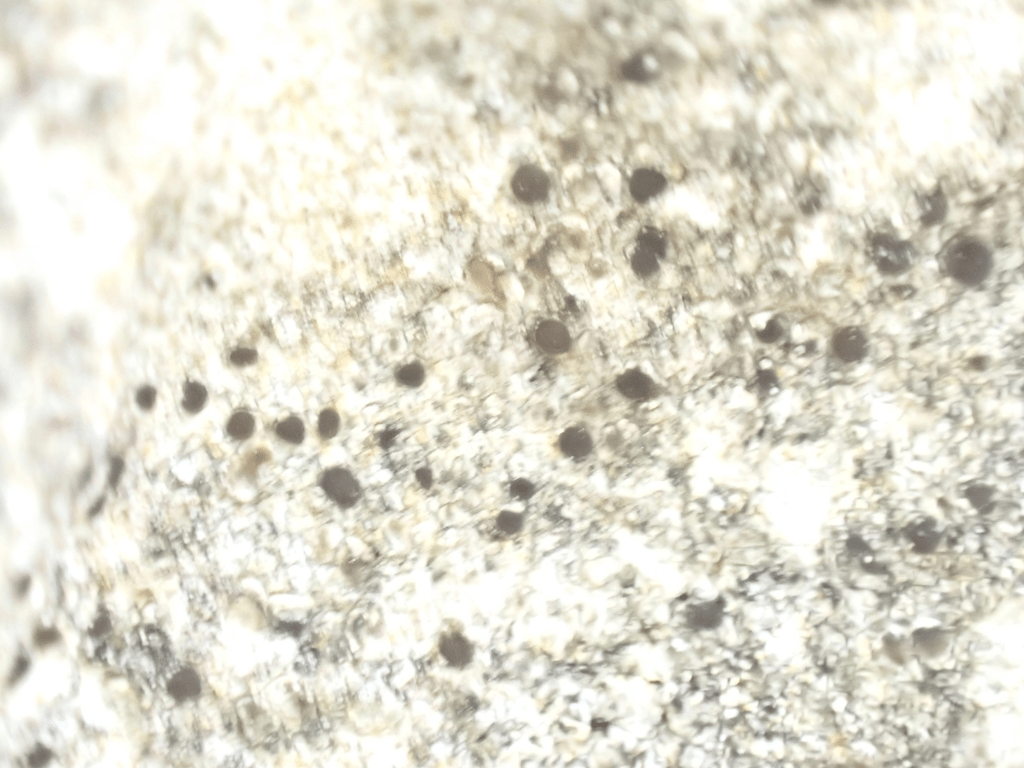
I had never heard if this lichen, so I looked it up. It is now called Paralecanographa grumulosa and it is considered Nationally Scarce by the British Lichen Society
There are many more interesting lichens on the walls of this church. I have detailed some of them here. This is very far from a complete survey of the lichens of the church; these are just what I found on a two-hour visit.
North Wall
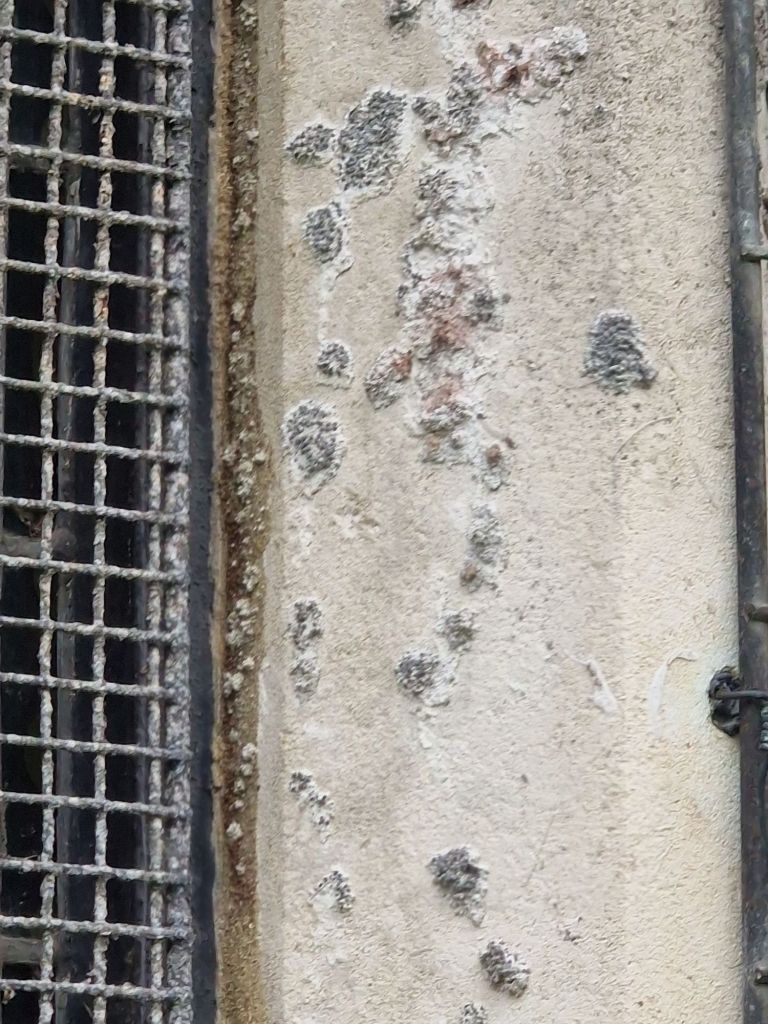
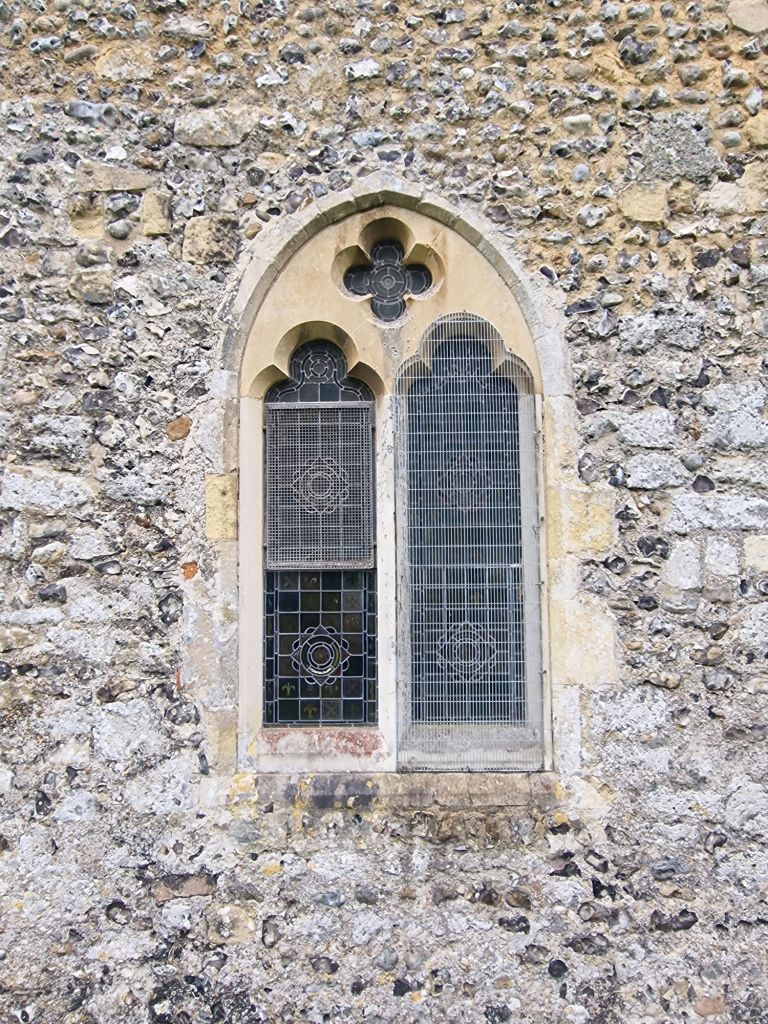
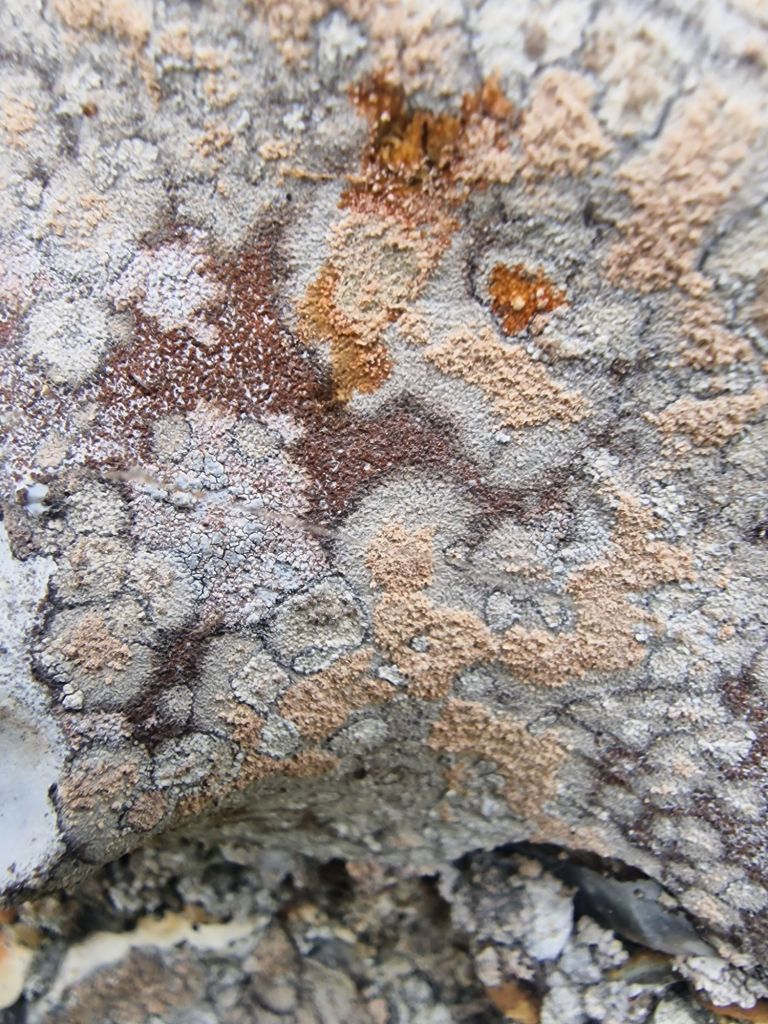
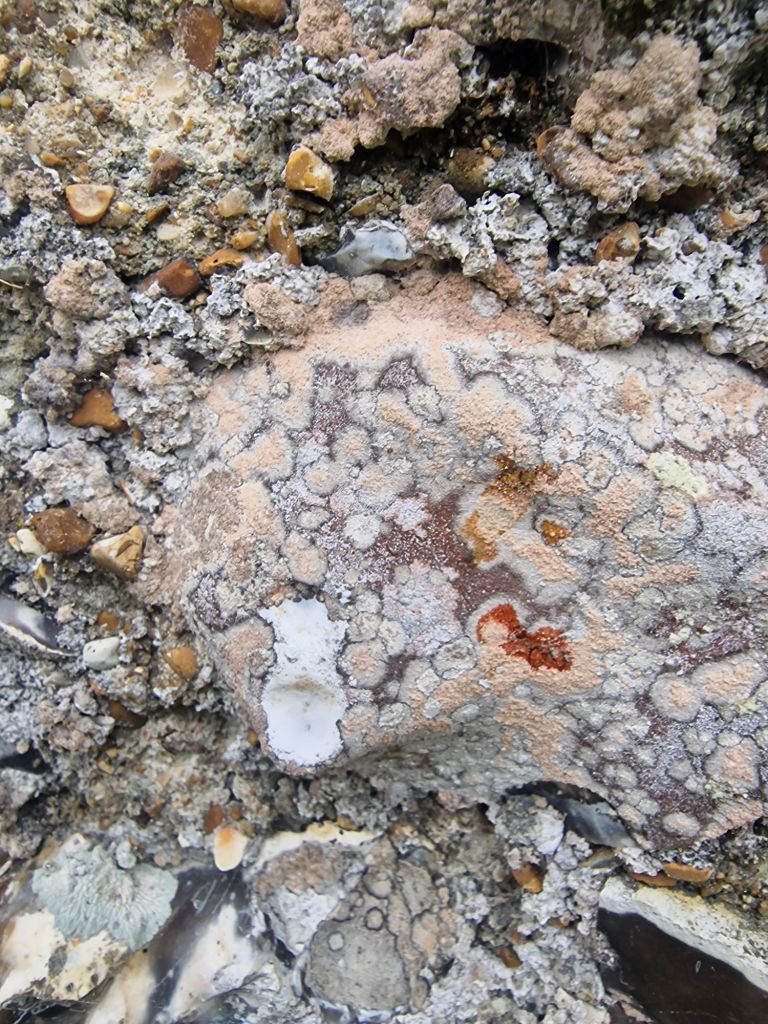
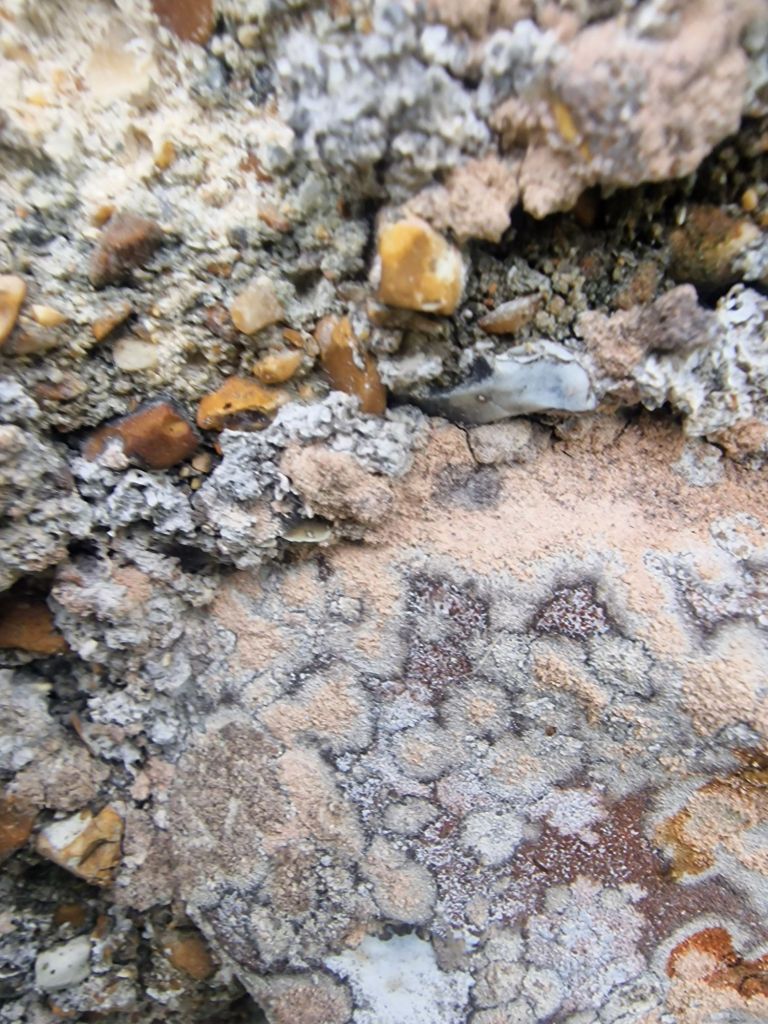
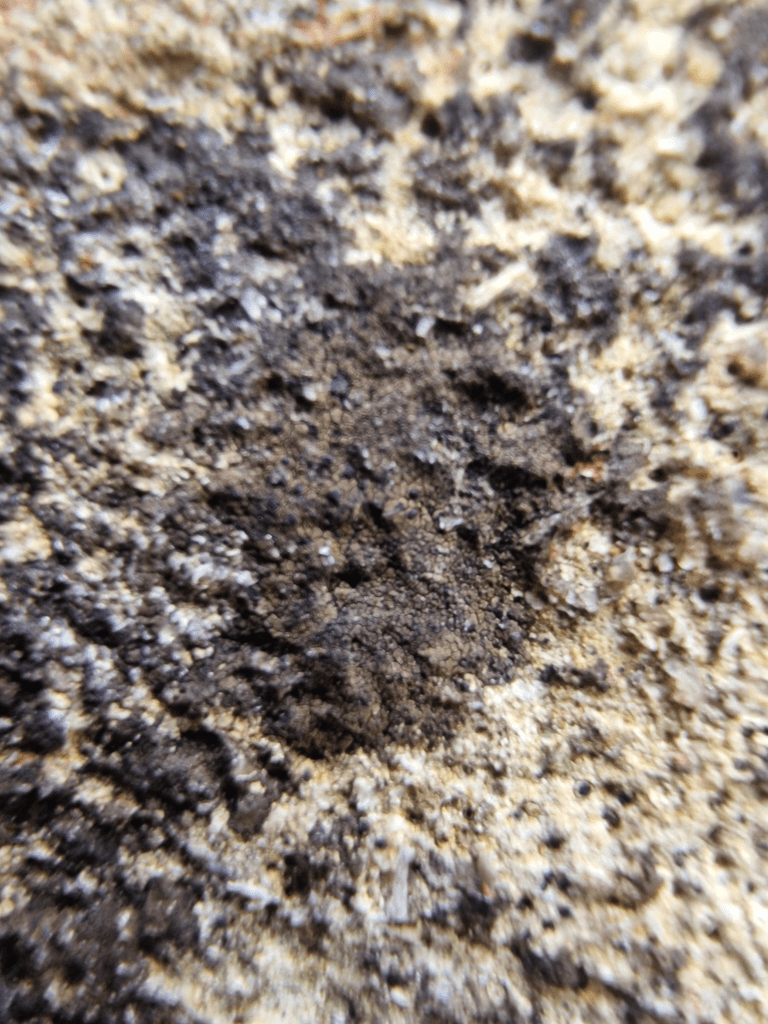
Paralecanographa grumulosa in the surrounds of windows of north walls of churches.
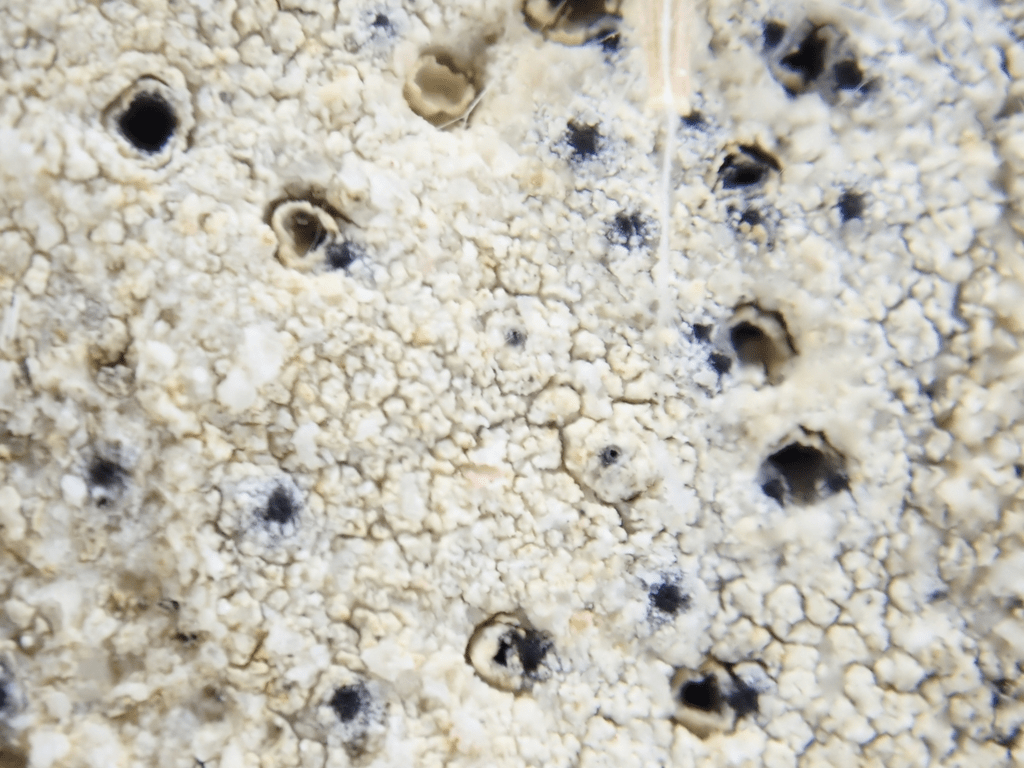
The fact that its apothecia were large, roundish and elongate, black, and partially immersed. with grey pruina (see description in Dorset Lichens) made it obvious that this was P. grumulosa, even though I had never seen it before, as the description of its apothecia is unlike any other lichen I know. However, I did do a chemical reagent test, and a tiny drop of sodium hypochlorite turned its thallus red.
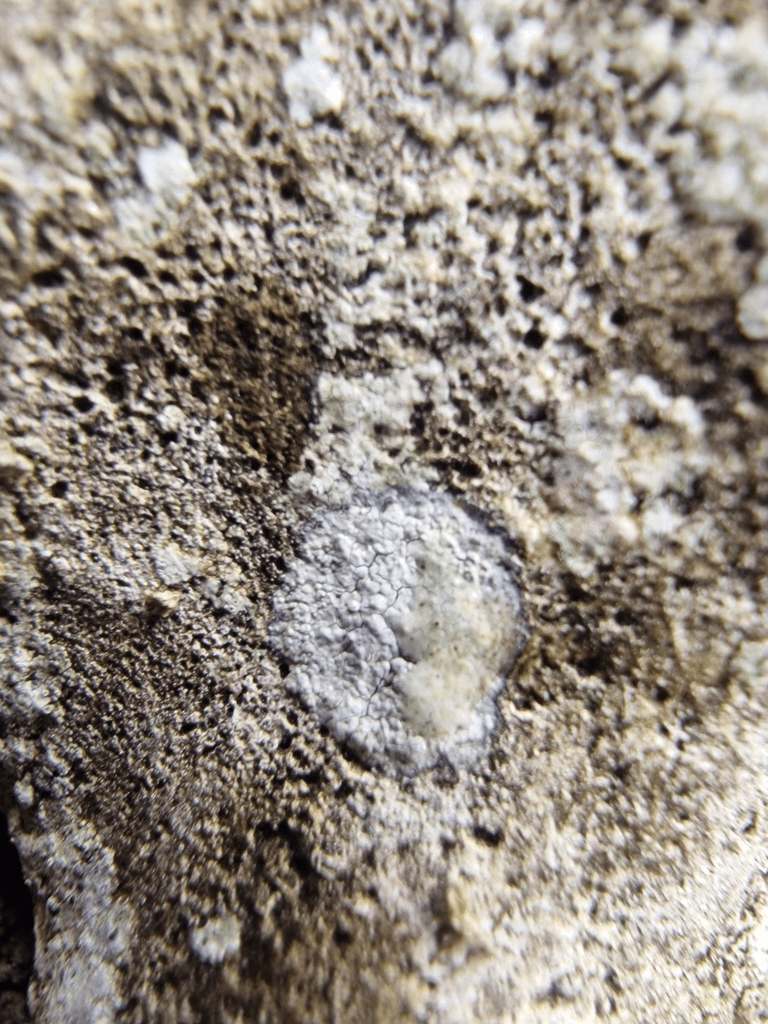
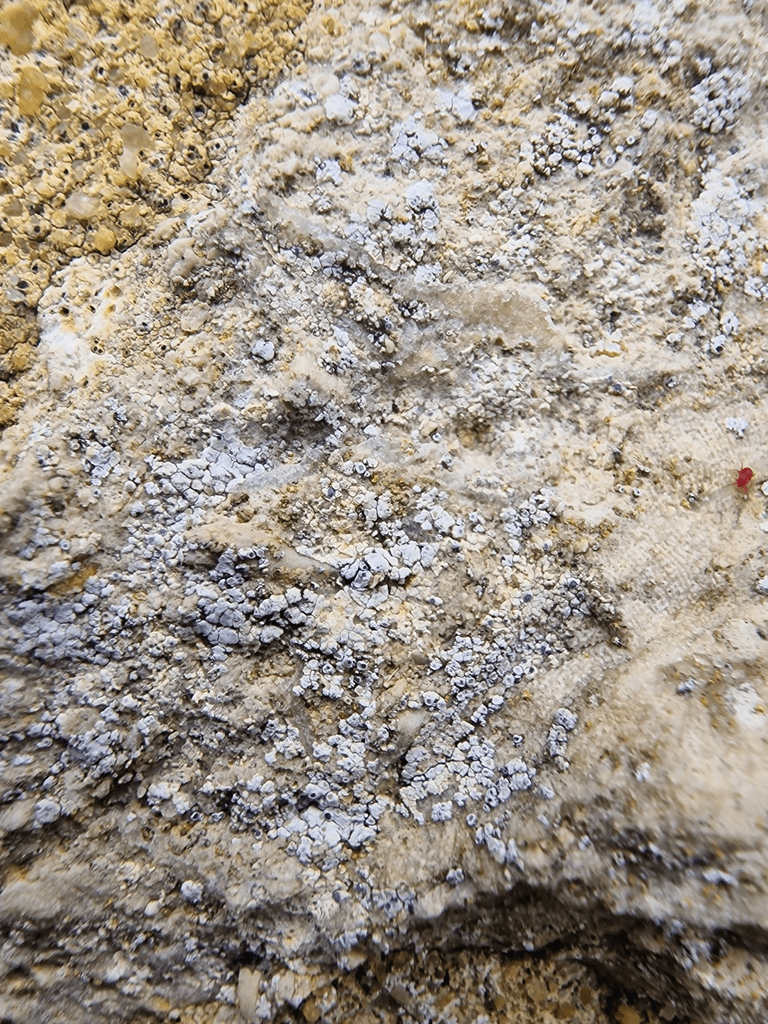
Also on the north wall was another rare lichen: Ingaderia vandenboomii. Rare, on vertical coastal siliceous rocks and on north facing church walls. BLS conservation evaluation: Least Concern but Nationally Scarce
When its thin, sightly uneven thallus is white-pink it is fairly easy to spot by overall appearance; but the thallus is not always white-pink. However, a tiny drop of sodium hypochlorite turned its thallus instantly red
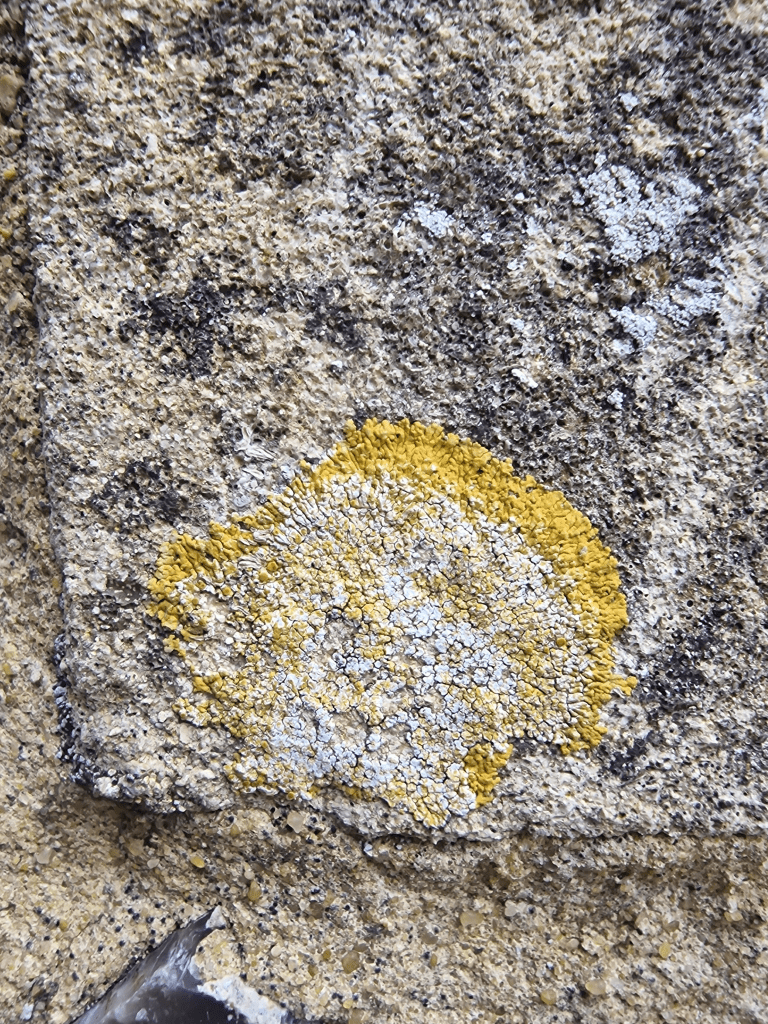
Xanthoria parietina Golden Shield Lichen
Tephromela atra Black-eye Lichen
Myriolecis dispersa Mortar Rim Lichen
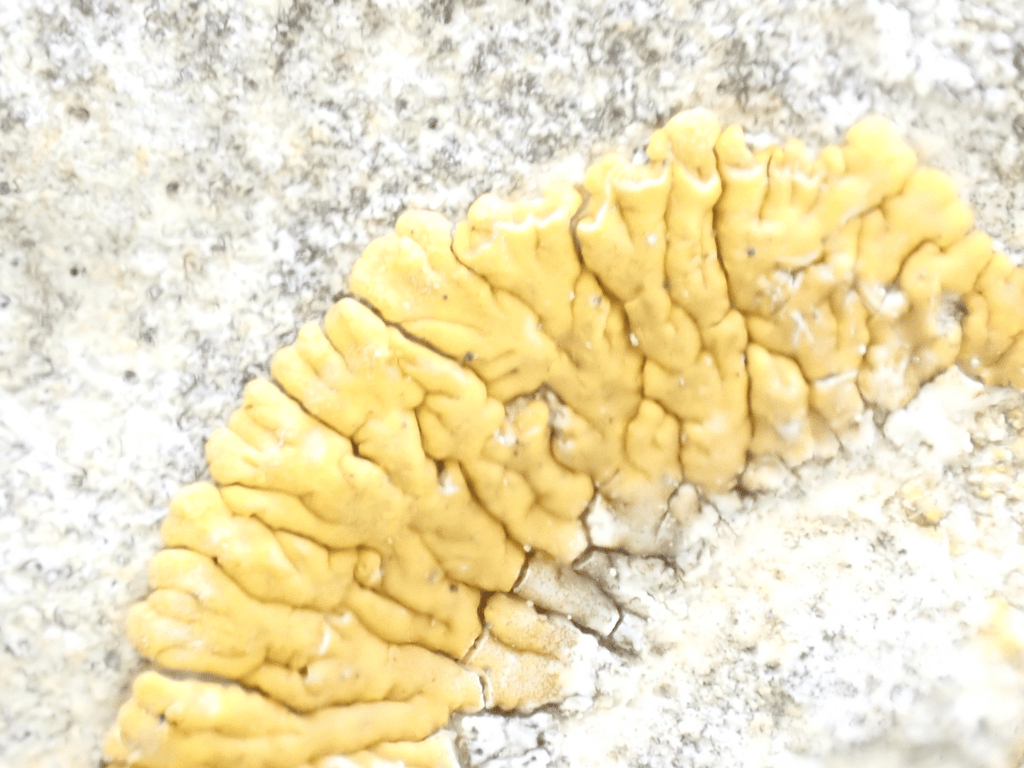
Variospora flavescensLimestone Lobed Firedot
West Wall
Variospora flavescens Limestone Lobed Firedot
Verrucaria nigrescens
Myriolecis albescens
South Wall
Verrucaria viridula
Myriolecis albescens
Variospora flavescensLimestone Lobed Firedot
Clauzadea monticola
East Wall
Sarcogyne regularis Frosted Grain-spored Lichen
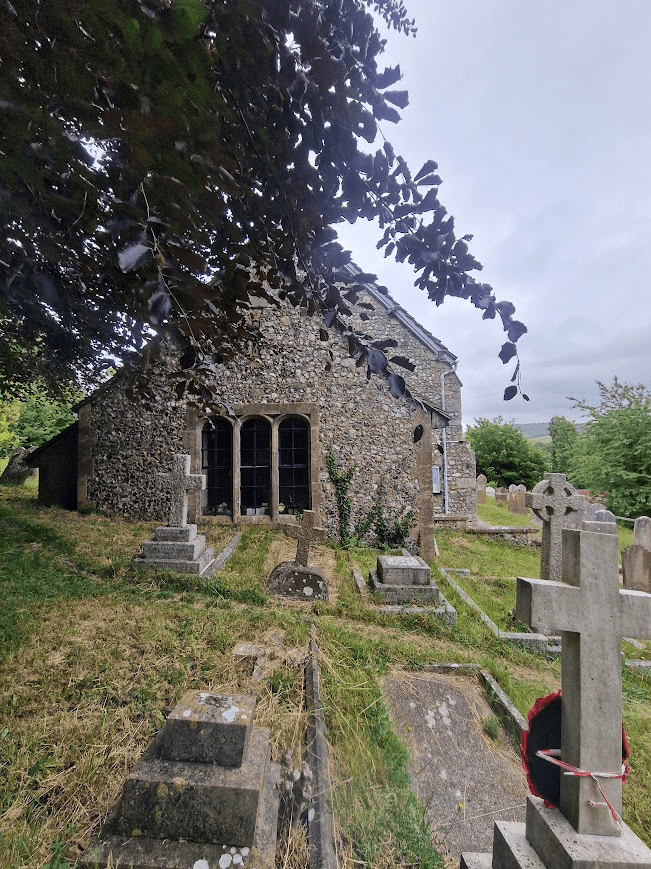
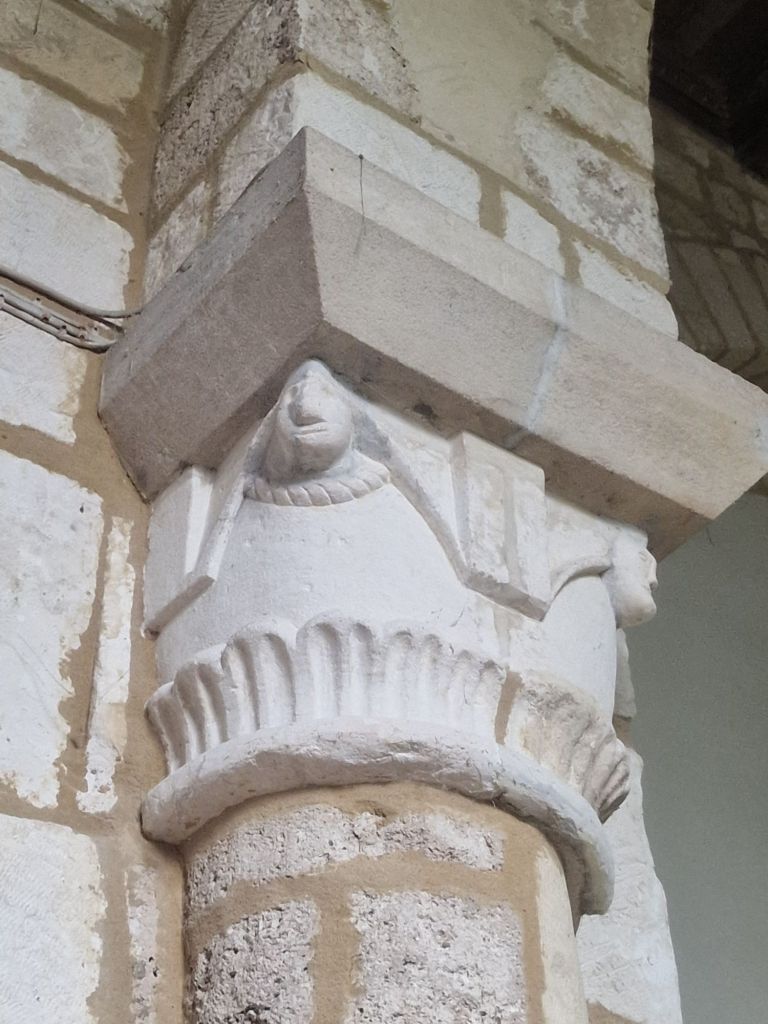
Even if you are not interested in lichens, St Nicholas is a very beautiful example of early norman architecture sited in a spectacular location next to the ruined Norman Bramber Castle
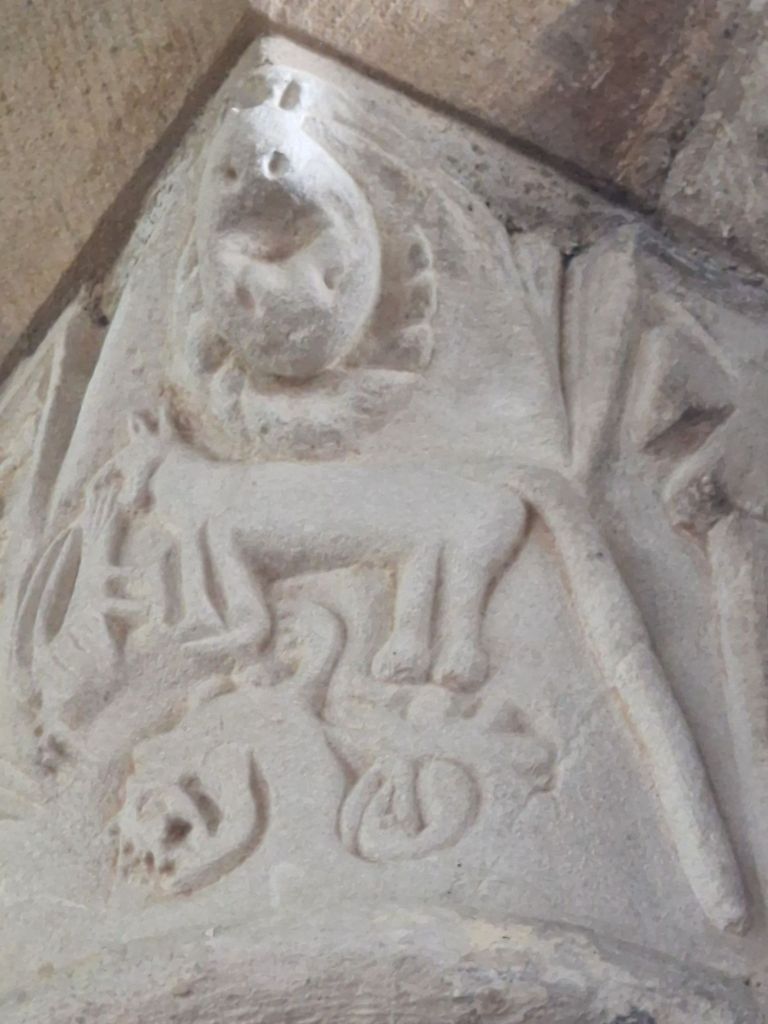
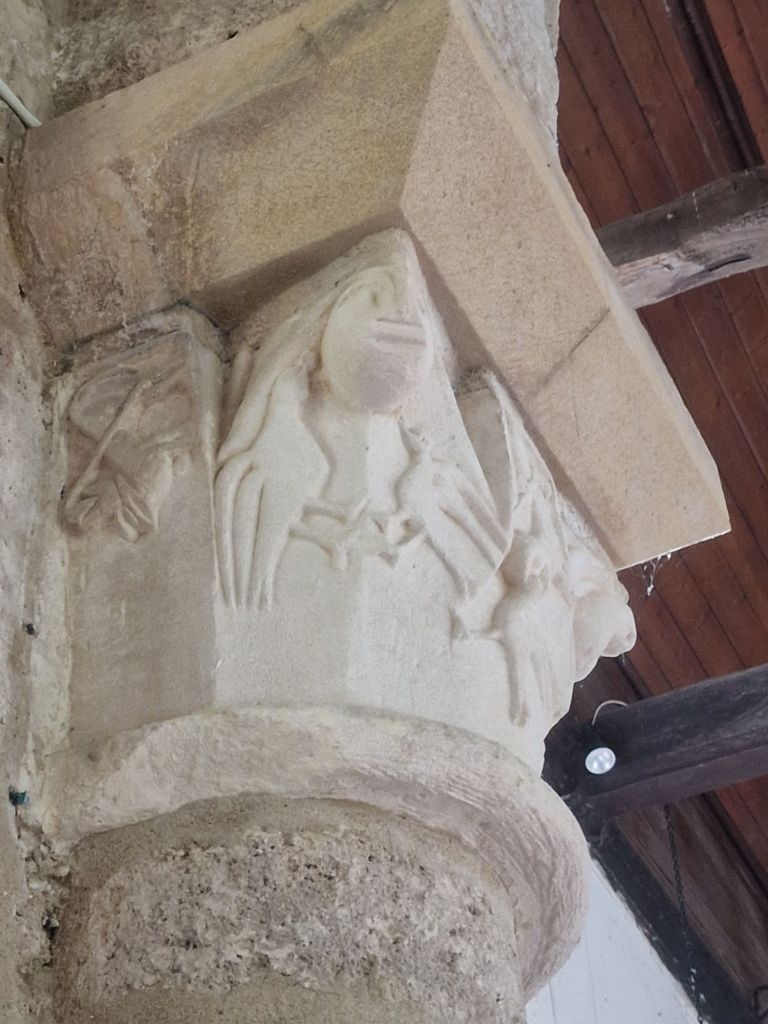
Bramber church stands on the same mound as the ruined castle and William de Braose, Lord of the Rape of Bramber, founded both. … The finest C11 work is in the crossing .. The capitals are carved with volutes, heads and in one case the story of the fox and geese. George Zarnecki (Zarnecki (1951) sees their flat carving, which is subordinated to the shape of the capitals, as further evidence of their C11 date. Bramber St. Nicholas’ Sussex Parish Churches
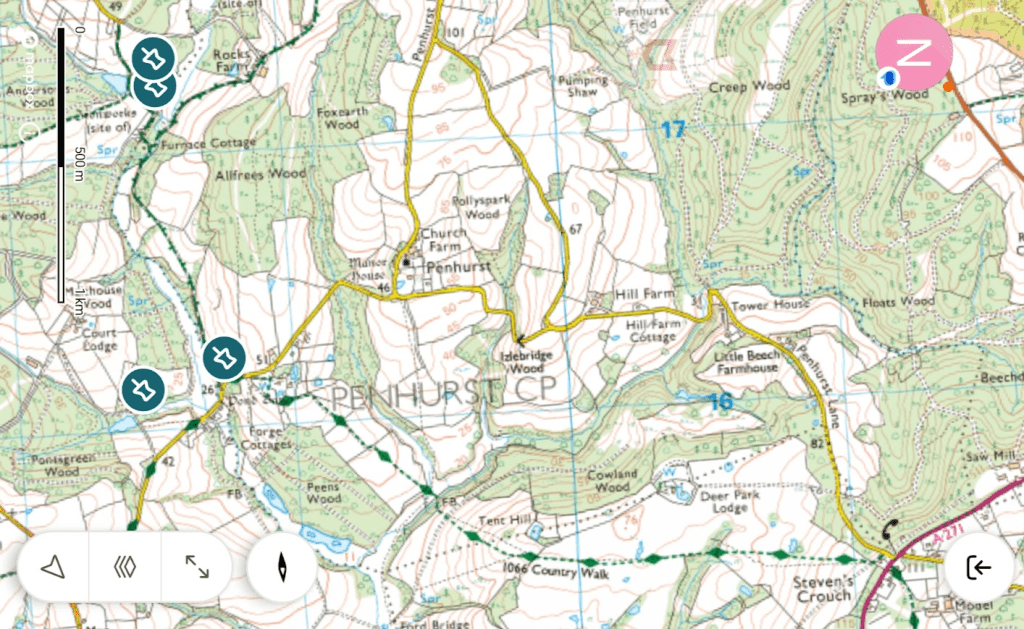
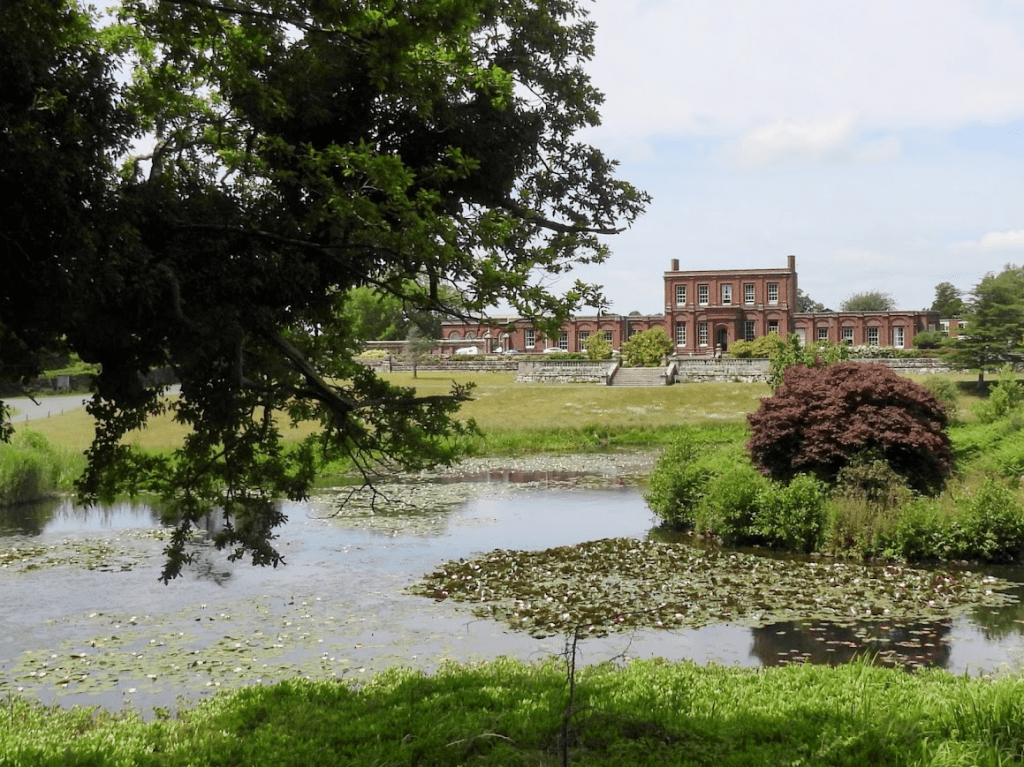
On Monday morning 16.06.25 I walked from West Lodge, Steven’s Crouch (“Crouch” likely originates from the Old English word “crūc,” meaning “cross” and is common in the south-east Family Search: Crouch) to Tent Hill (different sources suggest that either the Norman or Saxon army camped on Tent Hill the night before the Battle of Hastings. The historically accepted battle site is Senlac Hill where Battle Abbey now stands. 1066 Walk Guide), along the 1066 Country Walk, through what I believe is the remains of Ashburnham’s Deer Park. The Ashbourne Place Historic England Listing suggests that this area is the Deer Park from West Lodge is a track through the deer park, running parallel to the A271 Ashburnham Place Historic England Listing. In the afternoon I visited the relicts of Ashbourne Furnace
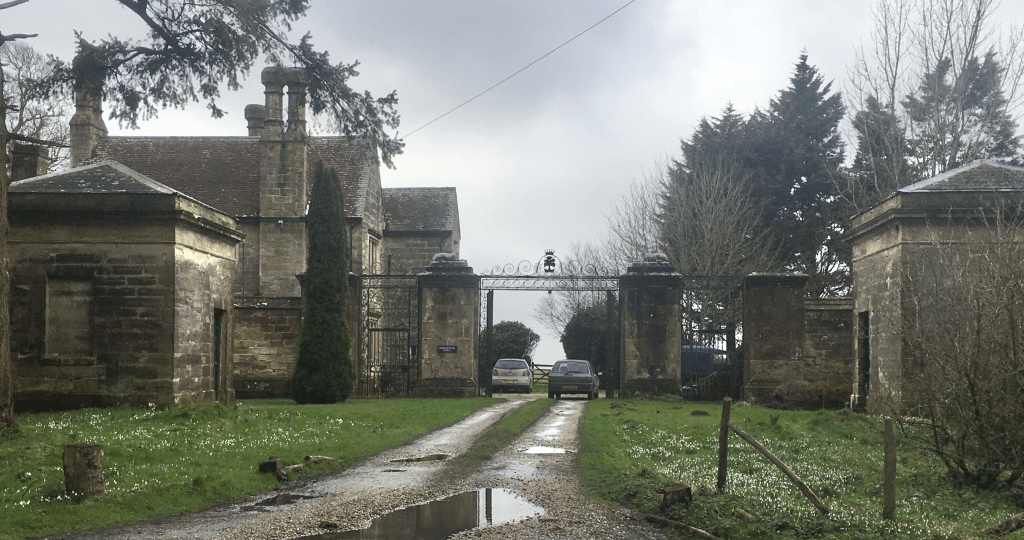
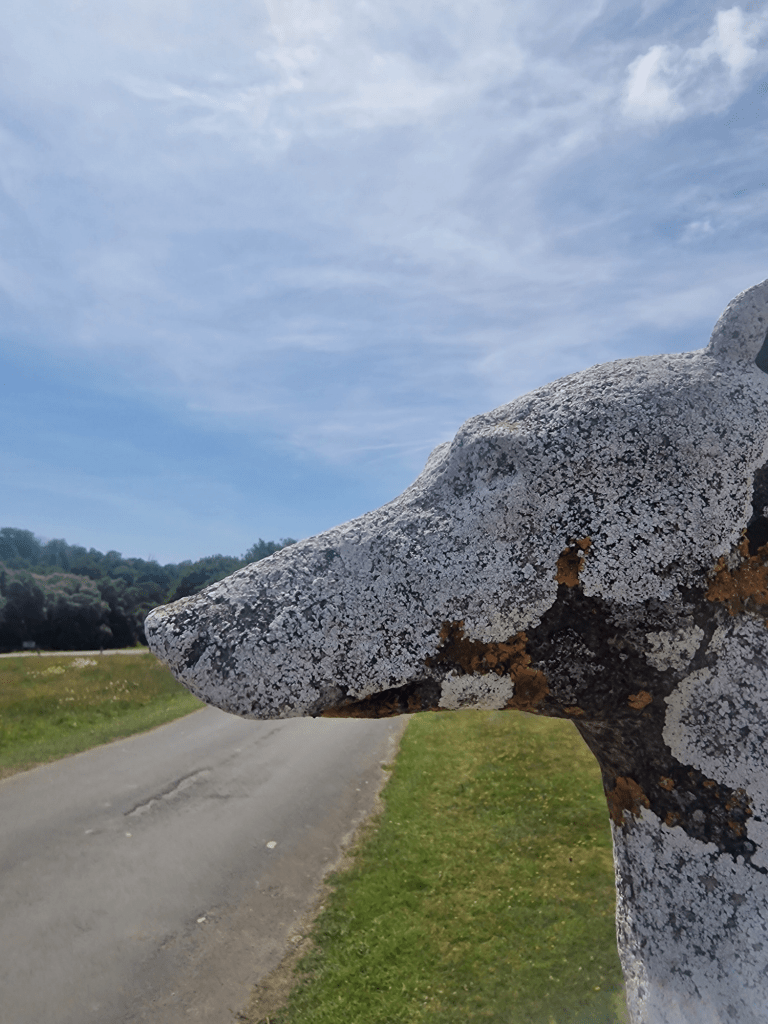
West Lodge, designed by Robert Adam in ca. 1780, is one of the gateways into Ashburnham Park. The central carriage drive has wrought iron double gates with an overthrow containing the design of a tree and a coronet. The gates are flanked by stone piers surmounted by couchant greyhounds in stone. On each side are pedestrian gates with overthrows and similar piers without the greyhounds on top.Historic England Listing
I got to Steven’s Crouch by public transport: train from Brighton to Bexhill, then bus from Bexhill to Steven’s Couch/Catsfield Road . Stagecoach 95 bus Bus Times. Steven’s Couch, where West Lodge is, is about a 20 minute walk west along the road from the Steven’s Couch bus stop.
It is hard to know exactly where the historic deer park was; but the quality of lichens along the path, on a wayside Oak and a pollarded Ash, suggest ecological continuity suggestive of a medieval deer park, as mentioned in the Ashburnham Place SSSI specification. The SSSI includes Cowland Wood, just above the 1066 path. The north-west outlier of the SSSI, so it is probably likely that the 1066 path runs through the pasture woodland of the medieval deer park, even though it is not the SSSI
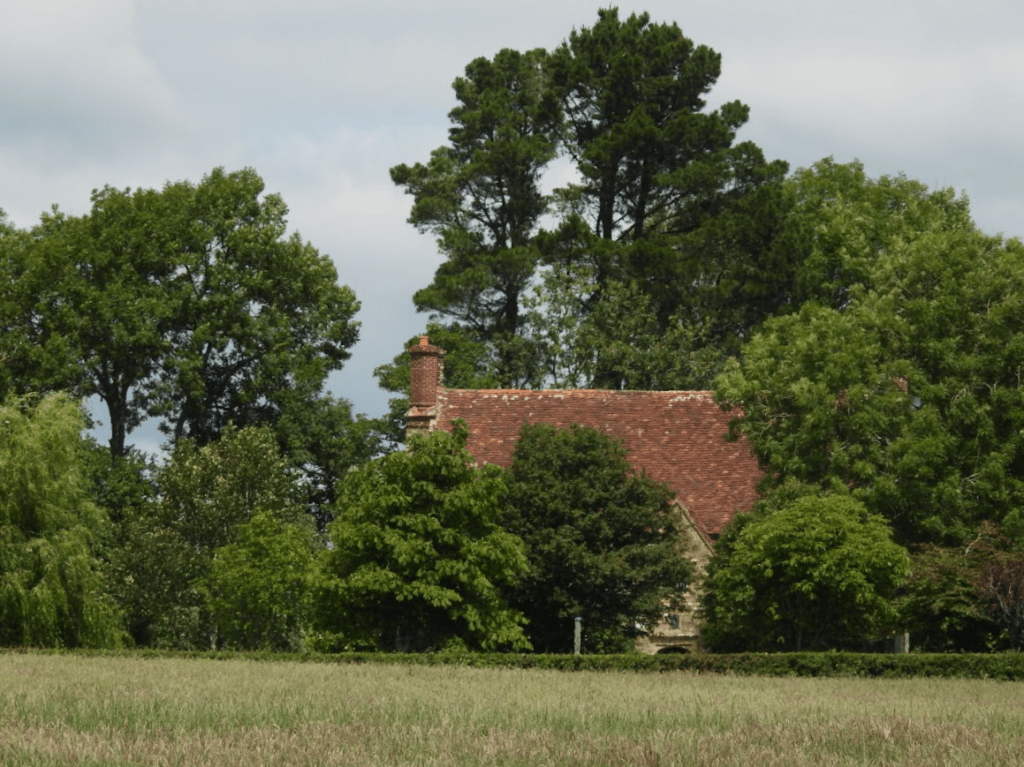
Deerpark Cottage (called Lodge on OS map) just south of Cowland Wood
Deerpark Cottage, Ashburnham Place 3.8.61 II Early C17. 2 storeys. 3 windows. Ashlar. Tiled roof. Casement windows of 4-lights with stone mullions and dripstones over. In the centre is a gabled porch with a 4-centred doorway and a room over. At each end is a stepped chimney breast.Historic England Listing
Location of Cowland Wood;the north-east outlier compartment of the SSSI on this SSSI map. I did not have time to explore Cowland Wood
Quercus robur at the end of the strip of trees that points north-east toward Cowland of the main compartment of the SSSI
with Rinodina roboris
an International Responsibility lichen
Certain British lichen assemblages are rich compared with equivalents elsewhere in Europe, and are of international importance (Fryday 2002; Coppins and Coppins 2005). This is partly associated with our oceanic climate, but also results from the extent of semi-natural habitat with relatively clean unpolluted air, and significant numbers of old trees2 in parkland and old growth pasture woodland (e.g. Farjon 2017). This contrasts with large tracts of western Europe (Rose 1992). It is the assemblages of hyperoceanic lichens that are of greatest significance at a European scale, and these are largely confined to woodlands (2.1.1) and
Southern oceanic old growth woodland lichen assemblages are outstandingly well-developed in the south of Britain, especially from North Wales south to Devon and Cornwall and east to the New Forest (Map 2) (Rose and James 1974; Sanderson 2010). The range of lichen communities of interest is greater than in the rainforests, consisting of: base-rich bark (Lobarion pulmonariae and Agonimion octosporae), acid bark (Parmelion laevigatae), smooth mesic bark (Graphidetum scriptae and Pyrenuletum chlorospilae), rough mesic bark (Pertusarietum amarae), dry bark and lignum on veteran and dead trees (Lecanactidetum Lichen communities, such as the Lobarion pulmonariae and Parmelion laevigatae are found in particular niches, such as base-rich bark or dry overhanging rock. Several communities can co-occur in a habitat, or even on a single tree. Neil Sanderson, Tim Wilkins, Sam Bosanquet and David Genney 1018 Guidelines for the Selection of Biological SSSIs. Part 2: Detailed Guidelines for Habitats and Species Groups Chapter 13 Lichens and associated microfungi. Joint Nature Conservation Committee 2018
This Oak also had
Lepra amara
a characteristic species of the Mature Mesic Bark Community (Pertusarietum amarae).
and Ramalina farinacea
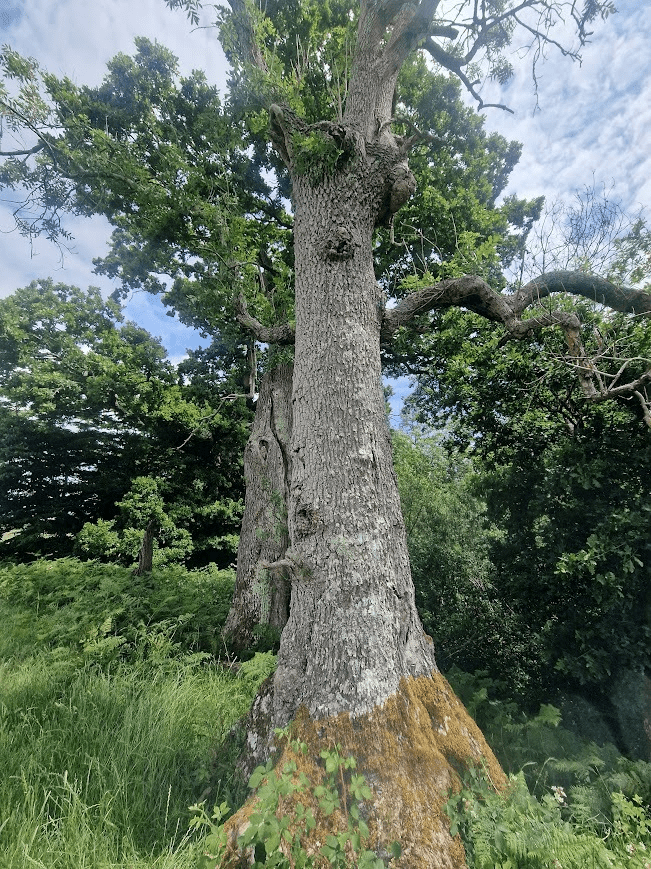
This exceptional pollarded ancient Ash Fraxinus sylvatica on Tent Hill
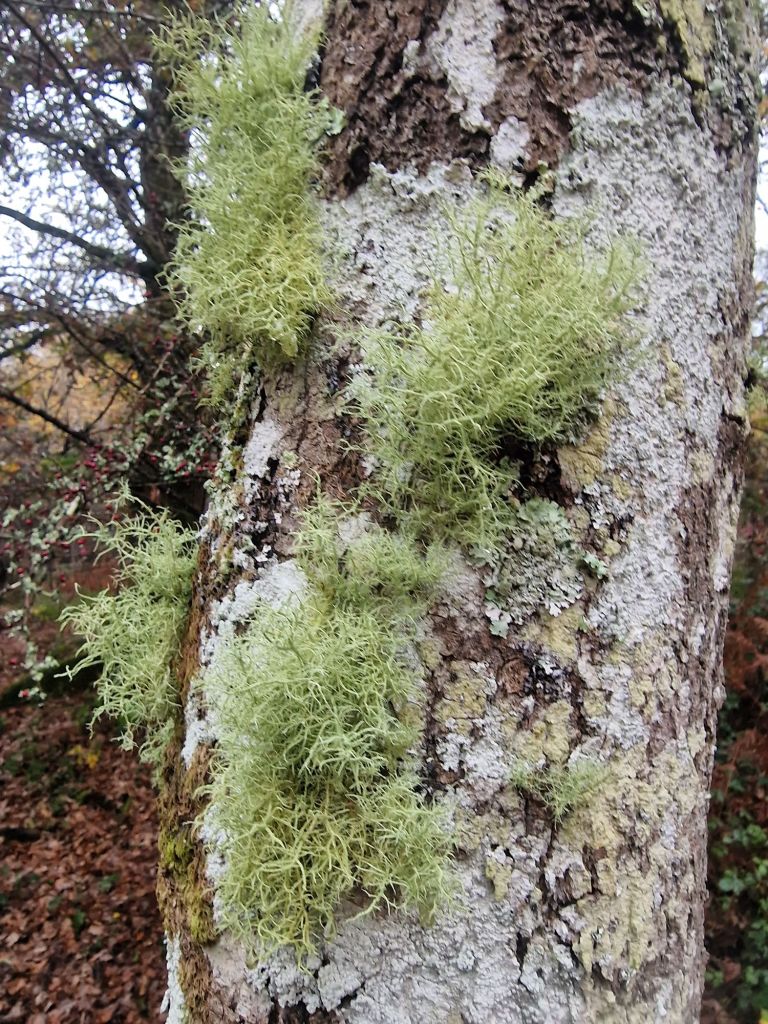
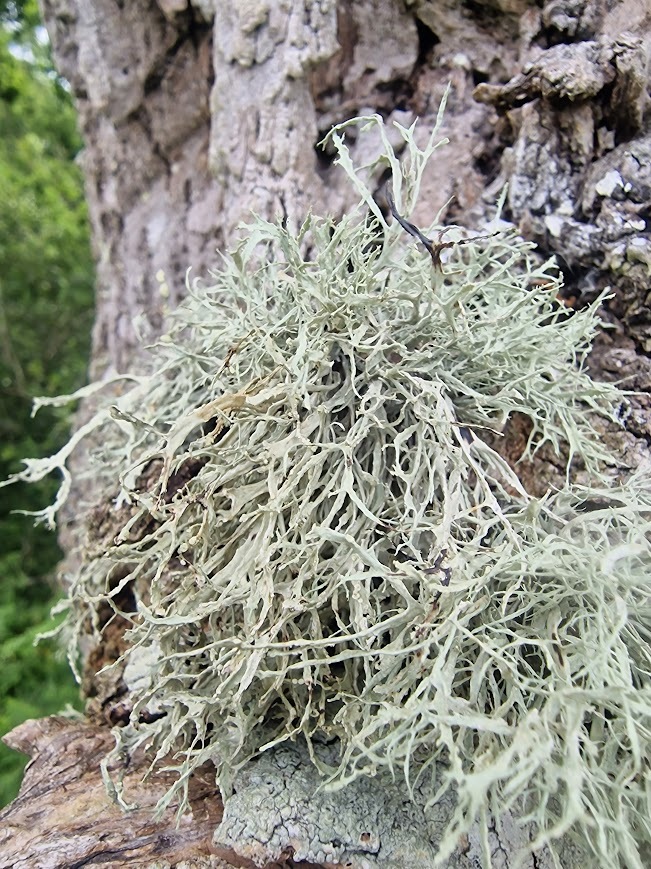
had Ramalina fraxinea, and International Responsibility lichen
A fruticose species with distinctive long, pendant, strap-shaped lobes. Most branches are flat or slightly caniculate, but wrinkled, and widen from the base. Well-developed specimens display large, pale fawn apothecia along its entire thallus.Ramalina fraxineacan be distinguished from Ramalina fastigiata by its long, pendant lobes and the presence of apothecia along its entire lobes rather than only the apices.Scottish Lichens: Ramalina fraxinea
It’s ironic that it’s on Tent Hill; where William the Conqueror’s army slept before the Battle of Hastings. His win resulted in the establishment of the deer parks created on land given to his vassal barons, which resulted in the pasture woodland that rarer lichens love!
Also on this Ash was: Phaeophyscia orbicularis
and Lecanora gangaleoides with Physcia adscendens over growing it
and Pertusaria pertusa
A characteristic species of the Mature Mesic Bark Community (Pertusarietum amarae).
The common ash, Fraxinus excelsior, is currently listed as Near Threatened on the IUCN Red List. This means that while it doesn’t currently qualify for threatened status, it is close to qualifying or is likely to qualify in the near future. The primary threat to ash trees is the fungal disease known as ash dieback, caused by Hymenoscyphus fraxineus.Kew Gardens I have noted that pasture woodland Ash, seem to be doing better than Ash in tall forest woodland; perhaps because the space between trees in pasture woodland reduces the risk of infection
Ashburnham Park on Tuesday 17.06.25
I made a further visit to Ashburnham Park on Tuesday 17.06.25 after visiting with two lichenologist fiends on 12.06.25. See:
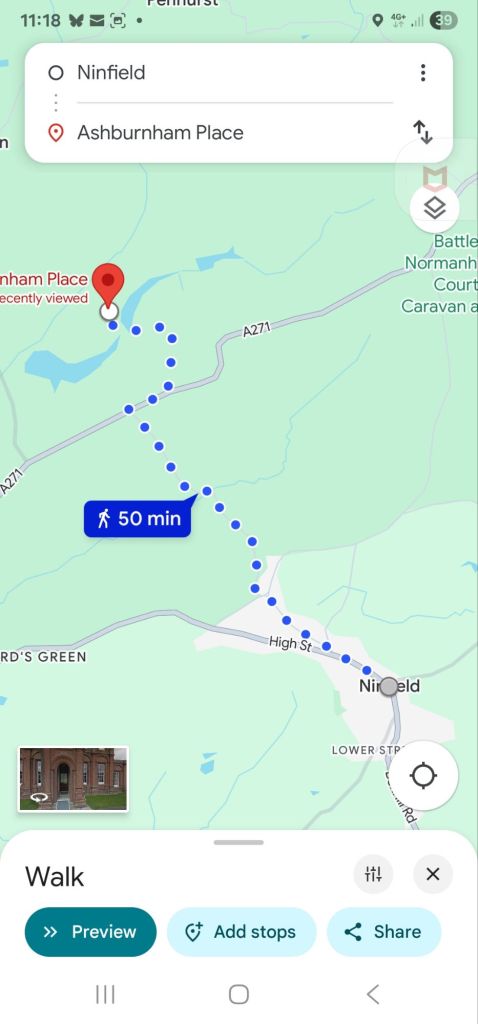
This post only lists things that we didn’t see on Thursday, 12.06.25. This time, I travelled by public transport: train from Brighton to Polegate, then bus from Polegate to Ninfield. Stagecoach 53 bus Bus Times. The walk from Ninfield to the entry to Ashburnham Park takes 49 minutes.
Woods
On the Quercus robur on the edge of the woods by the road near the main entrance was Varicellaria hemisphaerica
These Quercus robur have south facing trunks covered with lichens of the Pertusarietumamarae(mesic dry bark community): shade tolerant communities on rougher bark, with Pertusaria species dominant, and Varicellariahemisphaerica
Varicellaria hemisphaerica
and it was also on an Oak in Walk Wood
Chaenotheca ferrungea in bark grooves of a Quercus robur
We saw this last Thursday; but not with pin-head apothecia; the pinheads were just visible of this example.
In Walk Wood there were a number of notable maiden Hornbeams, Carpinus betulus in the woods. Normally, when I see Hornbeams in Sussex, they’re coppiced and have few lichens (mostly Pertusaria leioplaca and the Graphidetum scriptae association with Graphis scripta). But the Hornbeams in Ashburnham Park were much older non-coppiced maidens, which seem to have lichens of thePyrenuletum nitidae association (this is listed by James et al (1977) a continental association, the tail end of which is seen on ancient Beech and Hornbeam in south east England ….probably a separate southern oceanic community characterised by Pyrenula chlorospila with Enterographa crassa and Pyrenula macrospora) as well as of the Graphidetum scriptae association British Lichen Society Lichen Communities These hornbeam mosaics require more time than I had available to identify all their species.
Pertusaria sp. surrounded by Graphis scripta sensu lato. The revision of the Graphidaceae lichens in the Lichens of Great Britain and Ireland III has split Graphis scripta into more than one species, and spore microscopy is required for definitive identification of Graphidaceae lichen
Lecanora chlarotera/hybocarpa (microscopy of the apothecia crystals with polarizing light is required to separate L. chlarotera from L. hybocarpa) was part of these Hornbeam mosaics.
In the extreme north east of the wood around Reservoir Pond, where we hadn’t visited on Thursdays 12.06.25 there were several huge ancient Quercus robur near the perimeter fence, next to open parkland
which had quite a lot of Enterographa crassa on smooth patches around its base
The Terraces
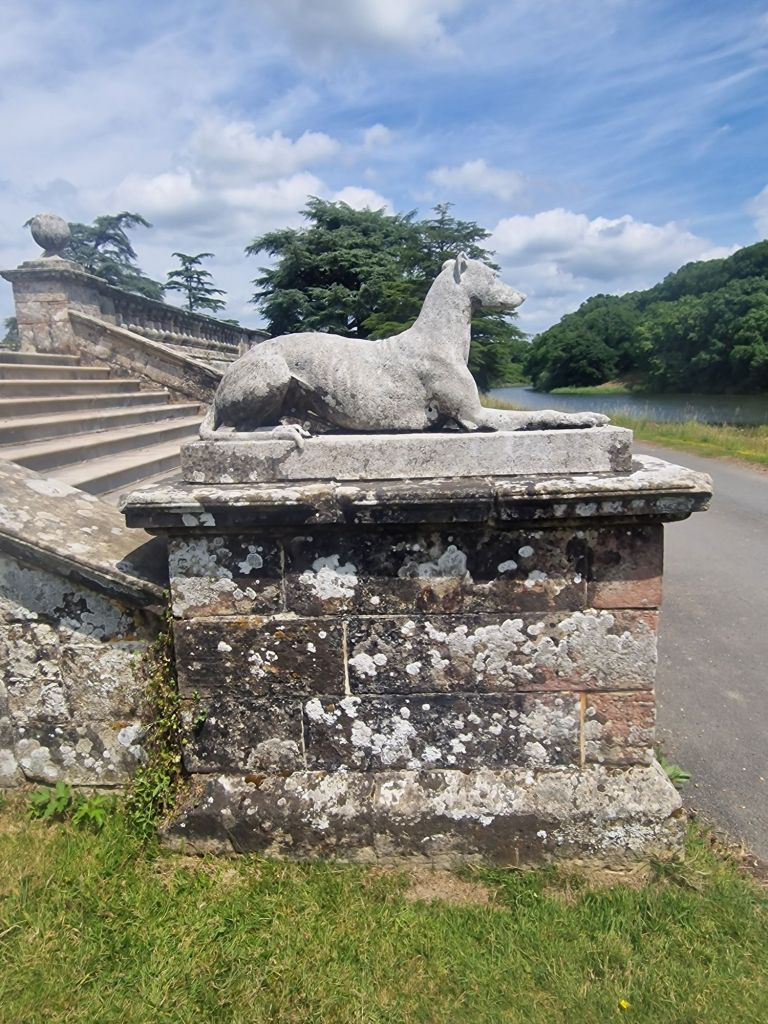
The terraces are on the front (south) of Ashburnham Place; they are approached by two central flights of steps bedecked with heraldic greyhounds. The terraces were designed by Neo-Classical architect George Dance in 1813.
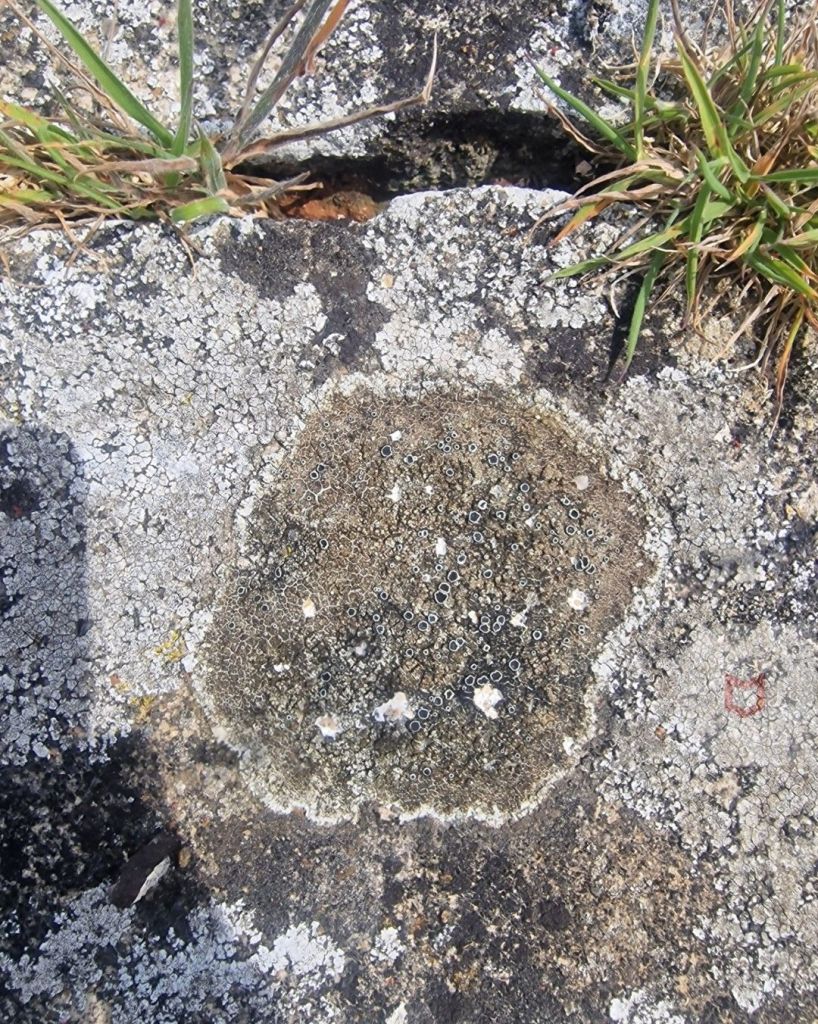
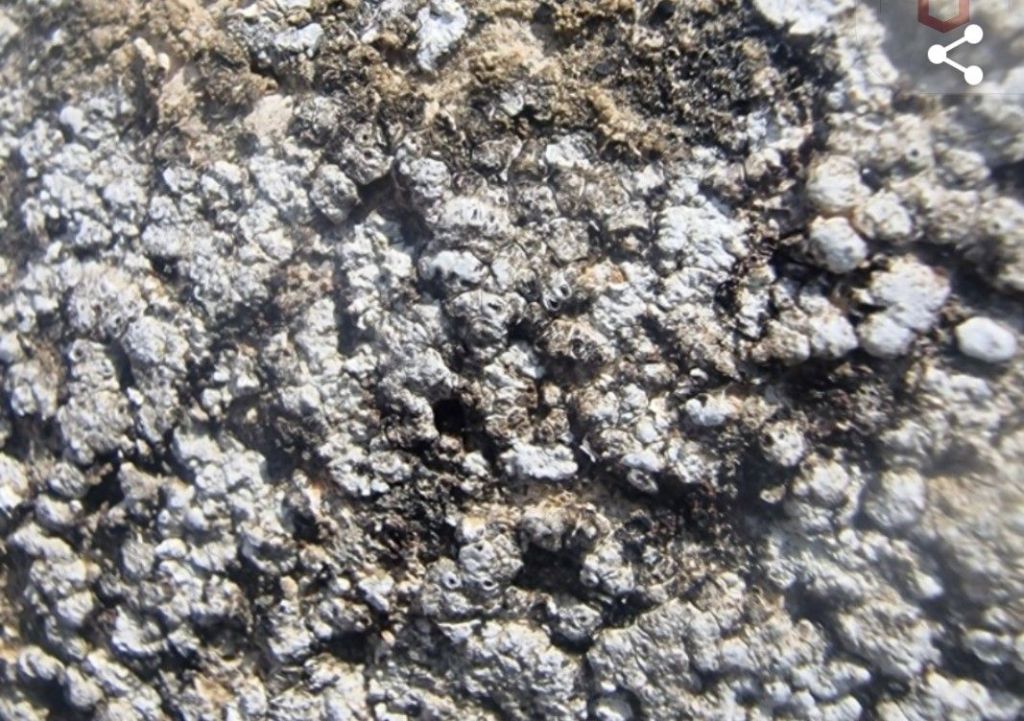
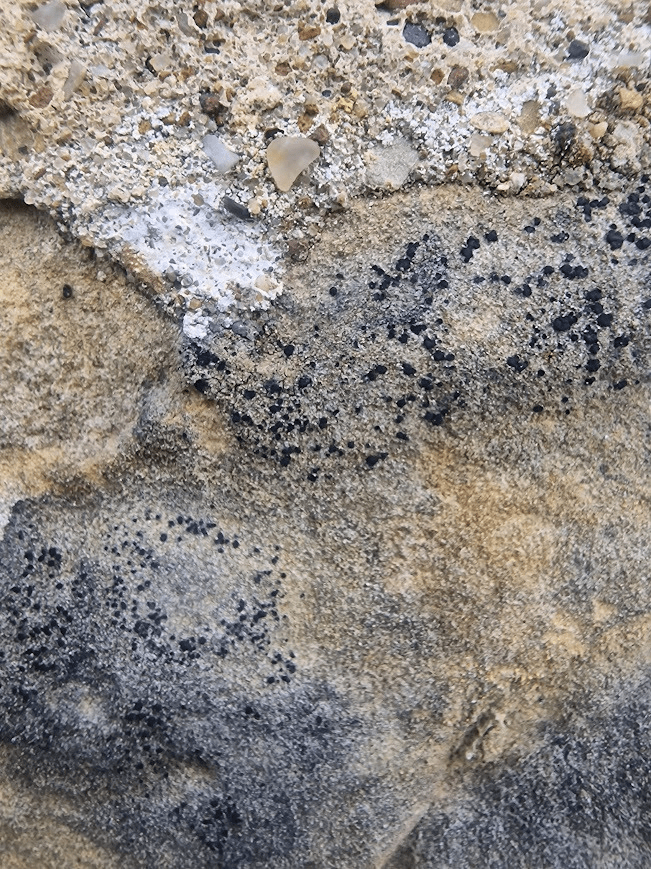
Pyrenodesmia variabilis, previously Caloplaca variabilis an Terrace wall. Not common in Sussex and not recorded at Ashburnham despite being often surveyed as its an SSSI, probably because the terraces of the house are not in the SSSI blocks.
Kuettlingeria teicholyta, previously Caloplaca teicholyta, was abundant on the walls of the terraces and on the greyhound garden statutory on the pedestals next to the steps to the terraces
The limestone greyhounds were dominated by Kuettlingeria teicholyta and Circinaria contorta, with yellow flashes of Variospora flavescens
Many of the walls were dominated by Verrucaria nigrescens and Myriolecis albescens; all common on old walls.
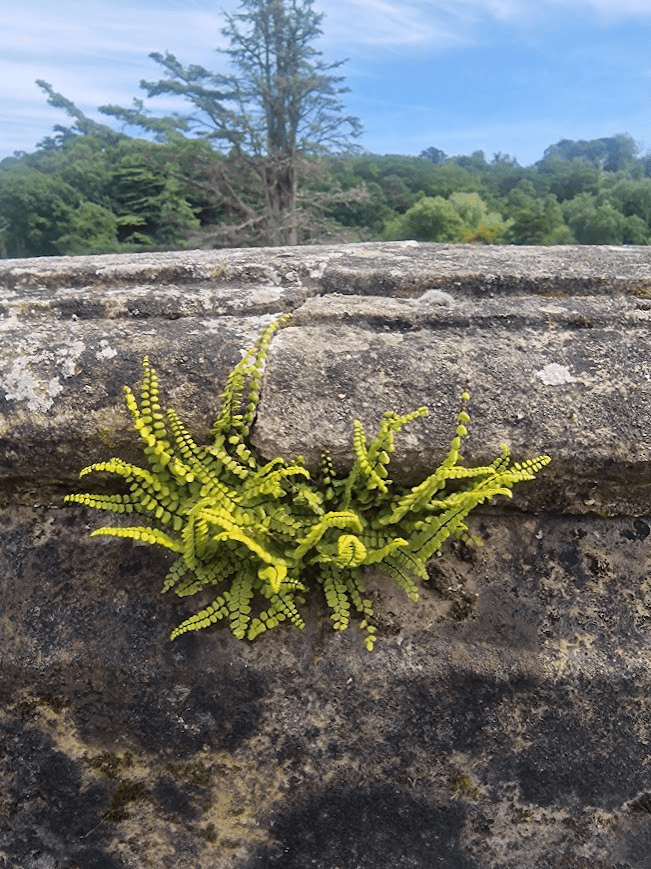
Maidenhair Spleenwort, Asplenium trichomanes, one of my favourite ferns. The moss Grimmia pulvinata, was also common on the walls, as it is on many Sussex old walls.























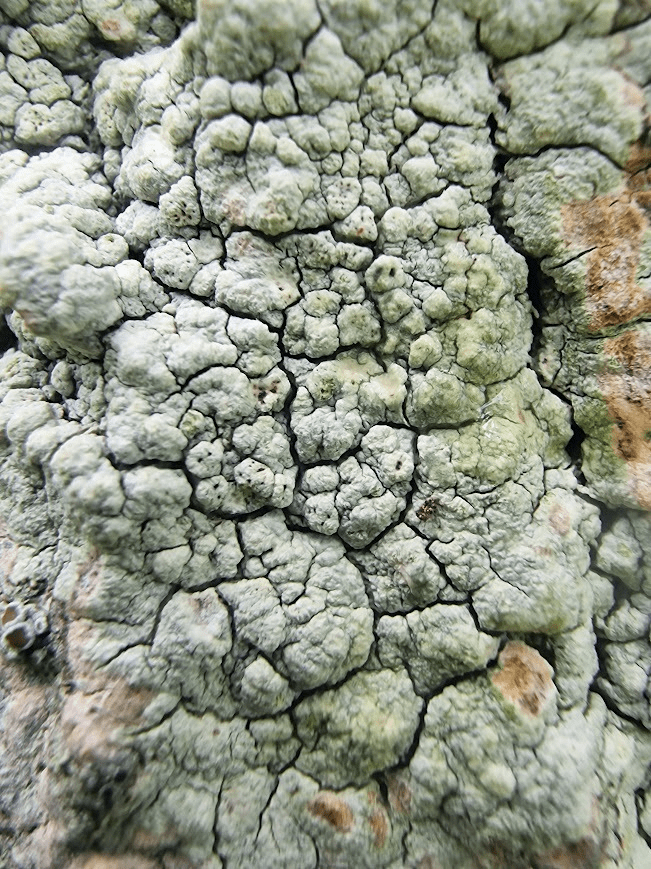
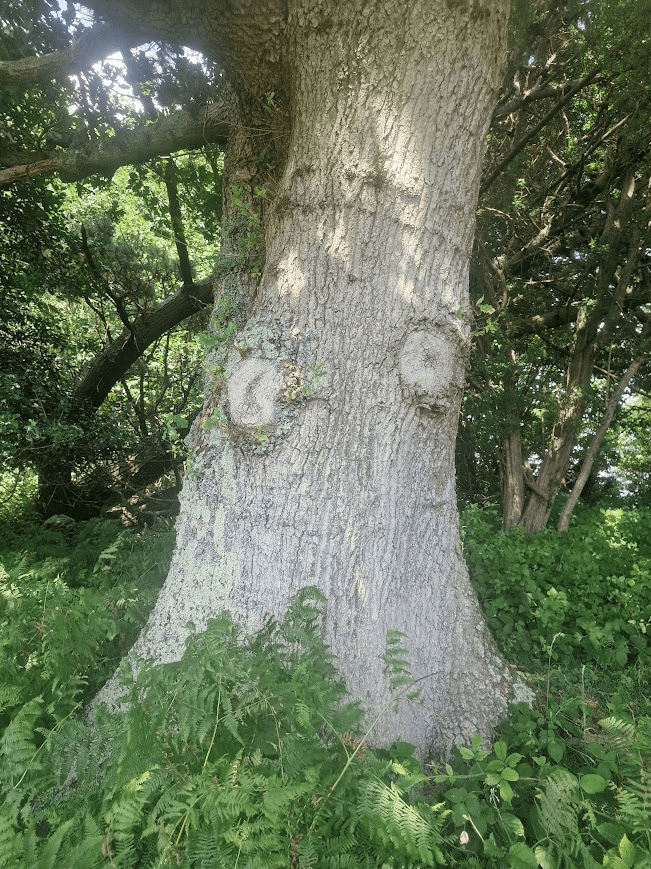
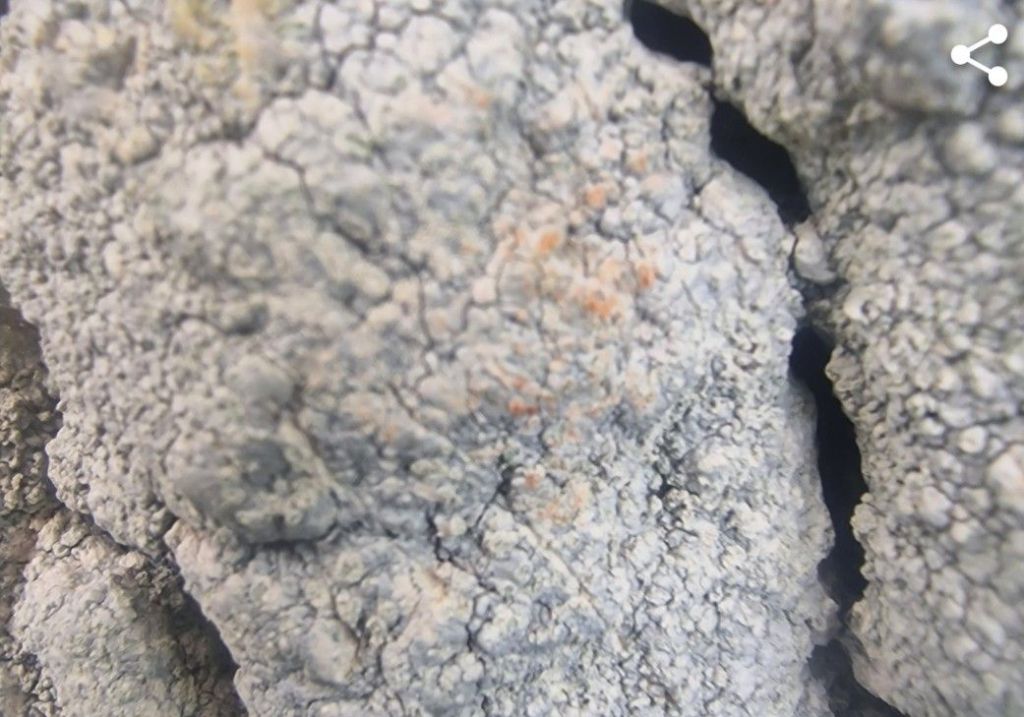

 Sim's Nature Notes