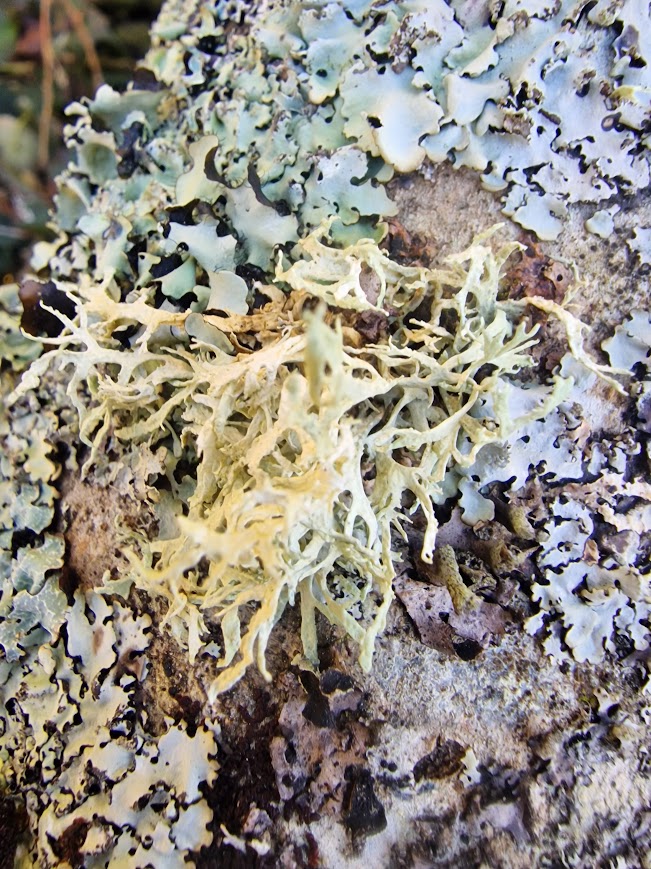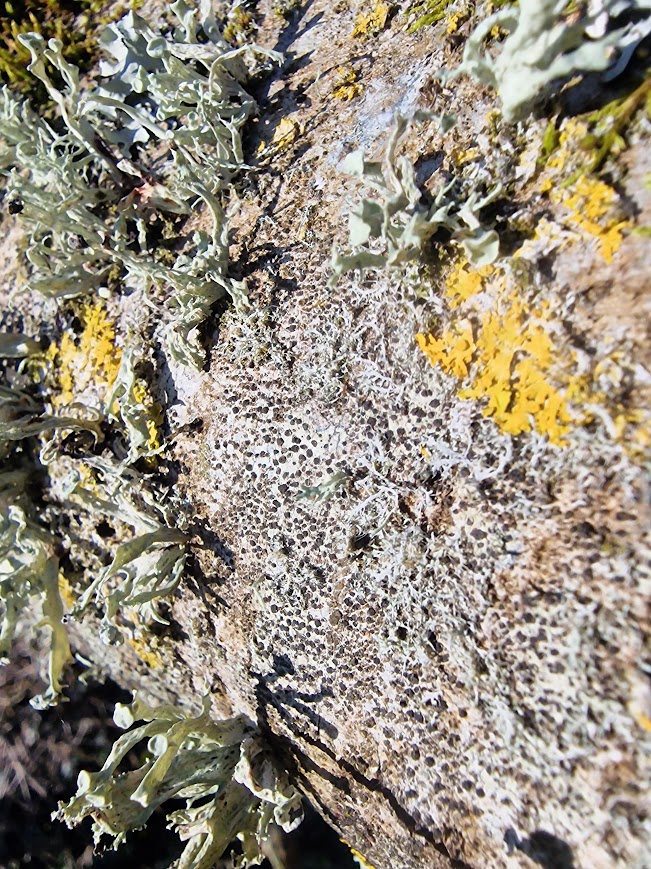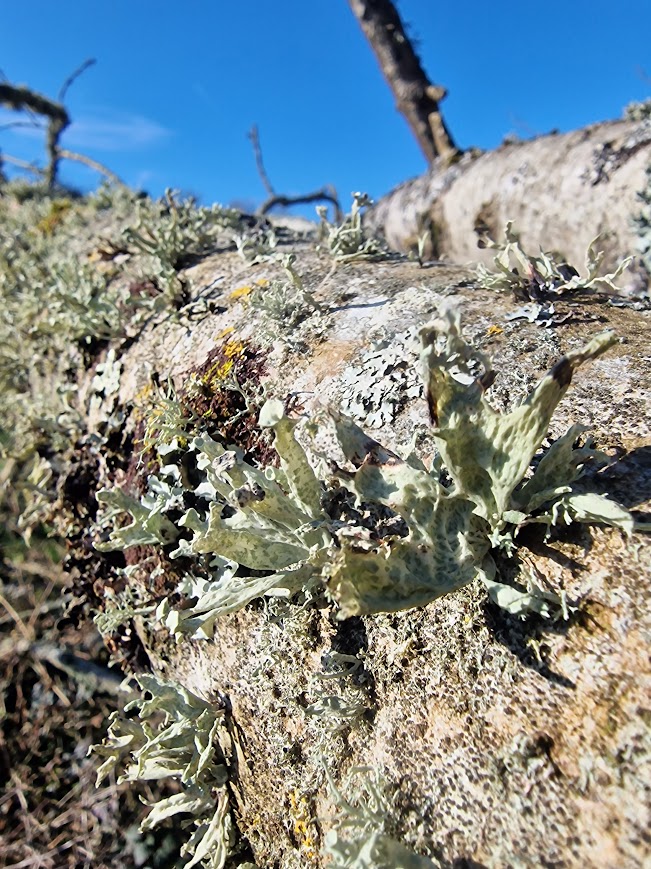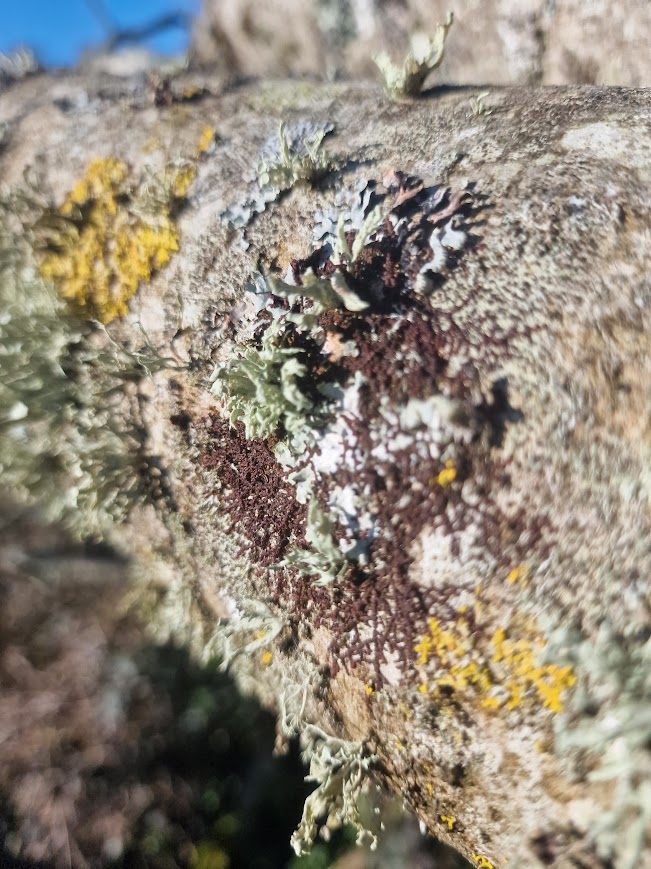
Friston Forest, Lullington Heath NNR and the Cuckmere Valley Churches; abundant Ingaderia vandenboomii (pink powder) and Usnea articulata (strings of sausages) 24.02,26

I went to the Seven Sisters Country Park visitors centre at Eceat on the Brighton and Hove 12 bus. From there I walked through Friston Forest to All Saints Chirch Westdean. I then walked further north through the forest to Lullington Heath, From the heath I walked down past the Lullington’s remote hillside Church of the Good Shepherd, then crossed the Cuckmere to visit Alfriston’s St Andrews, then crossed back over the Cuckmere and walked down the road from Litlington to Exceat, walking past t. Michael the Archangel Church, 
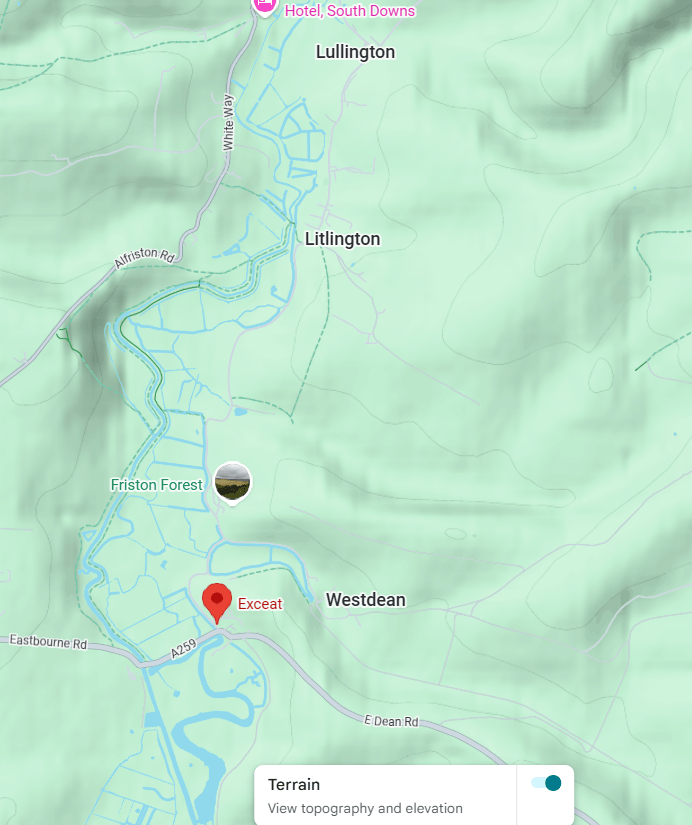
Google Maps

Explore OS Maps

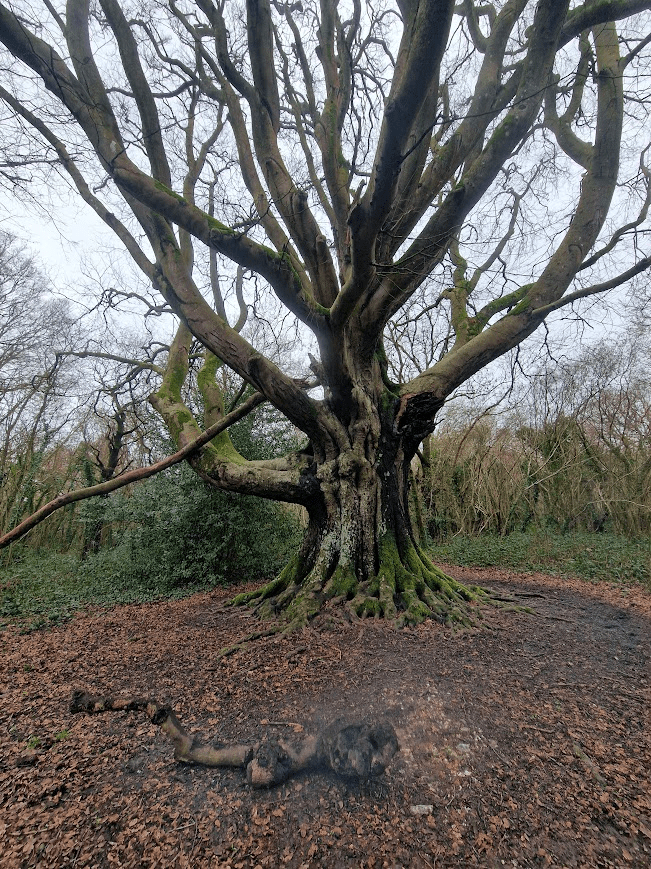
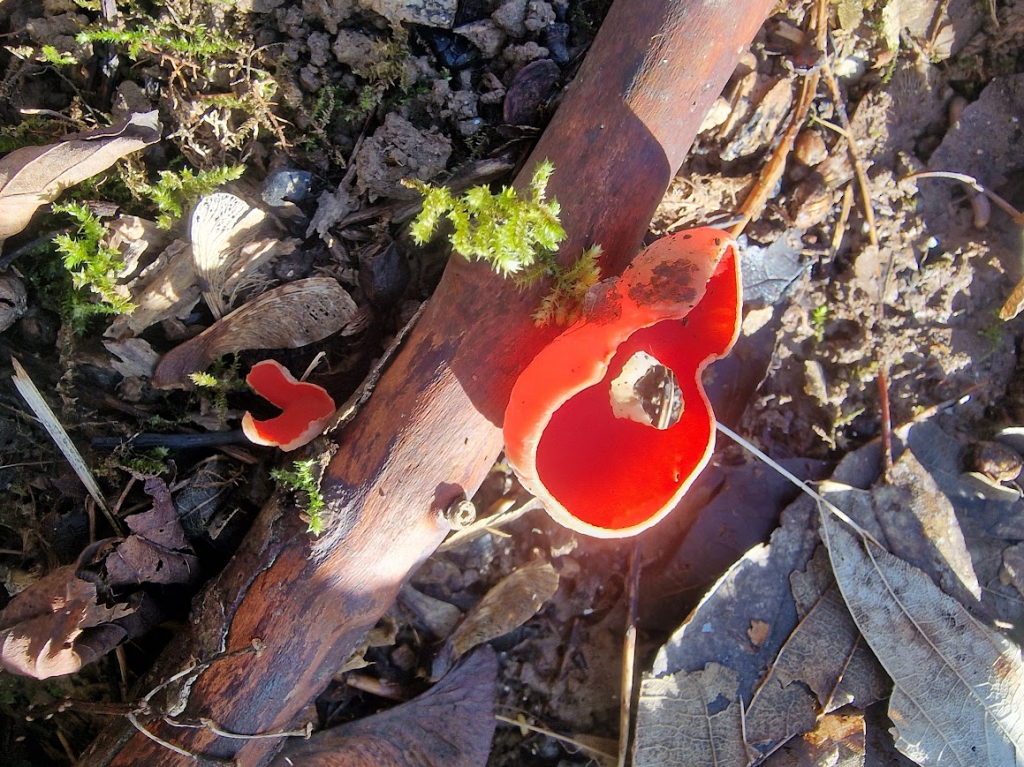
Friston Forest is a nearly 100 year old beech forest planted by the Forestry Commission; in the winter and early spring, when there are no leaves, it feels quite a barren landscape; but there are interesting things to see, including lots of red Elf Cups, Sarcoscypha sp. probably S. coccinea, Scarlet Elf Cup; looking lovely in the sun I see it a lot here in late winter/early spring.
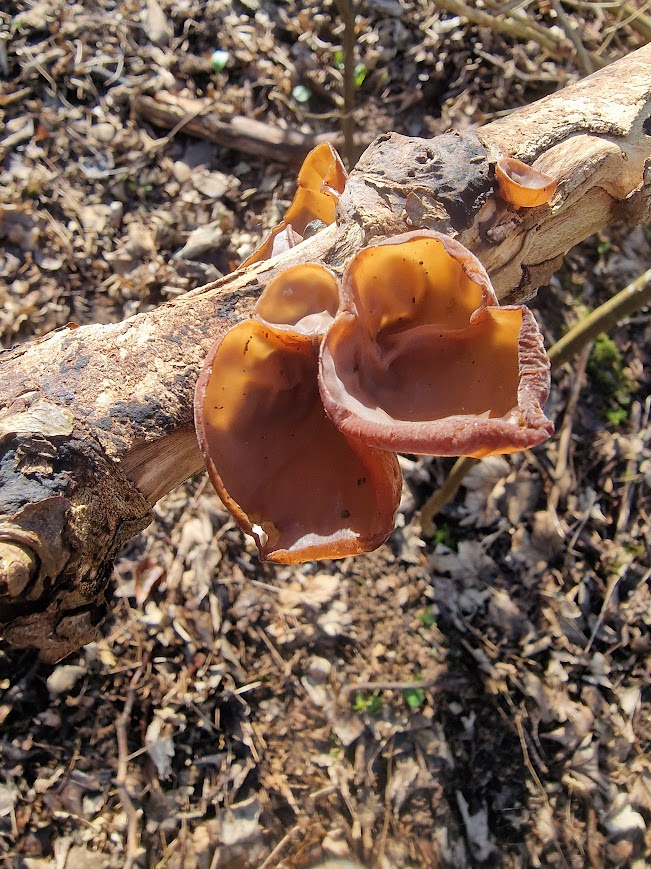
There was also lots of Jelly Ears, mostly on dead Elder
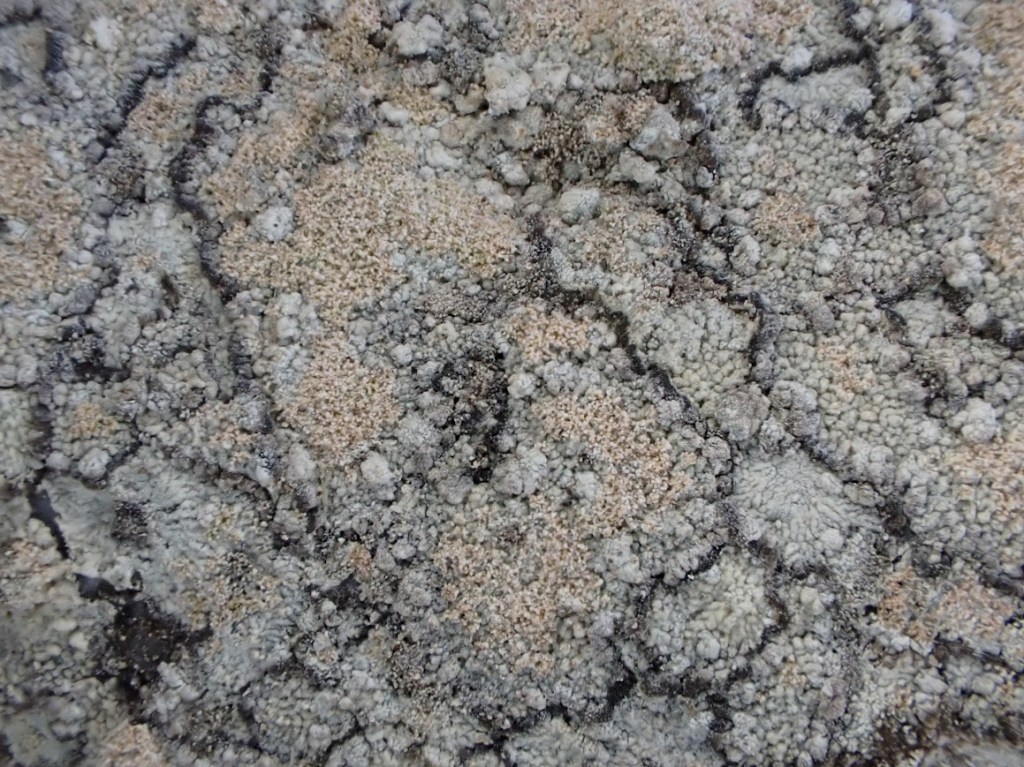
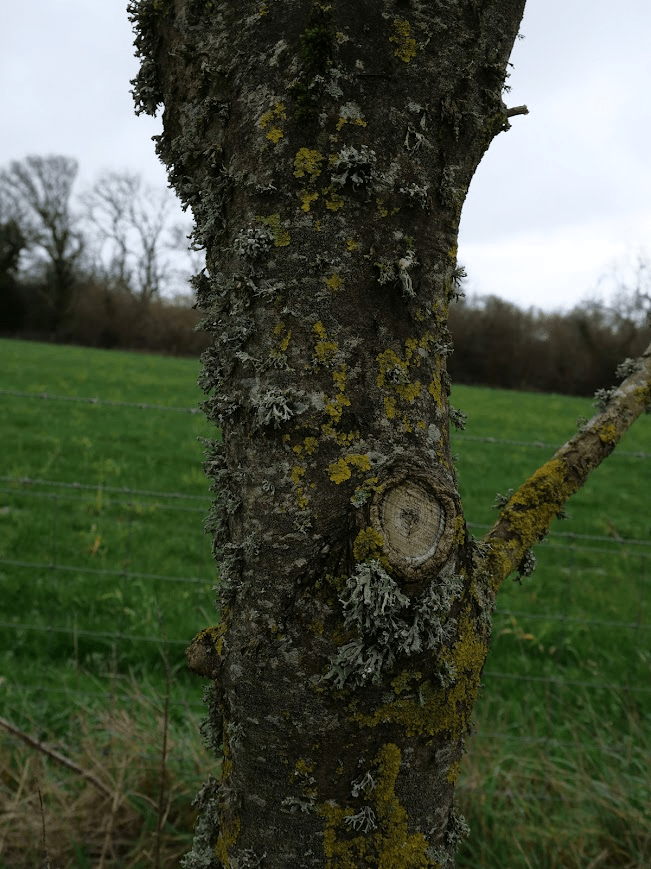
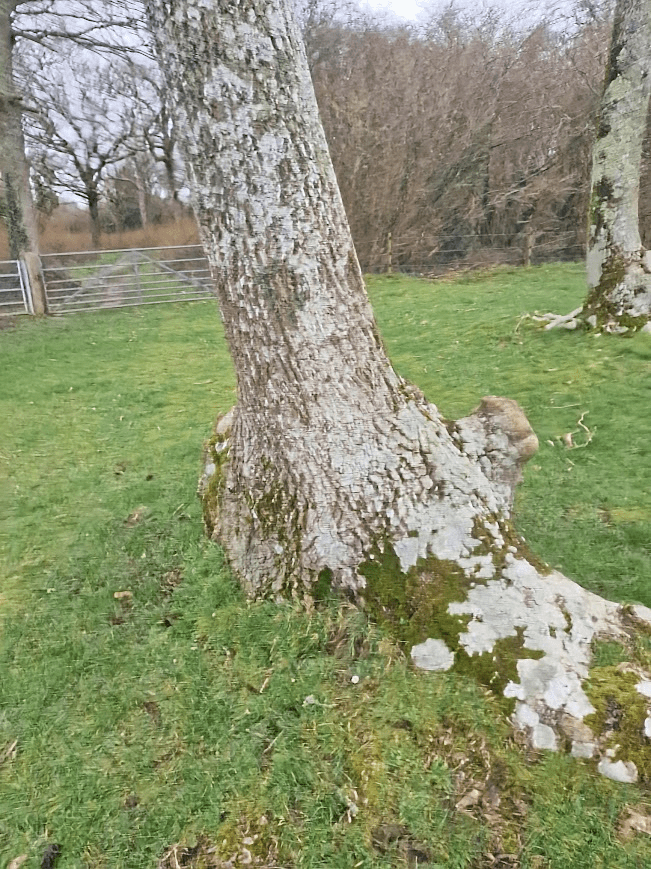
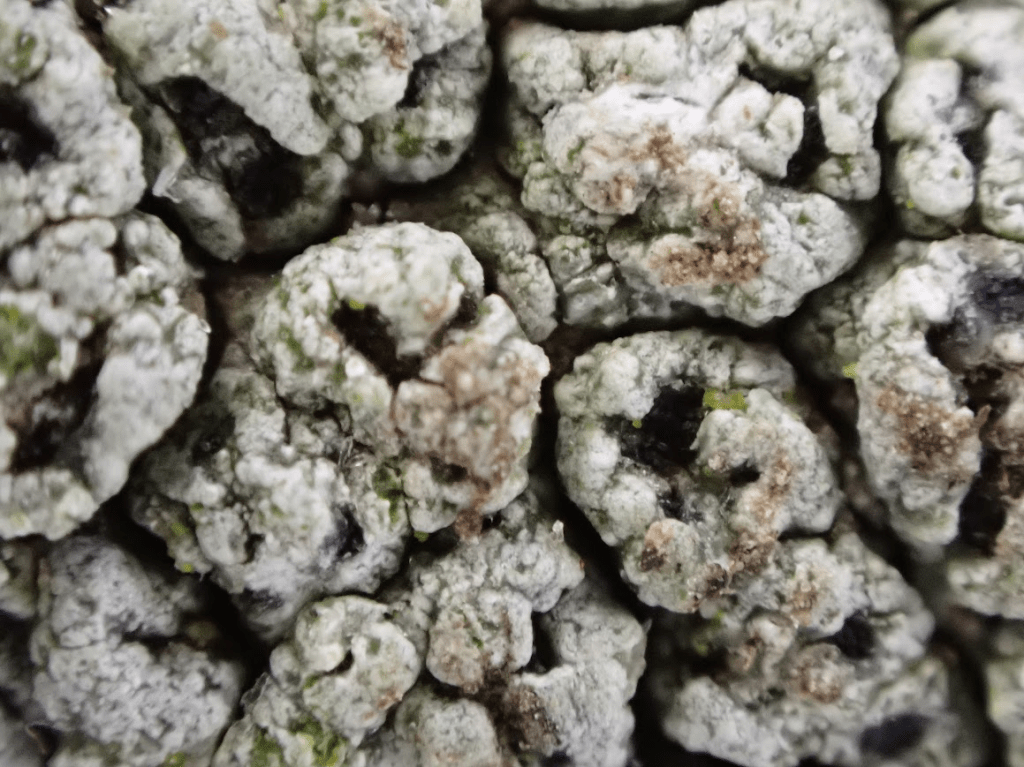
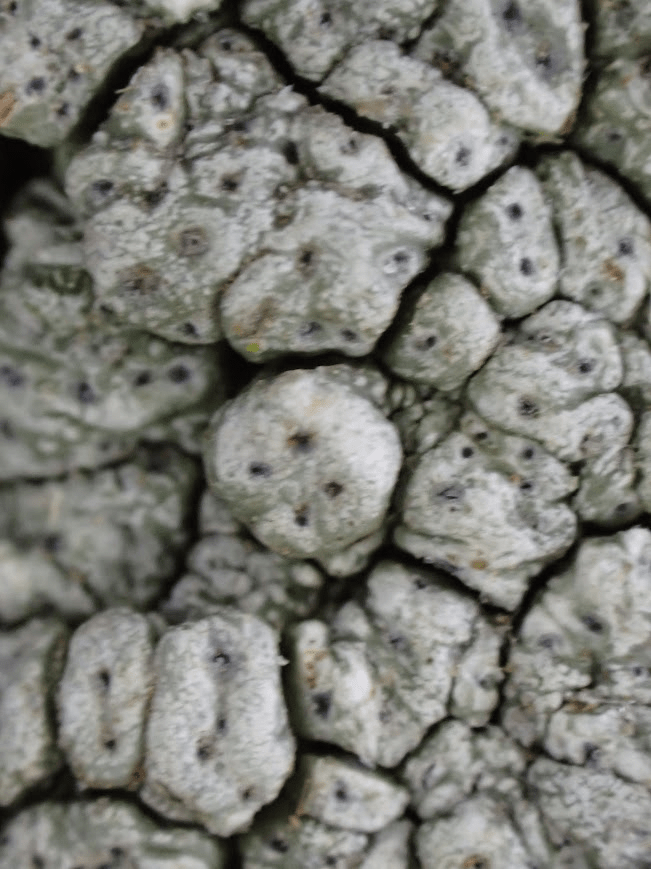
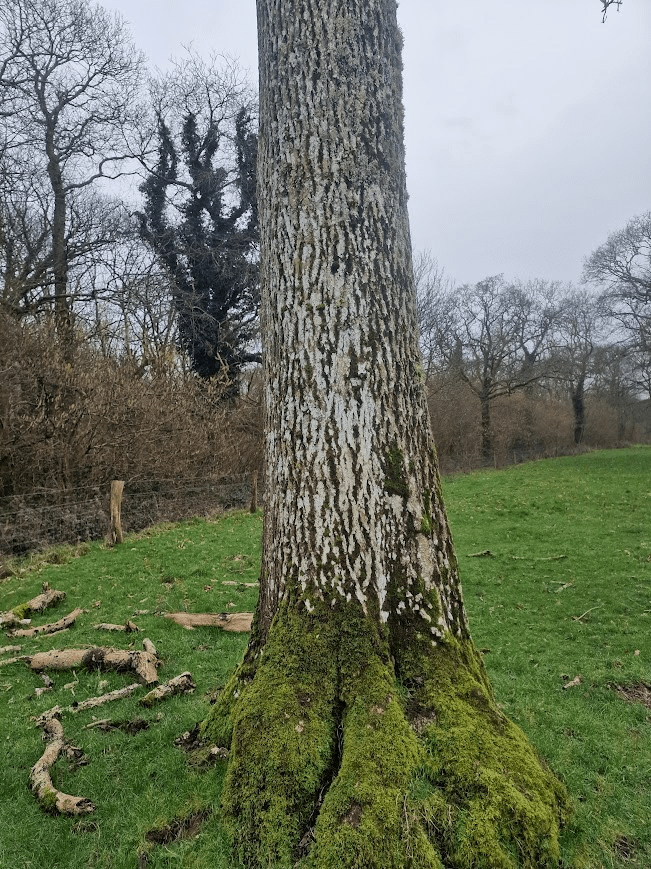
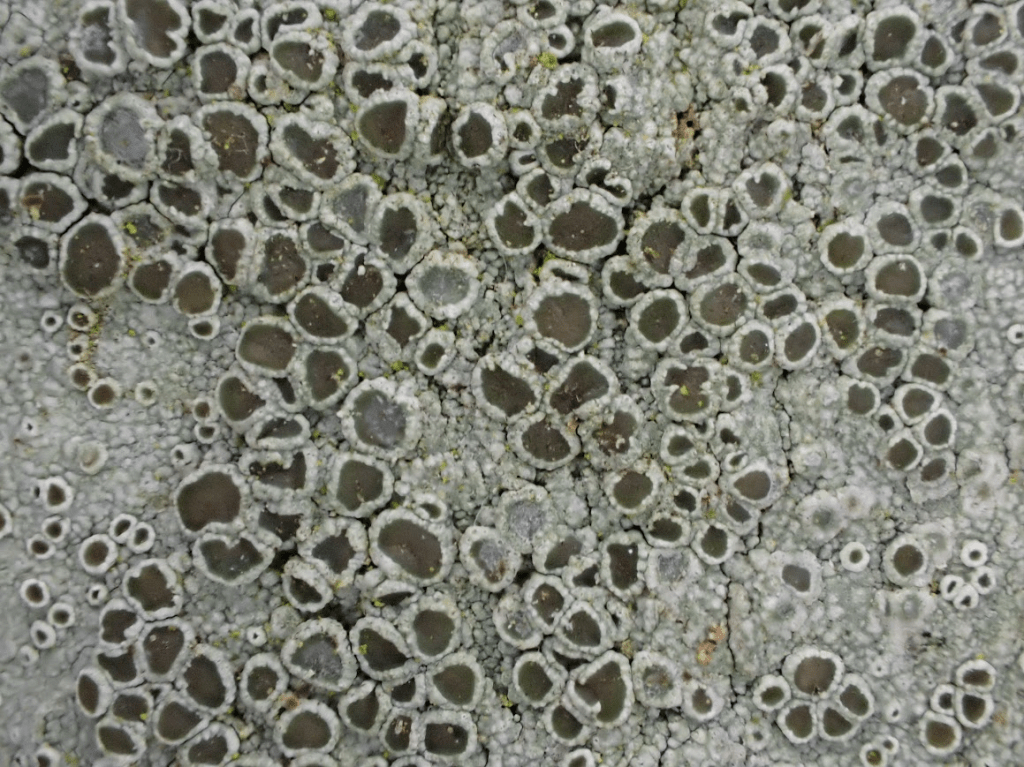
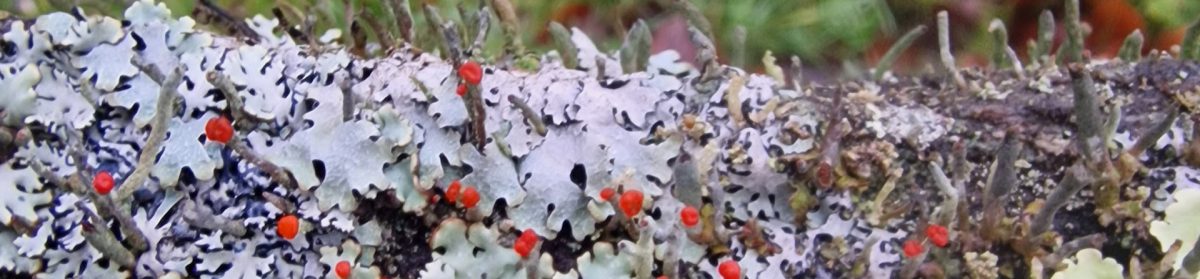
Many of the Beeches were covered in a green sorediate crust lichen. (Sorediate = covered in soredia, which are powdery, microscopic, asexual reproductive particles). Theses are impossible to differentiate between without doing chemical reagents tests. I use two common spot tests aqueous potassium hydroxide (K test) and calcium hypochlorite (C test).
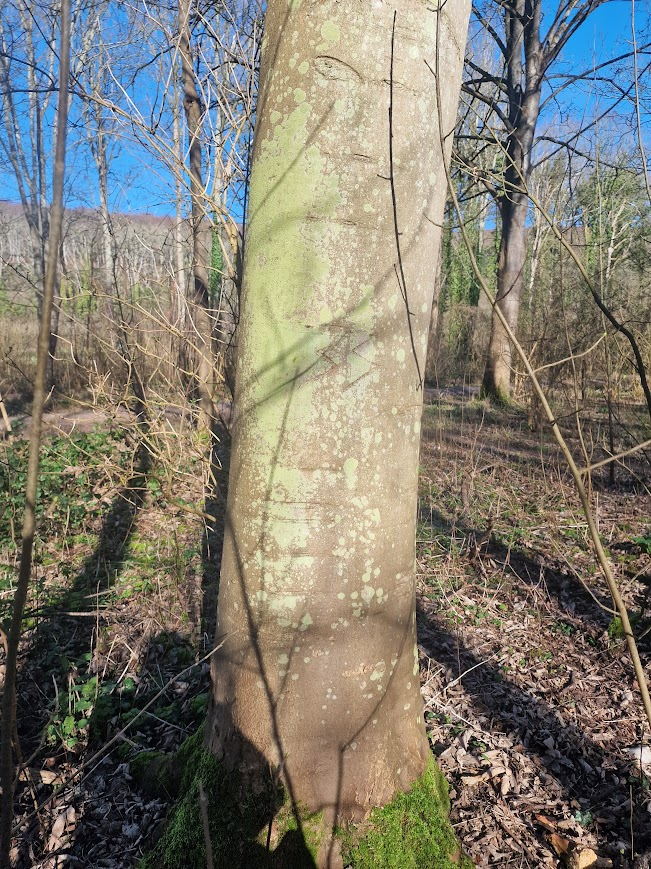
There are the four lichens that look very similar

Lecanora expallens K+ yellow (i.e. the lichen reacts yellow to Potassium hypochlorite) , C+ deep yellow or orange-red,

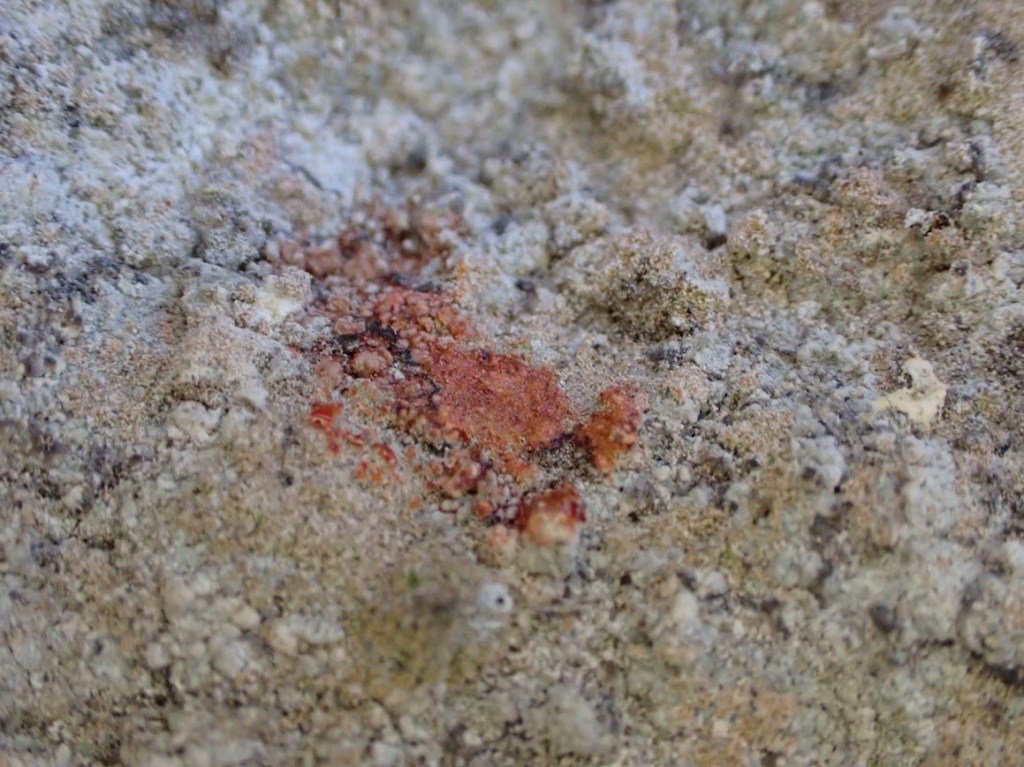
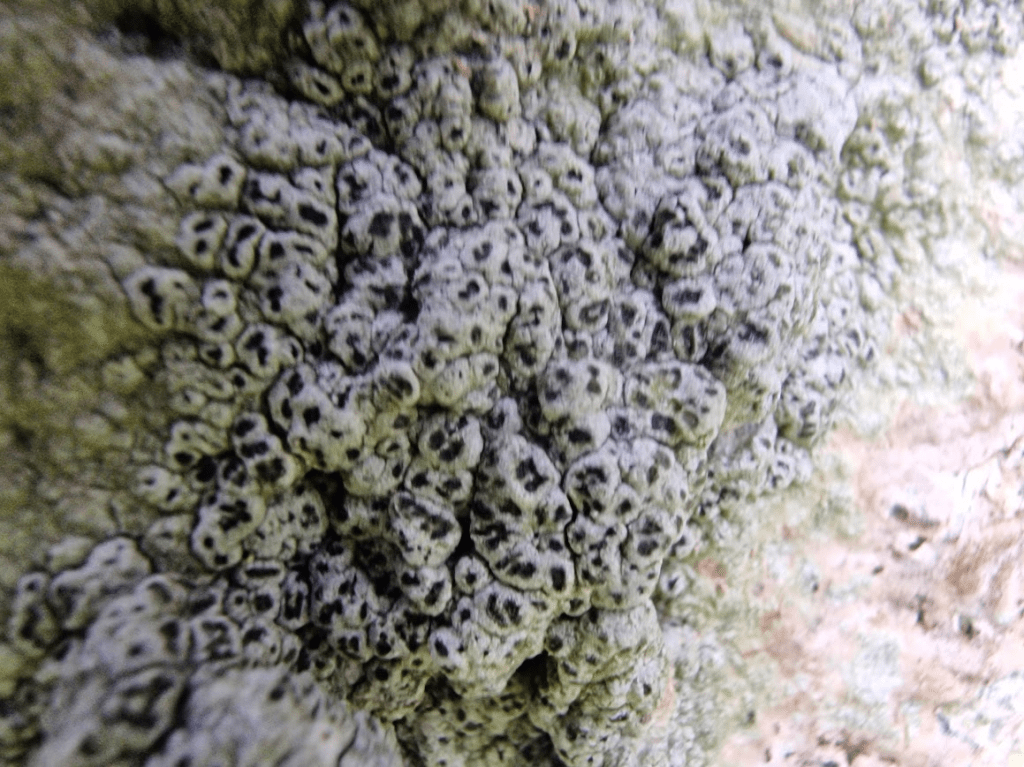
Pyrrhospora quernea K- (i.e. the lichen doesn’t react to Potassium hypochlorite, C+ orange (photograph of both below)

Lecanora barkmaniana K+ yellow, C-. 

Lecanora compallens K-, C-

These chemicals are caustic and should only be used if you know what you are doing see British Lichen Society Chemical Tests
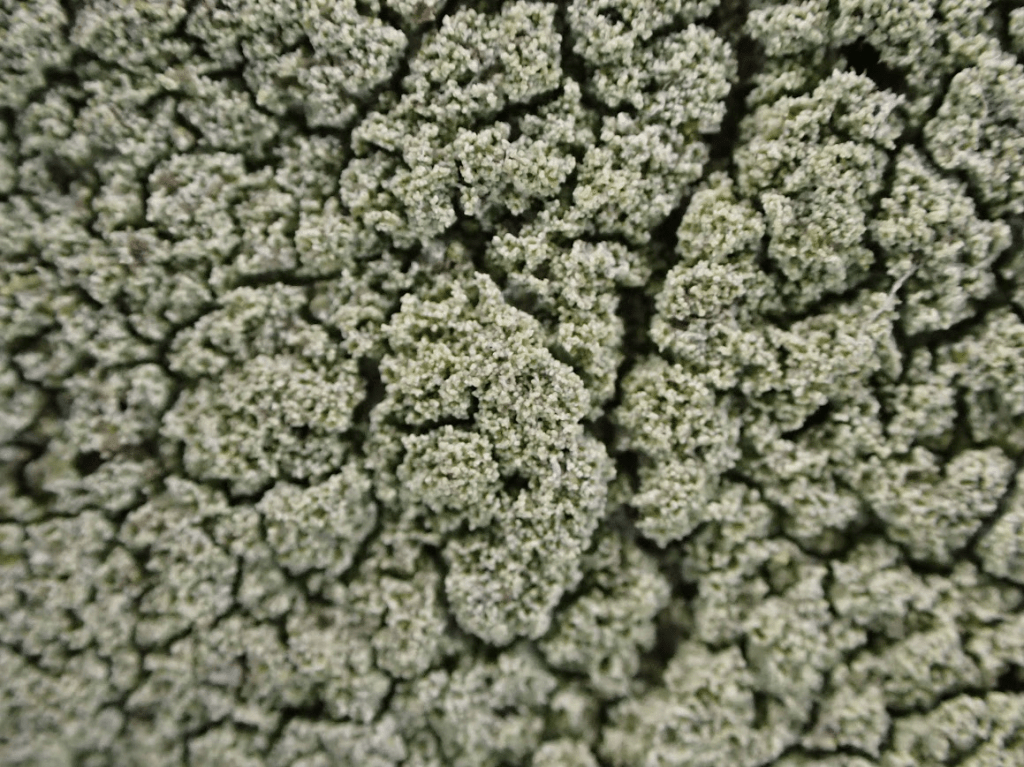
Response K- (the green is from K making the surface of the lichen (fungi) transparent so you can see the green of the alga underneath) C+ orange so Pyrrhospora quernea 
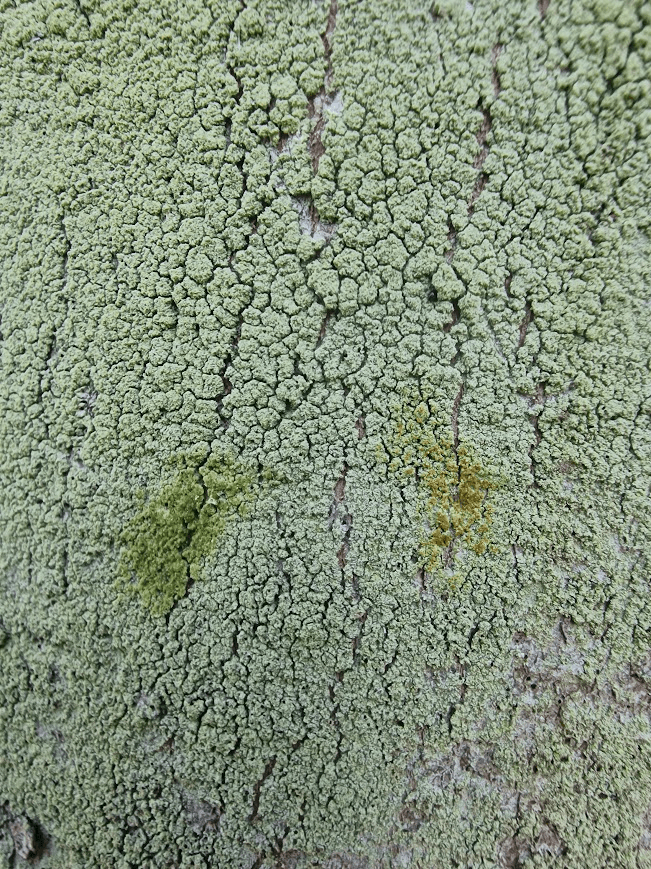
On the way to the Westdean village; on the steps of a barn.

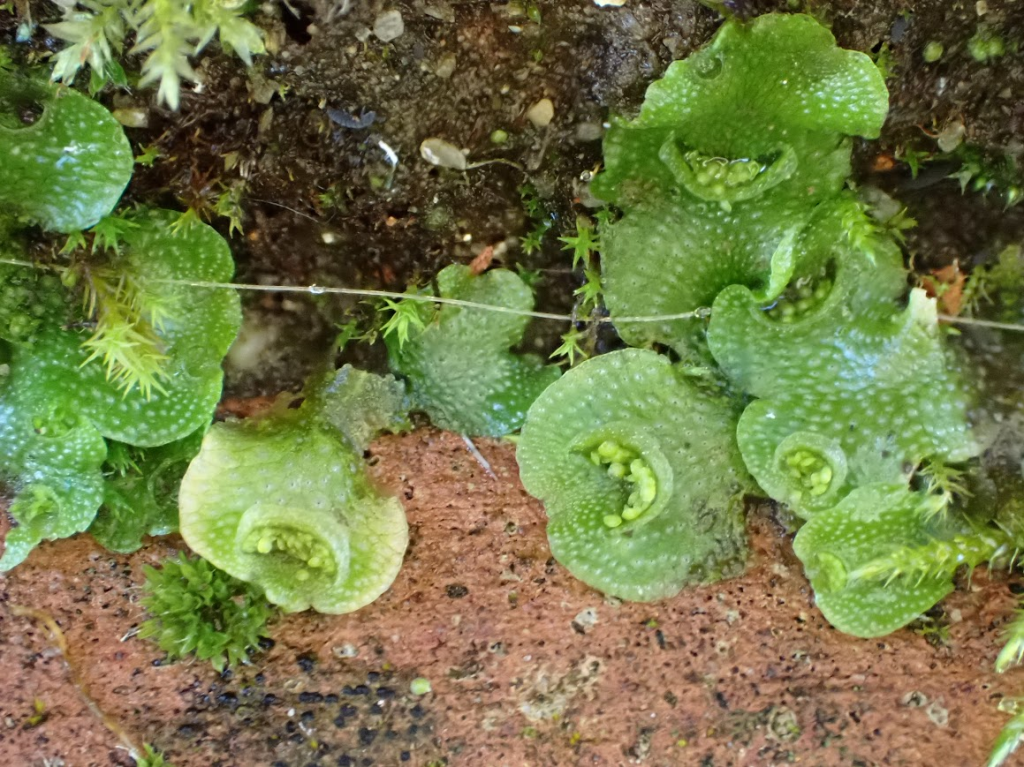
Lunularia cruciata, Crescent-cup Liverwort. When the gemma receptacles are present; Lunularia cruciata is obvious. Gemmae = small, clonal, haploid disc-shaped tissues for asexual reproduction, dispersed by raindrops, to grow into new, identical gametophytes.
All Saints and Ingaderia vandenboomii

Ingaderia vandenboomii doesn’t have a common English name, so I have made one up: pink powder

All Saints church (grade 1 listed) is of great antiquity with parts of the building dating back to Saxon times.  Most of the present structure is Norman, measuring 21m by 4.87m, and is constructed of flint and Eastbourne sandstone.  At the west end the square tower is covered by an unusual gable spire which John Betjeman in his Guide to English Parish Churches describes it as unique in Sussex.  It has been likened to a monk’s cowl and from a distance, the small high windows on the tower give the appearance of a face.  Cuckmere Churches, All Saints West Dean
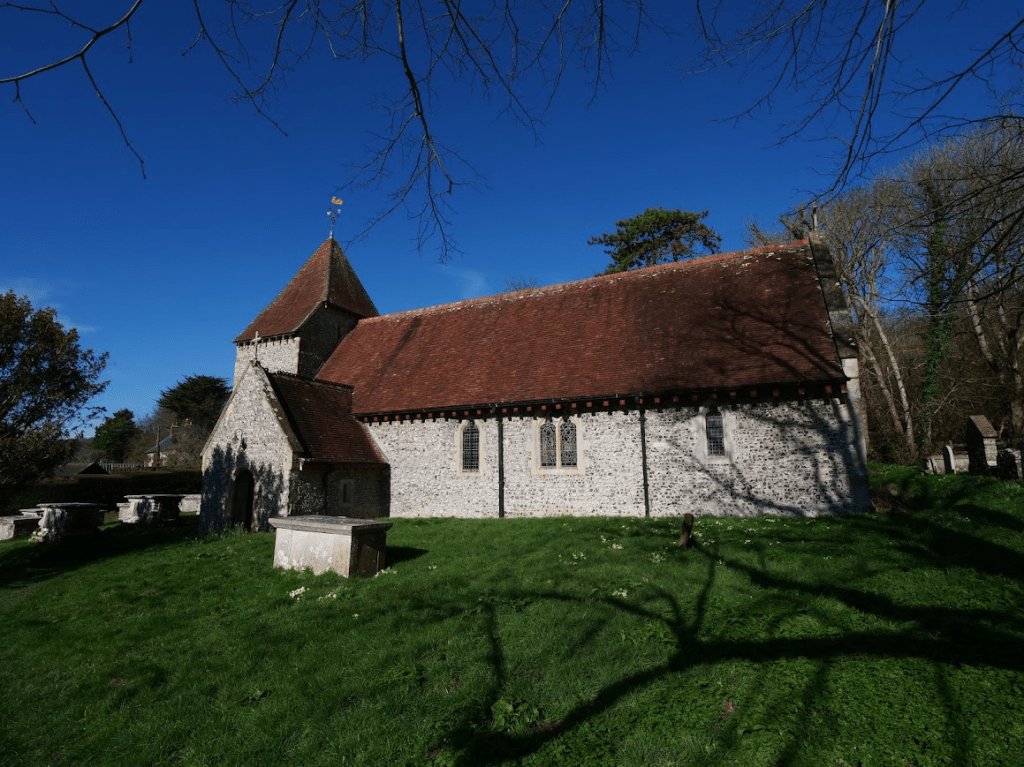
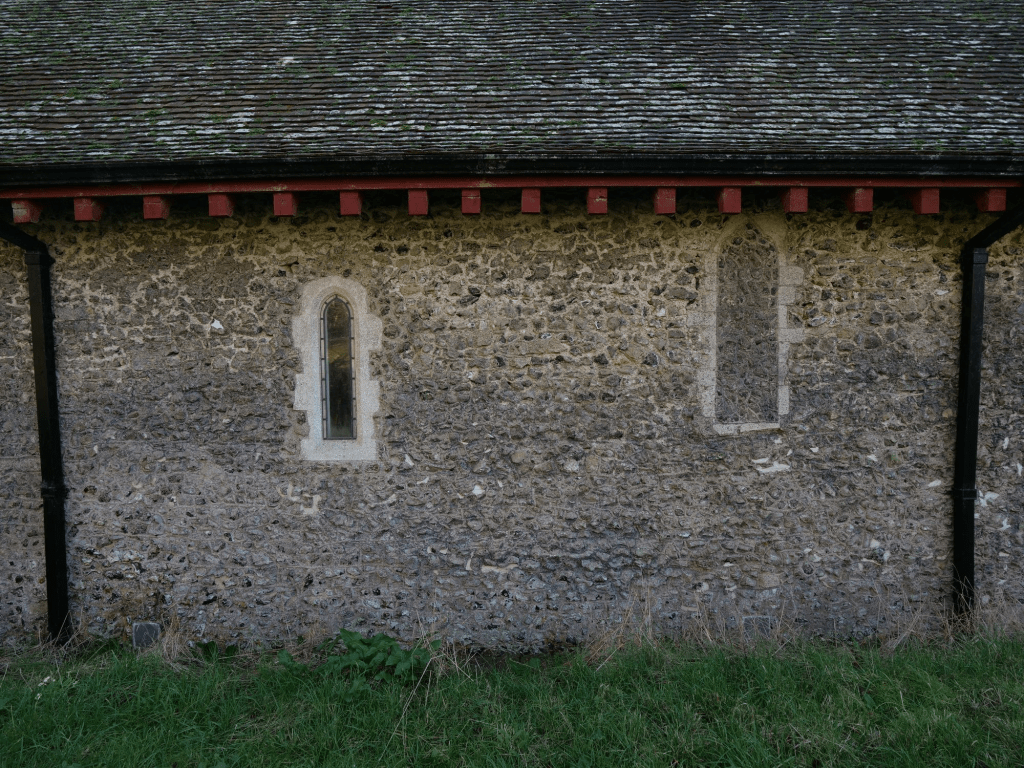
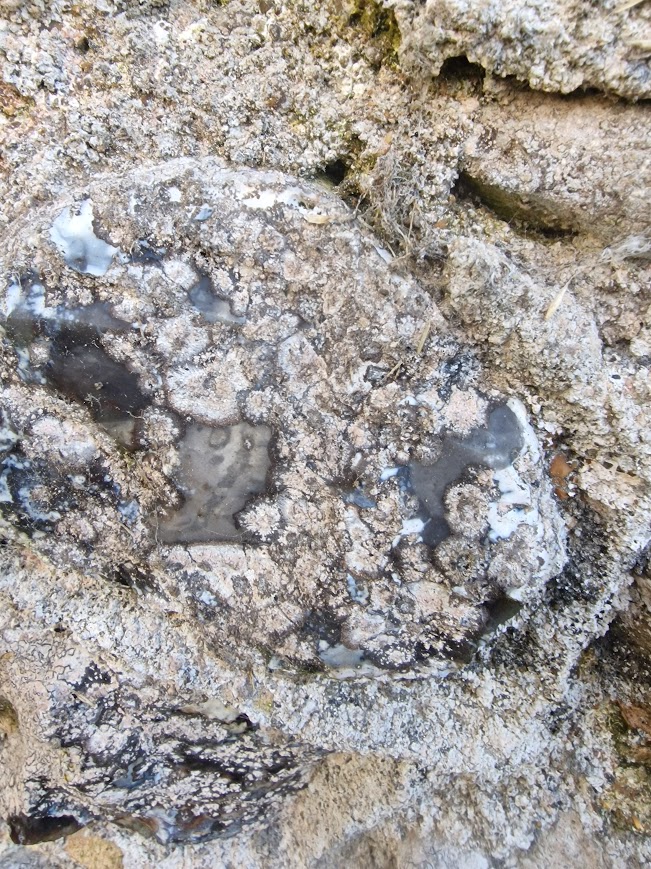
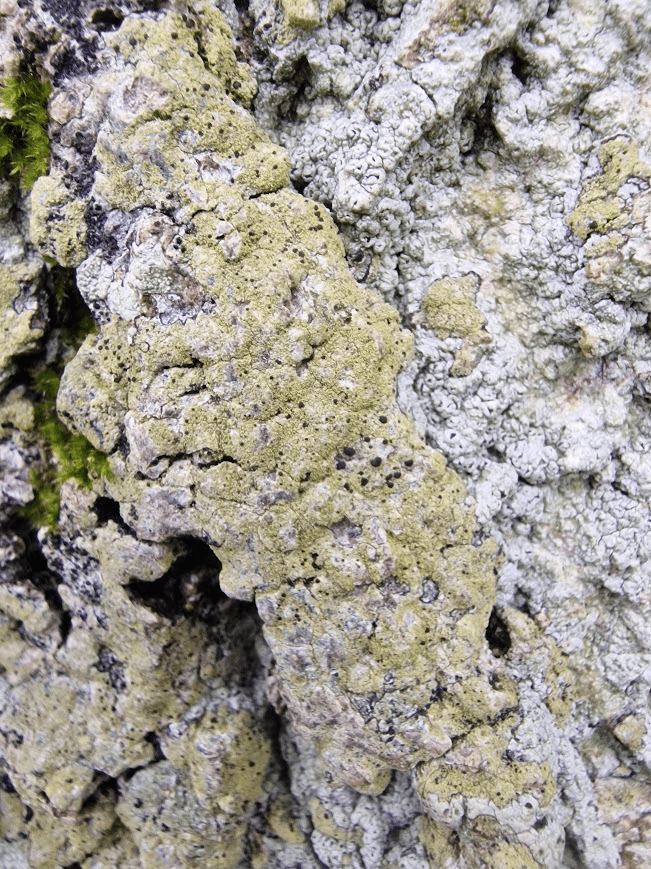
Ingaderia vandenboomii is a National Scarce lichen in the UK, but it is common on the north walls of Sussex coastal churches. Here, All Saints Church, Westdean, it covers ca. 50% of the entire north wall – flint & mortar
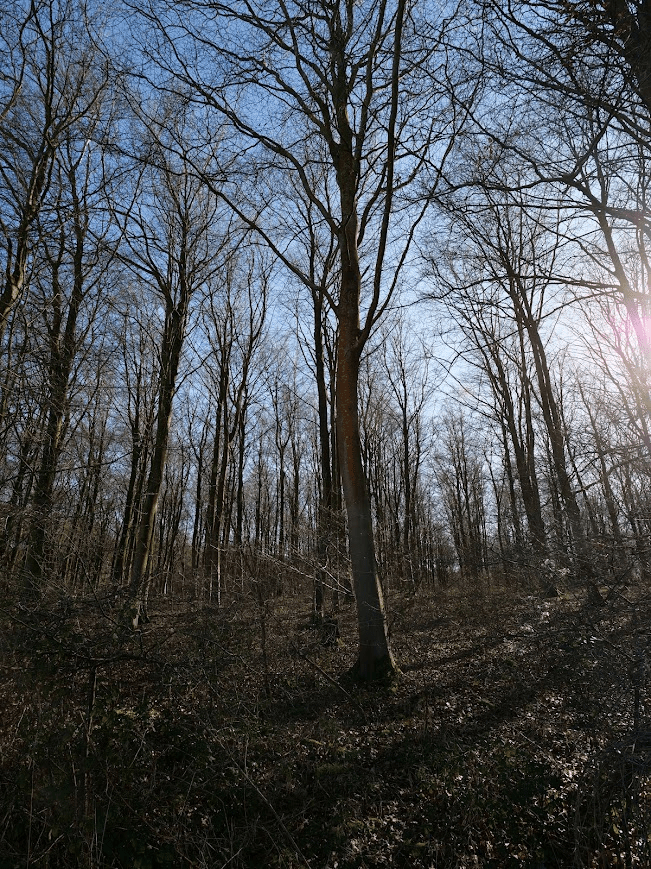
Bleak beech
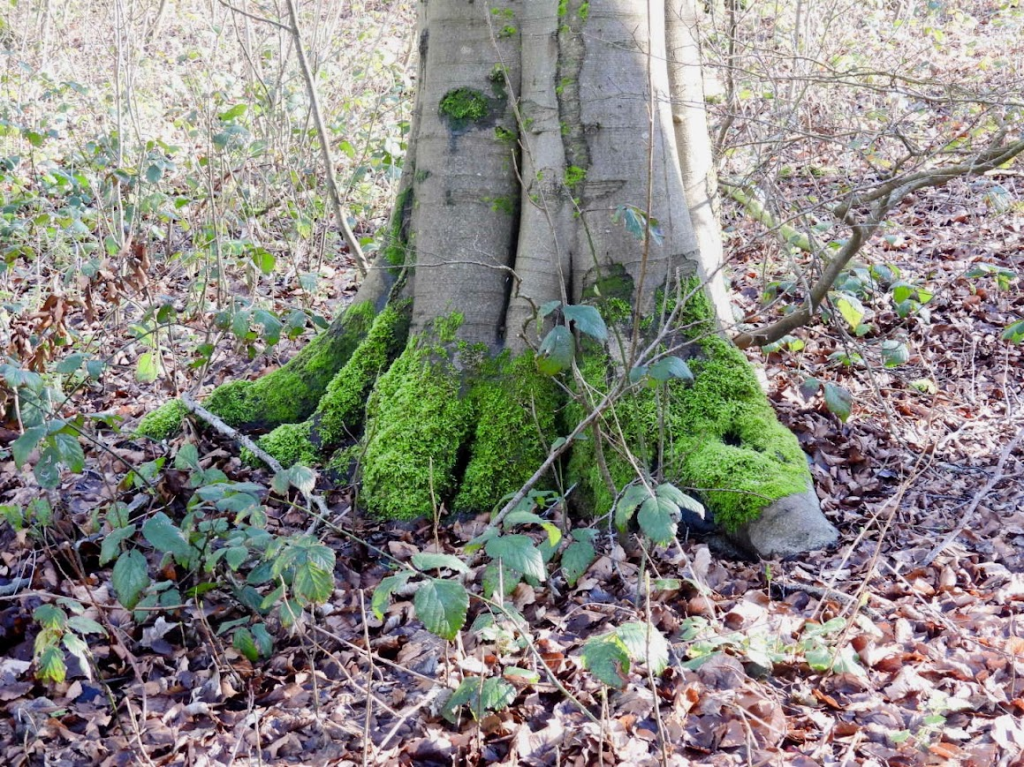
Brightened with moss. Probably Brachythecium rutabulum, Rough-stalked Feathermoss.  B. rutabulum can be recognized by its pale glossy shoot tips, which some say look a little like fairy lights. British Bryological Society Brachythecium rutabulum
Oak and Hawthorn from the beech wood of Friston Forest
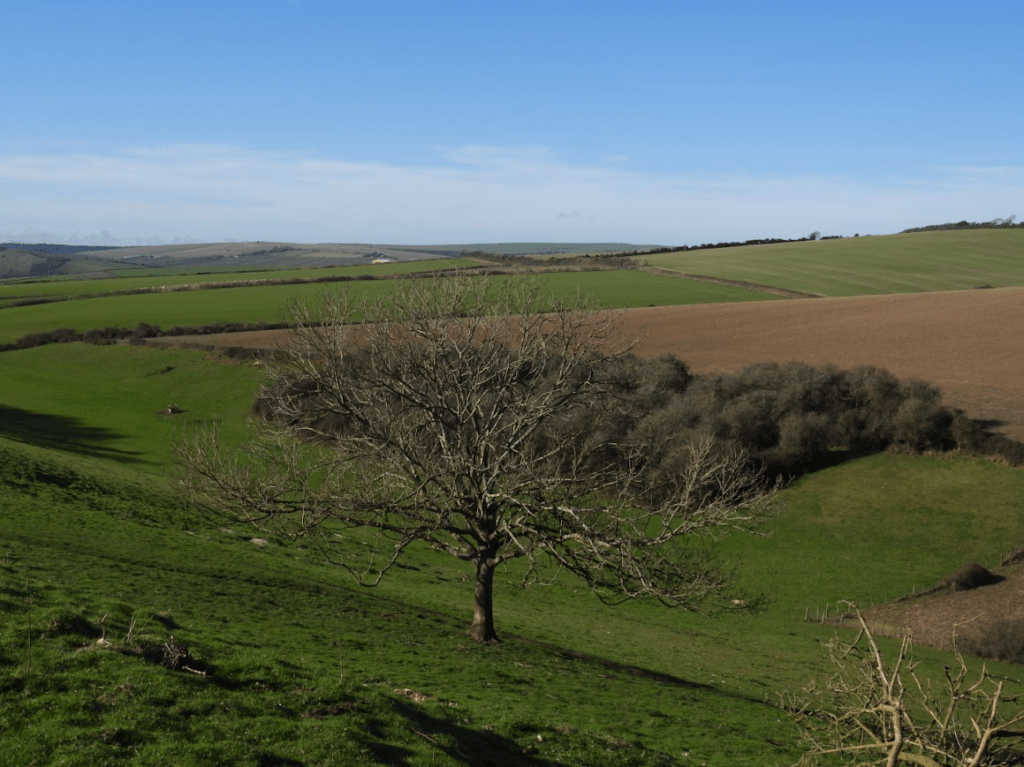
Looking over more beech – beginning to bud red – to Lullington Heath – with gorse and hawthorn.
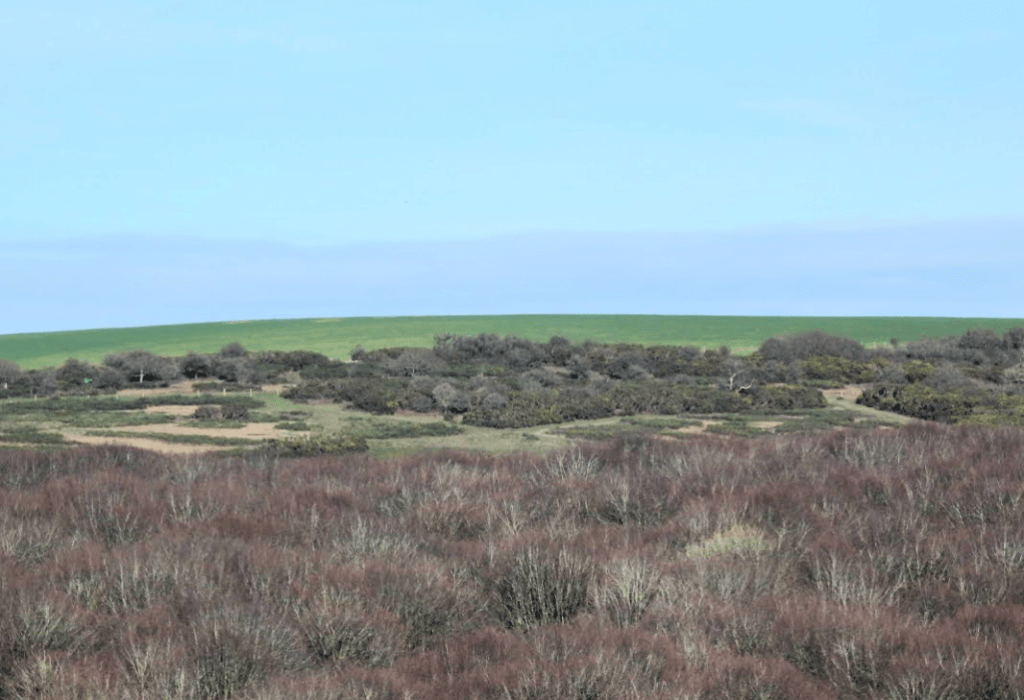
Sheep in the fields between the forest blocks; sheep grazing the South Downs has been going on forca. 3,000-6,000 years
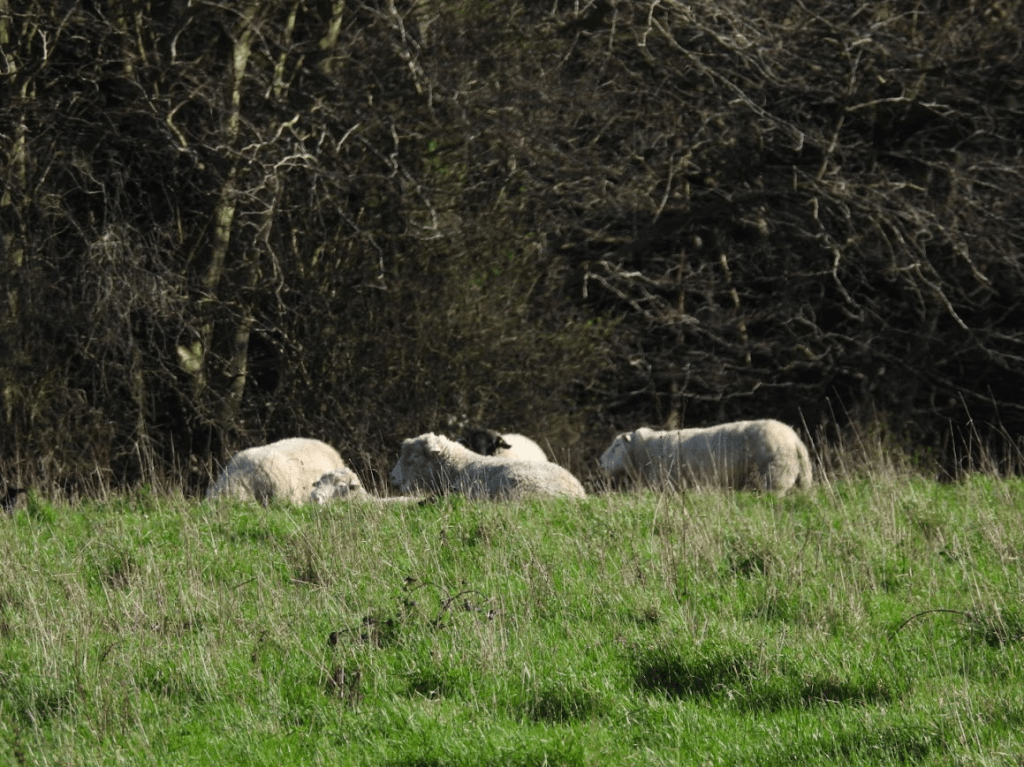
Rabbit grazing on the South Downs is also important to the ecology and biodiversity of chalk short-grass grassland
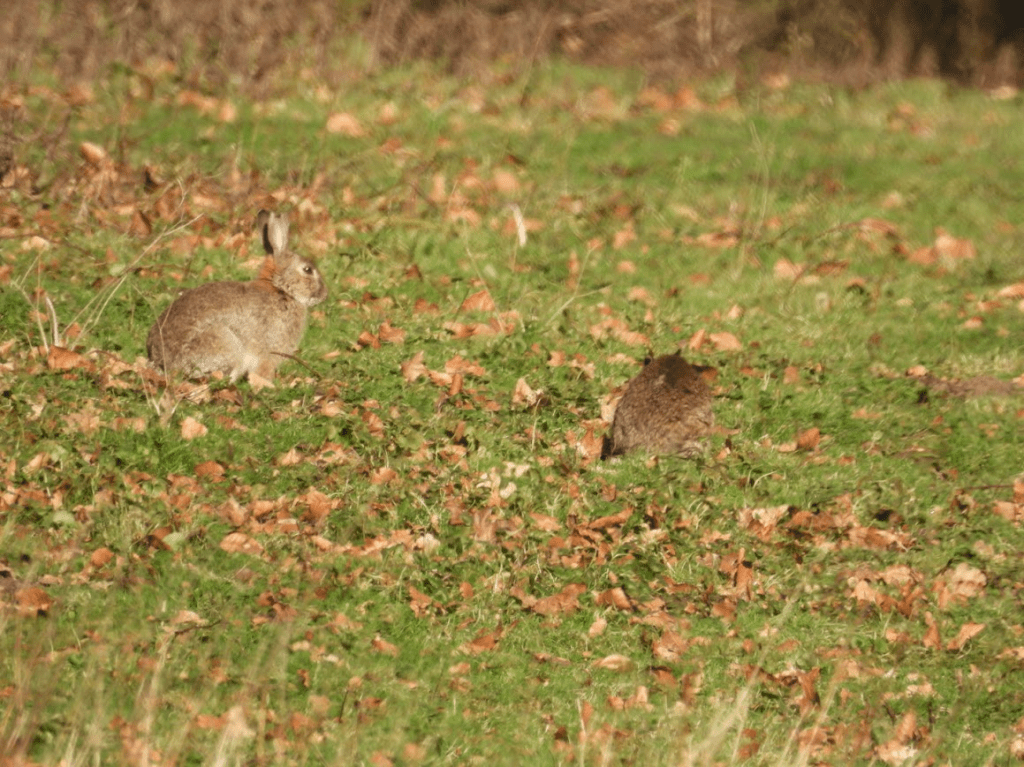
Rabbit populations declined by 64% in the UK between 1996 and 2018 and numbers of brown, mountain and Irish hares are also thought to have declined in some areas. As ecosystem engineers, the loss or reduction of these species can have major consequences, particularly for rabbit-dependent habitats. In their absence, the consequent changes in vegetation structure due to a lack of grazing can have further impacts on other wildlife, such as invertebrates. The NHBS Guide to UK Rabbit and Hare Identification

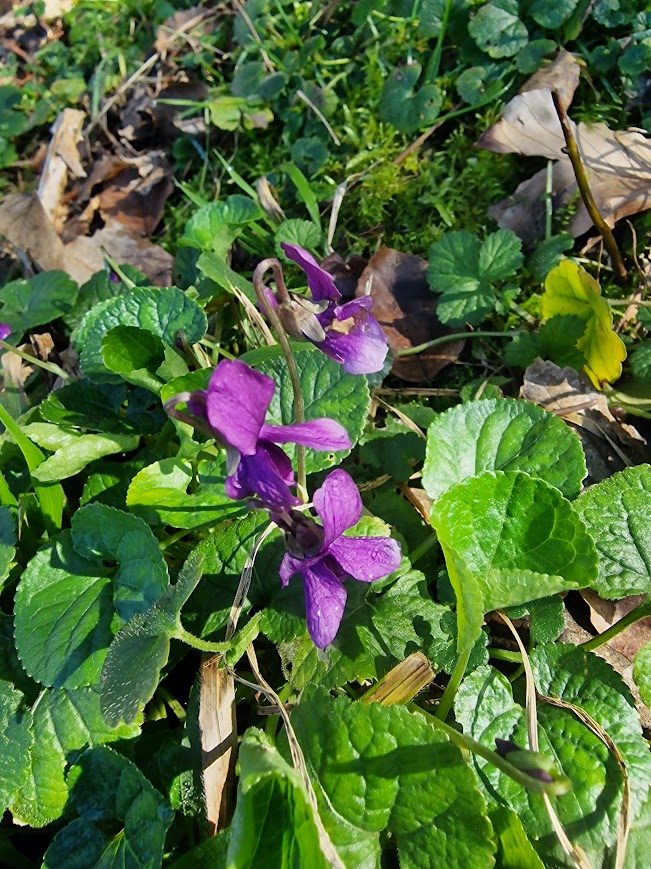
Sweet Violet

Romantic and showy, sweet violet grows on woodland edges, its flowers providing nectar for butterflies in early spring. Woodland Trust Sweet Violet
Hawthorne covered in Lichen
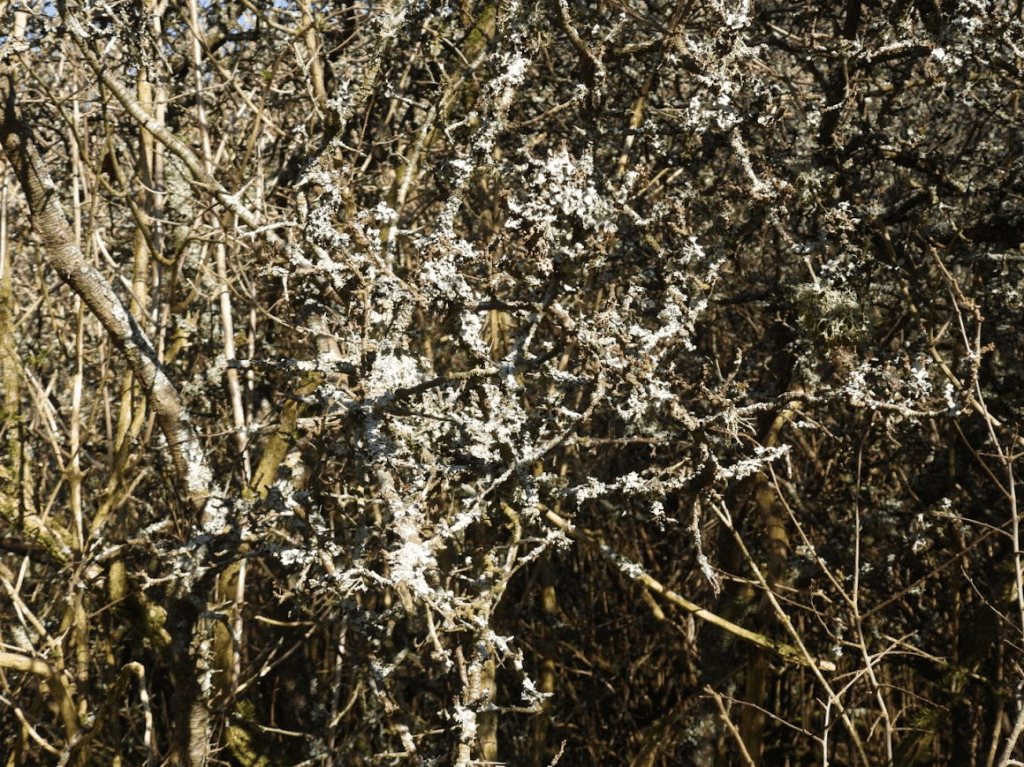
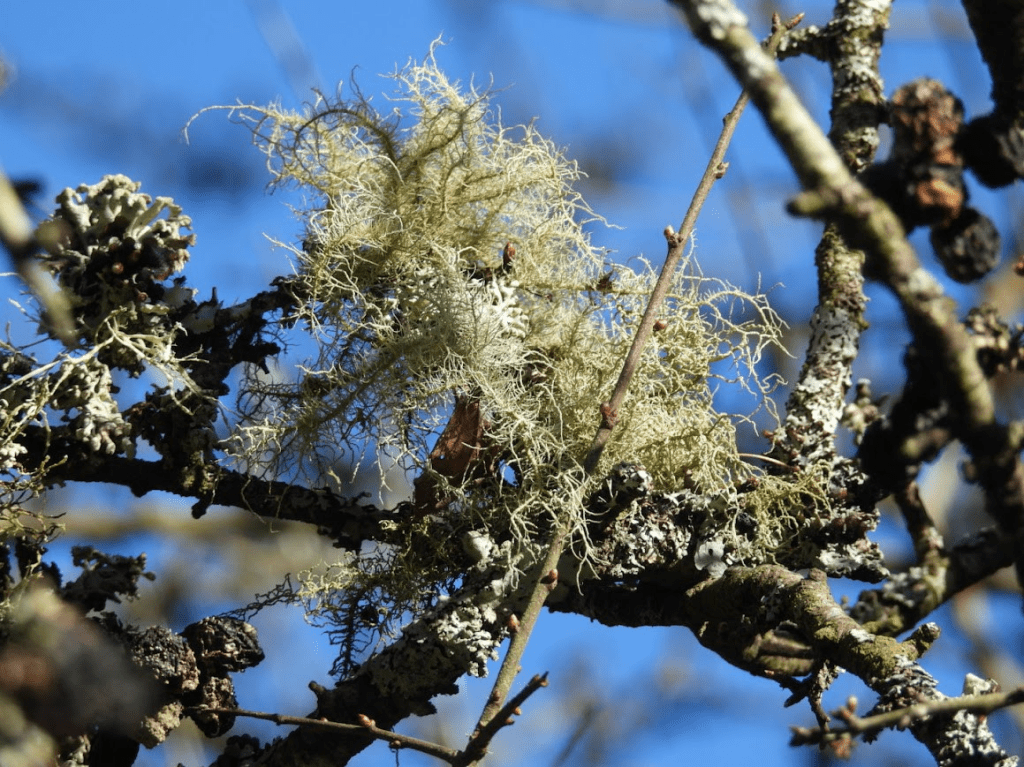
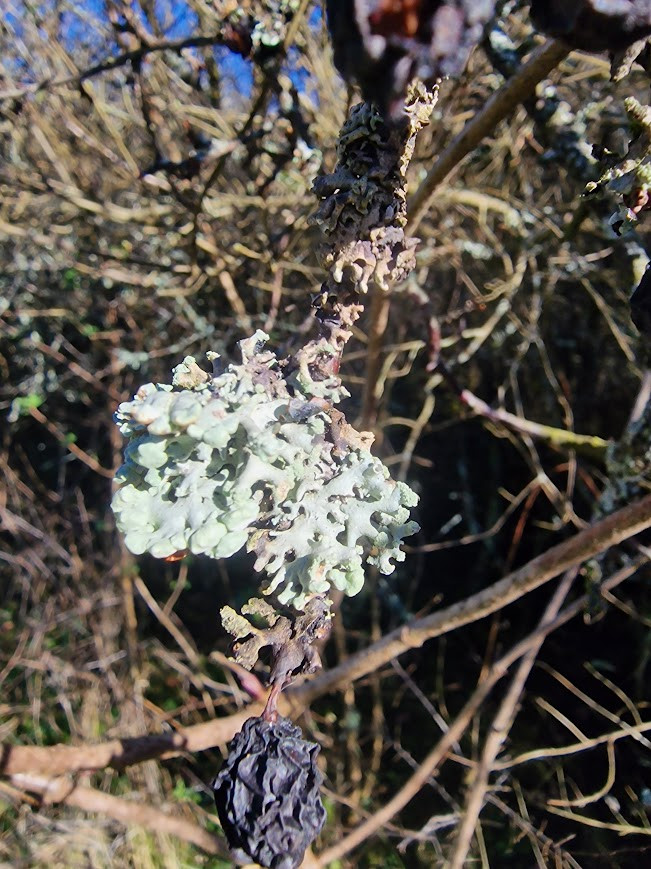
In Sussex, hawthorns are covered in lichens – but the lichen communities on coastal hawthorns is slightly different from inland hawthorns . Inland hawthorn have Usnea cornuta & Hypogymnia physodes (and on the top of Downs Teloschistes chrysophthalmus) which are absent on costal Hawthorns, but inland hawthorns don’t have Ramalina canariensis found on coastal lichens. On all hawthorn Ramalina farinacea, Ramalina fastigata, Evernia prunastri, Flavoparmelia caperata, Parmotrema perlatum, Parmelia sulcata and Lecidella eleachroma

Usnea cornuta
Hypogymnia physodes
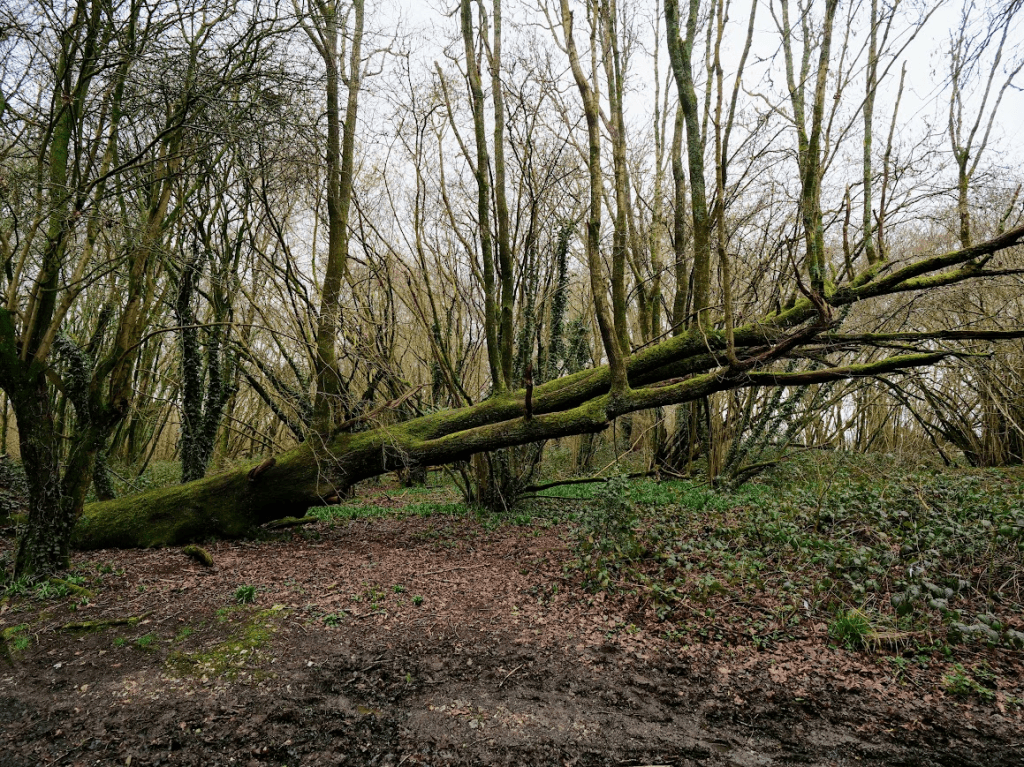
A felled ash
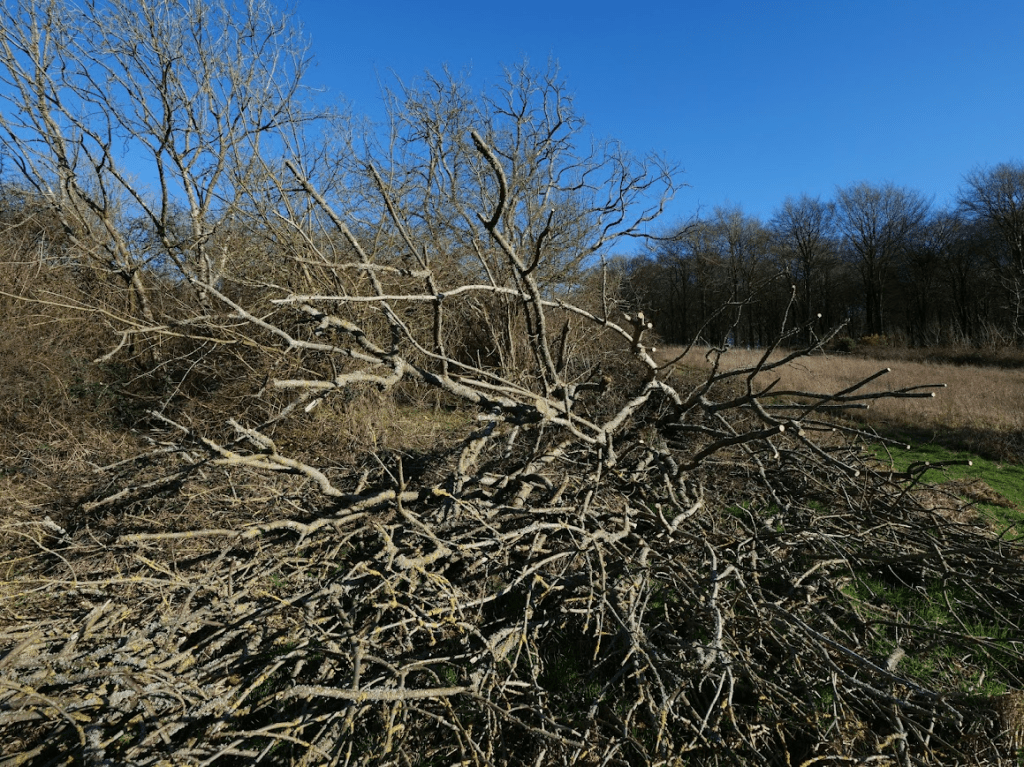
Sadly on the South Downs, I frequently see felled Ash, Fraxinus excelsior. Seen felled, you see what a wonderful substrate it is for lichens and bryophytes. The huge loss of Ash on the South Downs will have an impact on the ecology of the downs. Ash are very biodiverse holon ecosystems. Nearly every part of this Ash’s trunk & branches are covered in lichens & bryophytes. It’s harder to notice this continuous biodiversity along ash’s trunks when they are alive and standing. Ash is probably second only to Oak in terms of lichen diversity.
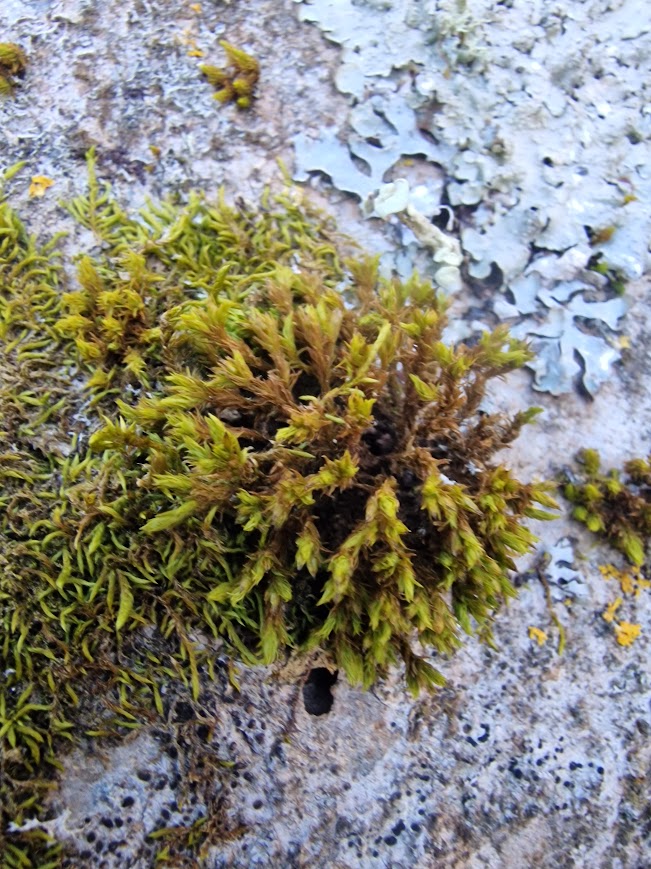
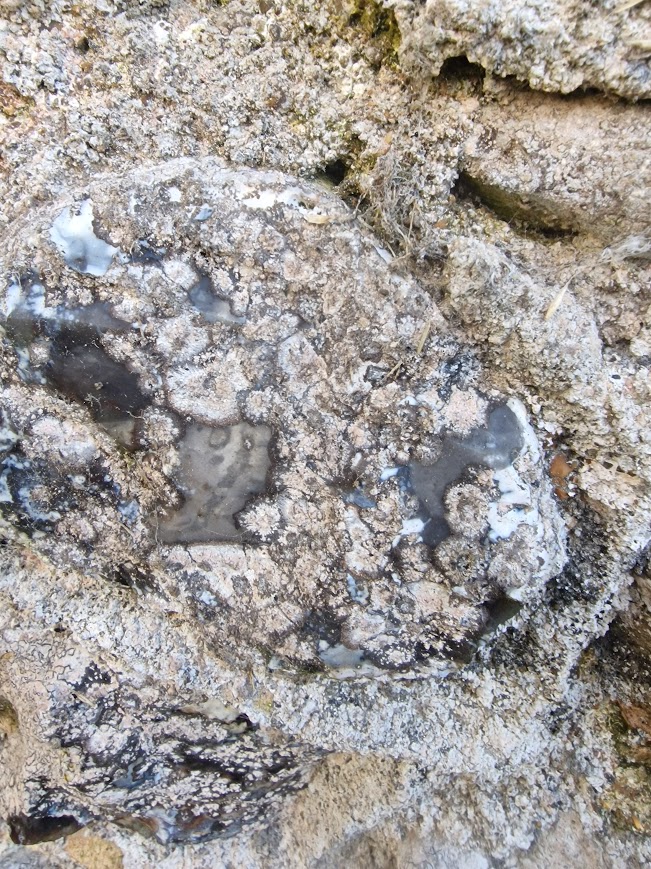
Lullington Heath NNR

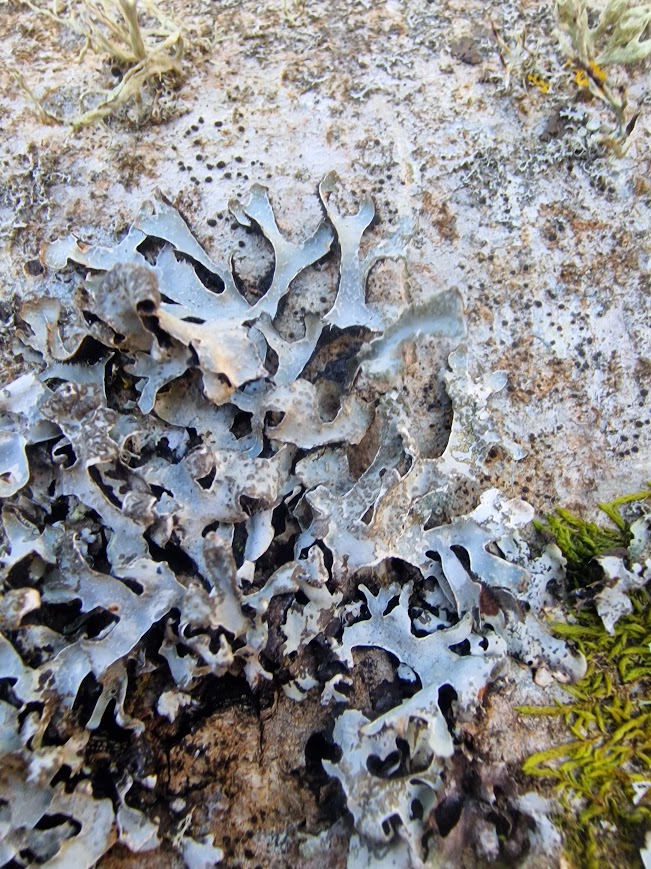
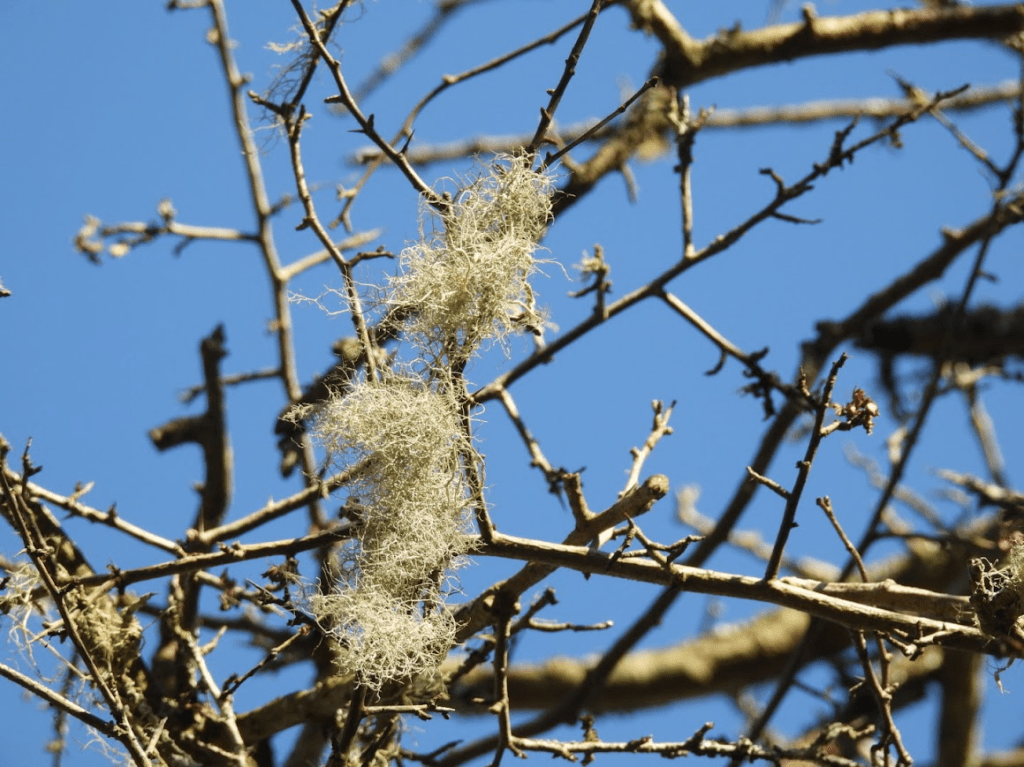
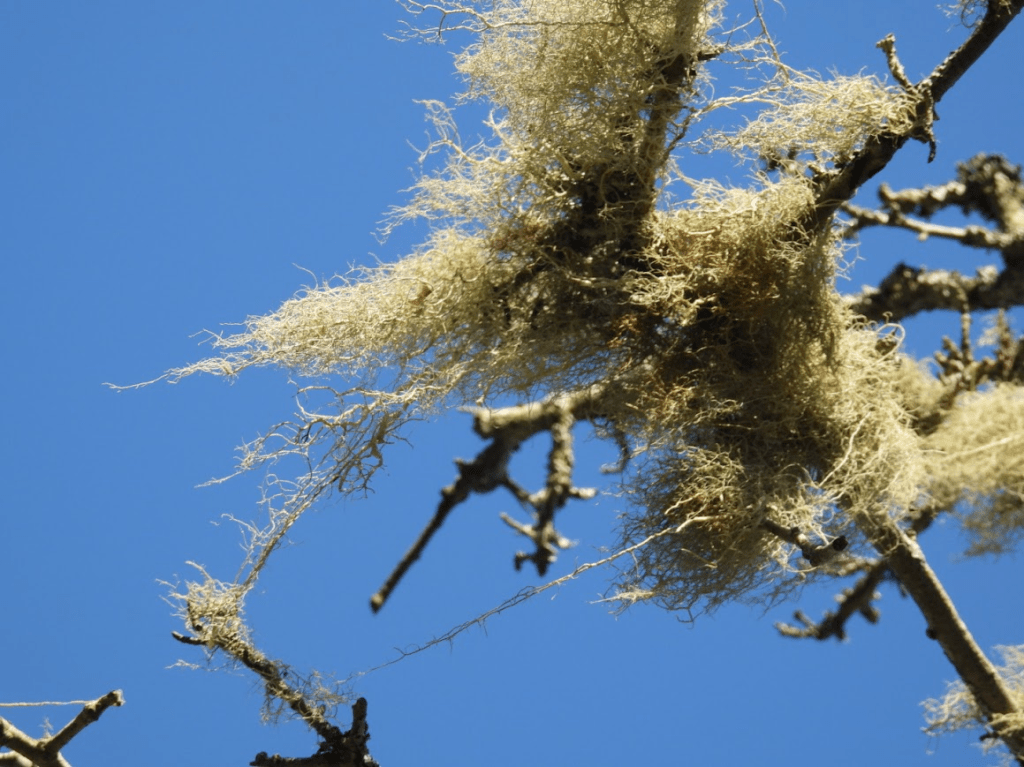
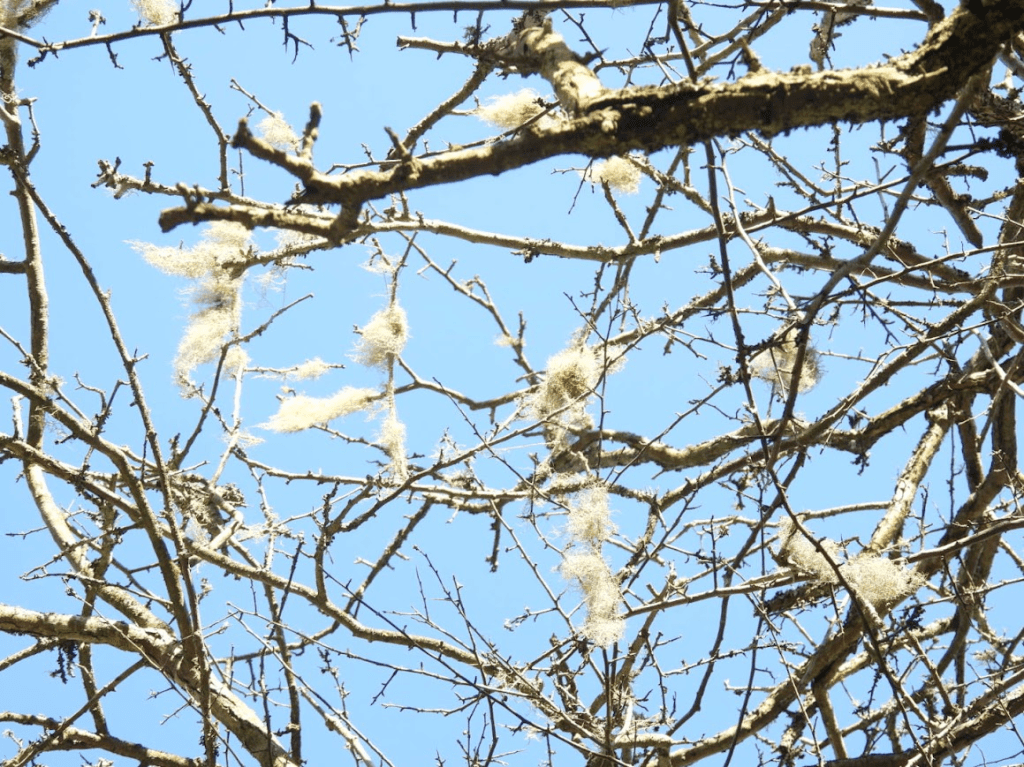
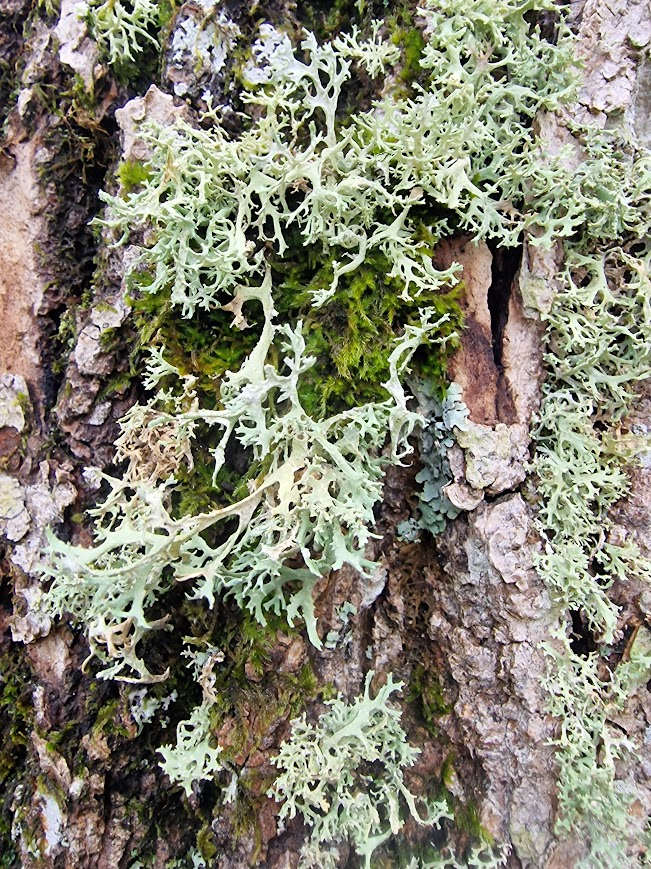
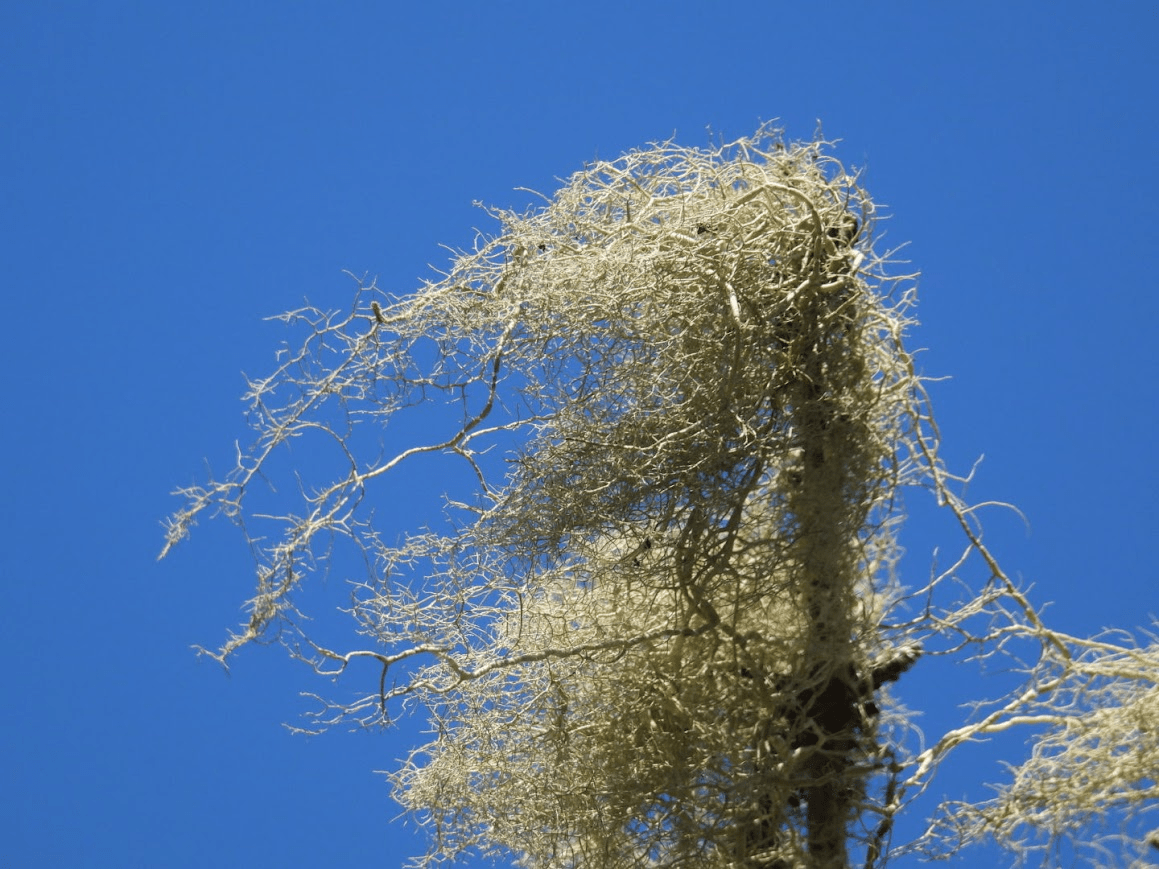
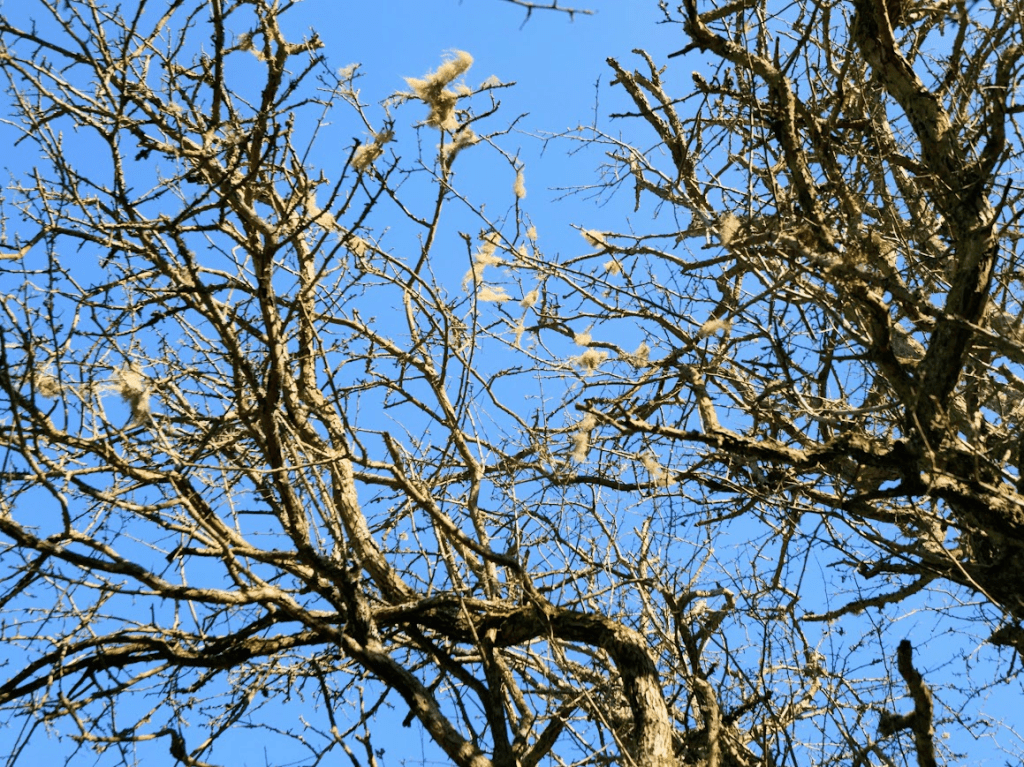
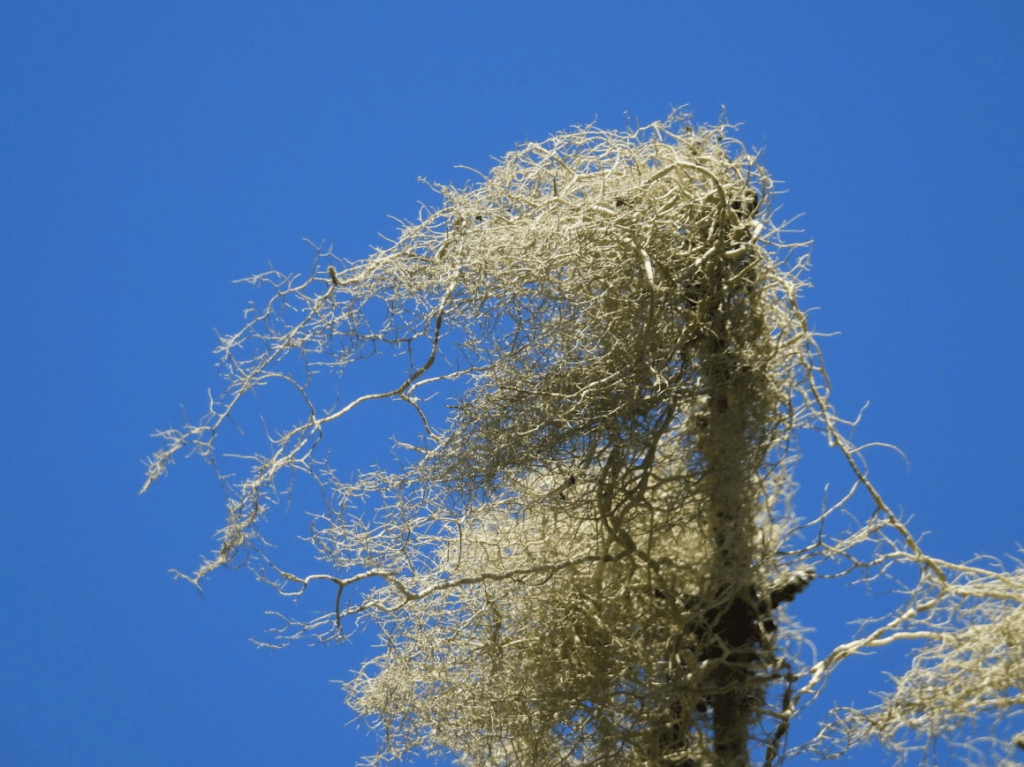
Trees with abundant Usnea spp. are not common in Sussex. But this Hawthorn in Lullington Heath NNR, chalk heath (loess: wind blown acid soil on chalk) has abundant Usnea right at its top. It looks very like U. articulata, String of Sausages; which is rare it Sussex; but it was too high up to get a sample.
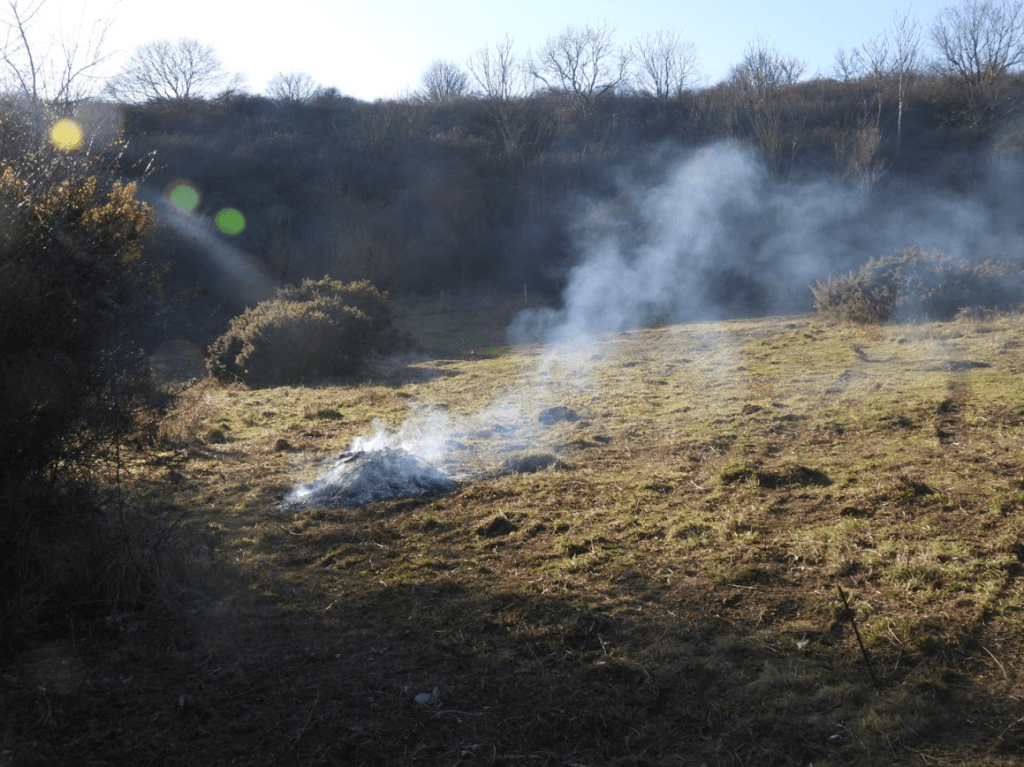
Managing the growth of Gorse on the heath. Lullington Heath NNR is chalk heath; covered with acid loess (wind blown acid soil)
Lullington Church
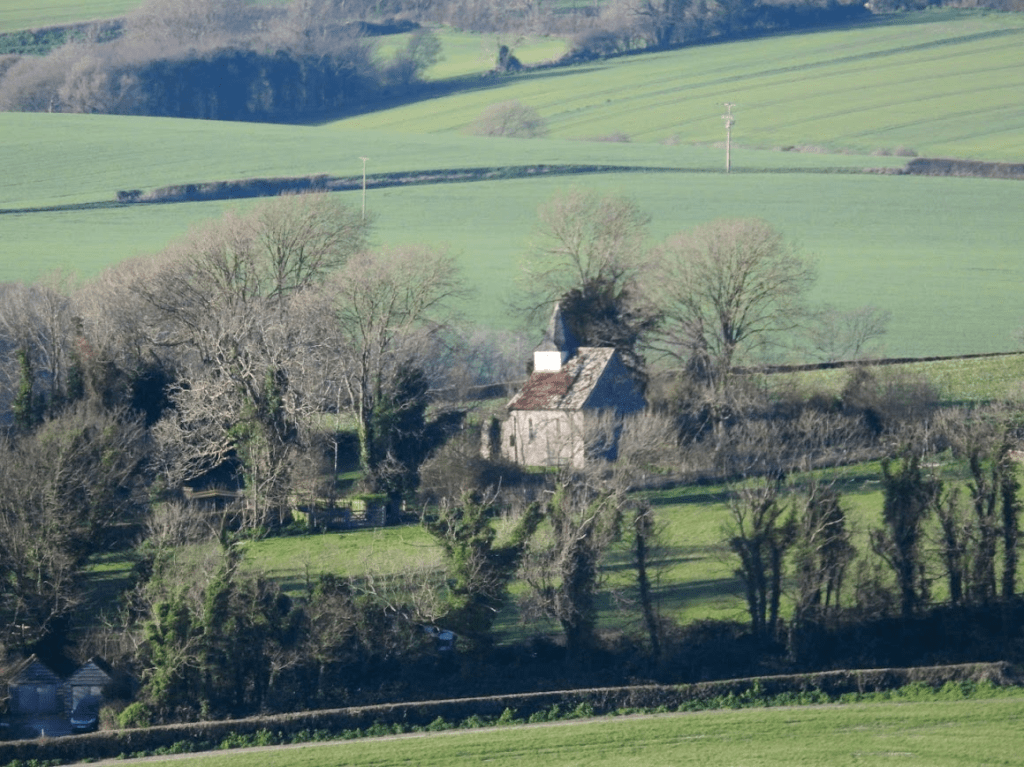
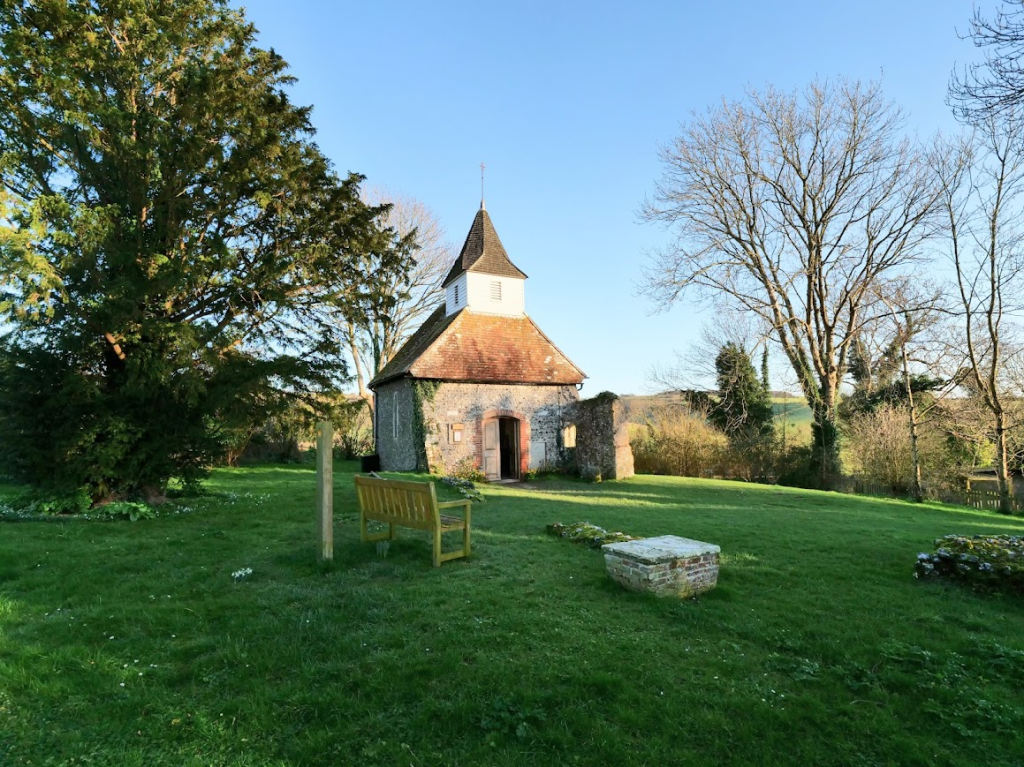
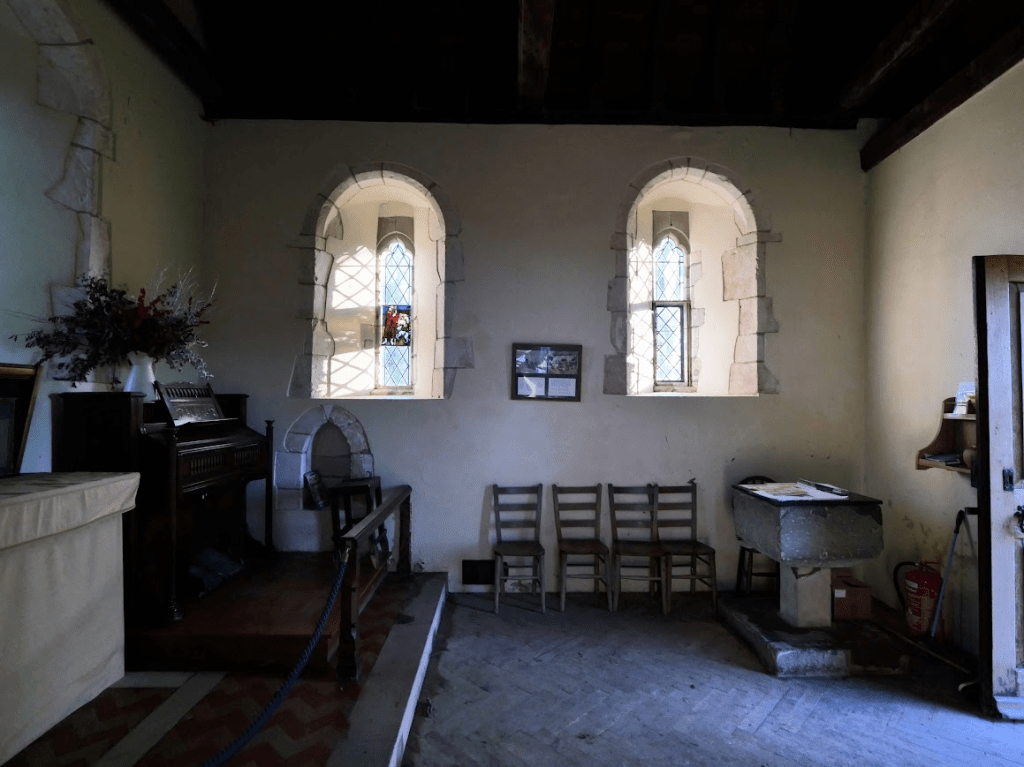
The church of the Good Shepherd, Lullington stands on the side of the South Downs above the Cuckmere Valley, almost hidden amongst a clump of trees. Its white weather boarded belfry peeps above the foliage, and there are magnificent views.

It is the smallest church in Sussex, and one of the smallest churches in the country, being 16 feet square, and seating only about 20. There is no electricity and evening services are conducted by candlelight. The building is the remains of the chancel of a larger church, which is believed to have been razed by fire in Cromwellian times.

The church dates from the 13th century, and is of Early English style, with the list of vicars extending back to 1356. The original dedication is not known for sure, but may be to St Zita (a saint canonised not because of miraculous powers, but because of simple devotion and hard work). More latterly, and after a decision by the local community, the church was rededicated in 2000 to the Good Shepherd (one of the earliest Christian titles for Jesus), in keeping with agricultural practices of the area.

More recently, the church was the inspiration for the popular song ‘The Smallest Church in Sussex’ by the nationally acclaimed band British Sea Power.

Alfriston St Andrews
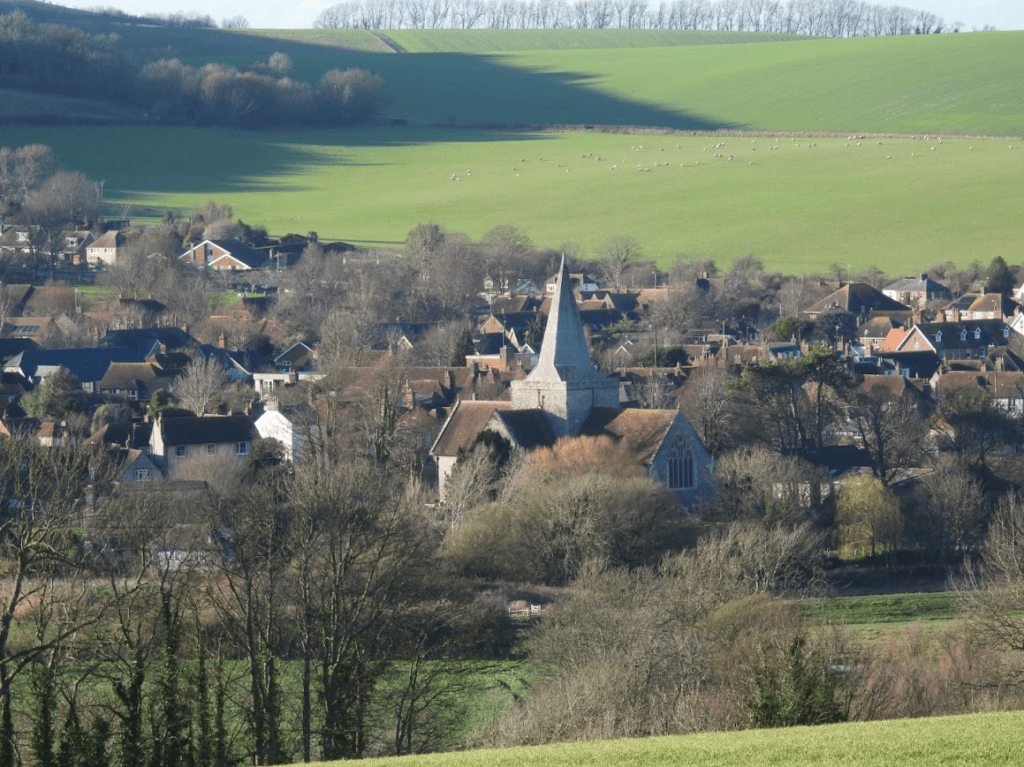
St Andrew across the Cuckmere River
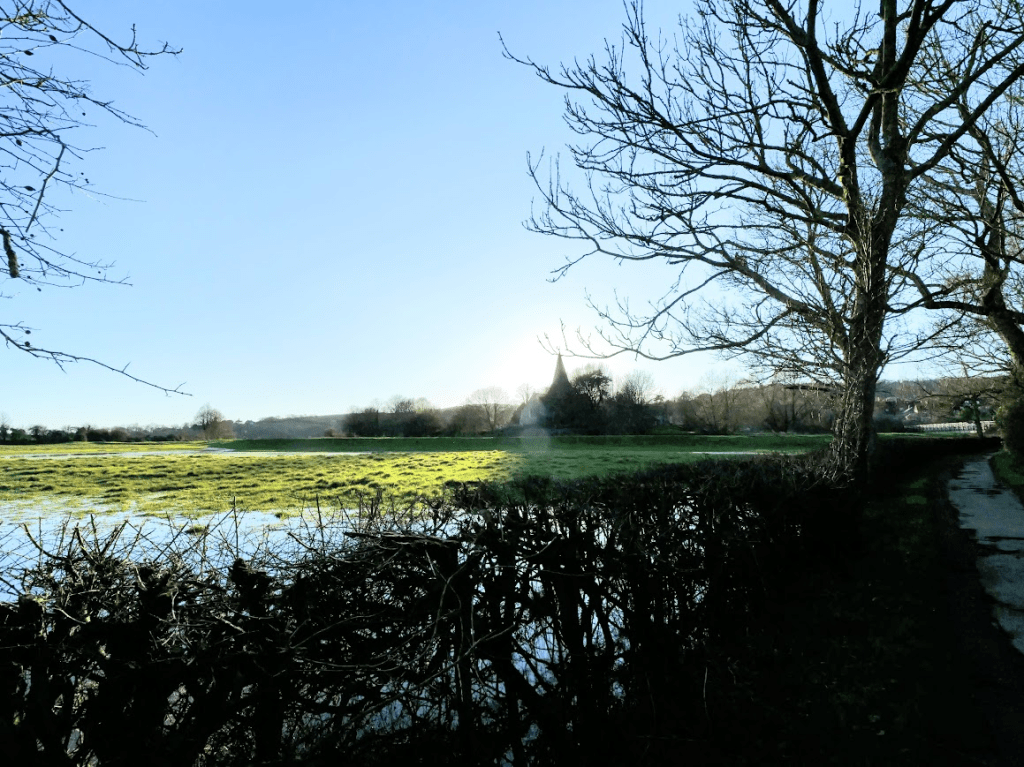
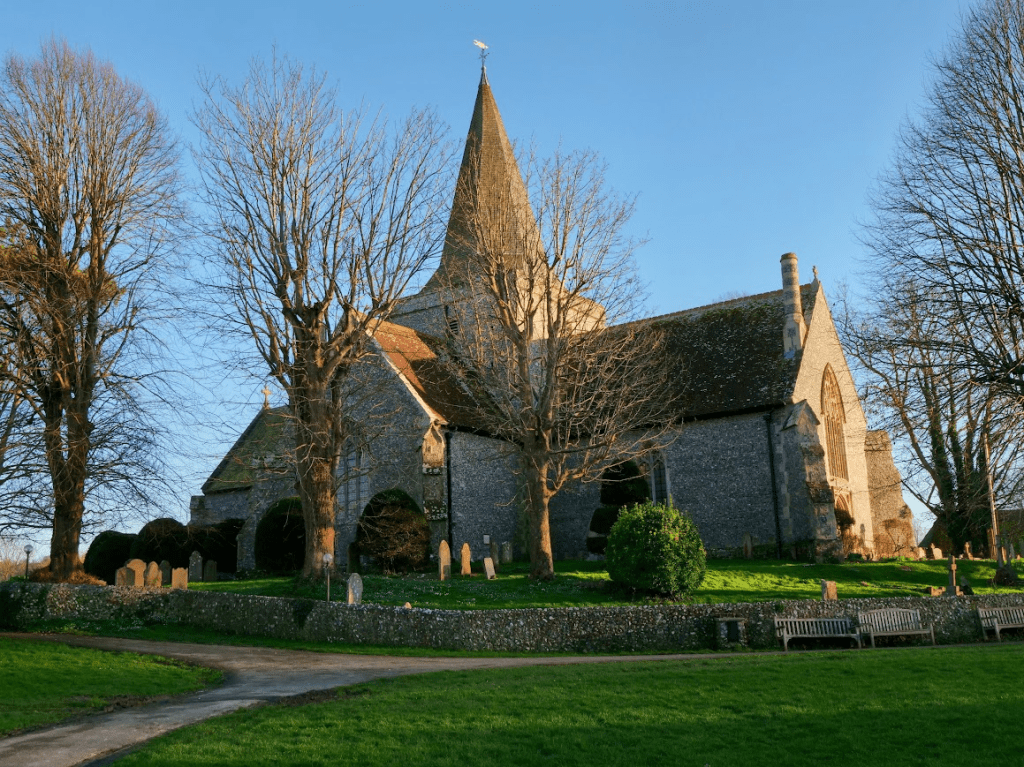
It stands beside the Tye, a large green that may have served as a market in medieval times. In 1399 the church was granted to Michelham Priory. The church is built on a small mound, surrounded by a flint wall, suggesting that the site was a sacred place in the pre Christian period. The sheer scale of the church has led to its moniker ‘The Cathedral of the Downs’. The church seems to have been built in one go, also unusual, at a time when most churches evolved slowly over centuries.

There is no indication of who built the church, and indeed, Alfriston did not even have a lord of the manor at the time. All of which raises the question of why a small village without even a lord of the manor should have such a large and impressive church.

Like most Sussex churches, it is built of knapped flint, with greensand stone for quoins. The roof was originally topped with Horsham stone, but that proved too heavy and was replaced by clay tiles.

The layout is very simple; a cruciform plan with a central tower and no aisles. The nave and chancel are the same length, though the transepts are shorter, creating a traditional cross shape.

One of the best features of St Andrew’s is the timber roof, built to a crown post design. Most is original 13th century work, save only the south transept. On the north side of the chancel is an Easter Sepulchre, within which is a chest tomb. Atop the tomb are carved stone figures that originally decorated the 19th century reredos over the high altar. On the north wall of the nave is a funeral hatchment to Richard Vincent (d1733). Under the gallery stairs is an old bell, cast in 1587.

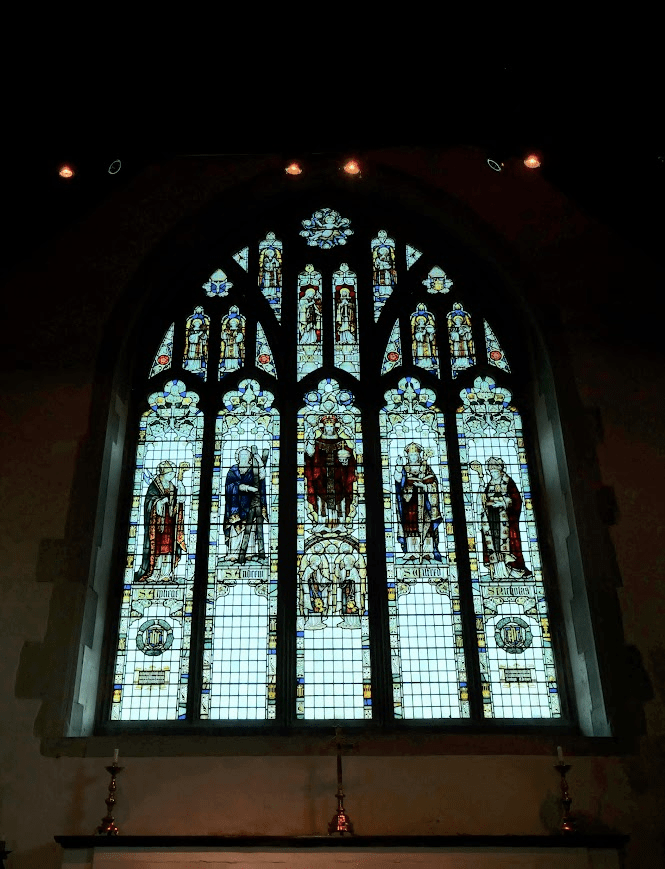
The font may be older than the church, but is at least 14th century, and is set atop a later base. There is a royal coat of arms to George I, dated 1725. The church contains a very pleasing mix of medieval and relatively modern glass. National Church Trust Alfriston St Andrew
 East Window by J Powell and Sons and designed by C E Powell, 1904 
Alfriston Congregational Church

… the building is a living memorial to the early nonconformists of Alfriston. Before 1801 a group of them had already broken away from the established church and were holding their meetings in a house known as the Urn, in North Street. The Old Chapel Centre Our History
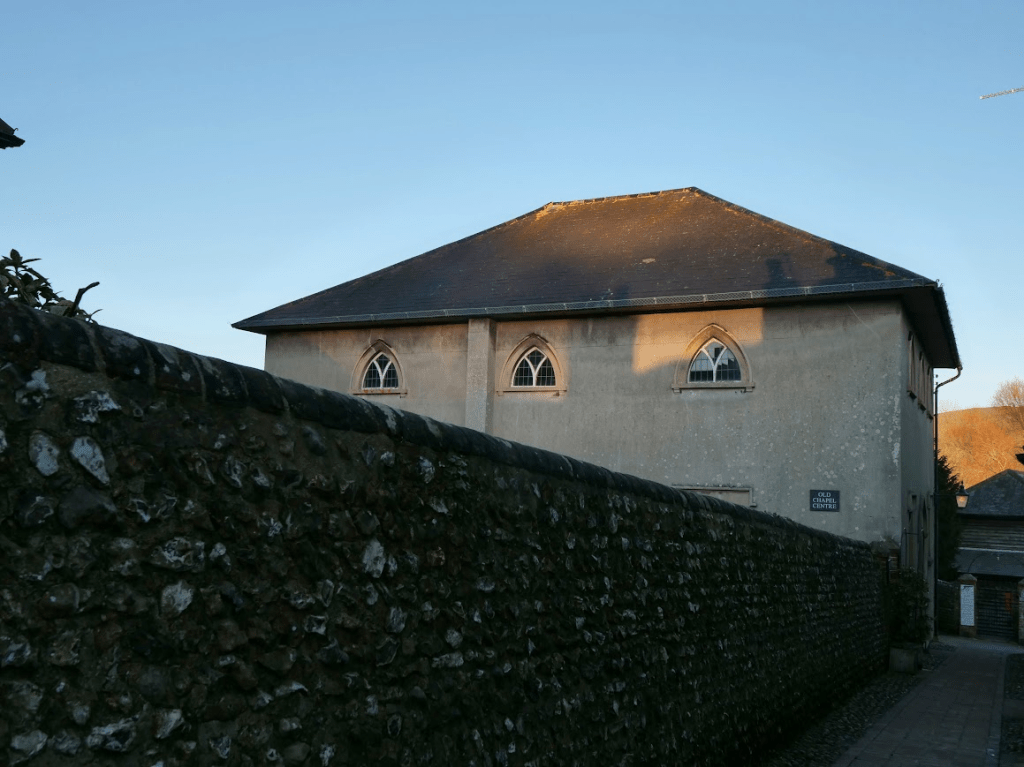
Non-conformist chapels are generally rarer and less visible than established Church of England churches in Sussex, although they have a strong, distinct, and historically significant presence. Lewes was a centre for non-conformists. Non-conformists were often persecuted 16th-18th century England because they posed a perceived threat to the stability of the state, which relied on strict religious, social, and political uniformity through the Church of England. Dissenters were seen as seditious for refusing to attend parish churches.

Litlington St Michael the Archangel at dusk
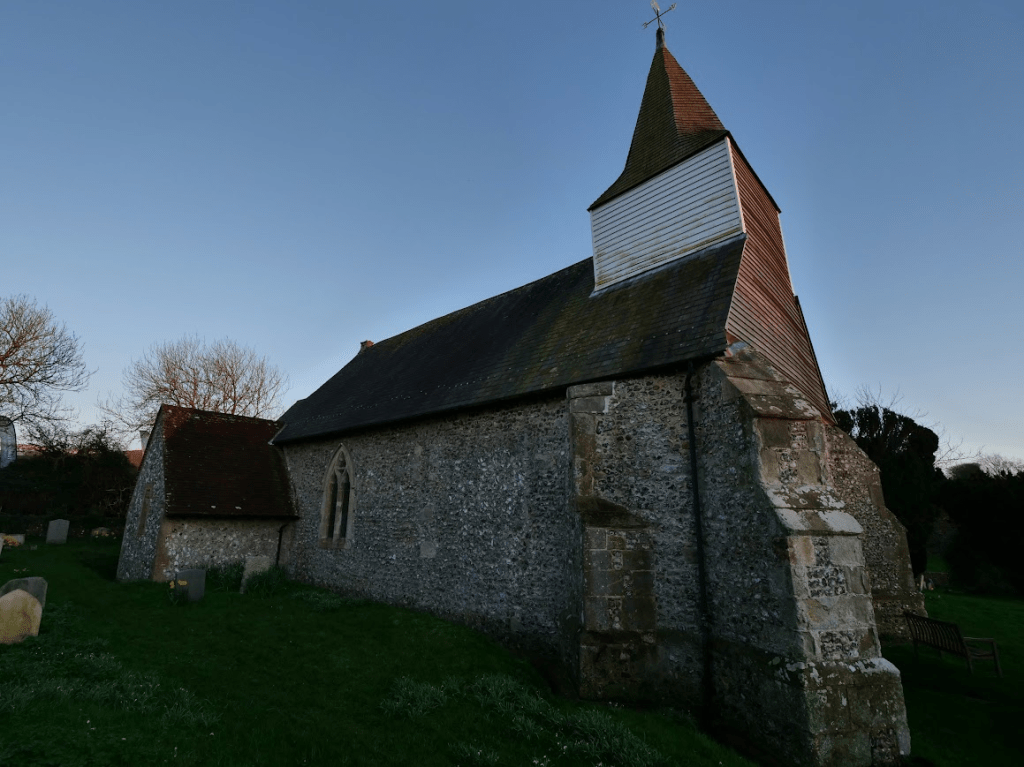
A very good example of a Downland church, built of flint with stone dressings, a white painted weather boarded wooden belfry tower which supports a broach spire covered with wooden shingles.

The main part of the building is thought to have been erected in about 1150 AD, but there are windows in the chancel which may well be Norman, and the remains of two Norman window openings (since closed) are visible in the north wall of the nave. Interestingly, but inexplicably, the floor falls 13” from east to west. The massive beams which support the main roof are original. Once there were three, but the Victorians removed one close to the chancel arch, which caused the church to split apart – since rectified by the insertion of a steel tie-bar. National Church Trust St Michael the Archangel

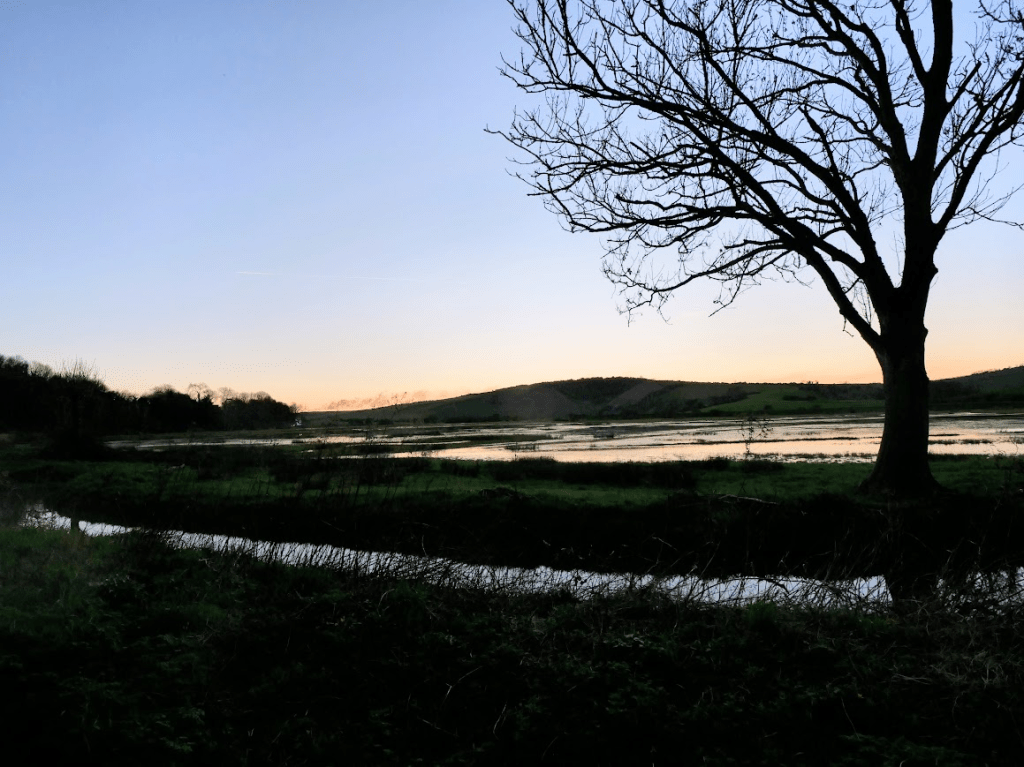
The Cuckmere flooding its flood plain
The Litlington White Horse at dusk
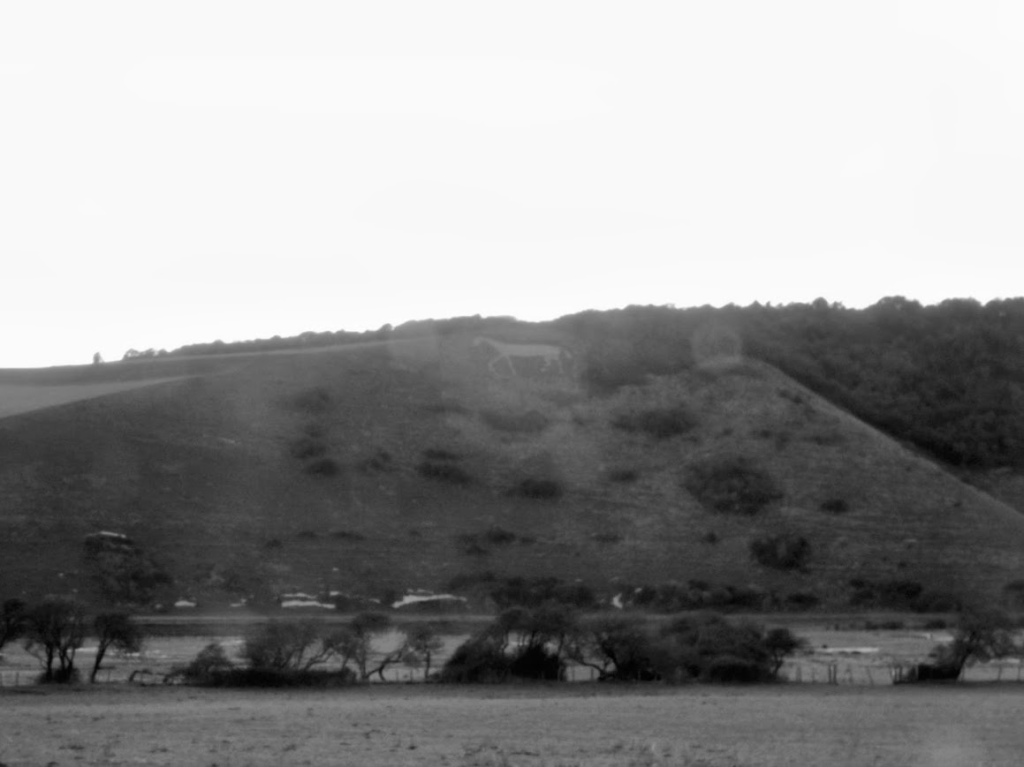
The myth of Sussex’s Litlington White Horse is still in the making. The chalk was cut – possibly – by James Pagden of Frog Firle Farm, near Alfriston, along with his two brothers, and cousin William Ade, who thought to scratch a horse in chalk to commemorate the coronation of Queen Victoria. But the makers of the horse might also have been John Ade, a certain Mr. Bovis, and Eric Hobbis, cutting it under the full moon of 20 February 1924. Another story is that it was cut as a memorial to a local girl whose horse bolted along the brow of Hindover Hill, throwing her down the hill to her death. And yet another suggests the white horse originally depicted a dog, cut by a farm boy to mark the grave of his dog drowned in the Cuckmere river below. It was covered up in the Second World War so as not to alert the Luftewaffe, and has been cut and recut, cleared and re-defined ever since.

It is this re-cutting and re-defining that keeps it alive, on the hill and in literature and in all our imaginations. Archaeologists believe there may have been many more chalk ‘geolyphs’ across the Downs, for if they are not looked after, they are soon overgrown. The Litlington White Horse speaks to that other, more well-known Sussex landmark, the Long Man of Wilmington, carved into the grass across the valley. Both chalk monuments remind us of the geographical and mythical echoes we have inherited from those who have stood on this ground, walked these tracks before us, and by connecting to them, we connect to the old ways, and step forward with the past – whether wholesome or destructive, whether more, or less understood – informing all our futures. Rosa Magazine Litlington White Horse

Bed time for Rooks in a rookery
Clapham, South Downs, West Sussex. An ancient wood with abundant polypody, butchers broom, lichens & dogs abducted by UFOs (allegedly) and a Norman church with archangels by Morris & Tudor tombs. 23.02.26

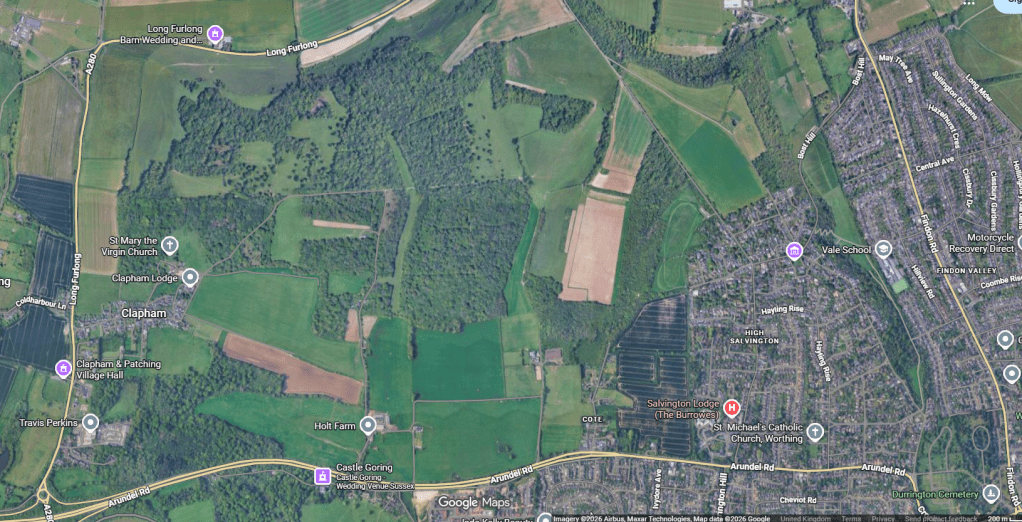
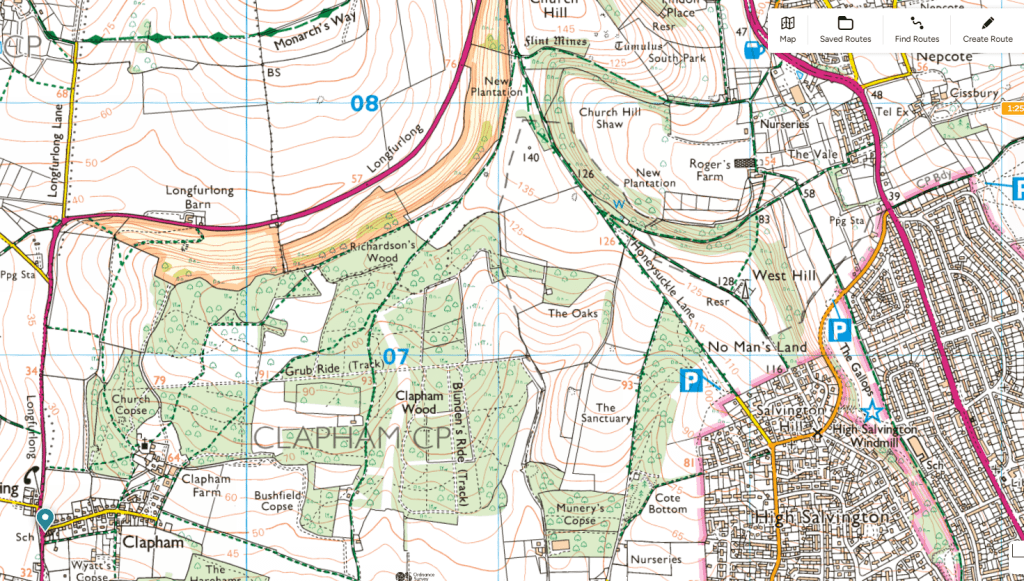
Clapham is not so easy to get to by public transport. It is possible to get the train to Goring-by-Sea and walk from there, but that entails walking along roads with no pavements. So I took the train to Worthing then took Metrobus 21 (every 30 minutes) to Findon Valley. I walked from Findon Valley Road to High Salvington Windmill; then walked on footpaths past West Hill to New Plantation, where I turned sharply south on the footpath into Richardson’s Wood above Clapham Wood
Screen shot of Google Maps Satellite View

Screen shot of Ordnance Survey Map from explore.osmaps.com

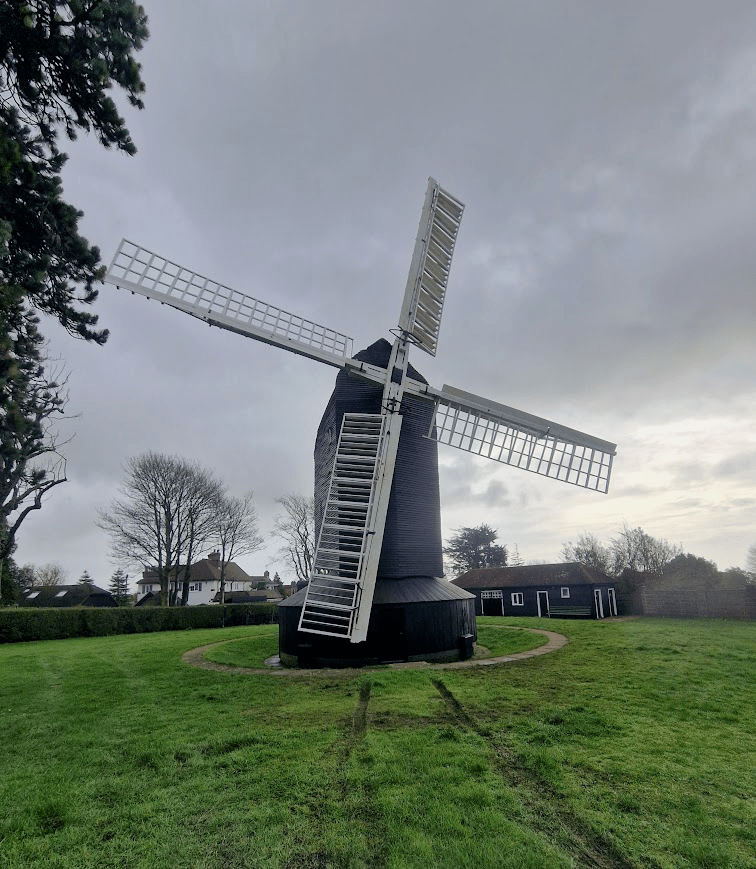
High Salvington Mill

High Salvington Windmill is a working post mill dating from approximately 1750.

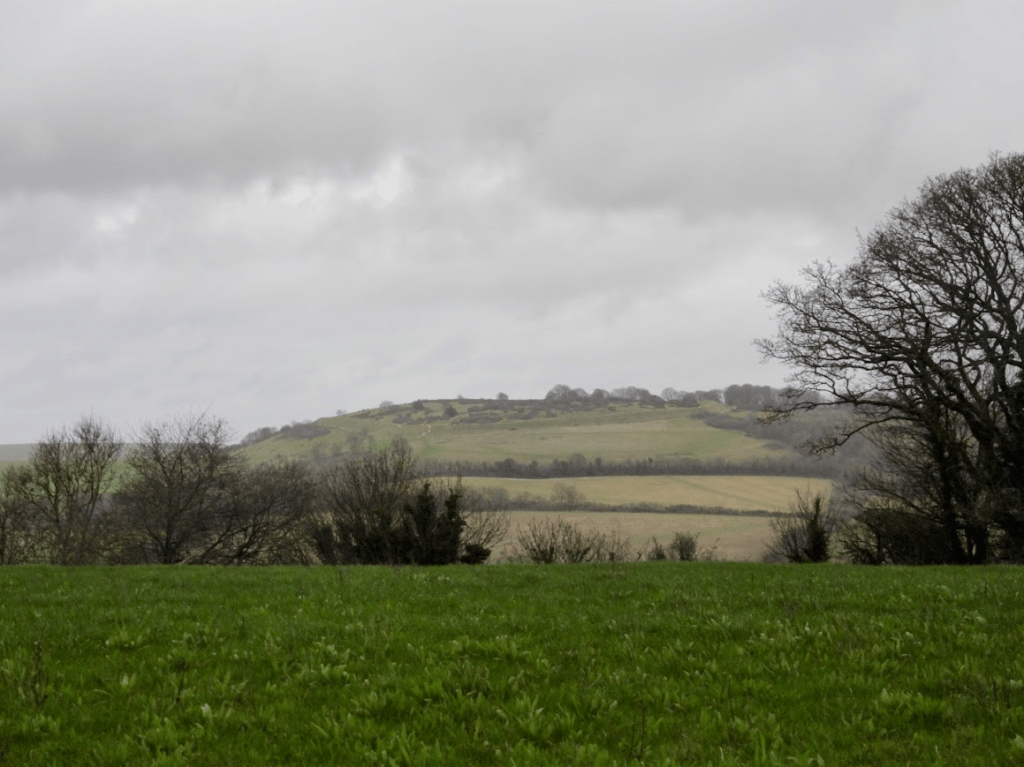
Looking over to Cissbury Ring for High Salvington
Cissbury Ring is a Middle Iron Age hill fort in Sussex ca. 250BCE, with Neolithic mine, one of the first flint mines in Britain. There are about 270 shafts dug into Cissbury hill over around 300 years of use. See National Trust History of Cissbury Ring
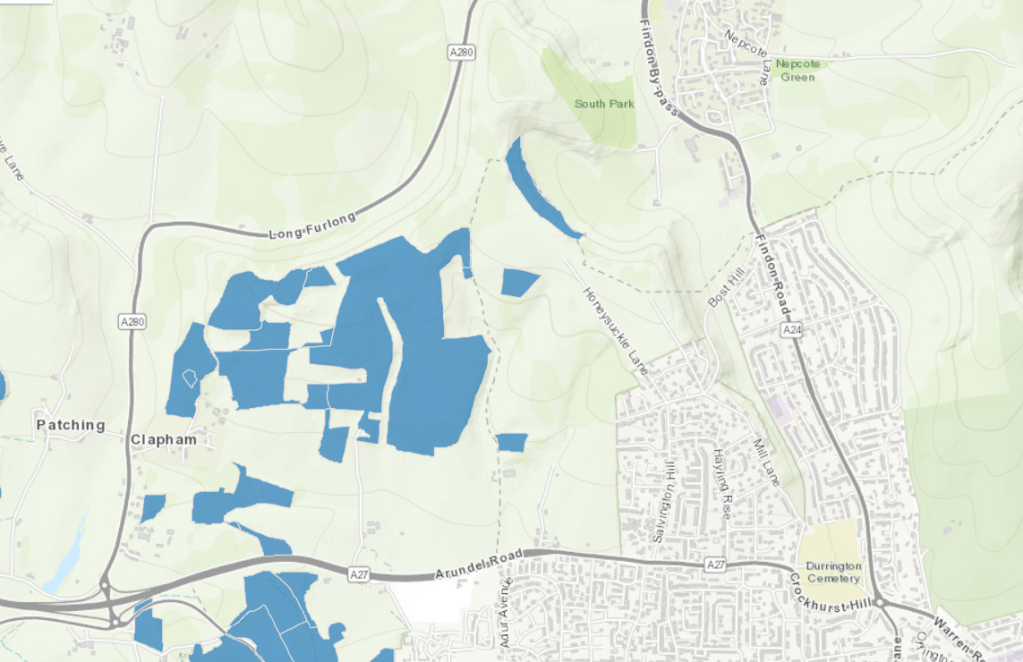
Clapham Wood is a Site of Nature Conservation Interest (SNCI). It is designated as Ancient Woodland by Natural England. Screen shot of Natural England Ancient Woodland (England) Natural England Open Data Publication

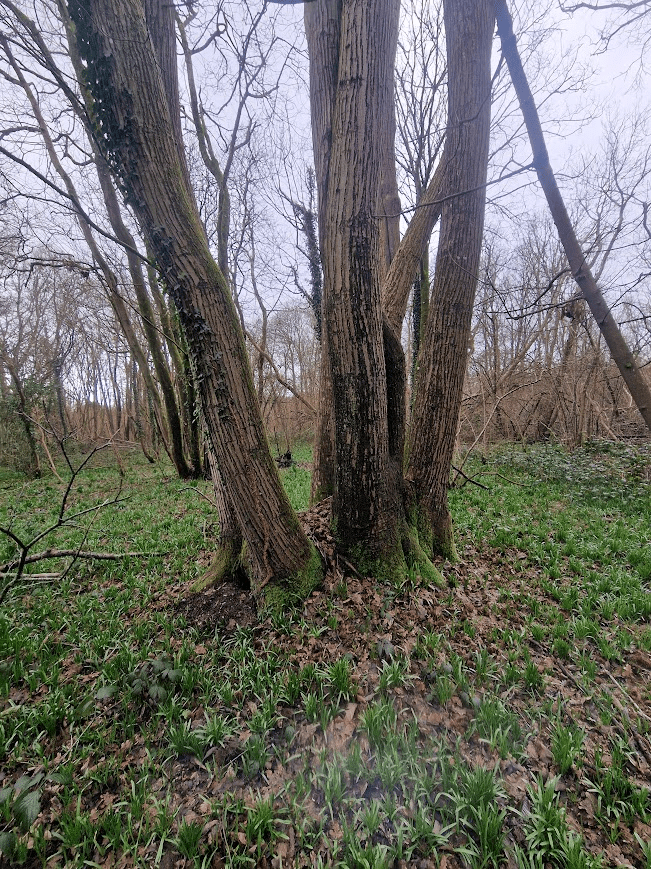
There is little ancient woodland left on the South Downs; the majority of that left is scarpe face woodland dominated by Ash, Beech, Hazel and Yew; Clapham Wood is a rare dip face wood dominated by Pedunculate Oak and Hazel, with some Beech and Yew and some introduced Sweet Chestnut. It is actively manged through coppicing; and it could be categorized as Hazel coppice with Oak standards; a traditional woodland management strategy.

Into the woods

Walking North to South

Ancient Sweet Chestnut

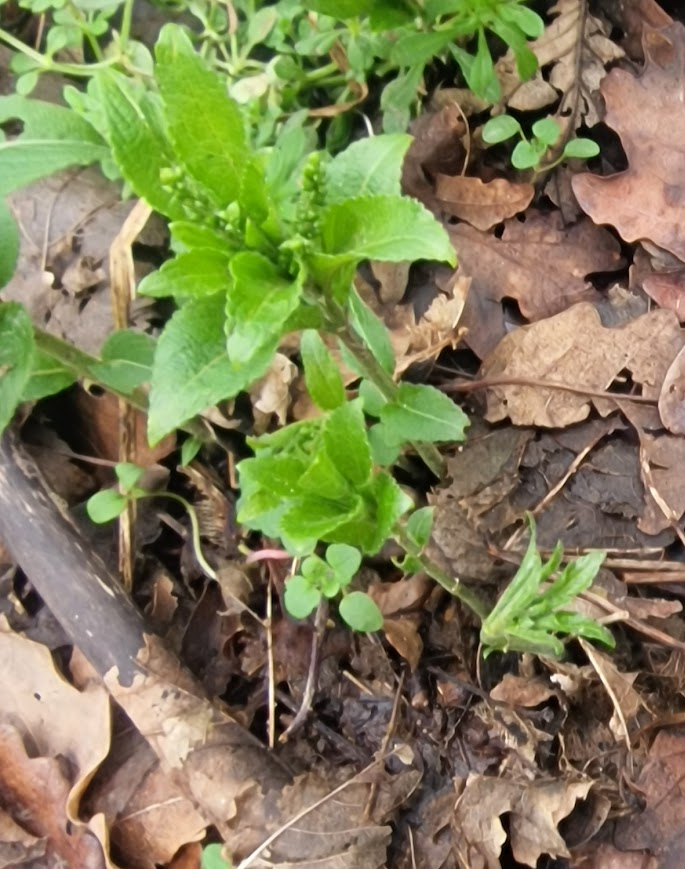
Dogs Mercury, and ancient woodland indicator plant

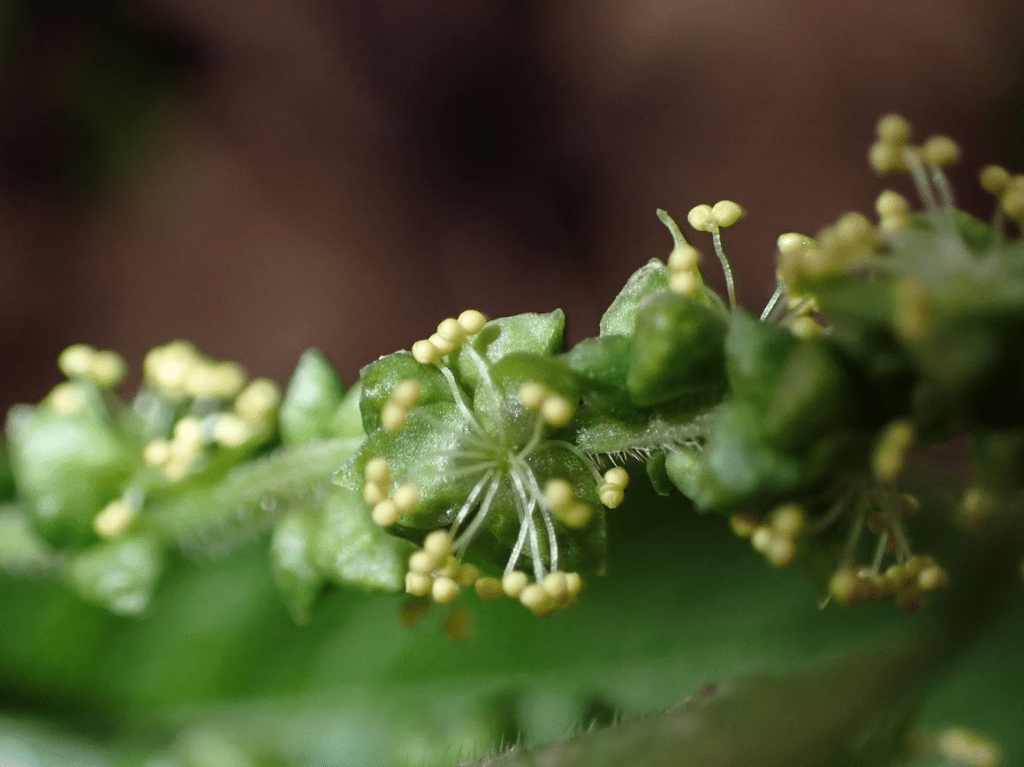
Close up of flowers

Ash covered with lichens (mostly Ramalina fastigiata and Xanthoria parietina)

Fallen Sweet Chestnut

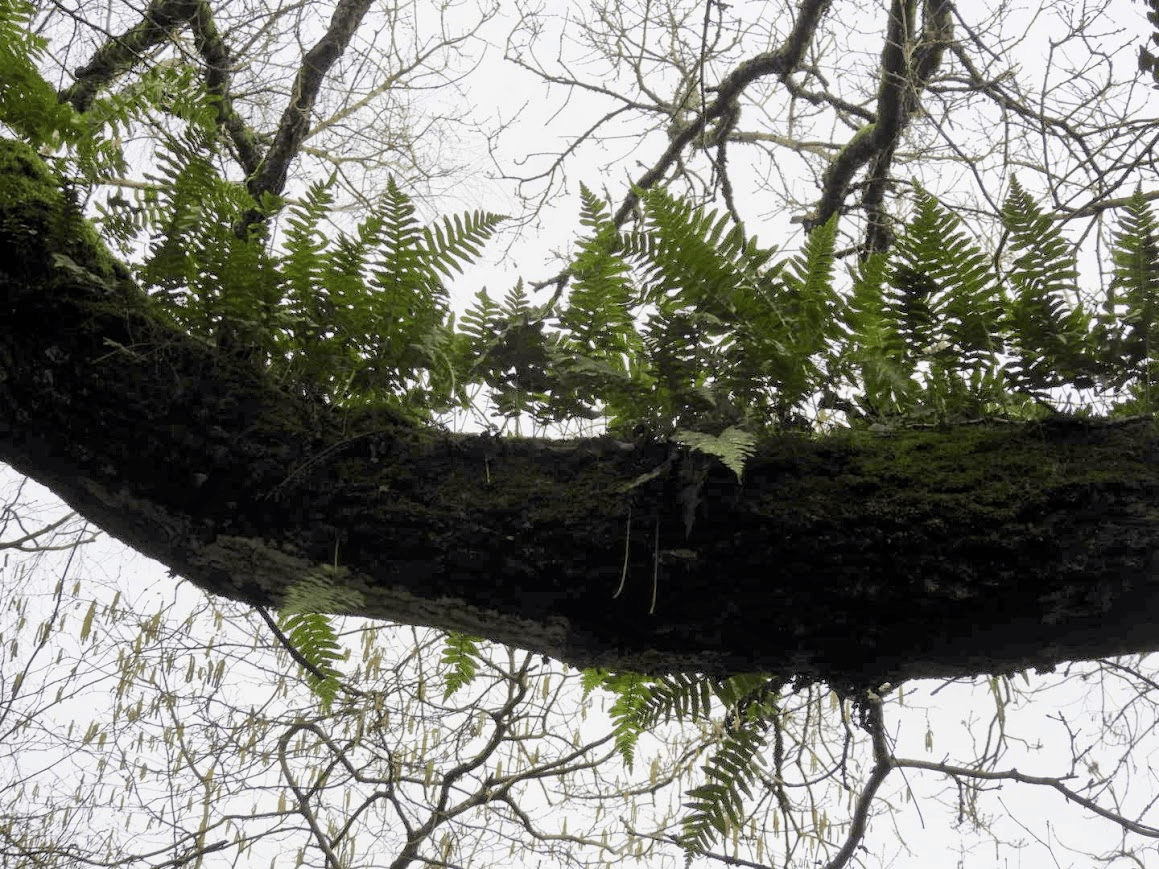
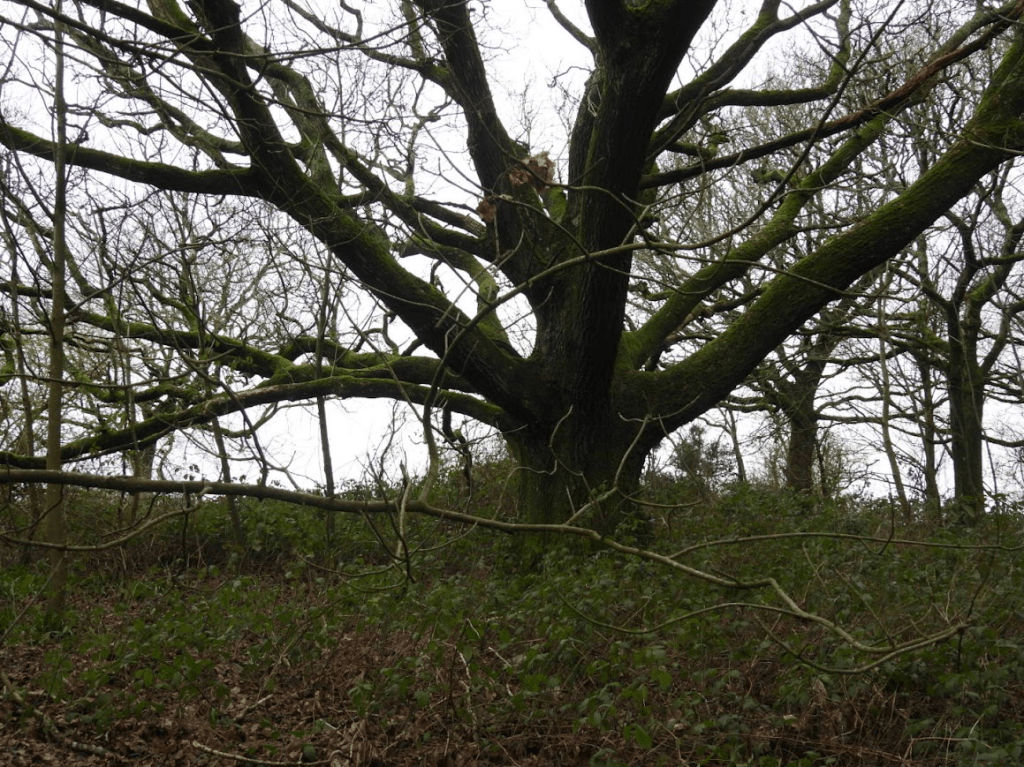
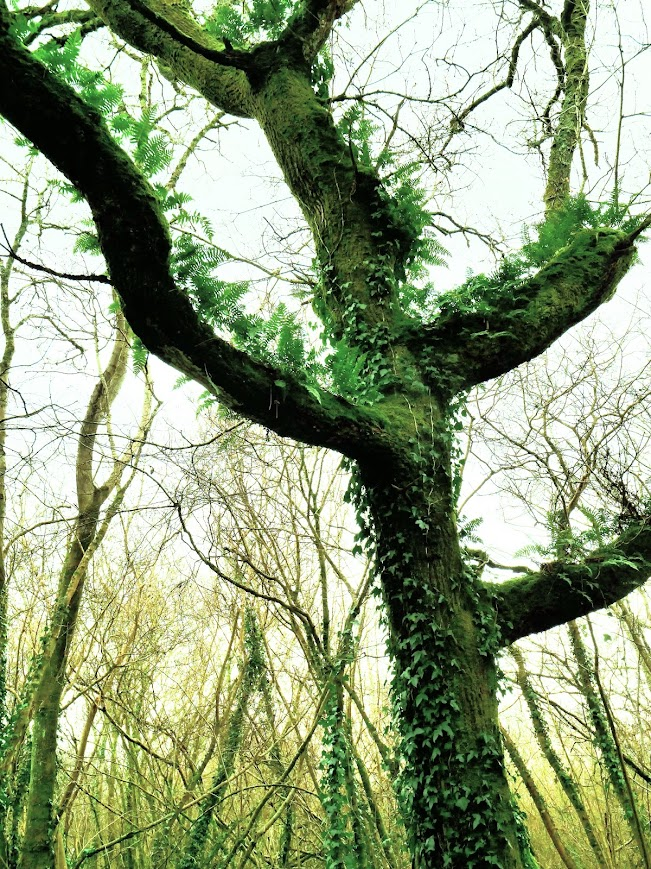
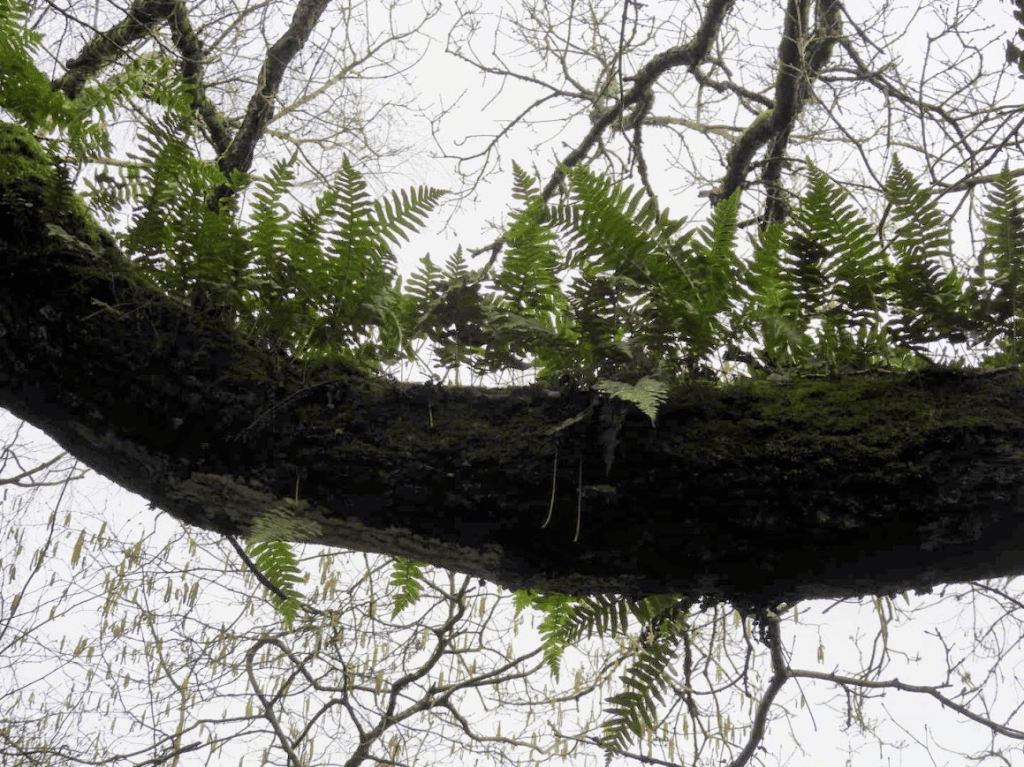
Pedunculate Oak covered in Polypody Fern; it is very unusual to see this much Polypody on a southern Oak. Polypodium spp. (any species) are ancient woodland indicators species in the south. See my post The ancient woodland of the Low Weald and Downs. Looking at plants. How do I know I am walking in ancient woodland? Butcher’s Wood, Lag Wood and Newer Copse (Wolstonbury Hill) 07.04.25 for more details

Coppiced Sweet Chestnut and Bluebells

Bluebells emerging; an ancient woodland indicator plant

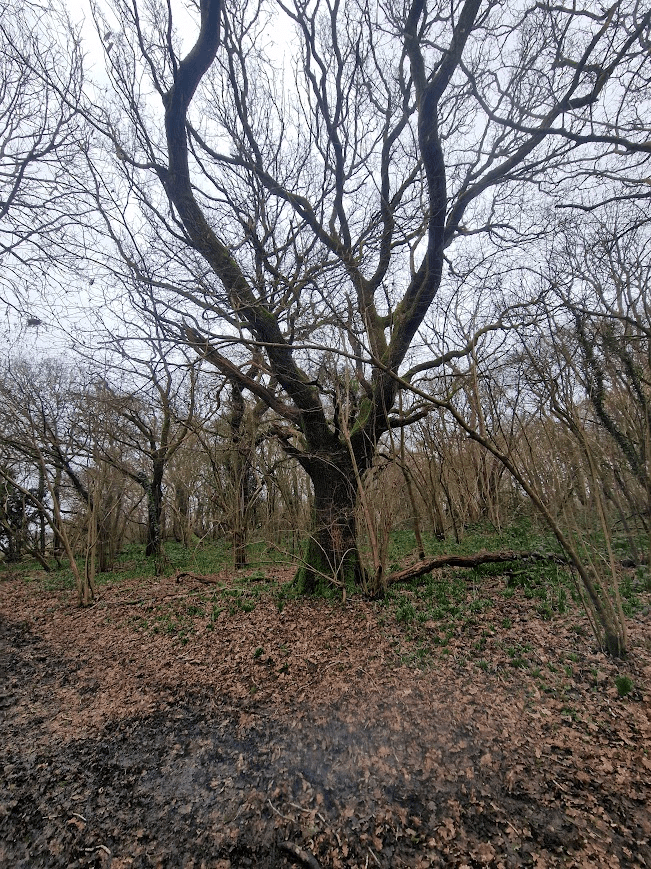
Maiden Pedunculate Oak and coppiced Hazel; a traditional way of managing ancient woodland

Maiden oaks are oak tree that has grown in its natural form, featuring a single, uninterrupted trunk for at least 1 meter above the ground and an unpollarded crown.

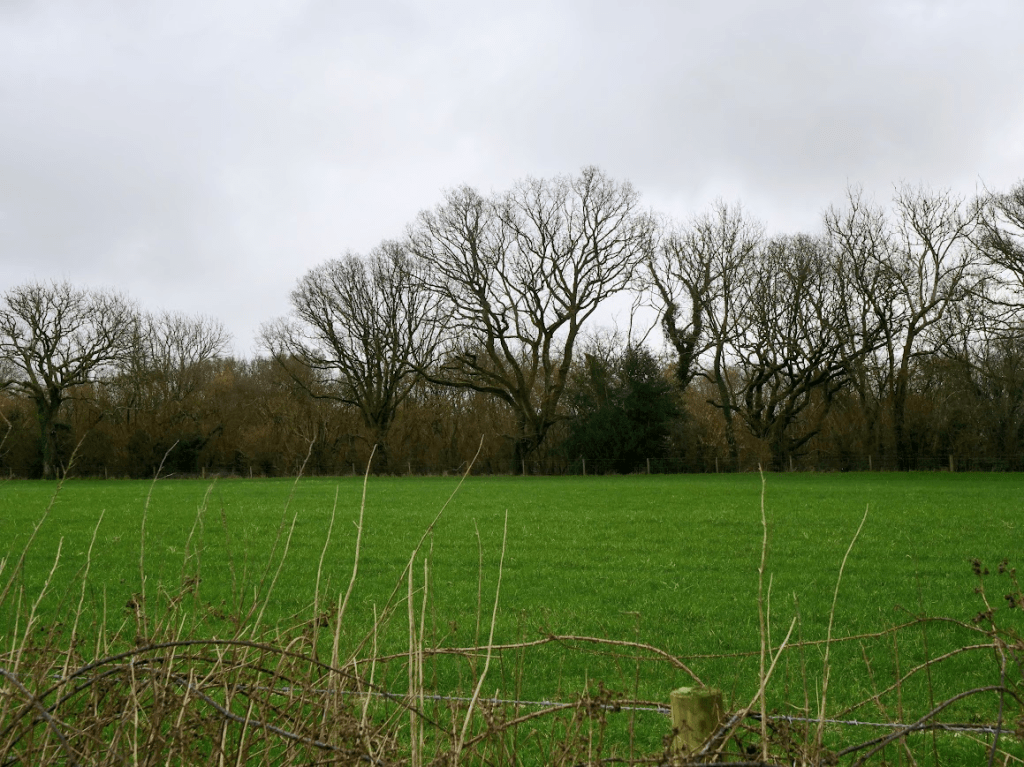
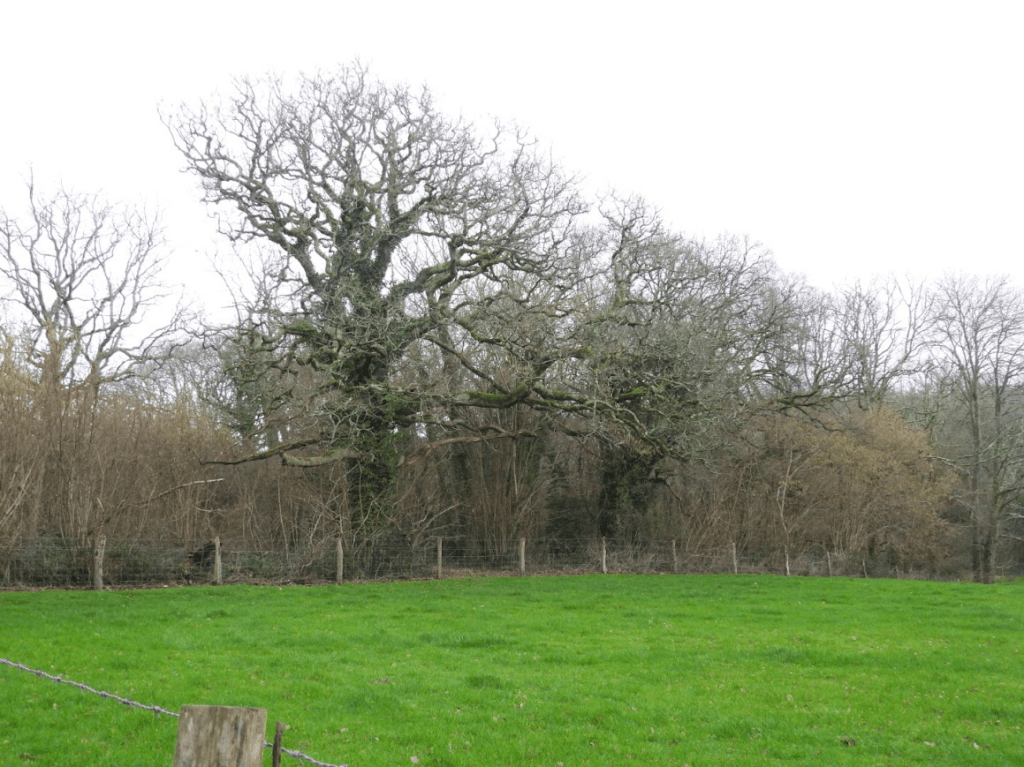
Huge boundary Oaks at the edge of a wood segment

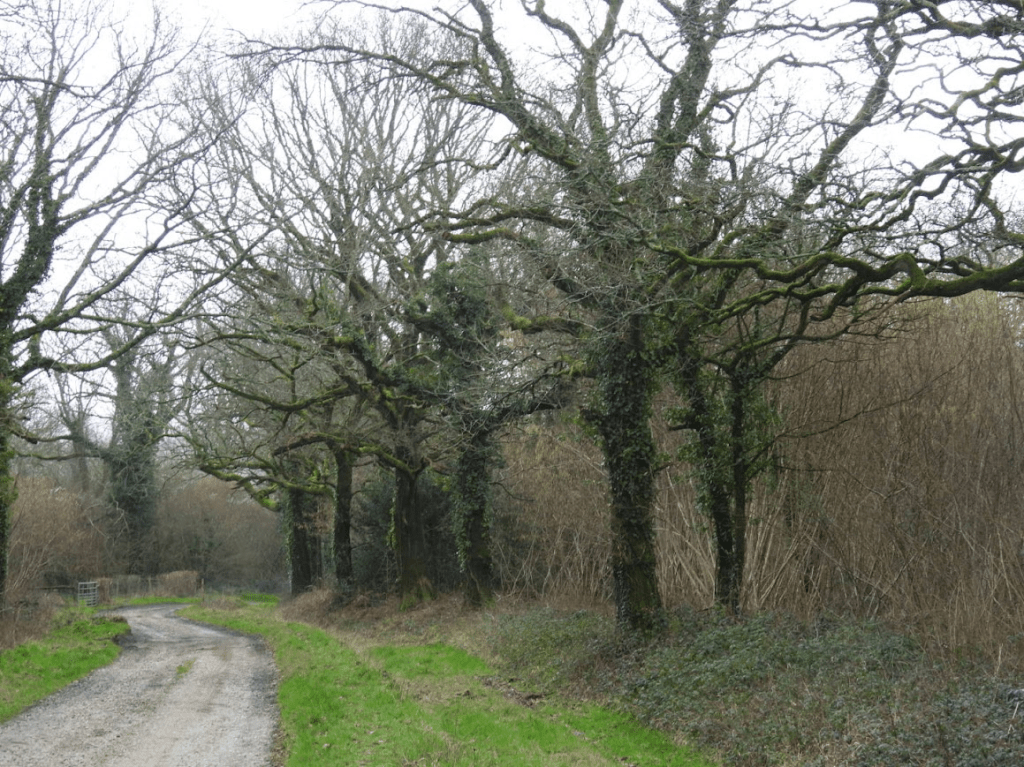
Pedunculate Oaks on an ancient boundary bank

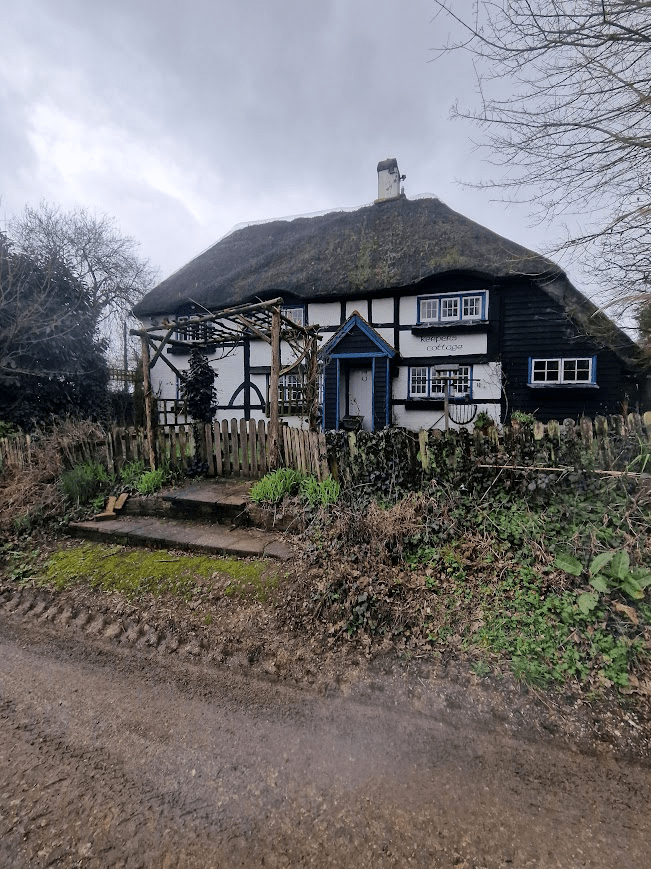
Keeper’s Cottage at Holt Farm in the hamlet of Holt (now just two cottages and the farm) on the edge of Clapham Wood. Grade II listed. Restored C17 or earlier timber-framed building with painted brick infilling. Hipped thatched roof with two “eyebrows” and pentice behind. Casement windows. Modern gabled weather-boarded porch. Two storeys. Three windows. Historic England: Keeper’s Cottage

The far-away Castle Goring (taken at x80 magnification) from the footpath running eat-west just south of Clapham Wood

The weird Palladian fronted, but Gothic on the north side (the view above) castle built by the poet Shelley’s grandfather, Sir Bysshe Shelley, about 1797-8. Built at the same date. …. The Palladian front was designed by Biagio Rebecca and is said to be a copy of a villa near Rome. It is of yellow brick. … The Gothic back is of flint and sandstone. Historic England Castle Goring List Entry

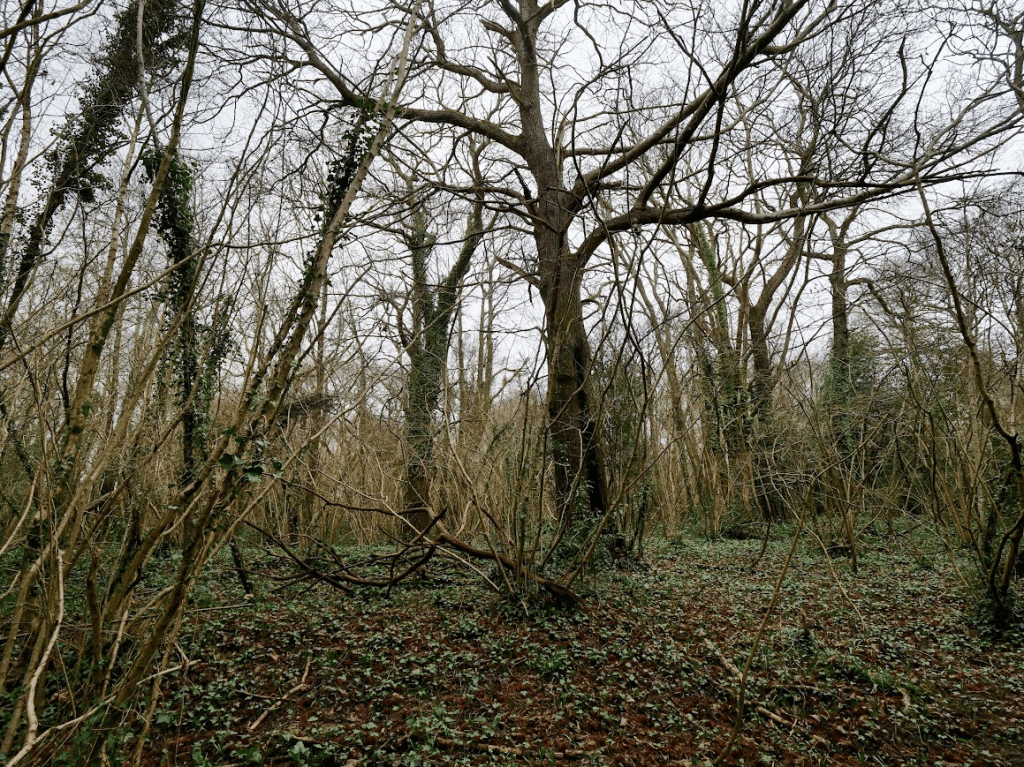
Part of the southern edge of Calpham Wood; with boundary maiden Pedunculate Oak prominent; behind maiden oaks and coppiced hazel.

Walking south to north

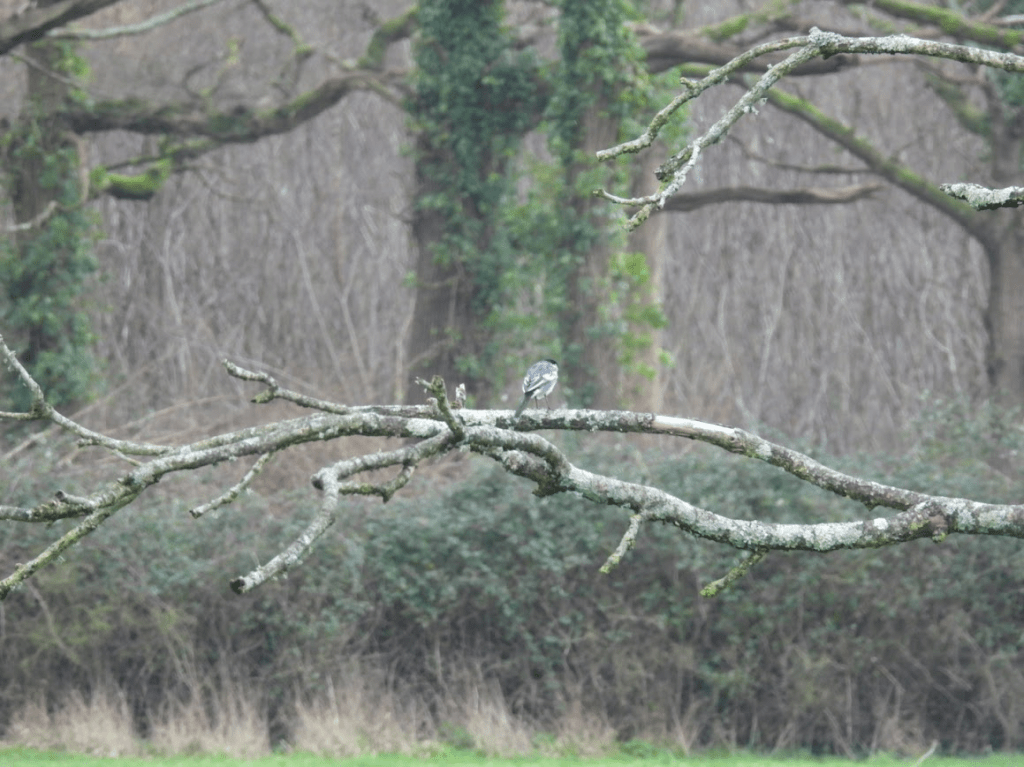
Pied Wagtail

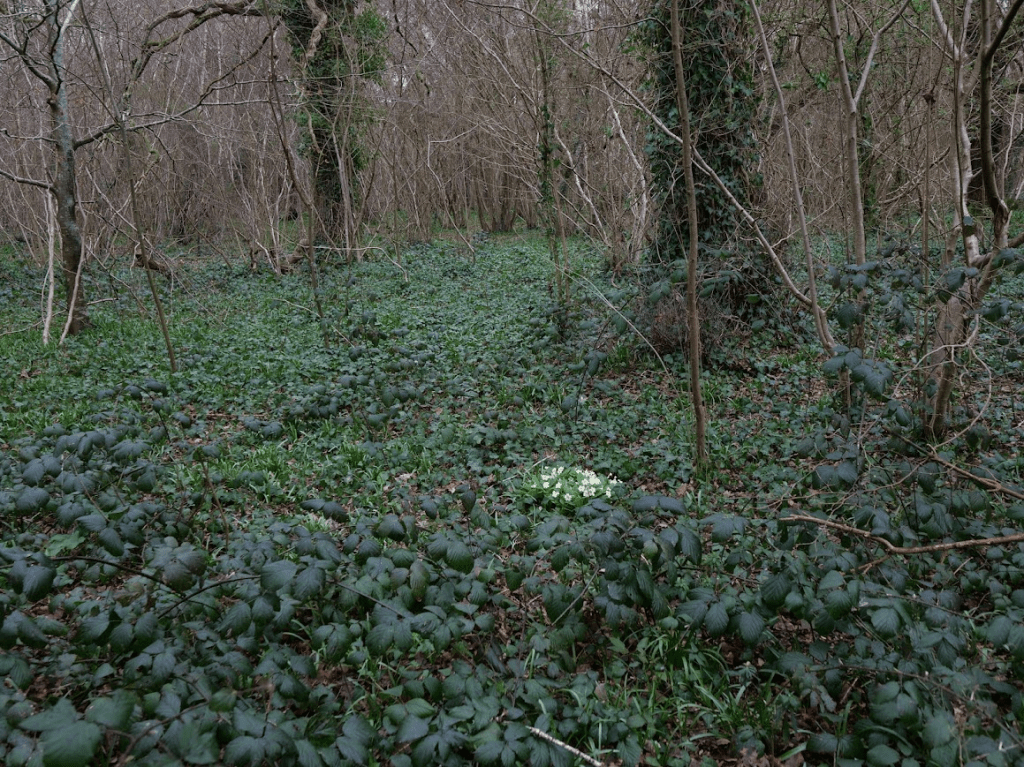
Primrose, an ancient woodland indicator plant

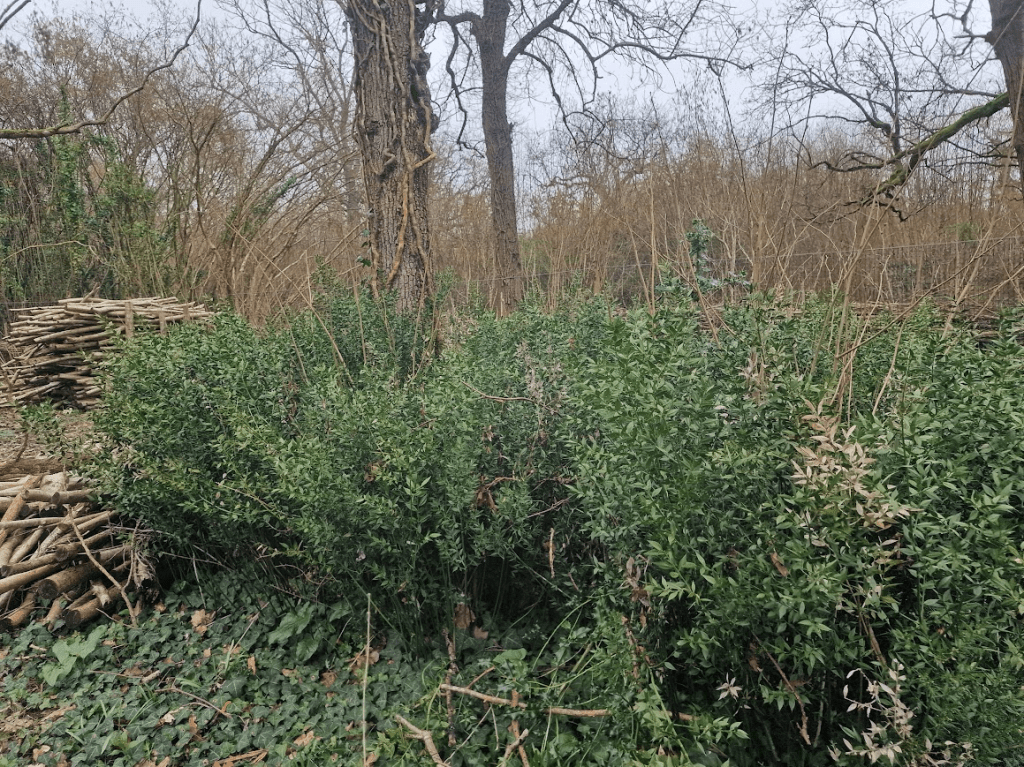
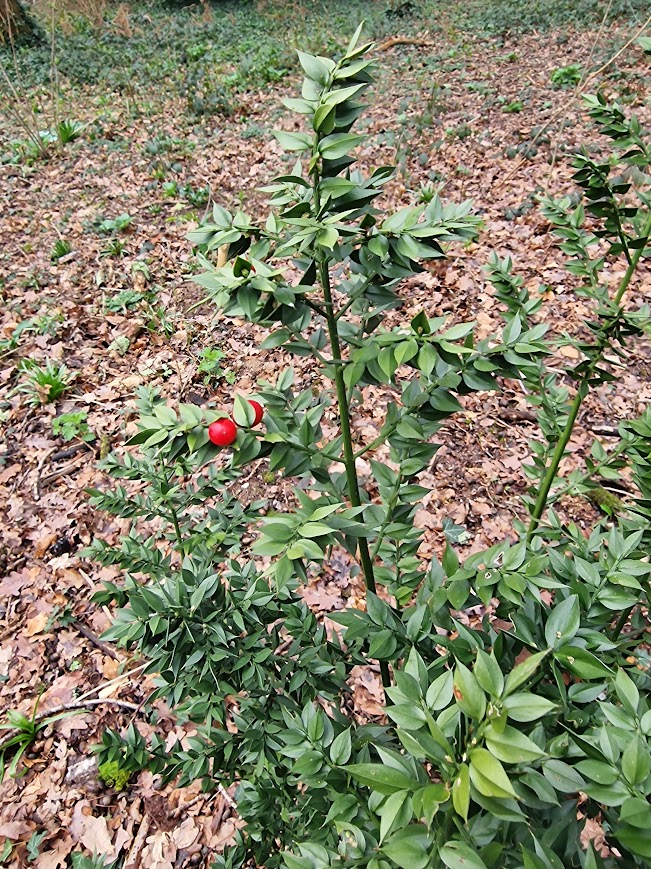
Butchers Broom, ancient woodland indictor plant

I love Butcher’s Broom and don’t see it often. When I do I am excited. It was very abundant in Clapham Wood’s Church Copse. It was in a fenced off area that was being coppiced by volunteers as part of a South Downs National Park Authority project see: https://www.southdowns.gov.uk/wp-content/uploads/2024/08/Role_profile_Church_Copse_2024.pdf

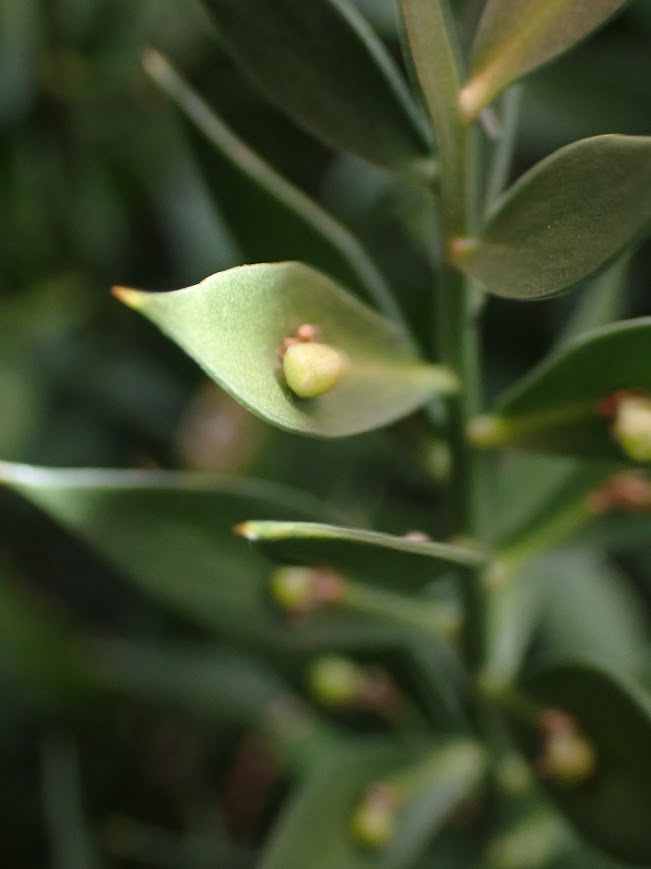
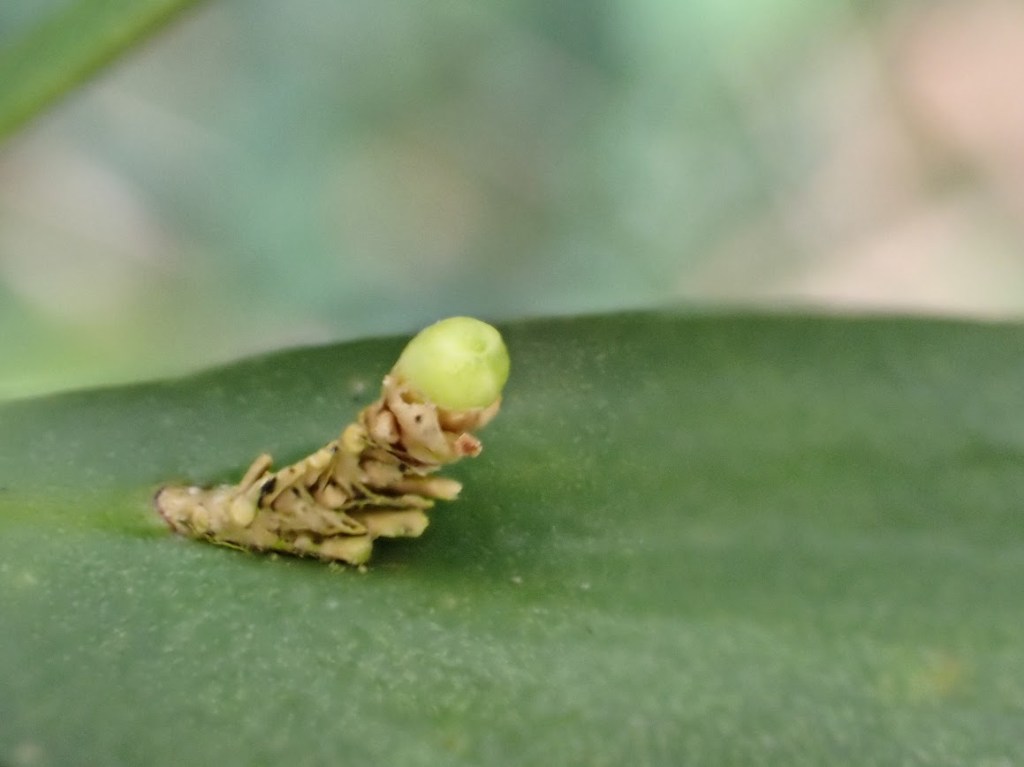
Butcher’s broom is a monocotyledon [a flowering plant with an embryo that bears a single cotyledon (seed leaf). Monocotyledons constitute the smaller of the two great divisions of flowering plants] of a most curious appearance. It is a multi-stemmed, evergreen shrub that rarely gets taller than one metre high, and appears to be covered in stiff, spiny leaf-like structures. However, closer examination shows that these structures cannot be true leaves; they sometimes bear tiny flowers, followed by spherical, bright-red, fleshy fruits, on their upper surfaces. The green structures are cladodes. Evolutionarily, cladodes are flattened stems that perform the same photosynthetic function as leaves. The true leaves are reduced to tiny, non-photosynthetic, papery scales associated with the flowers and the bases of the cladodes.

Butcher’s broom is native to southern England, and is the only British monocotyledonous shrub. It is slow growing and shade tolerant, and occurs naturally in dry, shaded woods and hedgerows. Outside of the Britain, is distributed north around the Mediterranean as far as northern France, Italy and Hungary, with scattered populations in North Africa. The species’ western limit is the Azores, whilst it extends through Turkey in the east.

Unusually for a stem-photosynthetic plant, butcher’s broom is highly shade tolerant and drought resistant with low transpiration rates and water storage in the cladodes. Stem-photosynthetic plants are usually associated with arid, high-light environments.

Butcher’s broom is dioecious, it has separate male and female plants with insect-pollinated flowers, apparently offering pollen as a reward. However, there is little direct evidence for either insects or wind having a role in pollen movement; this might explain the low levels of fruit and seed production found in natural populations. In addition, there is poor fruit dispersal despite the fruits having clear adaptations for bird and mammal dispersal. One idea to unite these apparent contradictions is that butcher’s broom is a relic of the tropical forests that covered parts of Europe during the Tertiary (2.58-65 million years ago). The ecological success of butcher’s broom populations today appears to be a consequence of vegetative reproduction. The plant has a deep, stout rhizome (horizontal underground stem) system.

The generic name derives from the Latin for a butcher’s broom, ruscum; this plant has traditionally been used for cleaning butcher’s chopping blocks. The specific epithet, aculeatus, is a reference to the plant’s spines. In antiquity, the plant had few medicinal uses, despite butcher’s broom containing a rich cocktail of steroidal saponins. These have been shown to have a wide range of potent medicinal effects; wild-collected material is particularly rich in these compounds. Oxford University Herbaria: Butcher’s Broom

Pedunculate Oak’s covered in “white” lichens; lichens of the Mature Mesic Bark Community (Pertusarietum amarae). The Community of Mature Mesic Bark often forms at the base of Oak and Ash on wayside trees (where they get much light) in Sussex

Moslty Pertusaria hymenea and

Pertusaria pertusa (Pepper Pot Lichen)

A whopper ancient pollarded Beech

An Ash covered in lichens

with much Lecanora chlarotera

Evernia prunastri (Oak Moss)

Pyrrhospora quernea

Flavoparmelia caperata (Common Greenshield Lichen)

Pertusaria hymenea . This P. hymenea is pretending to be a Lecanora sp. P. hymenea on shaded trees can form warts with more Lecanora-like apothecia, rather than its typical punctiform wart

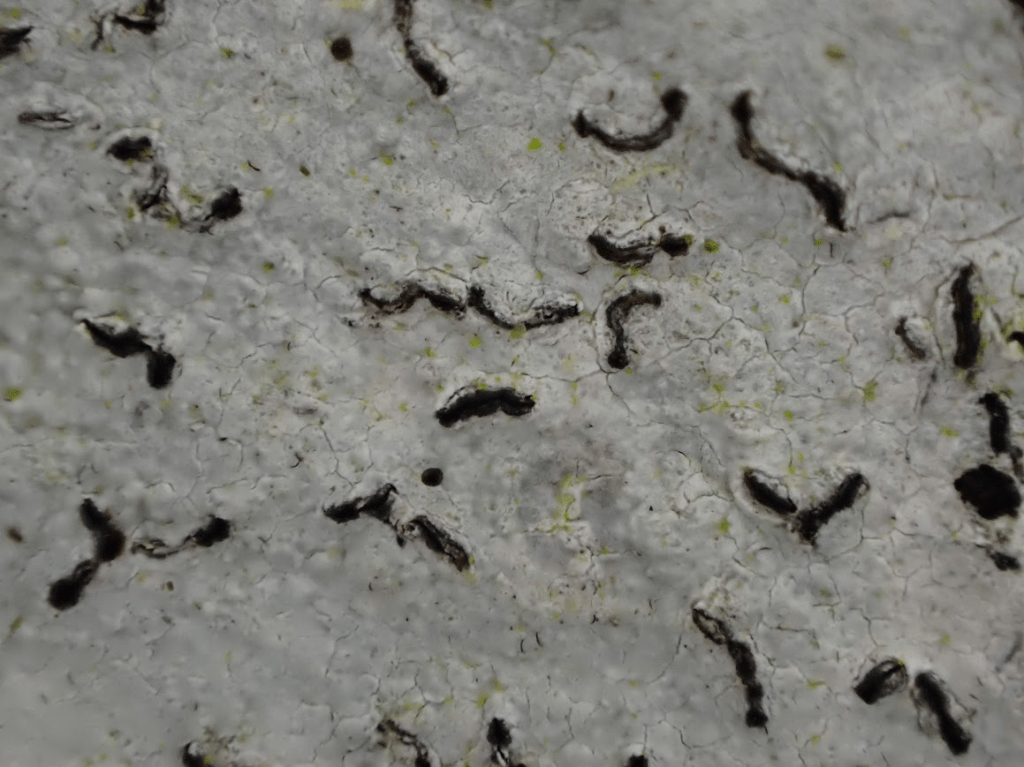
A Graphidaceae family lichen probably Graphis scripta; Graphidaceae family lichens can not be definitively identified to species level without spore microscopy.

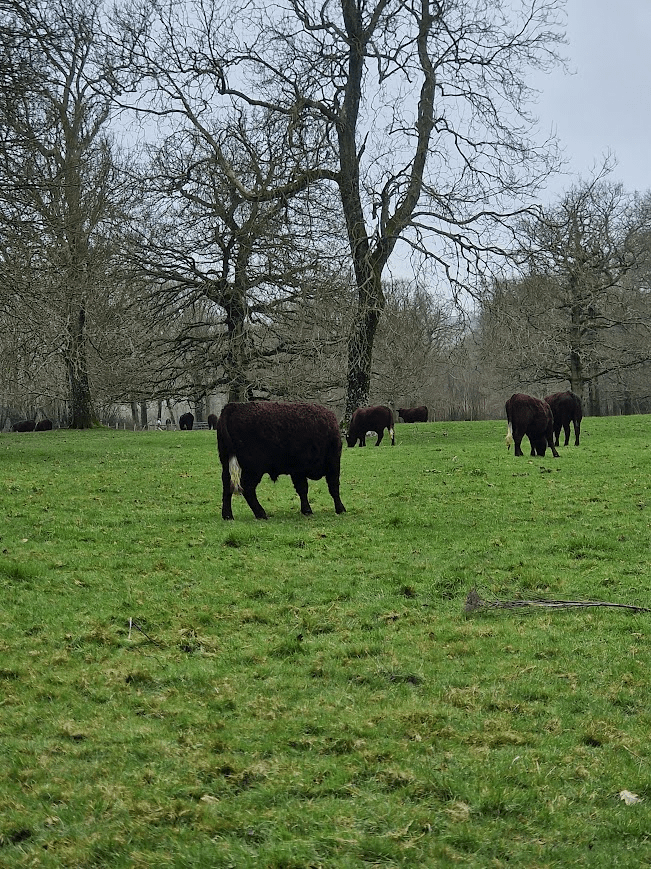
Sussex Reds in pasture woodland. A rare and declining cattle breed, in a form of pasture now rare in Sussex

Pollarded Oaks at the Northern Boundary of the wood

A 1975 segment from BBC’s Nationwide about alien dog abduction. Are these UFO hunters real, or are they pranksters. This would make an excellent 2026 comedy series with Toby Jones and Mackenzie Crook .

Sadly in the 1970s there were four dead bodies found in or near Clapham Woods, which resulted in conspiracy theories about satanists. An article from the Argos (a Sussex newspaper known for poor quality journalism) is at the end of this article.

This podcast from Folkways: The Folklore of Britain and Ireland, tells folk stories of Cissbury and Chanctonbury rings and Clapham Woods.

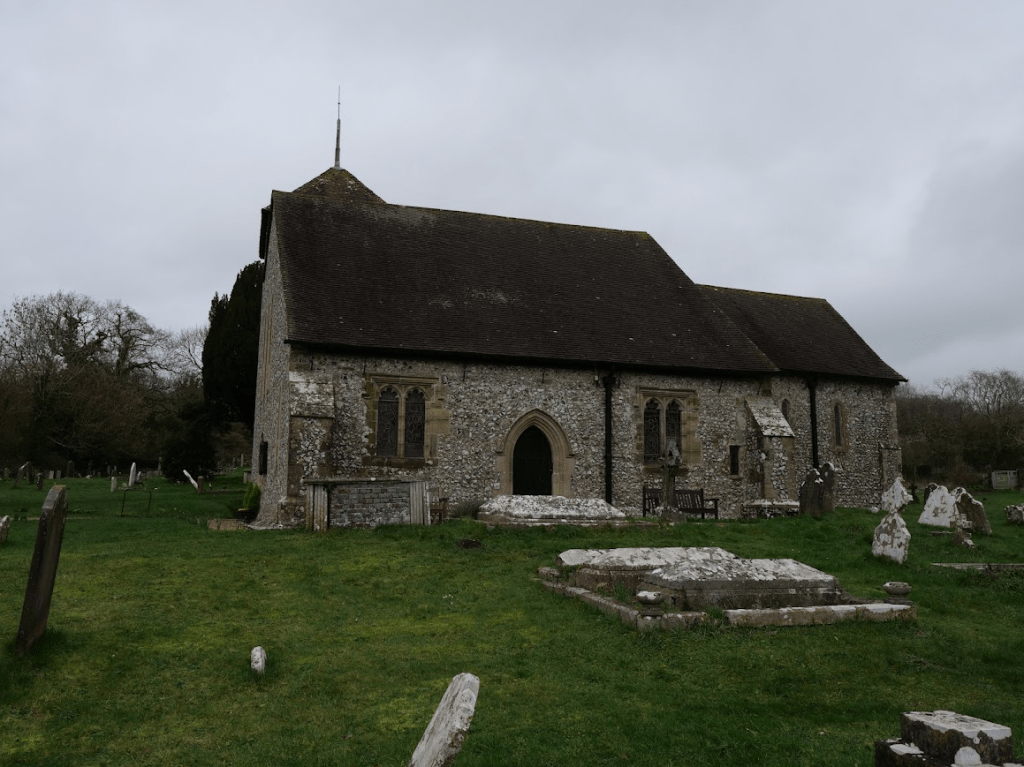
Clapham Church St Mary the Virgin

Clapham church stands in a wood north of the village, which has shrunk considerably in size since the Middle Ages.  The C12 nave has C13 aisles and a tower, whilst the restored chancel originated then.  There were further alterations in the C15 and C16 and a well documented restoration by Sir George G Scott with some good fittings and decoration Sussex Parish Churches Clapham – St Mary

From the outside, there are signs on the south side of what may have been an additional side chapel; there is also the remains of a low window, which legend has it was a ‘leper window’, through which lepers could receive communion and watch the service without infecting the congregation. National Churches Trust Clapham Church St Mary the Virgin

The writer of the blog John Ireland: music, people, places asserts: There was a medieval leper colony to the west of Harrow Hill, hence the story that lies behind Ireland’s tone poem. There are also a number of leper windows in the vicinity, including Clapham and Burpham parish churches, Presumably based on G. Palmer, Clapham Church (1952)

However, A History of the County of Sussex: Volume 6 Part 1, Bramber Rape (Southern Part). originally published by Victoria County History, London, 1980, available at BHO | British History Online, disputes this: Suss. Subsidies (S.R.S. x), 161. There is no evidence for the medieval leper settlement at Lee farm. mentioned by e.g. G. Palmer, Clapham Church (1952), 6.

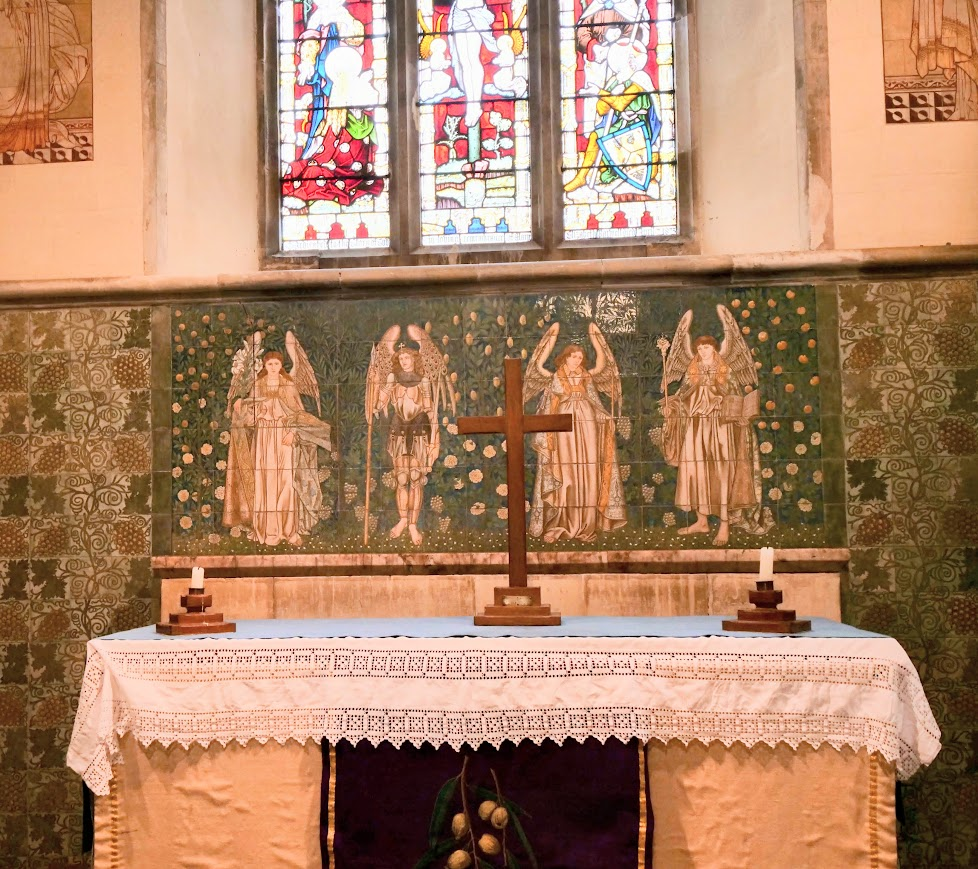
On the inside, the chancel is not in a straight line with the nave; one theory goes that this was deliberate, and was supposed to imitate the angle of Christ’s head on the cross. … The church has an exceptional collection of 16th century brasses and monuments, in memory of the de Michelgrove and Shelley families. The other pride and joy of the church is the set of tiles behind the altar, depicting the four Archangels. These are from the workshop of William Morris, and are believed to have been made by Morris himself. National Churches Trust Clapham Church St Mary the Virgin

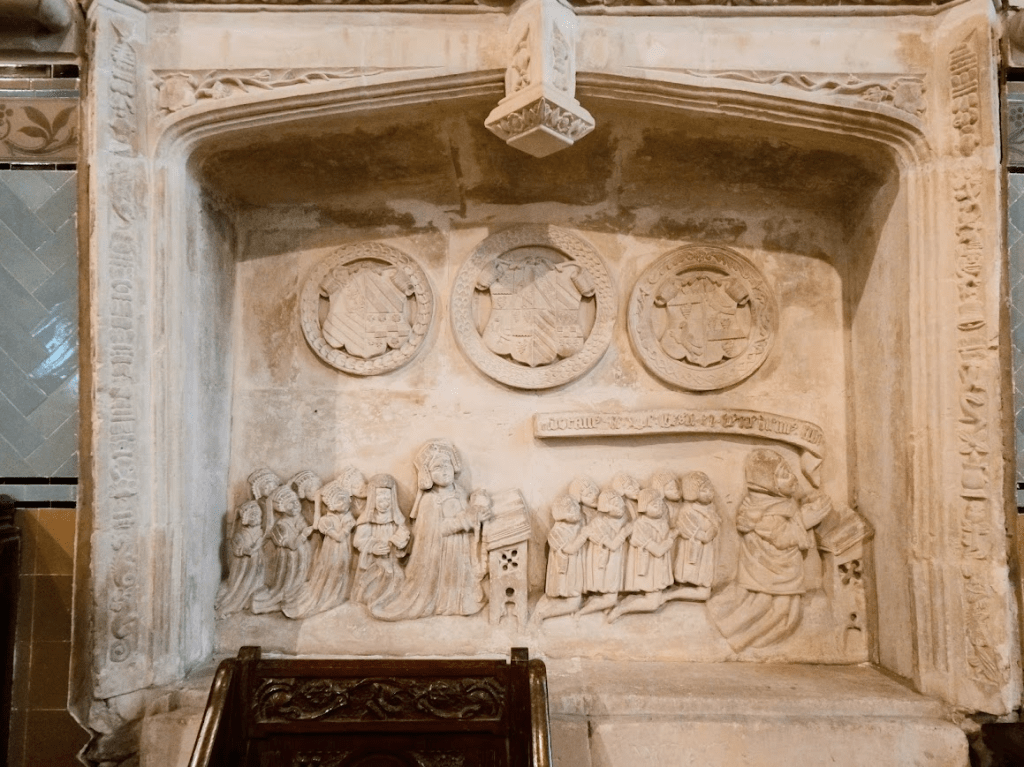
Tudor tombe to one of the Shelleys and his wife: William Shelley (1479-1548) and Alice Belknap (ca. 1475-1537), with seven daughters (one a nun) and seven sons

The Morris Reredos pf the archeangles

The tiles at Clapham benefitted from being produced at a time when the firm
had conquered the technical problems in glazing the hand-painted tiles and
therefore their original colouring is better preserved. Large rusty hooks above them
bear witness to the fact that they have almost certainly spent several years covered
by curtains, which may well have helped their preservation. Although the figures,
being placed immediately above the altar, are not as tall as the Findon tiles, they
shine with authority. The Morris tiling extends across the full width ofthe chancel.
In the centre, above the altar, is the main painted panel depicting four archangels- Gabriel, Michael, Raphael and Uriel- the four best known in Christian and
Jewish literature. Six-inch tiles have been used and the panel is six rows high by
fifteen rows wide. On either side to floor level are alternating rows oftiles showing
grapes, leaves and tendrils: this design has become known as the ‘Clapham Vine’.
Although the tiles show some irregularity and imperfections, they still complement
the strength and perfection of the archangels.
Tessa Kelly (n.d.) The Morris Reredoses at St. John the Baptist Church, Findon, and The Church of
The Blessed Virgin Mary, Clapham, West Sussex,
accessed online.

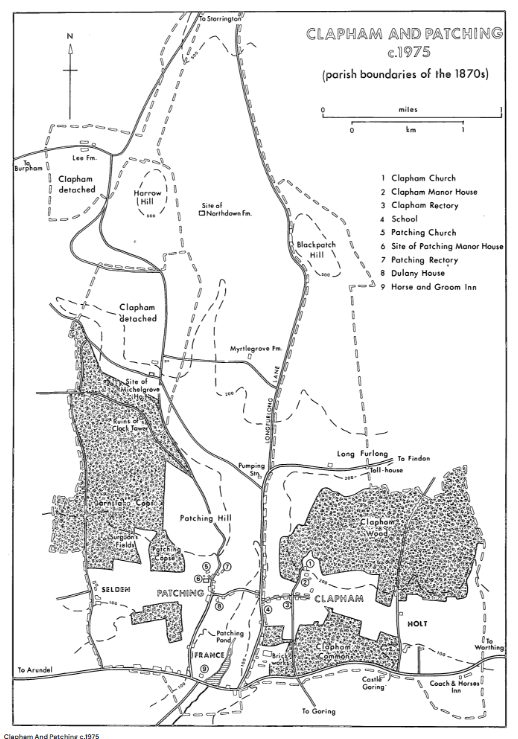
Clapham parish boundary from https://www.british-history.ac.uk/vch/sussex/vol6/pt1/pp10-21


John Ireland wrote Legend for Piano and Orchestra about Harrow Hill in the Clapham Parish 1933. It was first performed in 1934,  Inspired by a mystical experience on the South Downs, Orchestra of the Swan Bax/Ireland Piano Concertos CD with Mark Bebbington

Many of John Ireland’s works have strong Sussex connections: The Downland Suite, Equinox, Amberley Wild Brooks, the Cello Sonata inspired by a place on the Downs known as the Devil’s Jumps and, perhaps, most colourfully, Legend for Piano and Orchestra.

Harrow Hill is located high up on the Downs above and well to the south of Storrington. Access to Harrow Hill is by footpath – there is no public road. You are walking into a remote and mysterious region which one feels time has passed by. It was here that Ireland found the inspiration for Legend for Piano and Orchestra. It is based on two stories that were related by Norah Kirby : –

‘In the far distant past there had been a leper colony in a remote part of the Downs and there had been a steep path leading up to what was known as Friday’s Church because the clergyman attended it on Fridays for a service for the benefit of the lepers who were allowed to participate through a squint so that they shouldn’t contaminate the congregation. On one occasion John Ireland arose early, cut some sandwiches and chose Harrow Hill as the place for his picnic. Just as he was about to start eating, he noticed some children dancing around him in archaic clothing -very quiet, very silent, He was a little put out about having his peace invaded by children; he looked away for a moment, when he looked back they had disappeared. The incident made such an impression on him that he wrote about his experience to Arnold Machen whose books had greatly influenced much of his music. The reply he received was a postcard with the laconic message “So, you’ve seen them too!” ( See also Colin Scott Sutherland’s article John Ireland and Arthue Machen BMS News September 1995) John Ireland by Ian Lace retrieved form the John Ireland Charitable Trust website

Legend is beautiful, and its an example of English pastoral romantic music of the peculiar English type of English Music in the beginning of the 20th Century, totally anachronistic in an era of European modernisms.  Igor Stravinsky’s had disrupted the hegemony of the late romantic musical tradition with the premier of The Rite of Spring (Le Sacre du Printemps) on May 29 1934; but many English composers carried on as before

The tumulus at Harrow Hill is the site of many local legends. From The Sussex Folktale Centre (University of Chichester)  the last home of the fairies in England is said to be Harrow Hill, near Patching,  … Archaeologists discovered dozens of ox skulls buried here close to the Neolithic flint mines and a golden calf was believed to be buried at nearby Blackpatch Hill.

Older Sussex legends and the nonsense about the UFO-abducted dogs provided a context for fantasists to spin speculative stories of Satanism in Clapham Wood, here from The Argus, the home of very poor journalism

Quest to rid village of satanists, 23rd September 2002

Satanic rituals, animal sacrifice and UFO sightings seem more the stuff of Hollywood fiction than picturesque Sussex village life.

But the quiet village of Clapham, near Worthing, is thought to have been the home of a sinister black magic cult for more than 50 years.

That is, at least, according to supernatural investigator Charles Walker, who is determined to track down an occult group called the Friends of Hecate.

The chain-smoking 49-year-old retired council worker makes an unlikely-looking Fox Mulder, scouring the woods in his tracksuit and trainers.

But his tales of paranormal perils lurking amid the trees would easily fill an episode of the X-Files.

Now the glare of the media is back on Clapham Woods, 35 years after reports of dog disappearances and UFOs first put the village under the spotlight.

Cable channel LivingTV sent six young volunteers into the woods for a night as part of spooky new docusoap Scream Team.

Charles, of Western Place, Worthing, expects a revival of interest in the area’s mysterious past when the show is broadcast on Tuesday night.

But when that flash of curiosity fades, he will still be there – as he has been for the past 30 years.

He and colleague Wayne Lewis, spend every day looking for clues to the existence of the Friends of Hecate and stakes out the woods at night, once a month.

Charles believes the group has been using the woods for satanic ceremonies involving the sacrifice of animals.

He also links in four mysterious deaths in the Seventies, including that of retired Clapham vicar the Reverend Harry Neil Snelling.

The 65-year-old vicar went missing from his Steyning home on October 31, 1978.

His skeletal remains were found three years later near Wiston Barn on the South Downs. An inquest recorded an open verdict.

In their book The Demonic Connection, Charles and co-authors Toyne Newton and Alan Brown, suggest he was a victim of satanic foul play.

Clapham has borne a curse since 1288, when Robert Le Faulconer lost a case he brought against local parson Adam le Gest for alleged bodily harm.

Angered by the defeat, Le Faulconer pronounced: “I call upon She who knows to damn this accursed village and all its meagre holdings. May the priesthood of this false God soon come to know their fate.”

Charles started researching reports of missing dogs and UFO sitings in the early Seventies.

Other people have claimed to have felt sick, suffered stomach cramp, vertigo or felt an eerie presence, while in the woods.

A mysterious phone call one evening in 1978, was Charles’ first major breakthrough. Someone claiming to be from the Friends of Hecate summoned him to a meeting at a crossroads in the woods.

A booming voice addressed him from behind a bush, telling him the group was set up in Sussex 30 years earlier.

He was told how they met in Clapham Woods once a month and sacrificed animals, mostly dogs, to the Underworld goddess Hecate.

Charles said: “Maybe he was a dissatisfied member of the group who wanted it exposed. Or maybe he was warning me to go no further. “

In February 1996, Charles and an animal welfare campaigner found a well-constructed hide buried in the woods. A hidden door opened into two rooms which he thinks were used for rituals.

Charles has tried to work out which dates in the year are most likely to be marked with black magic rituals.

But he and his fellow investigators have never managed to time their woodland visits to coincide with a ceremony.

Charles said: “I want to find them, get photographic evidence and bring them to justice. They have to be stopped. I’ll keep doing this until the day I die.”