Colletes hederae was recorded as new to Britain in 2001 when Ian Cross discovered specimens at Langton Matravers in Dorset. Since then, the bee has spread across much of southern England (as far north as Shropshire, Staffordshire & Norfolk) and into south Wales. It is now extremely plentiful in some coastal localities, and increasingly, inland. Peak activity matches the flowering period of its key pollen forage plant, Ivy (Hedera helix), and the species is on the wing from early September until early November. This makes it the last solitary bee species to emerge each year. BWARS has been mapping the spread since its discovery in Britain 15 years ago. Colletes hederae mapping project | BWARS
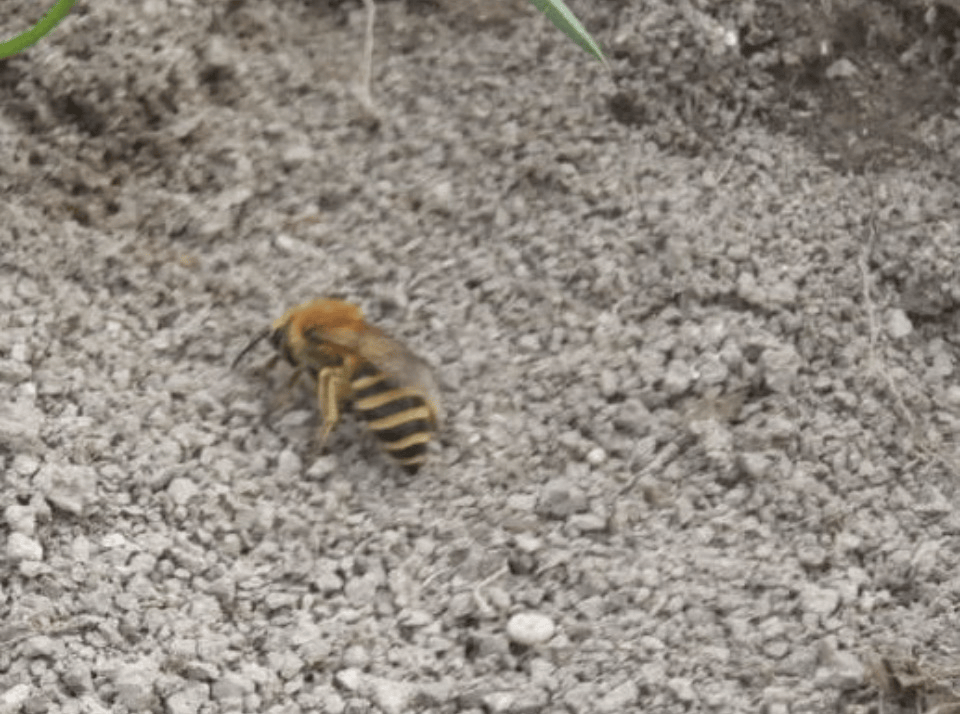
Today I saw an agglomeration of several hundred Ivy Bes: I have only seen an agglomeration of Ivy Bee nests once before; at Pett Level about 8 years ago. They were arriving with pollen and nectar to furnish their nests. Some seemed to fly straight to their nest; some seemed to go one or two before before arriving at theirs; some seemed to visit many nests before finding their own. I spend a lot of time looking at things that don’t move – plants, lichens, bryophytes – and enjoy that, but sometimes its to good to watch the behaviour (movements) of insects or birds as that prompts me to form ethological hypotheses from close observation; a discipline not needed in botany, lichenology and bryology. I watched these bees for ca. 15 minutes.
Ivy Bees were first recorded in Britain in 2001, and in Sussex in 2004 in Hastings. They have since colonised most of the county. They are usually found anywhere with flowering Ivy.
At the beginning of September, male bees emerge about two weeks before females, when scores of males can be seen flying low over the ground with an audible hum, much like honeybees around a hive. They are waiting for the first females to emerge. When one does, all the male bees try to mate with her, and this is when you might see a mating ball – as you can see in this amazing image, taken in Wadhurst churchyard and sent to us by Michael Howard. Any Suzy Izzard fans out there might bring to mind her ‘Covered in bees!’ sketch!
When a male succeeds in getting a female, they often fly off together, leaving the rest of the males to seek another female.
After mating, the female digs out a nest tunnel of around 30cm deep. which has side chambers. She supplies each of these chambers with pollen and nectar, then lays a single egg in each.
The females gather pollen exclusively from Ivy flowers, but will take nectar from other flowers as well. Female bees can be seen foraging on Ivy flowers …
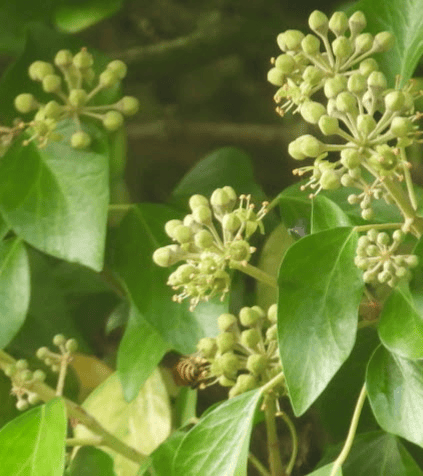
An ivy bee foraging on Ivy on an ash about 400m from the nest agglomeration
… before returning to their nest tunnels with yellow Ivy pollen on their hind legs
.The egg hatches into a larva, which eats the pollen and nectar which was provided by the female bee. Male bees do not contribute to nest building or provisioning
As the larva grows, it sheds its skin several times, like a caterpillar. It eventually turns into a pupa and then undergoes metamorphosis to become a bee, like a caterpillar turning into a moth or butterfly.
The new bee emerges from the nest tunnel the following September and the cycle starts all over again. The life cycle of Ivy Bees – Sussex Wildlife Trust
As watches the nest agglomeration, these two hypotheses emerged in my thinking
(1) In the behaviour of the bees (flying around repeatedly over an area, and landing at possible home nest and placing their heads close to the nest entrance holes) is processing olfactory and visual cues important to them in finding their own nests.
(2) Some bees seemed clearly better at finding their nests than others; are their genetic variation in ability to find their nests
Research on Hypothesis 1
Flying insects are believed to rely primarily on visual cues for orientation, with chemical cues often being overlooked. In the case of solitary bees and wasps, being able to return successfully to their nests and provision their brood cells is paramount for the survival of the species. While vision has been shown to be involved in pinpointing the nest location, our results confirm that olfaction is important in nest recognition. … We have analyzed the chemical profiles of three nesting bees (Osmia spp.) and one wasp (Sceliphron curvatum) and that of their nest entrances. A striking match in the identified chemicals was revealed between each nest and its occupant. When the chemicals were removed from the nest, a clear behavioral response could be observed for Osmia cornuta. This shows the importance of olfactory cues in complementing visual orientation for precise homing in a solitary species, thereby opening up various promising biological questions in the fields of sensory perception and complementation, or the trade-offs of nest aggregation and associated costs. S.P. Vandenabeele & T. Schmitt, Olfaction is essential for nest recognition in solitary Hymenoptera, Proc. Natl. Acad. Sci. U.S.A. 120 (25) e2304703120, https://doi.org/10.1073/pnas.2304703120 (2023).
Research on Hypothesis 2
I presume with bees, like other animals with brains, ranges of abilities and rates of learning are normatively distributed – some bees might just be more “abl”e at finding their nests than others!
According do BWARS Colletes hederae (ivy bees) do not generally have difficulty finding their own nests; but:
Factor 1: Differentiation between male and female behaviours. Males, which generally far outnumber females, occasionally settle to inspect open burrows Colletes hederae | BWARS so maybe the bees that went straight in the holes were females and those that seemed to explore other holes before entering their own were male; although I saw no mating occurring
Factor 2: disruption to local vector navigation. Because mining bee nest entrances are so small and look nearly identical, the bees don’t just look for the hole itself. Instead, they use a technique called local vector navigation. They map out the precise angles and distances of nearby objects like pebbles, twigs, and tufts of grass to pinpoint their exact destination.
From Google AI Gemini request. Date generated: 13.09.26. Prompt question: summary of research on how human observation of mining bee nest aggregation affects the behaviour of mining bees in nest aggregation
When a person stands over the nesting site, it creates two major disruptions [to vector navigation:
- Visual Obstruction: Your feet and legs completely block the tiny landmarks the bee memorized during its orientation flight.
- Shadow Interruption: Mining bees are highly sensitive to polarized light and shadow patterns. A large, moving human shadow alters the contrast of the terrain, making their visual map temporarily useless.
The hovering and “pacing” you see is actually the bee trying to re-orient itself. It will fly back and forth to widen its field of view, hoping to catch a glimpse of a familiar landmark outside of your shadow. Once you step away, the original visual cues reappear, and the bee can usually drop straight into its nest within seconds.
“Peeking” Behaviour: A female bee returning with pollen will often sit just below the rim of her burrow entrance, “peeking” out to watch a nearby human until they leave, delaying her provisioning
The most significant impact of human observation comes from sudden visual changes, specifically casting shadows or making rapid movements.
Aborted Landings: Foraging females returning to the nest aggregation are highly visually oriented. If a human observer stands directly over a nest entrance or moves abruptly, the bee will often abort her landing, circle the area, or hover nearby until the threat passes or the observer becomes still.
Freezing Behavior: When an observer approaches a active burrow, bees that are peeking out of their nest entrances (often sunning themselves or checking conditions) will immediately retreat downwards into the shaft or “freeze” motionless inside the tunnel collar.
From Google AI Gemini request. Date generated: 13.09.26. Prompt question: in mining bees is decison making learnt and is learning it normally distributed genetically
Active Learning & Plasticity: Once in the field, decision-making shifts heavily toward learning. A mining bee must make active choices regarding navigation back to its exact ground burrow, evaluating the quality of nearby nectar/pollen, and refining its floral handling skills. Research across bee species confirms that their brains possess neural plasticity; forming memories and learning from trial-and-error physically changes neural pathways in the brain’s cognitive centers
Polygenic Basis: Learning is not controlled by a single “smart gene.” Instead, it is governed by many interacting genes (a polygenic trait) that regulate neurotransmitters, brain size, and receptor sensitivity.
Normal Distribution: Because it is controlled by numerous genes, the baseline genetic potential for learning in a wild population of mining bees naturally forms a bell curve. Most bees fall into the average range of learning speeds, while a minority are genetically predisposed to be exceptionally fast learners (“curious” types) or slower to adapt.
In conclusion:
- visual and olfactory factors are important to navigating to the bees own nests
- mostly ivy bees are good at finding their nests quickly
- males and females may behave differently in nest agglomrations
- there is an observer effect when animals are observed; altering the subject’s normal actions.

 Sim's Nature Notes