I thought I had lost the MP4 of the extraordinary Broken Wing Display from a Ringed Plover, seen at Tide Mills on 03.05.22. But today I found it! This was one of the most remarkable things I have ever seen a bird do.
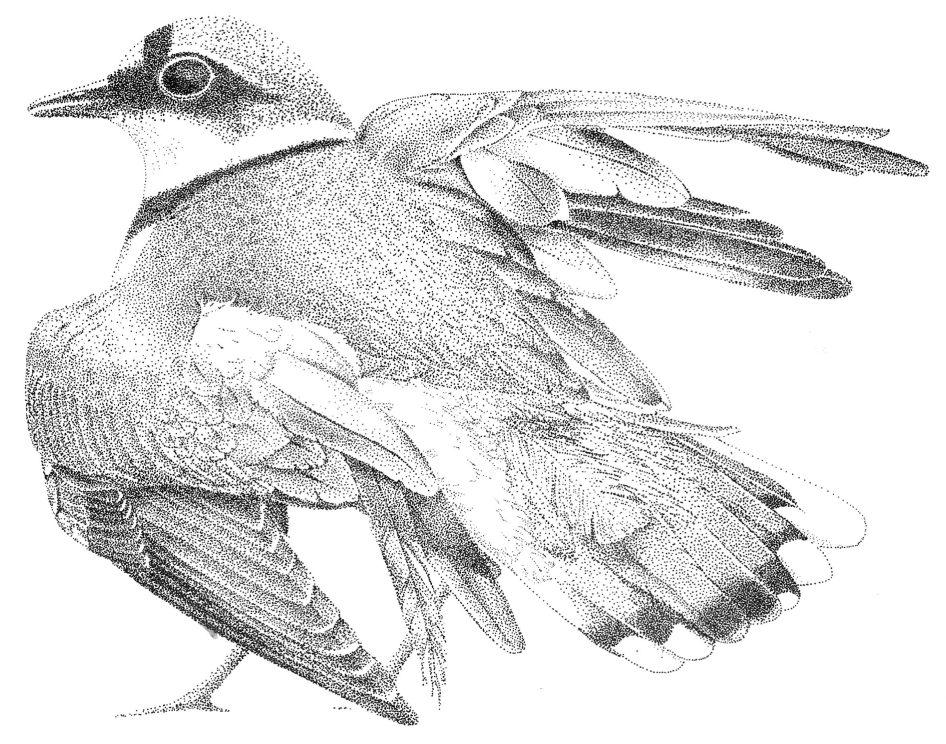
The broken-wing display. Depicted is a common ringed plover (Charadrius hiaticula). Illustration by L. de Framond.
The broken-wing display is a well-known and conspicuous deceptive signal used to protect birds’ broods against diurnal terrestrial predators. Although commonly associated with shorebirds, it remains unknown how common the behaviour is across birds and what forces are associated with the evolution of the display. Here, we use the broken-wing display as a paradigmatic example to study the evolution of a behaviour across Aves. We show that the display is widespread: it has been described in 52 families spread throughout the phylogeny, suggesting that it independently evolved multiple times. Léna de Framond, Henrik Brumm, Wren I. Thompson, Shane M. Drabing, Clinton D. Francis; The broken-wing display across birds and the conditions for its evolution. Proc. R. Soc. B 1 March 2022; 289 (1971): 20220058. https://doi.org/10.1098/rspb.2022.0058
Charming little bird, it calls you from the shoreline “poo-ee, Poo ee, POO, EE” without any thought for your feelings. It is also a deceitful bird that will happily feign a broken wing to lure predators away from its nest. It also likes to get its prey moving by laying down some cool beats by tapping its foot on the ground in a hypnotising rhythm.
It’s burglar-like appearance, with its natty banded mask, is another one of its deceits as it rarely steals or shares its food. A brace of ringed plovers can be seen feeding off of flies, spiders, worms, crustaceans, and molluscs.
The ringed plover travels vast distances to feed on our shores, from Canada and Greenland. Whilst stocking up on energy, we need to give the birds some space. The ringed plover is protected by the Wildlife and Countryside Act 1981 and is on the Red List. Ringed Plover (Charadrius hiaticula) | Bird Wise East Kent

 Sim's Nature Notes